Stock Analysis
Cerebras (CBRS) Jumps ~7% on a Q3 Beat and a Hyperscaler Deal, Bucking the AI Selloff
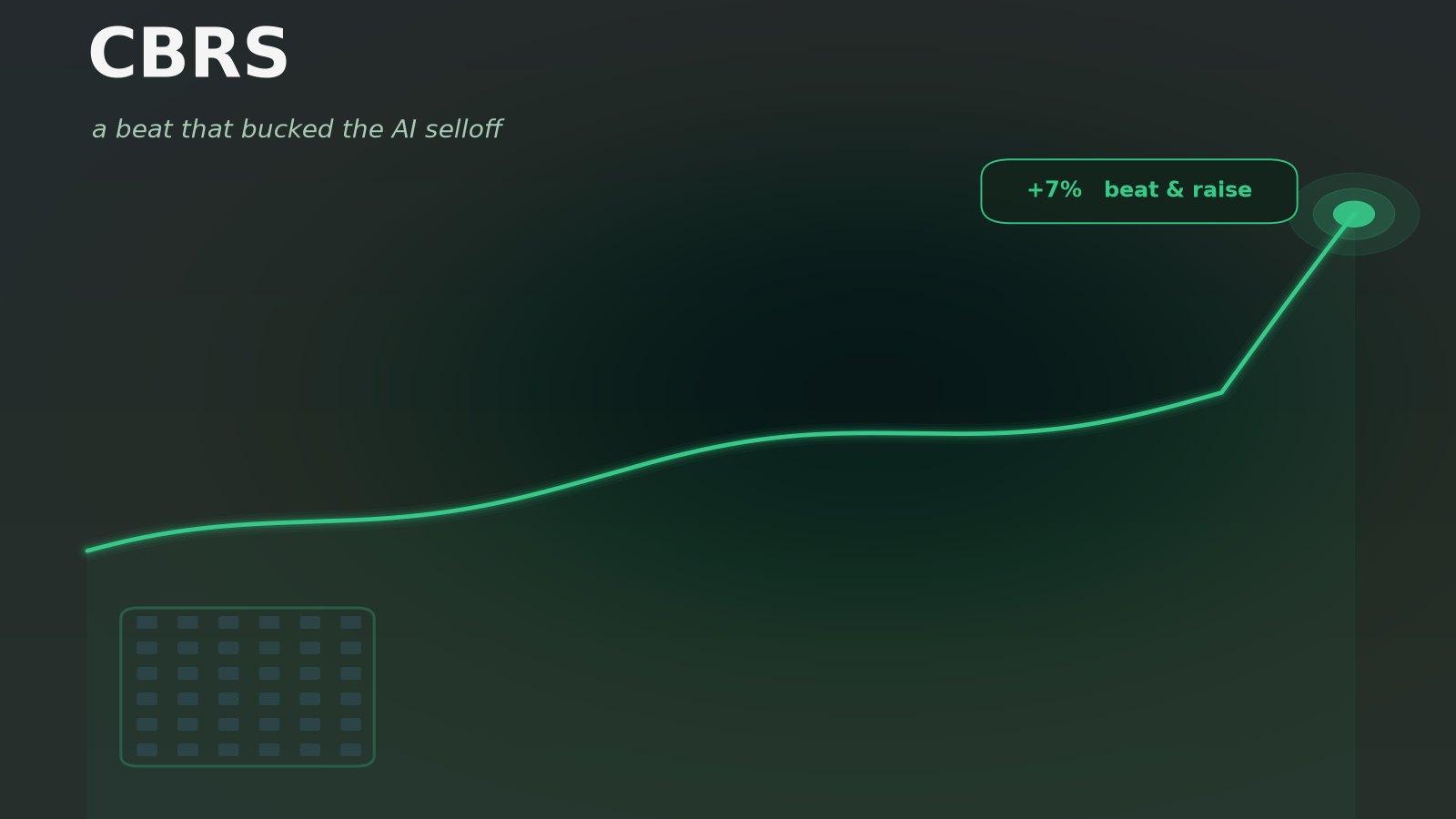
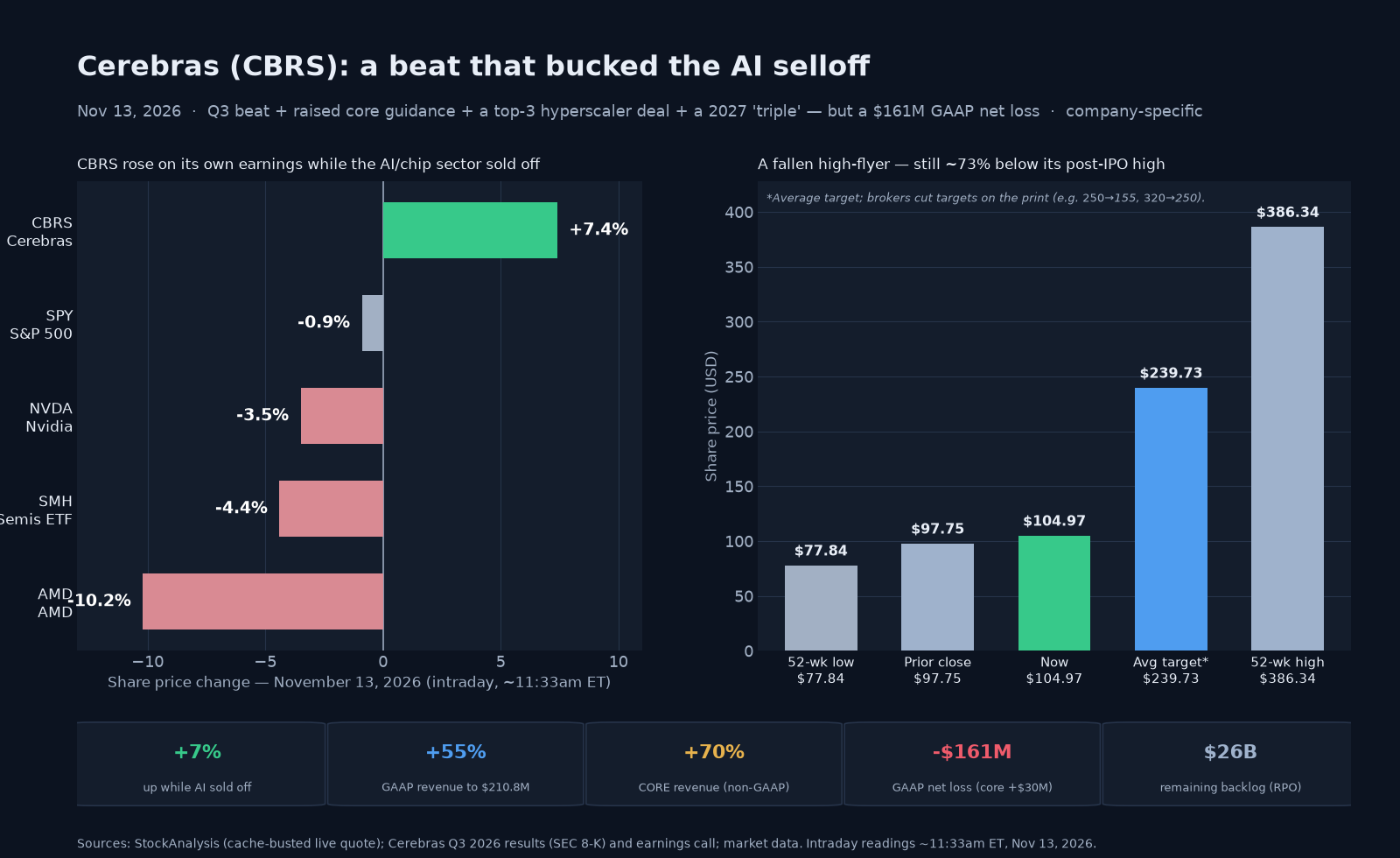
Cerebras Systems rose about 7% to roughly $104.50 on November 13 after reporting third-quarter results — and what made it notable was the backdrop: the same day, the broader AI and chip trade sold off hard, with Nvidia down 3.5%, the semiconductor ETF down more than 4% and AMD down about 10%. For a richly valued AI name to rise while its sector cratered is a clear sign the move was its own news. Cerebras — maker of dinner-plate-sized 'wafer-scale' chips built to challenge Nvidia — beat its own guidance for a third straight quarter, raised its full-year outlook, flagged a cloud deal with a top-three hyperscaler (unnamed in the release, reportedly Microsoft) and projected revenue will triple in 2027, with a $26 billion backlog. But the quarter must be read carefully: the most flattering numbers are non-GAAP. Cerebras highlights 'core' revenue up 70% to about $231 million and a core net profit near $30 million, but on a GAAP basis revenue rose 55% to $210.8 million and the company posted a $161 million net loss. The gap is real — 'core' revenue is higher than GAAP because it adds back customer-warrant amortization, and the 'core' profit excludes heavy stock compensation. The company is cash-rich (about $7.8 billion), so financing is not the worry, but it is deeply GAAP-unprofitable, heavily reliant on a few customers including OpenAI, and trades near 30 times sales. Even bullish analysts cut their targets on the print (UBS to about $155), while keeping Buy ratings. A strong quarter bought a day of outperformance in a weak tape — but the hardest questions about the business are still open.
Why Cerebras stock jumped — a beat-and-raise against a selling tape
On Friday, November 13, 2026, Cerebras Systems (NASDAQ: CBRS) rose about 7%, trading near $104.50 intraday, after reporting third-quarter results the evening before — and what made the move notable was the backdrop [1]. The same day, the broader AI and chip trade was selling off hard: Nvidia fell about 3.5%, the semiconductor ETF dropped more than 4%, and AMD tumbled roughly 10% [5]. For a richly valued AI name to rise ~7% while its sector cratered is strong evidence that the move was driven by the company's own news rather than the tape. Cerebras — maker of dinner-plate-sized "wafer-scale" chips built to challenge Nvidia in AI computing — beat its own guidance for the third straight quarter, raised its full-year outlook, flagged a new cloud deal with a major hyperscaler, and projected its revenue will triple in 2027 [2].
But the quarter needs to be read carefully, because the most flattering numbers are non-GAAP. Cerebras highlights a "core" revenue figure of about $231 million, up 70%, and a core net profit of roughly $30 million — its first positive core net income as a public company [2]. On the standard GAAP basis, however, revenue grew a still-strong but smaller 55% to $210.8 million, and the company posted a $161 million net loss with a deeply negative operating margin [2]. The gap is not cosmetic: Cerebras's "core" revenue is actually higher than its GAAP revenue because it adds back about $36 million of customer-warrant amortization (which GAAP treats as a reduction of revenue), partly offset by stripping out roughly $16 million of pass-through costs — a net gap of about $20 million — and that "core" profit exists mainly because it adds back roughly $155 million of stock-based compensation — about three-quarters of a quarter's revenue, non-cash but a real cost to shareholders through dilution [2]. So the honest summary is: genuinely strong growth and improving unit economics, but a "beat" and a "profit" that lean heavily on adjustments, over a business that is still deeply unprofitable on a GAAP basis and burning cash.
What actually drove the move — real traction, heavily adjusted numbers
Three things powered the gain. First, the beat-and-raise: Cerebras exceeded its own guidance for a third consecutive quarter and lifted full-year 2026 core-revenue guidance to about $940–$960 million, with fourth-quarter core revenue guided to roughly $310–$330 million and core gross margin stepping up toward the high-40s percent — evidence that its cloud-inference business is scaling and its economics are improving [2]. Second, the demand signals: Cerebras announced a cloud deal with a "top-three hyperscaler" (unnamed in the release, with details promised next year, though media reports identified it as Microsoft), said its inference will be available on Oracle's cloud in 2027, and reported a remaining performance obligation (backlog) of about $26 billion [2]. A hyperscaler win matters because it validates Cerebras's technology beyond its existing customers. Third, the 2027 ambition: management's projection to triple revenue next year reframes the stock as a hyper-growth story rather than a stalled one — which, against a day of AI-trade fear, was enough to send it higher [2].
The caveats, though, are substantial and explain why even bullish analysts trimmed their targets. Cerebras is heavily dependent on a handful of customers — just two accounted for about 72% of third-quarter revenue, with its master relationship agreement with OpenAI alone roughly a third (about $72 million) — so that $26 billion backlog is highly concentrated, and concentration cuts both ways [2]. More pointedly, the company is behind on delivering the capacity it has already committed: its OpenAI agreement covers 750 megawatts of inference capacity, Cerebras had delivered less than contemplated as of quarter-end, it expects delivery delays to persist into part of 2027, and contractual service credits began accruing on October 1, 2026 — so capacity and execution are not an abstract risk but a live one [2]. And the valuation leaves no room for error: even after falling roughly 73% from its post-IPO high, the stock trades at around 30 times trailing sales, an extreme multiple for a company losing money on a GAAP basis [3]. The one comfort is the balance sheet — Cerebras is cash-rich, with roughly $7.8 billion of cash and investments from its IPO, so unlike some AI-infrastructure peers it is not a near-term financing risk even while it burns cash [3]. The quarter advanced the story; it did not de-risk it.
The valuation question
Cerebras cannot be valued on earnings — it loses money on a GAAP basis and is burning well over a billion dollars of free cash flow a year as it builds out capacity [3]. It is valued entirely on growth: at about $25 billion of market value it trades near 30 times trailing sales (and roughly 11–12 times analysts' forward, next-twelve-month revenue estimates — which already reach well into the 2027 ramp; measured against the company's own full-year 2026 guidance of about $950 million, the multiple is far higher), among the richest multiples in the AI-chip space, which only makes sense if the 2027-triple trajectory and the hyperscaler wins play out [3]. The enterprise value is actually well below the market cap because of the large net-cash position, so the market is paying up for the equity's growth optionality, not for current cash flows. That is the whole debate in one line: Cerebras has a credible, fast-growing AI-inference business, a marquee backlog and a strong balance sheet, but at this multiple the stock is pricing in years of flawless execution against heavy customer concentration and a still-unproven path to GAAP profitability. The 73% fall from its post-IPO high shows how violently that kind of story can re-rate when enthusiasm fades; the 7% pop shows how quickly it can re-rate back on good news.
Why it matters
Cerebras is the most prominent public test of whether anyone can build a real alternative to Nvidia in AI computing, and this quarter offered genuine evidence that it is gaining traction — a hyperscaler win, accelerating revenue, a $26 billion backlog and a path the company says triples sales in 2027. That it rose while the broader AI and chip complex sold off is itself a message: in a market increasingly nervous about an AI-spending bubble, investors will still pay up for a specific, credible growth story with fresh proof points, even as they sell the group around it. But the quarter is also a case study in reading AI-era results critically. The distance between Cerebras's "core" numbers (up 70%, a $30 million profit) and its GAAP results (up 55%, a $161 million loss) is a reminder that in a sector full of adjusted metrics, the adjustments can be the story — here, adding back customer-warrant amortization turns the revenue line and excluding stock-based compensation turns the profit line. The resolution for the stock will come from whether the growth converts, over time, into GAAP profitability and diversified demand, or whether the concentration, capacity constraints and rich multiple reassert themselves. For now, a strong quarter bought Cerebras a day of outperformance in a weak tape — but the hardest questions about this business are still open.
The move, in one cross-section
The same-session tape shows CBRS going the opposite way to its sector — the signature of a company-specific catalyst [5]:
| Name (ticker) | Nov 13, 2026 (intraday) | Read-through |
|---|---|---|
| CBRS — Cerebras | ≈+7% | The earnings name — rose on a beat-and-raise, a hyperscaler deal and a 2027-triple projection, despite a GAAP loss [1][2] |
| SPY — S&P 500 (ETF) | ≈−0.9% | Broad market down modestly — CBRS went the other way [5] |
| NVDA — Nvidia | ≈−3.5% | AI-chip bellwether — down on the AI-trade selloff [5] |
| SMH — Semiconductor ETF | ≈−4.4% | The chip sector fell broadly — CBRS was the exception [5] |
| AMD — Advanced Micro Devices | ≈−10.2% | Among the hardest-hit chip names on the day [5] |
CBRS up about 7% while the chip sector fell 3%–10% is the signature of a company-specific catalyst — its own beat-and-raise — standing out against, not riding, the market [5].
What the Street thinks
Analysts are enthusiastic about the long-term story but grew more cautious on the price. The consensus rating is a Strong Buy from about 11 analysts, with an average 12-month target near $240 — more than double the current price — inside a wide range of roughly $170 to $325 on the consensus snapshot, which lags some of the freshest same-day cuts (UBS's revised ~$155 sits below it) [6]. The telling detail is the reaction to the print: several brokers cut their targets even as they kept Buy ratings — for example UBS to about $155 from $250, with others trimming toward the mid-$200s — reflecting concern about the valuation and the gap between core and GAAP results, while one firm nudged its target up [6]. That combination — bullish ratings, a target far above the price, but fresh cuts into a rally — captures the ambivalence: analysts believe in the growth and the technology, but after the stock's moves they are recalibrating how much to pay for a concentrated, GAAP-unprofitable, richly valued name. The targets remain well above the price, so the Street still sees upside, but the direction of revisions on the day was down, not up [6].
What to watch
- GAAP versus core. Whether the gap between core profitability and GAAP losses narrows as the business scales — the clearest sign the adjusted metrics are converging toward real profit [2].
- Customer diversification. Whether the hyperscaler win and new logos reduce reliance on a few large customers (notably the OpenAI relationship) and the concentration in the backlog [2].
- Capacity delivery. Whether Cerebras secures the data-center capacity and scales manufacturing to convert its $26 billion backlog on schedule [2].
- The 2027 trajectory. Any confirmation or slippage on the projection to triple revenue next year. Moves are tracked on the Cerebras stock page [6].
Illustrative scenario sensitivity
Because the move reflects a credible growth story meeting a demanding valuation rather than current earnings, the scenarios below are anchored to execution — backlog conversion, customer diversification and the path toward GAAP profitability — rather than to a single multiple [6]. They are a descriptive, author-weighted exercise over roughly the coming six-to-twelve months as those trends clarify — not a forecast, target, recommendation, or trading advice — with subjective weights that sum to 100%.
| Scenario | Illustrative price | Weight | Key drivers |
|---|---|---|---|
| Execution delivers, story re-rates | ~$175 | 25% | Backlog converts on schedule, the hyperscaler win broadens the customer base, GAAP profitability catches up with the improving core results, and the stock re-rates toward analysts' cut-but-still-high targets [6]. |
| Rich multiple caps it | ~$105 | 45% | Growth stays strong but the ~30× sales multiple, the core-versus-GAAP gap and customer concentration keep the stock a show-me name, range-bound near current levels [1]. |
| AI-capex or concentration strain | ~$78 | 30% | An AI-spending pullback, a capacity-delivery delay, or a concentration shock weighs on the richly valued, GAAP-unprofitable stock, which drifts toward its 52-week low [3]. |
Weighting those (0.25 × $175 + 0.45 × $105 + 0.30 × $78) gives an author-weighted reference value near $114 — an illustrative, probability-weighted scenario output mechanically derived from the weights above, and not a price target, fair-value estimate, or prediction — a touch above Friday's ~$104.50 intraday price [1][6]. The modest premium reflects genuine, accelerating growth, a marquee backlog and a strong balance sheet, offset by a rich valuation, heavy reliance on non-GAAP metrics, customer concentration and execution risk; the wide dispersion between the scenarios is the honest signal that the outcome hinges on execution far more than on this one quarter. This is a scenario exercise and descriptive analysis of a news-driven move, not investment advice.
Cerebras data snapshot — November 13, 2026
| Figure | Value | As-of / source |
|---|---|---|
| Intraday quote | ~$104.50 (+~7%) — an intraday reading (the session was open); opened $108.70 and popped toward $120 before giving back; day range $101.18–$120.44 | Fri, Nov 13, 2026, ~11:37am ET — StockAnalysis [1] |
| Prior close | $97.75 prior close (Q3 reported after the Nov 12 close; shares popped ~18% after-hours, then pared as the AI sector sold off) | Nov 13, 2026 [1] |
| 52-week trend | 52-week range $77.84–$386.34; ~73% below the post-IPO high (a fallen 2025 IPO high-flyer); below its 50-day average (~$151); short interest ≈9% of shares | As of Nov 13 [1] |
| Market cap | ≈$25.6B (≈243M shares, float ~110M); enterprise value ≈$19.7B (net cash ~$5.9B); cash + investments ~$7.8B vs ~$0.8B of working-capital loans | Nov 13 — StockAnalysis / company [3] |
| Valuation | Deeply GAAP loss-making (trailing net loss in the hundreds of millions, EPS ttm ≈−$6.28; no P/E) and burning cash (FCF ttm ≈−$1.4B); price-to-sales ≈30× trailing (~11–12× forward) — valued on the AI-growth story, not fundamentals | Nov 13 — StockAnalysis [3] |
| Q3 2026 results | GAAP: revenue $210.8M (+55% YoY); gross margin 20%; net loss $161.2M (−$0.67/sh; operating margin −106%). Core (non-GAAP): revenue $230.9M (+70%); gross margin 41%; core net income +$29.8M (adds back ~$36M customer-warrant amortization and excludes stock comp) | Nov 13 — Cerebras Q3 2026 results (SEC 8-K) [2] |
| Catalyst | Q3 beat-and-raise that bucked the AI selloff: beat its own guidance (3rd straight quarter), raised FY26 core-revenue guidance to $940–960M, flagged a top-3 hyperscaler cloud deal (unnamed; media say Microsoft), projected 2027 revenue to triple, and reported a $26B backlog — but on heavily adjusted (core) metrics, with heavy OpenAI customer concentration and capacity-delivery risk | Nov 13, 2026 — company results + earnings call [2] |
| Same-day cross-section | SPY −0.9%, NVDA −3.5%, SMH −4.4%, AMD −10.2% — the AI/chip sector sold off while CBRS rose ~7% on its own earnings (company-specific, opposite the sector) | Nov 13 intraday [5] |
| Analyst view | Consensus Strong Buy from ~11 analysts, avg target ~$240 (low ~$170, median ~$240, high ~$325) — but several brokers CUT targets on the print (e.g. UBS $250→$155, Citi $320→$250) even while keeping Buy ratings | Nov 13, 2026 — StockAnalysis / analyst notes [6] |
Cerebras (CBRS) stock FAQ
Why did Cerebras (CBRS) stock jump on November 13, 2026?
Cerebras rose about 7% to roughly $104.50 after reporting third-quarter results — and the move stood out because the broader AI and chip sector was selling off hard the same day (Nvidia down about 3.5%, the semiconductor ETF down more than 4%, AMD down about 10%). For a stock to rise ~7% against that backdrop is a clear sign the catalyst was company-specific. Cerebras beat its own guidance for a third straight quarter, raised its full-year outlook, announced a cloud deal with a top-three hyperscaler (unnamed in the release, reportedly Microsoft), reported a roughly $26 billion backlog, and projected its revenue will triple in 2027. The important caveat is that the most eye-catching numbers — 'core' revenue up 70% and a 'core' net profit near $30 million — are non-GAAP; on a standard GAAP basis revenue grew 55% to $210.8 million and the company posted a $161 million net loss. So it was a genuinely strong growth quarter, but the 'beat' and 'profit' rely heavily on adjustments.
What is the difference between Cerebras's 'core' and GAAP numbers?
It is the single most important thing to understand about this report. Cerebras emphasizes 'core' (non-GAAP) figures: core revenue of about $231 million (up 70%) and a core net profit of roughly $30 million. On the standard GAAP basis, revenue was $210.8 million (up 55%) and the company posted a $161 million net loss with a deeply negative operating margin. Two adjustments drive most of the gap. First, Cerebras's 'core' revenue is actually higher than its GAAP revenue because it adds back about $36 million of customer-warrant amortization, which GAAP records as a reduction of revenue (it also strips out some pass-through costs). Second, the 'core' profit exists mainly because it adds back roughly $155 million of stock-based compensation — about three-quarters of the quarter's revenue; that charge is non-cash, but it is a real cost to shareholders through dilution. These are common adjustments, and core metrics can be useful for seeing underlying trends, but investors should read them alongside GAAP, not instead of it — because on a GAAP basis Cerebras remains far from profitable and is burning cash. The right summary is strong growth with improving economics, reported through a flattering non-GAAP lens.
Is the Microsoft cloud deal confirmed?
Not by name in Cerebras's own release. The company said it announced a cloud deal with a 'top-three hyperscaler' and that more details would be shared next year, without naming the partner or disclosing terms. Media reports, including from Reuters, identified the hyperscaler as Microsoft, but that is reporting rather than a company confirmation. Separately, Cerebras said its inference technology will be available on Oracle's cloud in 2027. The distinction matters: a confirmed, named hyperscaler relationship with disclosed scale would be more meaningful than an unnamed deal with terms to come, so the appropriate way to treat it for now is as a credible but not-yet-detailed demand signal. Either way, winning a major hyperscaler is strategically important for Cerebras because it validates its technology beyond its existing, concentrated customer base — which is part of why the market reacted positively even amid a broad AI selloff.
Is Cerebras stock expensive?
On conventional measures, very — but it is a growth stock, not an earnings stock. Cerebras loses money on a GAAP basis and is burning well over a billion dollars of free cash flow a year as it builds capacity, so there is no meaningful price-to-earnings ratio. At about $25 billion of market value it trades near 30 times trailing sales (and roughly 11–12 times analysts' forward, next-twelve-month revenue estimates, which already reach into the 2027 ramp — far higher against the company's own 2026 guidance), among the richest multiples in the AI-chip space. That valuation only makes sense if the company delivers on its trajectory — tripling revenue in 2027, converting its $26 billion backlog, and eventually reaching GAAP profitability. The balance sheet is a genuine positive: Cerebras holds roughly $7.8 billion of cash and investments from its IPO, so it is not a near-term financing risk. But the multiple leaves little room for error against heavy customer concentration and execution risk, which is exactly why the stock fell about 73% from its post-IPO high and why analysts, even while bullish, cut their price targets on this report. This is descriptive analysis, not investment advice.
How did Cerebras's move compare with other AI and chip stocks?
It went the opposite way — which is the clearest signature of a company-specific catalyst. On the same day, the AI and semiconductor complex sold off broadly: the S&P 500 was down about 0.9%, Nvidia fell about 3.5%, the semiconductor ETF SMH dropped about 4.4%, and AMD tumbled roughly 10%, amid renewed worries about AI spending. Cerebras rising about 7% against that tape means the market was reacting to its specific results — the beat-and-raise, the hyperscaler deal and the 2027 projection — rather than to any sector tailwind. In fact, there was a strong sector headwind, which makes the outperformance more striking. That pattern is the inverse of a sector move: when a stock rises sharply while its peers fall, the cause is almost always something unique to that company. It also says something about sentiment — even in a jittery AI market, investors will still reward a credible, fast-growing name with fresh proof points.
What should investors watch next for Cerebras?
Four things. First and most important, whether the gap between its 'core' (non-GAAP) numbers and its GAAP results narrows as the business scales — that convergence is the real test of whether the adjusted profit becomes a genuine one. Second, customer diversification: whether the hyperscaler win and new customers reduce Cerebras's reliance on a few large accounts, notably its OpenAI relationship, and the concentration in its $26 billion backlog. Third, capacity delivery: whether Cerebras can secure the data-center capacity and scale manufacturing to convert that backlog on schedule, since delays would hit growth directly. Fourth, the 2027 trajectory: any confirmation or slippage on the projection to triple revenue. Because the stock trades at a hyper-growth multiple on heavily adjusted, concentrated results, it is likely to stay volatile and to react sharply to any signal on execution, customer mix or AI spending more broadly. The direction of the business is encouraging; the valuation demands that it be proven.