AI Infrastructure
Cerebras (CBRS) Stock Slides After Q2: GAAP Revenue Misses as Core Revenue Beats
Cerebras Systems fell about 12% intraday to ~$231 after Q2 results. The GAAP headline — a $450.5 million net loss and a $2.98 loss per share — is roughly 84% stock-based compensation, and on core metrics the company beat with revenue up 103% and a raised full-year guide. It sold off anyway: the stock had run up 11.6% into the print, GAAP revenue missed with hardware revenue down 23% year over year, and concentration and a ~53-55x valuation went unresolved while a selected set of AI-hardware peers rallied.
Why Cerebras stock fell on August 13
On Thursday, August 13, 2026, Cerebras Systems (NASDAQ: CBRS) fell about 11–12% to roughly $231 intraday, from a $262.06 prior close, after reporting second-quarter results the previous evening [3][4]. The session was still open as this was written, and the exact decline moved by the minute. The headline looked alarming: a GAAP net loss of $450.5 million and a diluted loss of $2.98 per share [1]. But that GAAP figure is heavily distorted by non-cash items: about $377 million of it is stock-based compensation — an outsized charge in a company's first quarters as a public company — and after the company's full set of non-GAAP adjustments the core net loss was $6.9 million [1]. On its core metrics Cerebras beat and raised guidance. So the loss line is not what moved the stock.
Three things did, and none is the GAAP loss on its own. Cerebras had run up 11.6% the day before, on August 12, straight into the after-close print — a setup that punishes anything short of perfection [3]. Its GAAP revenue of $180.1 million missed the ~$194.2 million LSEG consensus, with all of its 74% growth coming from cloud while GAAP hardware revenue actually fell 23% year over year [1][6]. And the questions that have shadowed the stock since its IPO — customer concentration and a very high valuation — were not resolved by anything in the release. The headline loss was not the only, and likely not the main, issue; it was one of several plausible reasons the market had to sell a stock priced for perfection.
GAAP versus company-defined core results
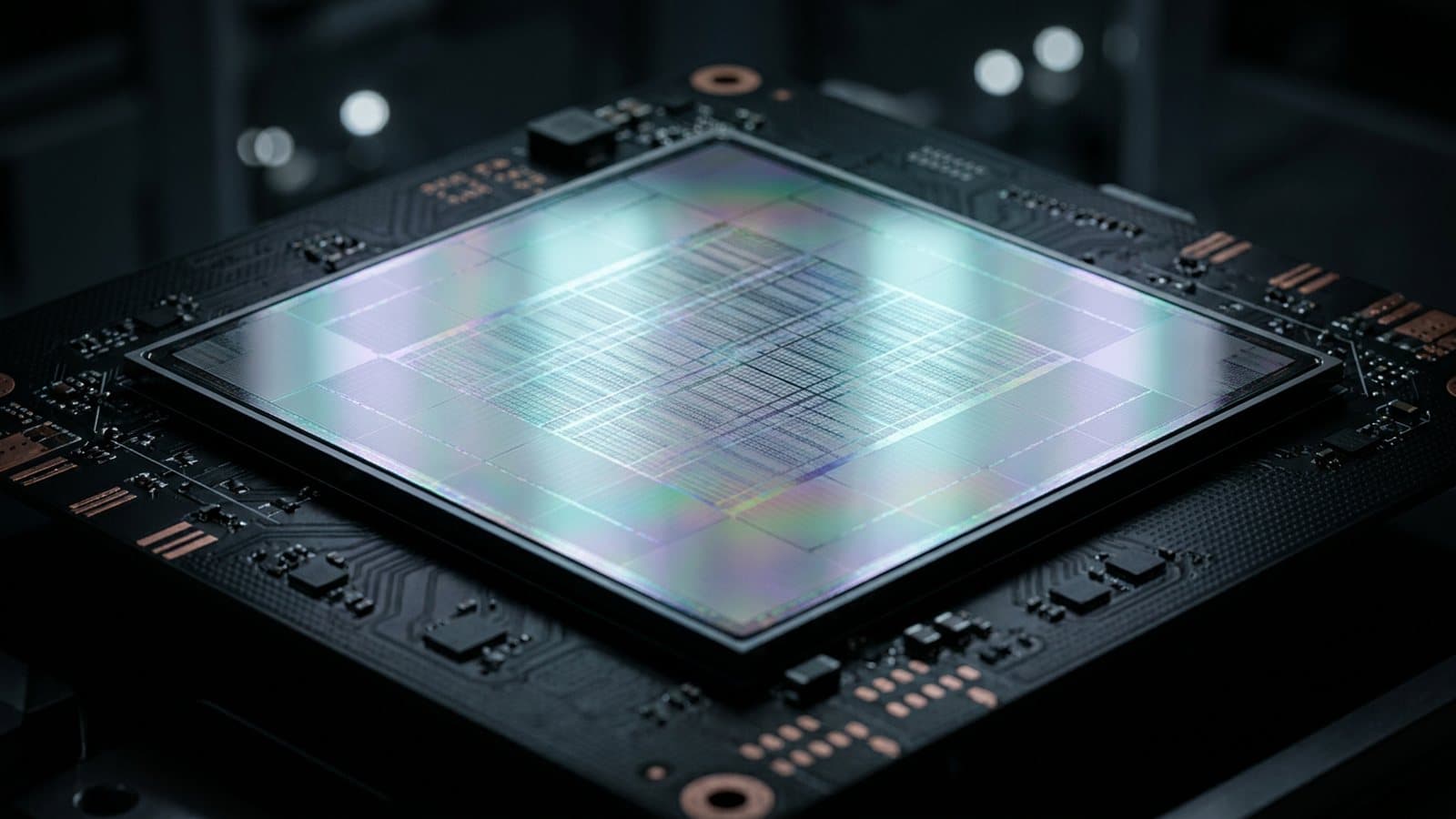
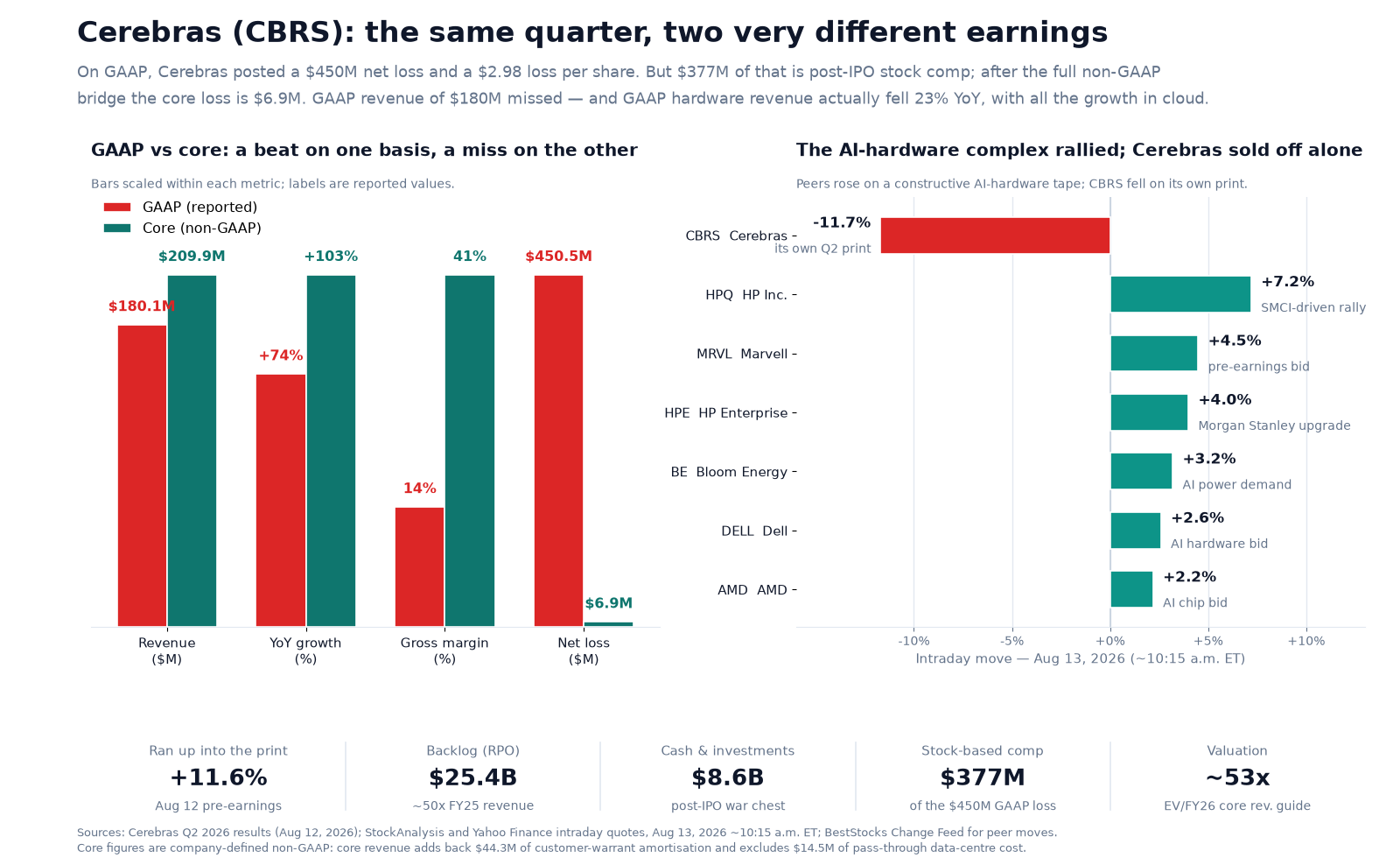
Cerebras builds wafer-scale AI processors — single chips the size of a dinner plate, positioned as a low-latency alternative to racks of NVIDIA GPUs for AI inference. It listed on Nasdaq on May 14, 2026, and this was only its second quarter as a public company [3][12]. The reaction makes sense only if you read GAAP and company-defined core (non-GAAP) figures side by side [1][2]:
- Revenue — GAAP $180.1 million (+74% YoY) vs core $209.9 million (+103%). GAAP missed the ~$194.2 million LSEG consensus; core topped the roughly $198 million figure cited by some earnings services. But the mix matters more than the beat-or-miss: GAAP hardware revenue fell to $54.1 million from $70.3 million a year ago, while GAAP cloud revenue surged to $126.0 million (+281%). Core hardware revenue is shown at $82.1 million because core adds back $44.3 million of customer-warrant amortisation and excludes $14.5 million of pass-through data-centre cost — so the 103% core growth is not directly comparable to the 74% GAAP figure [1][6].
- Net loss — GAAP $450.5 million vs core $6.9 million. Stock-based compensation of $377.0 million is about 84% of the GAAP loss; the rest of the bridge is warrant amortisation, roughly $22.8 million of IPO-related payroll tax and other items. Total operating expense was $502.8 million [1].
- Loss per share — GAAP −$2.98 vs core ≈ −$0.05. The ~−$0.17 consensus was an adjusted/non-GAAP estimate, so the meaningful comparison is core ≈ −$0.05 against ~−$0.17, a beat — not the GAAP −$2.98 against −$0.17, which mixes two different bases (core EPS is a derived figure) [1][6].
- Gross margin — GAAP 14% vs core 41%. The core figure is up sharply year over year, but it fell sequentially, to about 40.6% from roughly 43.4% in the prior period, on higher rented-compute costs — and third-quarter guidance points to continued near-term margin pressure [1][2].
- Guidance raised. Full-year 2026 core revenue is now guided to $880–890 million, with third-quarter core revenue of $214–216 million, above consensus [2].
- Liquidity and RPO. Cerebras holds $8.6 billion of cash, restricted cash and short-term investments against roughly $918 million of working-capital debt, and reported remaining performance obligations of $25.4 billion — contracted future demand, not recognised revenue [1].
The honest summary is that the quarter was mixed: strong company-defined core growth and raised guidance, offset by a GAAP revenue miss, a year-over-year decline in GAAP hardware revenue, sequential core-margin pressure and a very large GAAP-to-core reconciliation.
Concentration rotated; it did not go away
The concern the raised guidance does not address is customer concentration. In 2025 two UAE-linked entities — the university MBZUAI at about 62% of revenue and G42 at about 24% — together made up roughly 86% of Cerebras's revenue [11]. A $20-billion-plus multi-year agreement with OpenAI has since become the dominant component of the $25.4 billion RPO [9][1]. That diversifies Cerebras away from its historical UAE base, but it replaces two large customers with one very large one: a new, concentrated single-customer exposure rather than a resolved one. A record RPO that leans this heavily on a single agreement is a strength and a risk in the same figure.
Why it matters
Cerebras is a publicly traded alternative-architecture AI-compute company competing for workloads dominated by GPU-based systems, and its stock is becoming a test of what such a challenger can be worth. The bull case and the bear case live in the same numbers: the OpenAI agreement and the $25.4 billion RPO are large, but the RPO is concentrated, GAAP economics are loss-making with hardware revenue shrinking even as cloud scales, and the valuation prices years of conversion. This quarter sharpened that argument rather than settling it — the same question we track across the AI-infrastructure complex at CoreWeave: how much investors will pay for contracted future demand that has not yet converted to profit.
How the peers and sector traded the same day
The clearest evidence that this was largely company-specific is that a selected set of AI-hardware peers went the other way, on a constructive tape — with the broad market steady to higher — after Super Micro's strong guidance and other company-specific catalysts [7][8][10]:
| Name (ticker) | Aug 13 (~10:15 a.m. ET) | Driver |
|---|---|---|
| CBRS — Cerebras | −11.7% | Its own Q2 print, after an 11.6% run-up [1][3] |
| HPQ — HP Inc. | +7.2% | Data-centre rally after Super Micro's guidance [7] |
| MRVL — Marvell | +4.5% | Pre-earnings positioning in AI networking [7] |
| HPE — HP Enterprise | +4.0% | Morgan Stanley upgrade to Overweight [7] |
| AMD — AMD | +2.2% | AI-chip sector bid [8] |
Cerebras sharply underperformed this selected AI-hardware peer set, which is what the data support — a meaningful company-specific component to the decline, rather than a claim about the whole market.
What the Street did with it
Notably, analysts had already begun revising the day of the drop, so the targets were not stale. On August 13, Wedbush raised its target to $290 from $280 (Outperform) while Mizuho trimmed to $300 from $310 (Outperform), leaving a cross-provider average around $300 in a roughly $275–$340 range across a dozen analysts — still well above the ~$231 price [11]. The split — one firm up, one down, both still bullish — captures a Street that is re-underwriting the multiple rather than the thesis.
What to watch
- GAAP hardware revenue re-accelerating — the 23% year-over-year decline in GAAP hardware is the number the bull case most needs to reverse; watch whether systems revenue turns back up as new customers ramp [1].
- Core margin trajectory — core gross margin fell sequentially on higher rented-compute cost, and Q3 guidance implies more near-term pressure. Whether it re-expands toward the company's targets is central to the story [1][2].
- OpenAI ramp and RPO conversion — $25.4 billion of remaining performance obligations is the bull case, but it is contracted, not recognised, and heavily tied to one counterparty; watch the conversion pace and any diversification beyond OpenAI and the UAE [1][9][11].
- Stock-based compensation as a share of revenue — SBC dilutes shareholders even though it is non-cash; the current disclosures do not establish how quickly it normalises. Moves are tracked on the CBRS stock page and the earnings calendar [1].
Illustrative valuation sensitivity
The scenarios below are a descriptive EV/forward-core-revenue sensitivity — not a forecast, target, or recommendation. GAAP figures are distorted by stock-based compensation and warrant accounting, so the anchor is enterprise value against forward core revenue. Enterprise value is market capitalisation (about $54.9 billion at ~$231, on 237.6 million shares) plus roughly $918 million of working-capital debt, less $8.6 billion of liquidity — about $47 billion, or net cash near $7.7 billion — which puts the stock around 53x EV to full-year 2026 core-revenue guidance of $885 million (a standard vendor convention with a narrower cash definition is closer to 55x) [1][2][5]. Each implied price is computed as (multiple × $885 million + $7.7 billion net cash) ÷ 237.6 million shares, holding net cash and share count fixed — a limitation, given ongoing heavy stock-based compensation. The percentages are the author's illustrative weights and sum to 100%.
| Scenario | Implied price | Weight | Key drivers |
|---|---|---|---|
| Upside | ~$286 (68x EV/2026 core rev.) | 30% | The OpenAI RPO converts on schedule, hardware revenue re-accelerates, core margin re-expands and named new customers scale — the multiple re-rates toward the reset analyst targets in the high-$280s to $300 [2][11]. |
| Middle | ~$230 (53x EV/2026 core rev.) | 45% | Guidance is delivered and core revenue grows fast, but concentration, shrinking GAAP hardware and the SBC overhang hold the multiple near today's level while the market waits for cash profitability [1]. |
| Downside | ~$155 (33x EV/2026 core rev.) | 25% | RPO conversion slips, the OpenAI relationship wobbles, or unprofitable AI names de-rate broadly. Near the $160.81 52-week low [3][11]. |
Weighting those (0.30 × $286 + 0.45 × $230 + 0.25 × $155) gives an illustrative implied price near $228 — essentially at the ~$231 quote, inside a band that runs from the reset targets in the high-$280s to below the 52-week low [11]. The point is not that the stock is cheap or dear but that the current multiple embeds aggressive assumptions for growth, backlog conversion and diversification, which leaves little room for the kind of mixed print this quarter delivered. This is descriptive analysis of a corporate event, not investment advice.
CBRS data snapshot — August 13, 2026 (intraday, session open)
| Figure | Value | As-of / source |
|---|---|---|
| Prior close | $262.06 | Wed, Aug 12, 2026 [3] |
| Primary intraday quote | $231.25 (−$30.81, −11.76%) | Aug 13, 10:11 a.m. ET — Yahoo Finance [4] |
| Corroborating quote | $233.69 (−10.83%) | Aug 13, 10:13 a.m. ET — StockAnalysis [3] |
| Intraday range | $219.10 – $239.99 (had moved to ~$236 by 10:33 a.m.) | Aug 13 session, still open [3][4] |
| Prior-day run-up | +11.6% on Aug 12 (into the after-close print) | Aug 12 session [3] |
| Volume (heavy for the time) | ≈6.7M by 10:13 a.m. vs a ~7.2M full-day 3-month average | Aug 13, ~10:13 a.m. ET [3][5] |
| 52-week range | $160.81 – $386.34 (≈40% below the high) | As of Aug 13 [3][4] |
| Market cap | ≈$54.9B (237.6M shares) | At the ~$231 quote, Aug 13 [3] |
| Liquidity & debt | $8.6B cash/restricted/investments; ≈$918M working-capital debt; net cash ≈$7.7B | At Jun 30, 2026 — company results [1] |
| Enterprise value / valuation | ≈$47B simplified (≈$49B on a narrower cash basis); ~53–55x EV/FY26 core-revenue guide; RPO $25.4B | Aug 13 [1][2][5] |
| Analyst targets (post-print) | Wedbush $290 (from $280), Mizuho $300 (from $310); avg ~$300, range ~$275–$340 | Aug 13 — MarketBeat / Benzinga [11] |
Two independent feeds agree on the $262.06 prior close and a decline of roughly 11–12%; the exact figure differed by the minute because the session was open. All prices here are intraday snapshots, not closing prices.
The setup at a glance
| Question | Answer |
|---|---|
| What was the news? | Q2 2026 results after the close on Aug 12: GAAP revenue $180.1M (+74%) / core $209.9M (+103%), GAAP net loss $450.5M, core net loss $6.9M, raised FY26 core guidance to $880–890M, and a $25.4B RPO [1][2]. |
| Was it a huge miss? | Only on GAAP, and the GAAP loss is roughly 84% stock-based compensation. On core metrics — revenue, EPS, gross margin — Cerebras beat and raised guidance, though GAAP hardware revenue fell 23% year over year [1][6]. |
| Then why did it fall ~12%? | It ran up 11.6% into the print, GAAP revenue missed (~$180.1M vs ~$194.2M), and concentration and a ~53–55x valuation were unresolved — a mixed print into a stock priced for perfection [1][3]. |
| What is the concentration issue? | In 2025, MBZUAI (~62%) and G42 (~24%) made up ~86% of revenue. A $20B+ OpenAI agreement now dominates the $25.4B RPO — diversifying away from the UAE but creating a new, very large single-customer exposure [9][11]. |
| Was it a sector move? | No — a selected set of AI-hardware peers rose on a constructive tape (HPQ +7.2%, MRVL +4.5%, HPE +4.0%, AMD +2.2%) while Cerebras fell, pointing to a company-specific driver [7][8]. |
| How is it valued? | ≈$54.9B market cap; net of ~$7.7B net cash, roughly $47B enterprise value, about 53–55x the raised FY26 core-revenue guide [1][2]. |
Cerebras Systems (CBRS) stock FAQ
Why did Cerebras (CBRS) stock fall on August 13, 2026?
Cerebras fell about 11-12% intraday to roughly $231 from a $262.06 prior close after Q2 results the previous evening. The GAAP headline — a $450.5 million net loss and a $2.98 loss per share — is roughly 84% stock-based compensation, so on core metrics the company actually beat, with core revenue of $209.9 million (up 103%) and raised full-year guidance. It sold off because it had run up 11.6% into the print, its GAAP revenue of $180.1 million missed the ~$194.2 million consensus with hardware revenue down 23% year over year, and its customer concentration and high valuation were unresolved.
Did Cerebras beat or miss in Q2 2026?
It was mixed, which is why the reaction confused. On GAAP it missed: revenue of $180.1 million fell short of the ~$194.2 million LSEG consensus, GAAP hardware revenue fell 23% year over year, and the diluted loss was $2.98 per share. On company-defined core metrics it beat: core revenue of $209.9 million topped expectations, the core loss per share of about $0.05 beat the ~$0.17 adjusted estimate, and it raised full-year core-revenue guidance to $880-890 million. Core revenue adds back $44.3 million of customer-warrant amortisation, so the 103% core growth is not directly comparable to the 74% GAAP figure.
What is the OpenAI and customer-concentration risk?
In 2025 two UAE-linked entities — MBZUAI at about 62% of revenue and G42 at about 24% — made up roughly 86% of Cerebras's revenue. A multi-year agreement with OpenAI worth more than $20 billion now dominates the $25.4 billion remaining-performance-obligation backlog. That diversifies Cerebras away from the UAE but replaces it with a new, very large single-customer exposure rather than resolving concentration. The RPO is contracted future demand, not recognised revenue, so its conversion pace and its heavy tilt toward one counterparty are the key things to watch.
How expensive is Cerebras stock after the drop?
Even after falling about 12%, Cerebras carried a market capitalisation near $54.9 billion at roughly $231. Net of about $7.7 billion of net cash (its $8.6 billion of liquidity less roughly $918 million of working-capital debt), that is an enterprise value near $47 billion, or about 53-55x its raised full-year 2026 core-revenue guidance of $885 million depending on the cash convention. That is a demanding multiple that embeds aggressive assumptions for growth, backlog conversion and diversification. On August 13 analysts revised in both directions — Wedbush to $290 and Mizuho to $300 — leaving an average near $300. This is descriptive analysis, not investment advice.