Stock Analysis
Manhattan Associates (MANH) Jumps ~6% on a Morgan Stanley Upgrade to Overweight
Manhattan Associates jumped about 5.5% to roughly $216 on October 12 — after running as high as about $221 — on a Morgan Stanley upgrade to Overweight from Equalweight and a price-target raise to $250 from $180. The move bucked a down software tape: supply-chain peers were flat and the software sector fell, marking this as an idiosyncratic, catalyst-driven move. Analyst Chris Quintero leaned on three points — accelerating cloud subscription bookings under CEO Eric Clark, a narrative shift from Manhattan being seen as AI-vulnerable to an AI beneficiary via its agentic-AI suite, and a more attractive valuation — while citing only about 1–2% upside to consensus revenue, a tell that this is a re-rating of sentiment as much as of the numbers. The business is a genuinely profitable, cash-generative franchise (56% gross margins, ~25% operating margins, a net-cash balance sheet, ~$400M of free cash flow, cloud revenue up in the mid-20s percent), but it is not cheap: near a 52-week high at ~62x trailing and ~37x forward earnings after a ~70% six-month run, the upgrade pushed it to within a few percent of the ~$228 average analyst target. The next hard test is third-quarter earnings on October 27.
Why Manhattan Associates stock jumped — an upgrade and a narrative shift
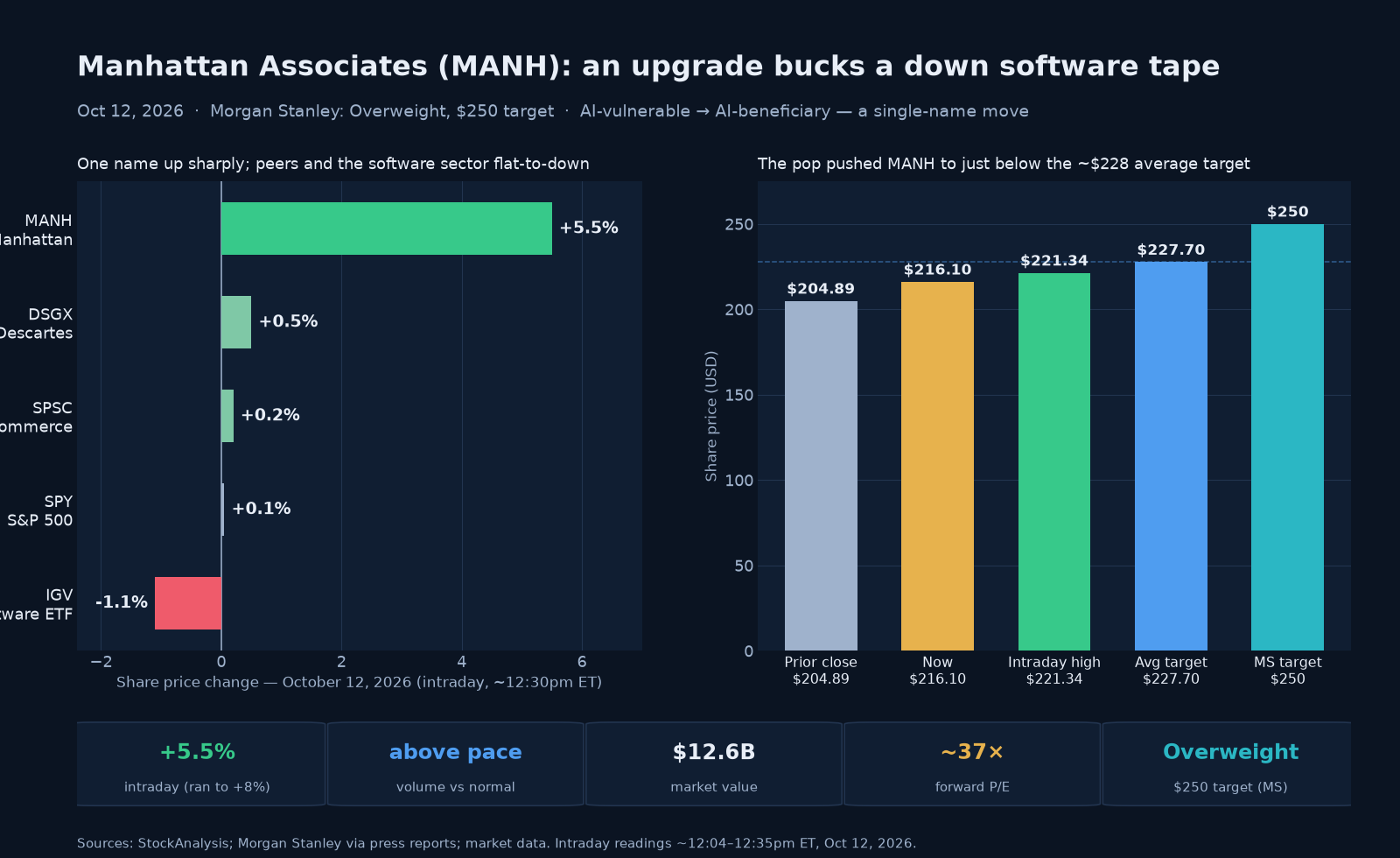
On Monday, October 12, 2026, Manhattan Associates (NASDAQ: MANH) rose about 5.5%, trading near $216 intraday after running as high as $221.34 (about +8%) and paring the gain [1]. The catalyst was clean and company-specific: Morgan Stanley upgraded the stock to Overweight from Equalweight and lifted its price target to $250 from $180 [2]. The move stood out because it happened against a down tape for software — the sector's optical and AI-infrastructure names were selling off, and the broad software ETF slipped about 1% — so this was a single name reacting to its own news, not a group lifting on a sector bid [5].
Analyst Chris Quintero built the call on three legs [2]. First, cloud subscription bookings are accelerating, helped by go-to-market changes under chief executive Eric Clark, who took the top job in 2025 — a trend Morgan Stanley expects to push cloud revenue estimates higher. Second, and most interesting, the firm argued the investor narrative is shifting: Manhattan had been debated as a company whose supply-chain software could be disrupted by artificial intelligence, and Morgan Stanley now frames it as an AI beneficiary instead. Third, it called the valuation more reasonable relative to an improving business. Notably, the note sees only about 1–2% upside to consensus revenue through fiscal 2028 [2] — a tell that this is a re-rating of sentiment as much as a revision of the numbers.
From "AI-vulnerable" to "AI-beneficiary"
That narrative pivot is the heart of the story. The bear worry had been that generative AI could erode the value of packaged enterprise software — that large language models might let customers build or commoditize what vendors like Manhattan sell. The bull reframing is that Manhattan is embedding agentic AI directly into its cloud platform and charging for it: its Active Agent offering and "Agent Foundry" have been rolled out to its Active customer base and monetized through paid 90-day pilots — low-cost proofs of concept that convert into recurring subscriptions, with a larger contribution expected in 2027. By mid-2026 management said AI agents were already touching more than 10% of the Active installed base through pilots or subscriptions [2]. Underneath the AI debate sits a genuinely strong cloud engine: cloud revenue has been compounding in the mid-20s percent — up about 24% in the first quarter and 26% in the second quarter of 2026, to roughly $127 million — more than half of new cloud bookings have come from net-new customers, and the company has raised full-year revenue guidance to $1.160–$1.166 billion [2]. In other words, the upgrade rewarded a company that is converting the AI question from a threat into a product line — though the realized AI revenue is still early, and the bigger contribution remains a 2027 expectation rather than a booked result.
The reasons for skepticism
The catalyst is real, but the price is not cheap, and that is the counterweight. Even before Monday's jump Manhattan traded at roughly 62 times trailing GAAP earnings, with a price-to-sales ratio near 11 [3] — a premium that leaves little room for disappointment. (A lower ~37x forward multiple sits on a different basis: Manhattan's adjusted earnings run well above its GAAP earnings — second-quarter adjusted EPS was $1.39 against $0.85 on a GAAP basis — so a trailing GAAP multiple and a forward adjusted one are not directly comparable.) The stock is also already near the top of its range: it has climbed roughly 70% from its April low near $119 and trades within about 5% of its 52-week high around $227, even if it is only modestly higher over a full 52 weeks [1]. So a single upgrade did not discover a hidden bargain; it re-rated an already-expensive, already-loved stock to within a few percent of the Street's average target. The AI monetization that underpins the bull case is still early — paid pilots now, with the bigger revenue contribution not expected until 2027 — and Manhattan's top-line growth has cooled to the mid-single digits (revenue up about 6.5% over the trailing year) [3]. The margin picture is also part of a broader cost-efficiency push, not pure demand: the company cut roughly 6% of its global headcount in June 2026 to improve efficiency [3]. Morgan Stanley's own modest 1–2% revenue-estimate bump underlines the point: the thesis rests more on confidence and multiple than on a step-change in the forecast.
Why it matters
The episode is a clean example of how much an analyst-driven re-rating can move a single name, and of how the market is repricing the AI question across software. For most of the past two years, investors treated application-software vendors as potential AI victims; Monday's upgrade is part of a broader swing toward asking which of them are AI winners. Manhattan is a useful test case because the answer is not abstract — it has shipped agentic-AI products, begun rolling them out across its installed base, and started charging for them. The cross-section shows how specific the move was: Manhattan jumped about 5.5% while its closest supply-chain software peers barely moved and the software sector as a whole fell [5]. That isolation is the signature of a company-specific catalyst rather than a sector wave. It also shows the limits of the move: when a stock this richly valued re-rates on a sentiment shift rather than a guidance raise, the durability of the gain depends on the next set of hard numbers — which is why October 27 matters more than October 12.
The move, in one cross-section
The same-session tape shows an idiosyncratic, catalyst-driven move against a soft software backdrop [5]:
| Name (ticker) | Oct 12, 2026 (intraday) | Read-through |
|---|---|---|
| MANH — Manhattan Associates | ≈+5.5% (ran to ~+8%) | The upgraded name — up on the Morgan Stanley Overweight call and $250 target [1][2] |
| SPSC — SPS Commerce | ≈+0.2% | Supply-chain software peer — roughly flat (no company catalyst) [5] |
| DSGX — Descartes Systems | ≈+0.5% | Logistics software peer — roughly flat [5] |
| IGV — software sector (ETF) | ≈−1.1% | The software group fell on the day — MANH bucked it [5] |
One name up sharply while its peers and sector are flat-to-down is the fingerprint of a single-stock catalyst — here, an analyst upgrade — rather than a market move [5].
What the Street thinks
Manhattan was already well-regarded before Monday, which is part of why the upgrade pushed it toward — rather than far past — the consensus. The average rating is a Buy, with an average 12-month target near $227.70 by one data provider's tally (a low around $190, a high near $260; other services show a somewhat lower average near $221) [6] — so even after the pop the stock trades only about 5% below the Street's average. The ratings are two-sided beneath that label: roughly six strong-buys and two buys against four holds, the holds reflecting the valuation debate rather than doubts about the business [6]. The freshest mark is Morgan Stanley's new Overweight with a $250 target; among standing marks, Truist Securities carries a Buy at $240 and Stifel a Buy at $250 (a target it has held since initiating coverage in 2025) [6]. The common thread is a premium, cash-generative software franchise where the argument is almost entirely about price, not quality — which is exactly why a narrative shift, rather than a numbers beat, was enough to move it.
What to watch
- Q3 earnings on October 27. The next hard test — cloud bookings, remaining performance obligations, and any early AI-agent revenue that has to justify a ~37x forward multiple [3].
- Cloud bookings mix. Whether net-new-logo bookings keep running above half of the total, the evidence Morgan Stanley leaned on for its upgrade [2].
- AI-agent monetization. Progress from paid 90-day pilots toward recurring revenue — the difference between an AI story and an AI business, with the bigger contribution flagged for 2027 [2].
- The multiple. Whether a stock near its 52-week high at ~62x earnings can hold the premium if software-sector sentiment stays soft. Moves are tracked on the MANH stock page [5].
Illustrative scenario sensitivity
Because the move is driven by a sentiment/narrative upgrade on an already-premium stock, the scenarios below are anchored to execution and multiple — whether the AI-agent and cloud-bookings story keeps compounding, and whether a rich valuation holds — rather than to a single valuation [6]. They are a descriptive, author-weighted exercise over roughly the coming six-to-twelve months as Q3 and early AI-monetization data arrive — not a forecast, target, recommendation, or trading advice — with subjective weights that sum to 100%.
| Scenario | Illustrative price | Weight | Key drivers |
|---|---|---|---|
| AI/cloud inflects | ~$255 | 20% | Cloud bookings accelerate and AI-agent monetization ramps, re-rating the stock to Morgan Stanley's $250 and toward the Street-high near $260 [6]. |
| Compounds at a premium | ~$220 | 35% | Execution continues and the quality multiple holds, with the stock grinding toward the ~$228 average analyst target [6]. |
| Pop fades / multiple compresses | ~$195 | 45% | The single-upgrade gain unwinds on any growth or AI-monetization wobble, or a soft software tape, pulling the ~62x multiple back toward the pre-upgrade level and 50-day average [1]. |
Weighting those (0.20 × $255 + 0.35 × $220 + 0.45 × $195) gives an author-weighted reference value near $216 — an illustrative, probability-weighted scenario output mechanically derived from the weights above, and not a price target, fair-value estimate, or prediction — essentially level with Monday's ~$216 intraday price [1][6]. That near-identity is the point: after the upgrade closed most of the gap to the average target, the risk and reward around a premium, cash-generative franchise look roughly balanced, with a wide dispersion that hinges on October 27. This is a scenario exercise and descriptive analysis of a news-driven move, not investment advice.
MANH data snapshot — October 12, 2026
| Figure | Value | As-of / source |
|---|---|---|
| Intraday quote | ~$216.10 (+~5.5%) — an intraday reading (the session was open); it ran to a $221.34 high (~+8%) and pared | Mon, Oct 12, 2026, ~12:27pm ET — StockAnalysis [1] |
| Prior close / open / range | $204.89 prior close; opened $212.13; day range $211.00–$221.34 | Oct 12, 2026 [1] |
| Volume | Running well above normal (the feed cited ~2.8× the time-adjusted average; ~525k shares by ~12:27pm) — a genuine-event move | Oct 12 — StockAnalysis / feed [1] |
| 52-week trend | 52-week range $119.06–$227.03; near the high (~5% below), up ~70% from the April low (6-month) but only modestly higher over 52 weeks; beta ≈0.95 (provider-dependent) | As of Oct 12 [3] |
| Market cap | ≈$12.60B (≈58.30M shares) | Oct 12 — StockAnalysis [3] |
| Valuation | At ~$216: trailing P/E ≈61.9×; forward P/E ≈37.1×; price-to-sales ≈11.2× — a premium multiple | Oct 12 — StockAnalysis [3] |
| Financials (TTM) | Revenue ≈$1.13B (+6.5%); net income ≈$210M; EPS ≈$3.49; gross margin ≈56%; operating margin ≈25%; free cash flow ≈$399M; net cash | TTM — StockAnalysis [3] |
| Catalyst | Morgan Stanley (Chris Quintero) upgraded MANH to Overweight from Equalweight and raised its target to $250 from $180, citing accelerating cloud bookings (under CEO Eric Clark), a narrative shift from AI-vulnerable to AI-beneficiary via its agentic-AI suite, and a more attractive valuation — seeing only ~1–2% upside to consensus revenue through FY2028 | Oct 12, 2026 — Morgan Stanley via press reports [2] |
| Same-day cross-section | SPSC +0.2%, DSGX +0.5% (supply-chain software peers, flat); IGV −1.1% (software ETF); SPY ≈flat — MANH bucked a down software tape | Oct 12 intraday [5] |
| Analyst view | Consensus Buy, avg target ~$227.70 (low $190 / high $260): Morgan Stanley Overweight $250, Truist Buy $240, Stifel Buy $250; ratings 6 Strong Buy / 2 Buy / 4 Hold; next earnings Oct 27, 2026 | Oct 12, 2026 — StockAnalysis / analyst notes [6] |
Manhattan Associates (MANH) stock FAQ
Why did Manhattan Associates (MANH) stock jump on October 12, 2026?
Manhattan Associates rose about 5.5% to roughly $216, after running as high as about $221, because Morgan Stanley upgraded the stock to Overweight from Equalweight and raised its price target to $250 from $180. Analyst Chris Quintero cited three reasons: accelerating cloud subscription bookings (helped by go-to-market changes under CEO Eric Clark), a shift in the investor narrative from seeing Manhattan as vulnerable to AI disruption to viewing it as an AI beneficiary through its agentic-AI products, and a more attractive valuation relative to the improving business. The move stood out because it happened on a day when the broader software sector was falling, which marks it as a company-specific reaction to the upgrade rather than a sector-wide move.
What does the 'AI-vulnerable to AI-beneficiary' upgrade actually mean?
For much of the past two years, some investors worried that generative AI could erode the value of packaged enterprise software — that AI models might let customers replicate or commoditize what vendors like Manhattan sell. Morgan Stanley's upgrade reframes that: rather than being disrupted, Manhattan is embedding agentic AI into its cloud platform and charging for it. Its Active Agent offering and 'Agent Foundry' have been rolled out across its Active customer base, and the company is monetizing them through paid 90-day pilots — low-cost proofs of concept that convert into recurring subscriptions — with a larger revenue contribution expected in 2027. In short, the argument is that Manhattan is turning the AI question from a threat into a product line — which, combined with strong cloud growth, is why the firm now expects the narrative around the stock to improve.
Is Manhattan Associates stock cheap after the upgrade?
No — it is a premium-priced, high-quality business, not a bargain. Even after being characterized as having a more attractive valuation, Manhattan trades at roughly 62 times trailing earnings and about 37 times forward earnings, with a price-to-sales ratio near 11. The stock is also near the top of its range, having climbed roughly 70% from its April low near $119 to close to its 52-week high around $227. So the upgrade did not uncover hidden undervaluation; it re-rated an already-expensive, already-well-liked stock to within a few percent of the Street's average target near $228. The quality is genuine — gross margins near 56%, operating margins around 25%, a net-cash balance sheet and roughly $400 million of annual free cash flow — but the valuation leaves little room for execution missteps.
What did Morgan Stanley say in its upgrade?
Morgan Stanley analyst Chris Quintero moved Manhattan Associates to Overweight from Equalweight and raised his price target to $250 from $180. His case rested on three points: cloud subscription bookings are accelerating, aided by go-to-market changes under CEO Eric Clark, which should drive cloud revenue estimates higher; the investor narrative is likely to shift from treating Manhattan as an AI-debated name to viewing it as an AI beneficiary, given early traction in its agentic-AI products; and the valuation looks more attractive relative to the improving business. Importantly, the firm saw only about 1–2% upside to consensus revenue estimates through fiscal 2028 — meaning the upgrade is largely a re-rating of sentiment and confidence rather than a major change to the revenue forecast.
How did Manhattan Associates move compared with its peers?
The move was idiosyncratic — specific to Manhattan rather than a sector rally. On the same day, Manhattan rose about 5.5% while its closest supply-chain software peers barely moved: SPS Commerce was up about 0.2% and Descartes Systems about 0.5%. The broader software sector actually fell, with the software ETF down roughly 1%, and the day's biggest decliners were optical and AI-infrastructure names in a sector-wide pullback. The S&P 500 was roughly flat. One stock rising sharply while its peers and sector are flat-to-down is the classic fingerprint of a single-company catalyst — in this case the Morgan Stanley upgrade — rather than a market-wide move.
What should investors watch next for Manhattan Associates?
The key event is third-quarter earnings on October 27, 2026, which will be the first hard test of whether the upgrade's optimism is justified. Watch cloud bookings — specifically whether net-new-logo bookings keep running above half of the total, the evidence Morgan Stanley leaned on — and any early revenue from the company's AI agents, which is the difference between an AI story and an AI business, with the larger contribution flagged for 2027. The other variable is the multiple: at roughly 62 times earnings and near a 52-week high, the stock prices in continued execution, so it is unusually sensitive to any growth wobble or a soft software-sector tape. Because the jump was driven by a sentiment upgrade rather than a guidance raise, the durability of the gain depends on those upcoming numbers.