Stock Analysis
Gap (GAP) Stock Jumps Nearly 16% on a Q3 Profit Beat and Gap-Brand Strength, Despite a Lowered Sales Outlook
Gap jumped about 16%, to around $21.75, on November 20 after reporting fiscal Q3 results — a company-specific move while the S&P 500, Levi's and Ross Stores were lower. It was a profit beat, not a sales beat: GAAP EPS rose ~39% to $0.86 (adjusted $0.82 beat ~$0.78) and the operating margin expanded ~140 basis points to 9.9%, but net sales rose just 2% and comparable sales were flat, a miss. The star was the Gap brand (comp +9%, its 12th straight positive quarter); Old Navy — the biggest brand — was only flat, and Athleta kept shrinking. The jump came despite a lowered full-year sales and margin outlook, because the stock had fallen to its 52-week low, the guide cut was modest, and a cheap, heavily shorted, high-beta name re-rated on better-than-feared earnings quality. Even after the pop it trades below the Street's ~$24 average target, though its ~6x trailing multiple is flattered by one-time tariff and legal gains (nearer 9–10x on adjusted earnings).
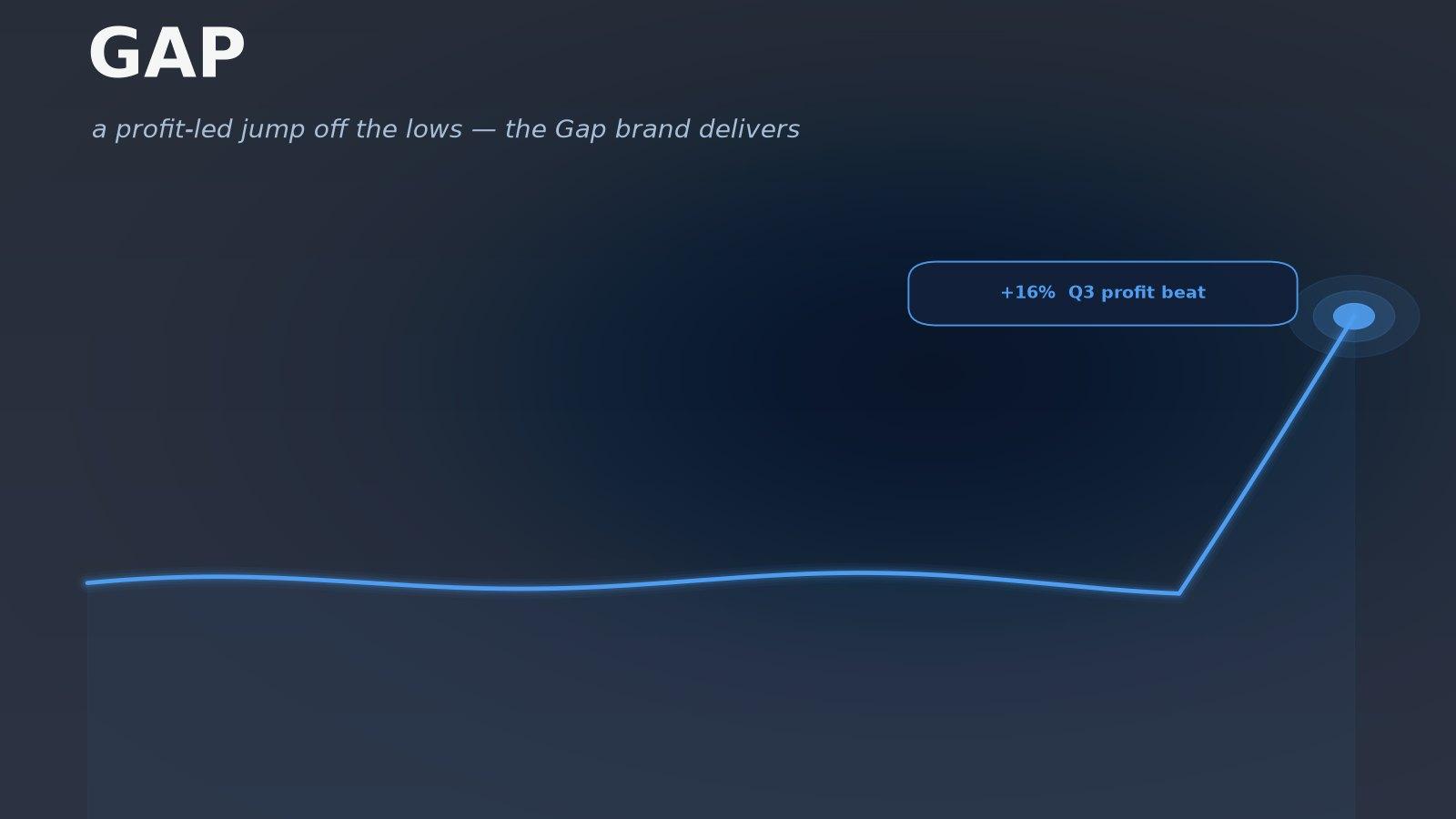
On Friday, November 20, 2026, Gap Inc. (NYSE: GAP) jumped about 16% in intraday trading, to around $21.75 (from an $18.79 prior close), after reporting fiscal third-quarter results the evening before [1]. The move stood out against a soft tape: the S&P 500 was lower, off-price retailer Ross Stores fell on its own weak guidance, and Levi Strauss slipped, so Gap's surge was plainly its own news rather than a retail-sector wave [5]. What makes the reaction interesting is that it came despite a trimmed outlook — and off a washed-out base. Gap had drifted down to roughly its 52-week low into the print, so this was less a growth-acceleration story than a beaten-down, heavily shorted stock violently re-rating on better-than-feared earnings quality [1].
The crucial distinction is that this was a profit beat, not a sales beat. Gap reported GAAP earnings of $0.86 a share, up about 39% from $0.62 a year earlier, and adjusted EPS of $0.82 that cleared the roughly $0.78 analysts expected [2]. But the top line was unremarkable: net sales rose just 2% to $4.0 billion, and comparable sales were flat — actually a miss against the ~1.3% gain the Street modeled [6]. The quality of the earnings is also worth a caveat: about $0.04 of the GAAP figure came from a one-time tariff recovery (the adjusted $0.82 strips it out), so the cleanest way to read the quarter is that operating profit, not revenue, did the work — operating income rose about 19% to $396 million and the operating margin expanded roughly 140 basis points to 9.9% [2].
What actually drove the move — the Gap brand delivers, and the market feared worse
The single best number in the release was the Gap brand itself: net sales up 11% and a comparable-sales gain of 9% — its 12th consecutive quarter of positive comps [2]. Under CEO Richard Dickson, the once-ailing namesake banner has become the company's growth engine, and this quarter extended that streak convincingly. The rest of the portfolio was far more mixed, which is the real tension in the story: Old Navy, by far the largest brand at roughly 57% of sales, managed only flat comps (an improvement from down 4% in the prior quarter, but still not growing); Banana Republic comps fell 3%; and Athleta remained in outright decline, with sales down 14% and comps down 15% [2]. So the "beat" rested on the Gap brand, cost discipline and margin expansion rather than broad-based demand.
Why did Gap jump nearly 16% on a quarter with flat comps and a lowered outlook? Three things. First, expectations were on the floor — the shares had fallen to their 52-week low, so "better than feared" was a low bar, and a profit beat plus the Gap brand's momentum cleared it. Second, the guidance cut was modest and had already been feared: management trimmed full-year net-sales growth to "roughly flat" (from up 1% to 1.5%), nudged the adjusted operating-margin outlook to about 7.2% (from 7.4%–7.6%) and the adjusted-EPS range to roughly $2.29–$2.34 (from $2.35–$2.45), blaming warm October weather that softened demand before trends improved as temperatures cooled [2]. Third, the mechanics likely amplified the move: Gap carries meaningful short interest (around 12% of its float) and a high beta (about 2.06), so a relief rally in a cheap, out-of-favor stock tends to swing hard [3].
The valuation question
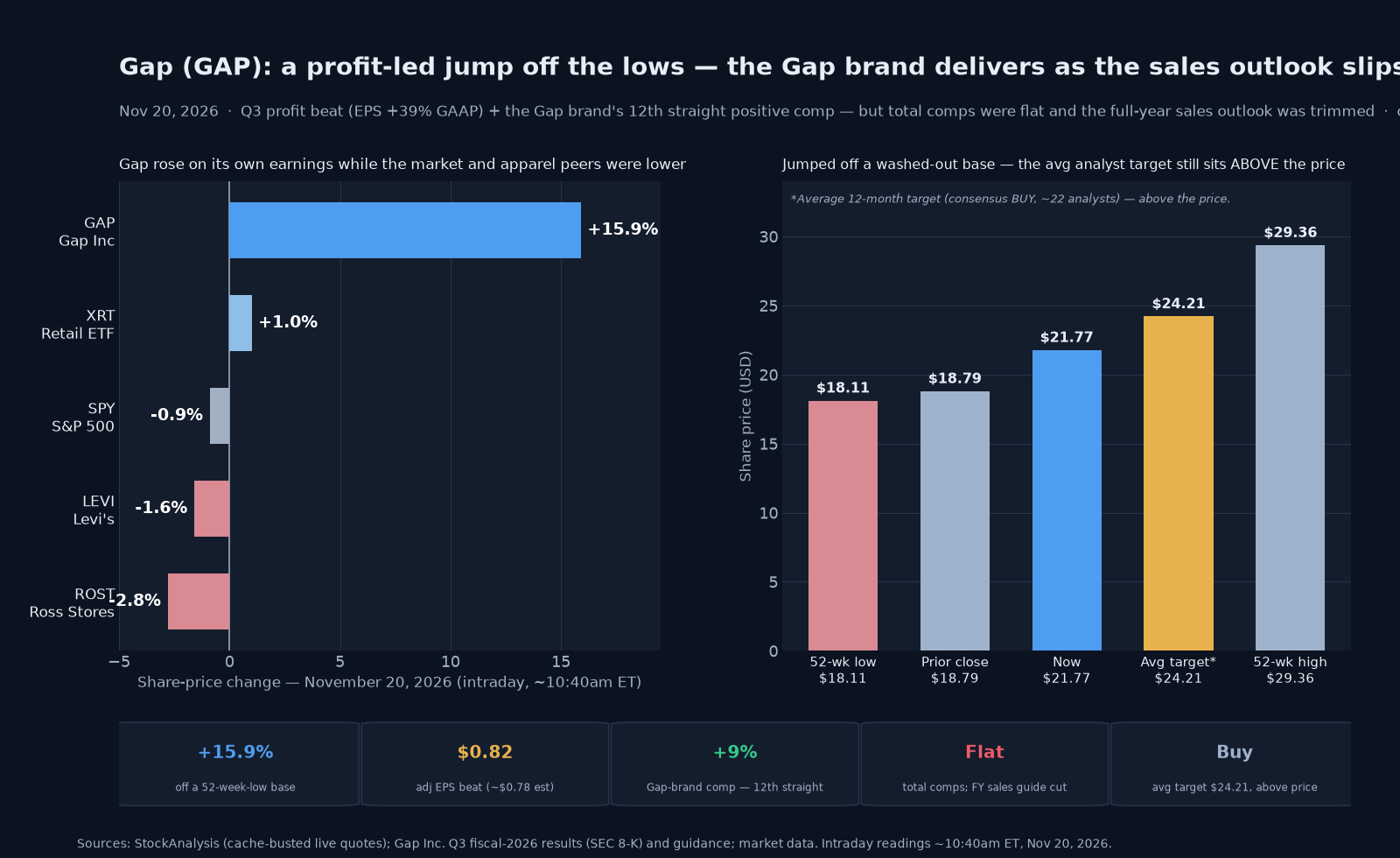
Here is what makes Gap different from a stock already trading at a stretched valuation: even after a 16% pop, it is still inexpensive and below where analysts peg it — though less cheap than the headline multiple suggests. The shares trade around 6 times reported trailing earnings, but that figure is heavily flattered by one-time gains booked this year — tariff recoveries and a legal settlement that together add about $1.42 a share to the company's full-year GAAP EPS. Measured against management's fiscal-2026 adjusted-EPS guidance of about $2.30, the stock trades closer to 9–10 times earnings, and roughly 0.5 times sales [3]. Even so, the valuation is modest, the average 12-month analyst target of about $24.21 sits above the current price, and the consensus rating is a Buy. The balance sheet looks strong at a glance — Gap ended the quarter with about $2.6 billion of cash and reported $815 million of free cash flow over the first nine months (up from $280 million a year earlier) — but that cash flow is not a clean read on the business: roughly $536 million of tariff refunds and $263 million from a legal settlement (about $799 million combined, or nearly all of it) drove the increase, so it overstates recurring cash generation [2]. What is genuinely solid is the capital return: the company cut inventory 6%, returned roughly $788 million to shareholders this year — $601 million of it in buybacks that shrank the share count about 5% — and pays a dividend yielding about 3% on a modest payout — about 20% of reported earnings, or nearer 30% of its adjusted earnings [2]. The forward P/E near 8.75 (on analysts' next-twelve-month estimates, which already reach into fiscal 2027) sits above the ~6x trailing multiple largely because the trailing earnings are inflated by those one-time items, not merely because guidance was trimmed. The valuation case rests on whether Dickson's turnaround keeps compounding recurring profit even with a stalled Old Navy, not on the business suddenly growing faster [3].
Analyst view
This is a profitability-and-brand turnaround meeting a stock that was priced for failure, and the discipline is to hold both ideas at once. The bull case is concrete: the Gap brand is genuinely working (a 9% comp and a 12-quarter positive streak), the operating margin expanded despite flat comparable sales, buybacks are robust, the stock is inexpensive — roughly 9–10x the company's adjusted earnings, and cheaper still on a reported ~6x trailing multiple that one-time gains flatter — with a ~3% yield, and the Street's average target still sits above the price with a Buy consensus. The bear case is about the engine and the direction of travel: Old Navy — the biggest brand — is only flat, Athleta is shrinking, Banana Republic is soft, management cut the full-year sales and margin outlook rather than raising it, the headline-cheap valuation and this year's cash flow are both flattered by one-time tariff and legal gains, and a flat-comp quarter carried by cost control and buybacks is lower-quality than one built on growth. With a beta above 2, the stock will swing hard in both directions. The most balanced read is that Gap delivered a genuinely better-than-feared quarter that justifies a relief rally off a washed-out base and validates the Gap-brand momentum — but that the move is a re-rating of sentiment, not proof of accelerating demand, and the next leg depends on Old Navy returning to growth and the margin gains holding as guidance softens. The right lens is Old Navy's comps: if the largest brand turns positive, the whole story re-rates; if it keeps stalling, a high-beta name at a low multiple has room to give the pop back. This is descriptive analysis of a news-driven move, not investment advice.
Why it matters
Gap is a bellwether for the value-oriented American consumer, and its results read as a picture of selective, promotion-sensitive demand rather than broad strength. The company explicitly flagged that sales softened in October and early November amid unusually warm weather, then improved as temperatures cooled — a reminder of how weather-dependent apparel demand is heading into the holidays, and part of why it trimmed its outlook [2]. The split within Gap's own house is the bigger signal: the Gap brand is winning while Old Navy, the mass-market value banner, is merely holding — consistent with a shopper who will still pay for a resonant brand but is cautious on everyday basics. The quarter also showcases a turnaround that is, for now, a margin and capital-returns story (this year's cash flow was itself flattered by one-time tariff and legal receipts): Dickson has rebuilt profitability and shareholder returns faster than he has rebuilt the top line, which is why a flat-comp quarter can still send the stock up 16%. For Gap specifically, the episode reframes the debate from "can this company make money again?" — clearly yes — to "can it grow again?", a question the stalled Old Navy and the lowered guidance leave genuinely open.
The move, in one cross-section
The same-session tape shows Gap rising on its own earnings while the broad market and apparel peers were lower — the signature of a company-specific catalyst [5]:
| Name (ticker) | Nov 20, 2026 (intraday) | Read-through |
|---|---|---|
| GAP — Gap Inc. | ≈+15.9% | The earnings name — up on a Q3 profit beat and Gap-brand strength, off a 52-week-low base [1] |
| XRT — S&P Retail (ETF) | ≈+1.0% | Retail ETF only modestly higher — Gap's own weight and a soft-but-positive retail bid [5] |
| SPY — S&P 500 (ETF) | ≈−0.9% | Broad market lower — Gap went the other way on its results [5] |
| LEVI — Levi Strauss | ≈−1.6% | Apparel peer lower — no read-through to Gap's beat [5] |
| ROST — Ross Stores | ≈−2.8% | Off-price retailer fell on its own weak guidance — the opposite reaction [5] |
Gap up ~16% while the S&P 500, Levi's and Ross Stores were all lower points to a single-company catalyst — its own earnings — rather than a sector or macro move. That an off-price retailer (Ross) fell the same day on disappointing guidance underscores that this was Gap's story, not retail's [5].
What the Street thinks
Unusually for a stock that just jumped 16%, the sell-side still sees upside. The consensus rating is a Buy from about 22 analysts, with an average 12-month price target near $24.21 — above the post-earnings price [3]. That configuration — a cheap, out-of-favor stock trading below its average target even after a sharp rally — says the Street has viewed Gap as undervalued on its profitability and cash returns, and that the market is only now starting to close the gap. Expect estimate revisions to be two-sided after this print: higher on the earnings-power and Gap-brand momentum, but tempered by the trimmed sales and margin guidance. The tension between a Buy consensus and a business cutting its outlook is the clearest measure of how much the story now hinges on execution — specifically, on whether Old Navy can rejoin the Gap brand in positive territory [3].
What to watch
- Old Navy comps. The single most important metric — whether the largest brand (~57% of sales) can move from flat to positive, the proof the recovery is broadening beyond the Gap brand [2].
- The holiday quarter. Whether the trimmed Q4 outlook (sales flat to down 1%) proves conservative, and whether the "improvement as temperatures cooled" holds through the season [2].
- Margin durability. Whether the ~140-basis-point operating-margin gain sticks as the company guides gross margin "down slightly" for the year — the difference between a durable profit turn and a one-quarter high [2].
- Earnings quality and capital returns. How much of future EPS is operational versus one-time items (such as this quarter's tariff recovery) or buyback-driven share-count reduction. Moves are tracked on the Gap stock page.
Illustrative scenario sensitivity
Because the move reflects a better-than-feared quarter meeting a washed-out stock, the scenarios below are anchored to whether the turnaround broadens beyond the Gap brand — not to this quarter alone [3]. They are a descriptive, author-weighted exercise over roughly the coming six-to-twelve months as the holiday season and fiscal-2027 trends clarify — not a forecast, target, recommendation, or trading advice — with subjective weights that sum to 100%.
| Scenario | Illustrative price | Weight | Key drivers |
|---|---|---|---|
| Turnaround broadens | ~$28 | 30% | Old Navy returns to positive comps, margins hold, Athleta stabilizes, and the stock re-rates toward its 52-week high and past the Street's target as the discount closes [3]. |
| Cheap and improving, Old Navy stalled | ~$22 | 45% | The Gap brand and margins carry the story but Old Navy stays flattish and the trimmed guidance holds; the stock consolidates its pop near current levels [1]. |
| Demand softens, guidance keeps slipping | ~$16 | 25% | A soft consumer and warm-weather drag persist, Old Navy turns negative, the one-time-aided earnings normalize lower, and a high-beta name gives back the relief rally [2]. |
Weighting those (0.30 × $28 + 0.45 × $22 + 0.25 × $16) gives an author-weighted reference value of about $22.30 — an illustrative, probability-weighted scenario output mechanically derived from the weights above, and not a price target, fair-value estimate, or prediction — essentially in line with Friday's ~$21.75 price [1]. That the weighted figure lands close to the current price reflects a simple reading: the market has repriced Gap for better-than-feared profitability, so from here the stock largely tracks whether the turnaround broadens beyond the Gap brand. This is a scenario exercise and descriptive analysis of a news-driven move, not investment advice.
Gap data snapshot — November 20, 2026
| Figure | Value | As-of / source |
|---|---|---|
| Intraday quote | ~$21.75 (≈+15.9%) — an intraday reading (market open); opened $20.25, day range $20.05–$22.16; jumped off a near-52-week-low base ($18.79 prior close vs the $18.11 52-week low) | Fri, Nov 20, 2026, ~10:40am ET — StockAnalysis [1] |
| Prior close / 52-week trend | $18.79 prior close; 52-week range $18.11–$29.36 — still ~26% below the high; beta ~2.06 (a high-volatility name, which amplified the move) | Nov 20, 2026 [1] |
| Market cap / valuation | ≈$7.64B (≈351M shares); enterprise value ≈$10.44B; P/E ≈6.1 on reported trailing earnings — but flattered by ~$1.42/sh of one-time tariff/legal gains, so ~9–10x on FY2026 adjusted EPS (~$2.30); forward P/E ≈8.75; P/S ≈0.5 on ~$15.4B trailing revenue; dividend $0.70 (≈3.2% yield, ~20% payout) | Nov 20 — StockAnalysis [3] |
| Q3 FY2026 results | GAAP EPS $0.86 (+39% YoY vs $0.62); adjusted EPS $0.82 vs ~$0.78 consensus (beat) — ~$0.04 of the GAAP figure from a one-time tariff recovery. Net income $311M (+32%). Operating income $396M (+19%); operating margin 9.9% (~+140bps); gross margin 42.5% (+10bps). Net sales $4.0B (+2%); comparable sales FLAT (vs ~+1.3% est) | Nov 19 — Gap Inc. Q3 FY2026 results (SEC 8-K) [2] |
| By brand (comp / net sales) | Gap +9% comp / +11% sales — 12th straight positive comp (the star); Old Navy flat comp / +1% sales (largest brand, ~57%); Banana Republic −3% comp / −3% sales; Athleta −15% comp / −14% sales (the laggard) | Nov 19 — Gap results [2] |
| Guidance (lowered) | Full-year net-sales growth cut to "roughly flat" (from +1% to 1.5%); adjusted operating margin ~7.2% (from 7.4%–7.6%); adjusted EPS ~$2.29–$2.34 (from $2.35–$2.45); adjusted gross margin "down slightly." Q4 net sales flat to −1%; warm-weather softness in Oct/early Nov, improving as temperatures cooled | Nov 19 — Gap results [2] |
| Balance sheet & returns | Cash ~$2.6B; 39-week free cash flow $815M (vs $280M) — but ~$799M of it from one-time tariff refunds (~$536M) + a legal settlement (~$263M), so not a clean recurring figure; inventory −6%; buybacks $601M YTD (vs $152M; ~5% fewer shares); ~$788M total returned to holders YTD; quarterly dividend $0.175 (+6%) | Nov 19 — Gap results [2] |
| Same-day cross-section | GAP +15.9% vs XRT +1.0%, SPY −0.9%, LEVI −1.6%, ROST −2.8% — a company-specific move (an off-price retailer, Ross, fell on its own weak guidance) | Nov 20 intraday [5] |
| Analyst view | Consensus "Buy" from ~22 analysts, average target ≈$24.21 — ABOVE the post-earnings price (the Street still sees upside); estimate revisions likely two-sided after the profit beat and the guidance cut | Nov 20 — StockAnalysis [3] |
Gap (GAP) Q3 earnings FAQ
Why did Gap (GAP) stock jump on November 20, 2026?
Gap rose about 16% to around $21.75 after reporting fiscal third-quarter results the evening before that beat on profit, even though the top line was soft and it trimmed its outlook. GAAP earnings of $0.86 a share rose about 39% year over year, adjusted EPS of $0.82 cleared the ~$0.78 expected, and the operating margin expanded roughly 140 basis points to 9.9%. The standout was the Gap brand, with a 9% comparable-sales gain — its 12th straight positive quarter. Crucially, the stock had fallen to its 52-week low going into the print, so a better-than-feared profit beat in a cheap, heavily shorted, high-beta name produced a violent relief rally. The move was company-specific: the S&P 500, Levi's and Ross Stores were all lower that day.
Did Gap actually beat earnings, or is the quarter weaker than it looks?
Both are true, which is why the quarter needs care. Gap genuinely beat on profit — adjusted EPS of $0.82 topped the ~$0.78 consensus, GAAP EPS of $0.86 was up about 39%, and the operating margin expanded about 140 basis points to 9.9%. But this was a profit beat, not a sales beat: net sales rose only 2% to $4.0 billion and comparable sales were flat, actually a miss against the ~1.3% gain analysts expected. The earnings quality carries an asterisk too — about $0.04 of the GAAP figure came from a one-time tariff recovery (the adjusted $0.82 excludes it), and part of the EPS growth reflects a ~5% reduction in the share count from buybacks. And Gap lowered its full-year sales and margin guidance. So the profitability and the Gap brand were genuinely strong; the growth and the outlook were not.
Why did Gap stock rise even though it cut its guidance?
Three reasons. First, expectations were on the floor: the shares had fallen to their 52-week low into the report, so 'better than feared' was a low bar that a profit beat and the Gap brand's momentum easily cleared. Second, the guidance cut was modest and widely dreaded — management trimmed full-year net-sales growth to 'roughly flat' (from up 1% to 1.5%) and adjusted EPS to about $2.29–$2.34 (from $2.35–$2.45), blaming warm October weather that softened demand before trends improved as temperatures cooled. Third, the mechanics amplified the move: Gap carries meaningful short interest (around 12% of its float) and a high beta (about 2.06), so a relief rally in a cheap, out-of-favor stock swings hard. In short, the market had been bracing for worse and the quarter cleared a very low bar.
Is Gap stock cheap after the jump?
It is inexpensive, but less cheap than the headline multiple suggests — and the question is whether the earnings are durable. Gap trades near 6 times reported trailing earnings and roughly 0.5 times sales, which looks very cheap, but the trailing earnings are heavily flattered by one-time gains this year (tariff recoveries and a legal settlement that add about $1.42 a share to full-year GAAP EPS). Measured against management's fiscal-2026 adjusted-EPS guidance of about $2.30, the stock trades closer to 9–10 times earnings — still modest for the sector, but not the dirt-cheap 6x the headline implies. The dividend yields about 3% on a ~20% payout, and the average analyst target of about $24.21 still sits above the current price with a Buy consensus. The balance sheet looks strong — about $2.6 billion of cash and $815 million of nine-month free cash flow — but roughly $799 million of that cash flow came from one-time tariff refunds and a legal settlement, so it overstates recurring cash generation. The valuation case depends on the turnaround continuing to grow recurring profit rather than on growth re-accelerating.
Which Gap brands are doing well, and which are struggling?
The results were a tale of two halves. The Gap brand is the clear winner: net sales up 11% and comparable sales up 9%, its 12th consecutive quarter of positive comps, making the once-ailing namesake banner the company's growth engine under CEO Richard Dickson. The rest of the portfolio lagged. Old Navy — by far the largest brand at roughly 57% of sales — managed only flat comps (an improvement from down 4% the prior quarter, but still not growing). Banana Republic comps fell 3%, and Athleta remained in outright decline, with sales down 14% and comps down 15%. That split is the central tension: the turnaround is real at the Gap brand but has not yet broadened to Old Navy, whose return to growth is the key to the next leg of the story.
What should investors watch next for Gap?
The single most important thing is Old Navy's comparable sales — whether the largest brand can move from flat to positive, which would show the recovery is broadening beyond the Gap brand. Beyond that, watch whether the trimmed Q4 outlook (sales flat to down 1%) proves conservative and whether the 'improvement as temperatures cooled' holds through the holidays; whether the roughly 140-basis-point operating-margin gain sticks even as the company guides gross margin 'down slightly'; and the quality of earnings — how much of future EPS is operational versus one-time items like this quarter's tariff recovery or buyback-driven share-count reduction. Because the stock has re-rated on better-than-feared profitability rather than growth, the next move depends on the top line actually turning. This is descriptive analysis, not investment advice.