Consumer
Gap (GAP) Stock Jumps ~13%: A Margin Beat Despite Lower Sales, and a Tale of Four Brands
Gap Inc. jumped about 13% to roughly $23.50 on August 28 after a fiscal Q2 report that beat on profit even as sales fell about 2% and comps slipped 1%. Adjusted EPS of $0.52 topped the ~$0.48 estimate on a wider gross margin, management raised its full-year adjusted-EPS guide to $2.35–$2.45, and Gap named a new CEO for its weakest brand, Old Navy. The nuance: the flashy ~40% jump in trailing GAAP net income (and the ~7x trailing P/E) is heavily distorted by one-time gains — a Q1 legal settlement and a Q2 tariff refund — while on an adjusted basis Q2 profit actually dipped year over year; the cleaner gauge is ~9x forward. Underneath, a tale of four brands: Gap +10% (its 11th straight quarter of comp growth) and Banana Republic +3%, but Old Navy — the biggest — fell 4% and Athleta 12%. A hold-heavy Street (about 12 of 20 at Hold; UBS $42 and Telsey $34 the bulls) reflects doubts about the shrinking top line.

Why Gap stock jumped — a profit beat, not a sales beat
On Friday, August 28, 2026, Gap Inc. (NYSE: GAP) jumped about 13% to roughly $23.50 (an intraday reading), from a $20.79 prior close [1]. The unusual part is what it jumped on. Gap's fiscal second-quarter sales actually fell about 2% to $3.65 billion, and companywide comparable sales slipped 1% [2]. Yet the stock soared, because the report cleared the bar on profit: adjusted earnings of $0.52 a share topped the roughly $0.48 estimate on the strength of a wider gross margin, and management raised its full-year adjusted-EPS guidance to $2.35–$2.45 [2]. Investors also welcomed a leadership shake-up at the troubled Old Navy brand — Gap named Michael Francis as Old Navy's next CEO, effective November 2 — which Reuters cited alongside the profit outlook as a driver of the rally [2]. On a stock that looks cheap on the surface, a gross-margin-driven beat plus a fix for the weakest brand was enough to re-rate the shares fast.
Cheap on the surface — but mind the one-off gains
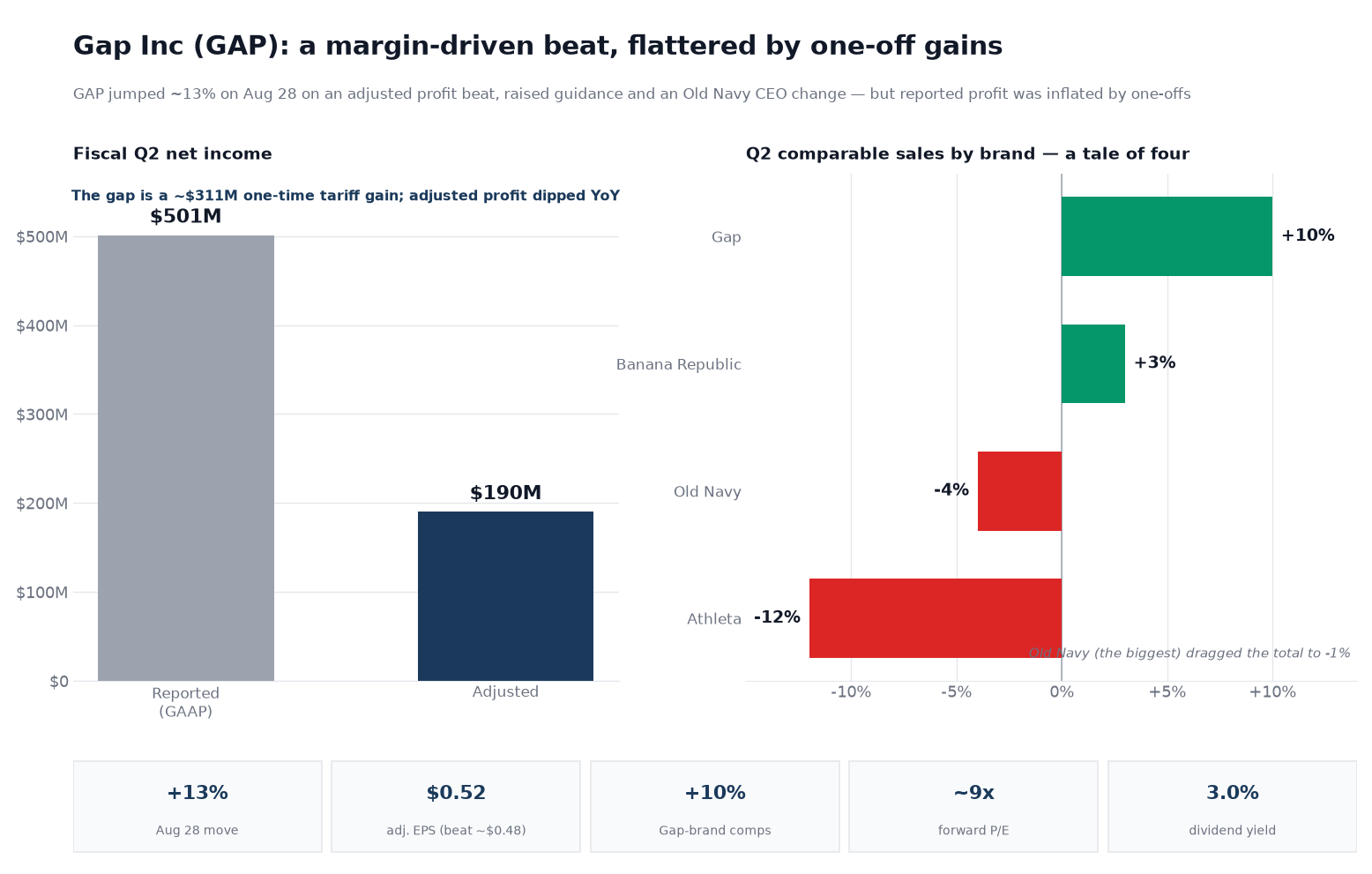
Gap screens as strikingly cheap: about 7 times trailing earnings, half its annual sales in market value, and a 3% dividend. But that trailing multiple is misleadingly low, because Gap's reported profit this year has been inflated by two large one-time items. In the first quarter, GAAP net income of $339 million included a roughly $313 million pre-tax legal-settlement gain (partly offset by a $50 million charitable contribution); in the second, results included a $417 million pre-tax net tariff recovery under the IEEPA program, worth about $311 million after tax, or $0.86 a share [2]. Strip the one-offs out and the picture is far more sober: adjusted second-quarter net income was about $190 million, actually down from $216 million reported a year earlier, and the adjusted operating margin was 7.1% versus a reported ~7.8% [2]. So the eye-catching "profit up ~40%" trailing figure is largely one-off gains, not a surge in underlying earnings — which is why the cleaner gauge is the ~9 times forward multiple, built on adjusted estimates, rather than the ~7 times trailing number.
None of that erases the beat. The quarter genuinely exceeded expectations where it counts for the turnaround: adjusted gross margin widened about 20 basis points to 41.4%, management said gross-margin strength drove the profit beat, and it nudged its full-year adjusted operating-margin guide up to 7.4%–7.6% [2]. Under CEO Richard Dickson, cleaner inventory, fuller-price selling and healthier brands are making Gap more profitable — but the improvement is measured in tens of basis points, not the 40% the GAAP headline suggests. A cheap stock, a real (if modest) margin beat and a raised outlook were enough to move the shares 13%; the one-off gains just make the reported numbers look better than the underlying business.
A tale of four brands
Underneath the flat headline, Gap's four brands are moving in very different directions [2]. The namesake Gap brand is the star: comparable sales rose 10%, its 11th consecutive quarter of growth, powered by denim, fleece and kids. Banana Republic added 3%, its fifth straight positive quarter. The drags were the other two: Old Navy, the company's biggest brand at $2.06 billion of the $3.65 billion total, saw comps fall 4% — its first negative comparable-sales quarter in about three years, which management blamed on weak women's seasonal product and an unanticipated traffic slowdown (though it said trends have improved since) — and Athleta, still in an early rebuilding phase, fell 12%. Because Old Navy is so much larger than the others, its stumble is what pulled the companywide comp negative even as Gap and Banana Republic improved. It is also why the leadership change matters: bringing in Michael Francis to run Old Navy (from November 2) is Gap's attempt to fix the very brand that just cracked, and investors treated it as a step toward stabilizing the largest piece of the company [2]. The bull case is that the two healthy brands keep compounding and a new leader steadies Old Navy; the bear case is that the biggest brand is the one now in question.
Reported vs adjusted: two very different guidance numbers
The one place to be careful is Gap's two full-year EPS figures. The adjusted guide of $2.35–$2.45 — the number Gap raised, and the one that excludes the tariff and legal items — is the cleaner measure of the business; importantly, the $0.52 adjusted quarterly beat likewise excludes the tariff refund, so the headline earnings surprise was not manufactured by the windfall [2]. The much larger reported outlook of $3.77–$3.87, by contrast, is flattered by one-offs: it includes the IEEPA tariff recovery plus a net benefit from the first-quarter legal settlement (about $0.63 a share, partly offset by a related $0.10 charitable contribution) [2]. So the tariff and settlement primarily inflate the GAAP and reported figures, not the adjusted beat. Notably, Gap also trimmed its full-year net-sales-growth outlook (to 1–1.5% from 1–2%) because of the Old Navy lag, even as it nudged the profit guide up — a reminder that this is a margins-and-earnings story, not a growth story [2].
Why it matters
Gap is a case study in a specific kind of turnaround — the margin turnaround, where a tired brand portfolio is made steadily more profitable without necessarily growing much. That model has been one of retail's quiet winners: cleaner assortments, less discounting and tighter costs can lift earnings even when sales are flat, and the market will pay up for it as long as the improvement looks durable. But Gap's quarter also shows the model's limits — in two ways. First, the improvement is real but incremental (gross margin up tens of basis points), not the 40% the GAAP profit line implies, since one-time gains flatter the reported figures. Second, profitability can only carry a stock so far if the biggest brand is losing customers; eventually the top line has to cooperate, which is why the new Old Navy leadership matters. The 13% pop says investors still believe in the Dickson turnaround, welcomed the Old Navy shake-up and love the cheap headline valuation; the soft Old Navy comp, the trimmed sales outlook and the one-off-flattered earnings are the reasons a large part of the Street stays on the sidelines. Which force wins — durable margins or a fading top line — is the question that will define the next few quarters.
A big gain on a quiet market day
Gap's move stood out precisely because the broad market did not do much [5]:
| Name (ticker) | Aug 28, 2026 (intraday) | Read-through |
|---|---|---|
| GAP — Gap Inc. | ≈+13% | A profit beat and raised EPS guide re-rated a cheap turnaround stock [1][2] |
| S&P 500 | ≈flat | A roughly flat broad market (it swung either side of unchanged through the day), underscoring that this was a company-specific move [5] |
A 13% single-day gain on a day the market barely moved is the signature of an idiosyncratic earnings reaction, not a sector tide [5].
What the Street did with it
Coverage carries a Buy label but is more cautious underneath, and the print produced a telling split. Across 20 analysts the consensus is a Buy with an average 12-month target near $26 (about 12% above Friday's level) and a median near $26, but the rating distribution is actually hold-heavy — roughly 8 buy-side ratings against 12 holds and no sells [6]. The bulls stand out: UBS raised its target to a Street-high $42 (Buy) after the results, and Telsey Advisory sits at $34 (Buy) [6]. But the more common reaction was to nudge targets up while staying neutral and close to the stock: Bank of America to $27 (Neutral), and Morgan Stanley and Barclays both to $23 (Equal-weight) [6]. The aggregate ~$26 average already lags UBS's fresh $42, and that cluster of neutral targets near the share price captures the market's ambivalence: the beat was real, but a shrinking top line and one-off-flattered earnings keep much of the Street from underwriting more upside.
What to watch
- Old Navy's traffic. The biggest brand's first negative comp since 2023 is the swing factor. Watch whether the "improved" trends management cited translate into a positive comp next quarter [2].
- Margins vs the tariff tailwind. Watch how much of the profit story is durable operating improvement versus the one-time IEEPA tariff refund in the reported guidance [2].
- Gap and Banana Republic momentum. The two healthy brands are the bull case; watch whether Gap's 10% comp and Banana Republic's streak hold [2].
- Whether sales growth returns. Guidance was trimmed on the top line; watch for any inflection. Moves are tracked on the GAP stock page [1].
Illustrative valuation sensitivity
Gap has real, growing earnings, so the scenarios below are anchored to its forward earnings power (a forward P/E near 9× the ~$2.40 adjusted guidance) and to the analyst target distribution (low ~$20, average ~$26, high ~$42), turning on whether the margin gains prove durable and the top line stabilizes. They are a descriptive, author-weighted exercise — not a forecast, target, recommendation, or intrinsic fair-value calculation — with subjective weights that sum to 100%.
| Scenario | Illustrative price | Weight | Key drivers |
|---|---|---|---|
| Upside | ~$31 | 30% | Old Navy's traffic recovers, margins hold, and the cheap multiple expands as the turnaround proves durable and sales inflect toward the bullish targets [6]. |
| Middle | ~$26 | 45% | Margins stay strong but the top line stays soft; the stock drifts toward the consensus target as investors weigh a profit turnaround against shrinking sales [6]. |
| Downside | ~$20 | 25% | Old Navy's weakness deepens, the tariff benefit rolls off, and a value multiple compresses toward the low end of the range as the self-help runs its course [2][6]. |
Weighting those (0.30 × $31 + 0.45 × $26 + 0.25 × $20) gives an author-weighted reference value near $26, above Friday's ~$23.50 and in line with the ~$26 consensus [1][6] — reflecting a genuine, cheap margin turnaround set against a soft and uncertain top line. This is a Street-target-based scenario exercise and descriptive analysis of an earnings reaction, not investment advice.
GAP data snapshot — August 28, 2026 (intraday)
| Figure | Value | As-of / source |
|---|---|---|
| Intraday quote | ~$23.50 (+~13%); feed +13.30% | Aug 28 — StockAnalysis / Change Feed [1] |
| Prior close | $20.79 | Thu, Aug 27, 2026 [1] |
| 52-week range / change | $18.11–$29.36; ~+5% over 52 weeks (~20% below the high; above its 50-day ~$20 and near its 200-day ~$24 averages; RSI ≈71) | As of Aug 28 [3] |
| Market cap / EV | ≈$8.4B (360M shares); enterprise value ≈$11.7B; beta ≈2.0 | Aug 28 — StockAnalysis [3] |
| Valuation | Forward P/E ≈9× (on adjusted estimates — the cleaner gauge); ≈0.55× sales; dividend yield ≈3.0% ($0.70). The ~7× trailing P/E is misleadingly low: trailing GAAP profit is heavily inflated by one-time gains | Aug 28 — StockAnalysis [3] |
| Financials (TTM) | Revenue ≈$15.3B (+1.1%); reported net income ≈$1.25B (GAAP EPS $3.29) — but ~half is one-off gains (Q1 legal settlement, Q2 tariff refund); adjusted operating margin ≈7.5%; gross margin ≈43% | TTM — StockAnalysis / company [3] |
| Volume | ~18M shares vs a ~6.9M 20-day average (~2.6×, very heavy) | Aug 28 — StockAnalysis [1] |
| The quarter (fiscal Q2) | Net sales $3.65B (−2%); comps −1%; adjusted EPS $0.52 (beat ~$0.48) on gross margin +20bps to 41.4% — but adjusted net income ~$190M dipped from ~$216M YoY (reported GAAP $501M includes a ~$311M tariff gain); by brand: Gap +10%, Banana Republic +3%, Old Navy −4%, Athleta −12%; FY adjusted-EPS guide raised to $2.35–$2.45; net-sales-growth outlook trimmed to 1–1.5%; new Old Navy CEO (Michael Francis) named, effective Nov 2 | Aug 27 — company [2] |
| Same-day tape | GAP ≈+13% vs S&P 500 ≈flat — one of the day's biggest gainers on a market that swung either side of unchanged | Aug 28 [5] |
| Analyst view | 20 analysts, consensus Buy but hold-heavy (≈7 strong buy / 1 buy / 12 hold / 0 sell), avg target ≈$26 (median ≈$26; range ~$20–$40, lagging fresh raises); UBS $42 (Buy) & Telsey $34 (Buy) the bulls; BofA $27 (Neutral), Morgan Stanley $23 & Barclays $23 (Equal-weight) | Aug 2026 — StockAnalysis / market coverage [6] |
The August 28 figures are intraday snapshots that moved through the session, not closing prices.
The setup at a glance
| Question | Answer |
|---|---|
| Why did Gap stock jump on August 28? | It reported fiscal Q2 results the evening before that beat on profit even though sales fell about 2% and comparable sales slipped 1%. Adjusted EPS of $0.52 topped the ~$0.48 estimate on a wider gross margin, Gap raised its full-year adjusted-EPS guidance to $2.35–$2.45, and it named a new CEO for its weakest brand, Old Navy (Michael Francis, effective Nov 2). On a cheap-looking stock, that combination re-rated the shares up about 13% [1][2]. |
| Did Gap's underlying profit really surge? | Not really — that is a common misread. Over the trailing year, reported (GAAP) net income is up ~40%, but roughly half of that is one-time gains: a ~$313 million legal-settlement gain in Q1 and a ~$311 million IEEPA tariff refund in Q2. On an adjusted basis, second-quarter net income actually dipped (~$190 million versus ~$216 million a year earlier). The genuine improvement is a wider gross margin (up ~20 basis points to 41.4%), which is real but incremental — not a 40% surge [2][3]. |
| Which of Gap's brands are doing well? | It is a tale of four. The Gap brand rose 10% (its 11th straight quarter of comp growth) and Banana Republic rose 3% (its fifth), but Old Navy — the biggest brand at ~$2.06 billion of ~$3.65 billion in sales — fell 4% (its first negative comp in about three years, on a traffic slowdown), and Athleta fell 12% while it rebuilds. Because Old Navy is so large, its decline pulled the companywide comp to −1%, which is also why Gap installed a new Old Navy CEO [2]. |
| What is the tariff nuance in the guidance? | Gap's reported full-year EPS guide of $3.77–$3.87 is flattered by one-offs: it includes an IEEPA tariff refund plus a net benefit from a Q1 legal settlement (about $0.63, less a $0.10 charitable contribution). The cleaner figure is the adjusted guide of $2.35–$2.45, which Gap raised and which excludes those items — as does the $0.52 adjusted quarterly beat, so the earnings surprise was not manufactured by the refund. Gap also trimmed its full-year sales-growth outlook (to 1–1.5% from 1–2%) because of Old Navy [2]. |
| Is Gap stock cheap? | It looks cheap, but less so than the headline suggests. The ~7-times trailing earnings multiple is misleadingly low because trailing GAAP profit is heavily inflated by one-time gains; the cleaner gauge is about 9 times forward adjusted earnings, still inexpensive, at roughly half its sales in market value with a ~3% dividend. The catch is that sales are shrinking, so the low multiple reflects real doubts about growth [3]. |
| What do analysts think? | A Buy label, but hold-heavy underneath — about 12 of 20 analysts sit at Hold. The average target is near $26 (range $20 to $40). UBS is the loud bull at a Street-high $42 and Telsey is at $34 (both Buy), while a cluster of neutral desks sits near the current price — Bank of America at $27 (Neutral) and Morgan Stanley and Barclays both at $23 (Equal-weight) [6]. |
Gap (GAP) stock FAQ
Why did Gap (GAP) stock jump on August 28, 2026?
Gap reported fiscal second-quarter results the evening before that beat on profit even though the top line was soft. Net sales fell about 2% to $3.65 billion and comparable sales slipped 1%, but adjusted earnings of $0.52 a share topped the roughly $0.48 estimate on a wider gross margin, and management raised its full-year adjusted-EPS guidance to $2.35–$2.45. Investors also welcomed a leadership change at the struggling Old Navy brand, where Gap named Michael Francis as CEO effective November 2 — a driver Reuters cited alongside the profit outlook. On a stock that looks cheap on the surface, that combination re-rated the shares quickly, up about 13%.
Did Gap's underlying profit really surge 40%?
No — and this is the key thing to understand. Over the trailing twelve months, reported (GAAP) net income is up roughly 40%, which makes the ~7-times trailing earnings multiple look very cheap. But about half of that reported profit is one-time gains: a roughly $313 million pre-tax legal-settlement gain in the first quarter and, in the second, a $417 million pre-tax IEEPA tariff recovery worth about $311 million after tax (roughly $0.86 a share). On an adjusted basis, second-quarter net income actually dipped, to about $190 million from $216 million reported a year earlier, and the adjusted operating margin slipped to 7.1% from a reported ~7.8%. The genuine, durable improvement under CEO Richard Dickson is a wider gross margin — up about 20 basis points to 41.4% — which is real but incremental, not a 40% surge. That is why the cleaner valuation gauge is the roughly 9-times forward multiple on adjusted earnings, not the 7-times trailing number.
How are Gap's individual brands performing?
They are diverging sharply. In the second quarter, the namesake Gap brand's comparable sales rose 10% — its 11th consecutive quarter of growth, led by denim, fleece and kids — and Banana Republic rose 3%, its fifth straight positive quarter. But the two other brands lagged: Old Navy, Gap Inc.'s largest brand at about $2.06 billion of the $3.65 billion total, saw comparable sales fall 4%, its first negative quarter in about three years, which the company blamed on weak women's seasonal product and an unexpected traffic slowdown (though it said trends have since improved); and Athleta, still early in its rebuilding, fell 12%. Because Old Navy is so much bigger than the others, its decline pulled the companywide comparable sales to −1% despite the strength at Gap and Banana Republic — which is exactly why Gap installed a new Old Navy CEO, Michael Francis, effective November 2, a move investors welcomed as an attempt to fix the largest brand.
What is the tariff caveat in Gap's guidance?
Gap gave two very different full-year EPS figures. Its adjusted guidance, which it raised to $2.35–$2.45 on margin strength, is the cleaner measure of the underlying business — and, importantly, the $0.52 adjusted quarterly beat also excludes the tariff, so the earnings surprise was not manufactured by the refund. Its reported guidance of $3.77–$3.87, by contrast, is flattered by one-offs: it includes an IEEPA tariff recovery plus a net benefit from a first-quarter legal settlement (about $0.63 a share, less a related $0.10 charitable contribution). Those items primarily inflate the GAAP and reported figures, not the adjusted beat. Gap also trimmed its full-year net-sales-growth outlook (to 1–1.5% from 1–2%) because of the Old Navy shortfall, underscoring that this is an earnings story, not a growth story.
Is Gap stock cheap after the jump?
It looks cheap — but less so than the headline multiple implies. The ~7-times trailing earnings figure often quoted for Gap is misleadingly low, because trailing GAAP profit is heavily inflated by one-time gains (a Q1 legal settlement and a Q2 tariff refund). The cleaner gauge is about 9 times forward adjusted earnings, which is still inexpensive — the stock is valued at roughly half its annual sales and pays a ~3% dividend. But that low multiple reflects real skepticism, not just a bargain: the company's sales are shrinking and its largest brand just posted its first negative comp in years. The stock is priced as a cheap turnaround with something to prove on the top line. This is descriptive analysis, not a recommendation.
What do analysts think of Gap?
They carry a Buy label but are more cautious underneath. Across 20 analysts the consensus is a Buy with an average 12-month price target near $26 (about 12% above the August 28 level), but the ratings are hold-heavy: roughly 12 of the 20 sit at Hold, with about 8 buy-side ratings and no sells. The targets span a wide range — StockAnalysis's aggregate shows about $20 to $40, though UBS's fresh $42 (the true high) has not yet flowed through. The bulls stand out — UBS at $42 (Buy) after the results and Telsey Advisory at $34 (Buy) — while a cluster of neutral desks nudged targets up but stayed near the stock: Bank of America at $27 (Neutral), and Morgan Stanley and Barclays both at $23 (Equal-weight). That split — a couple of enthusiastic bulls against a wall of neutrals near the price — captures the market's ambivalence about a cheap-looking retailer whose sales are shrinking and whose reported earnings are flattered by one-offs.