Stock Analysis
NetApp (NTAP) Rises ~3.5% as Evercore Upgrades to a Street-High $300 on AI Storage
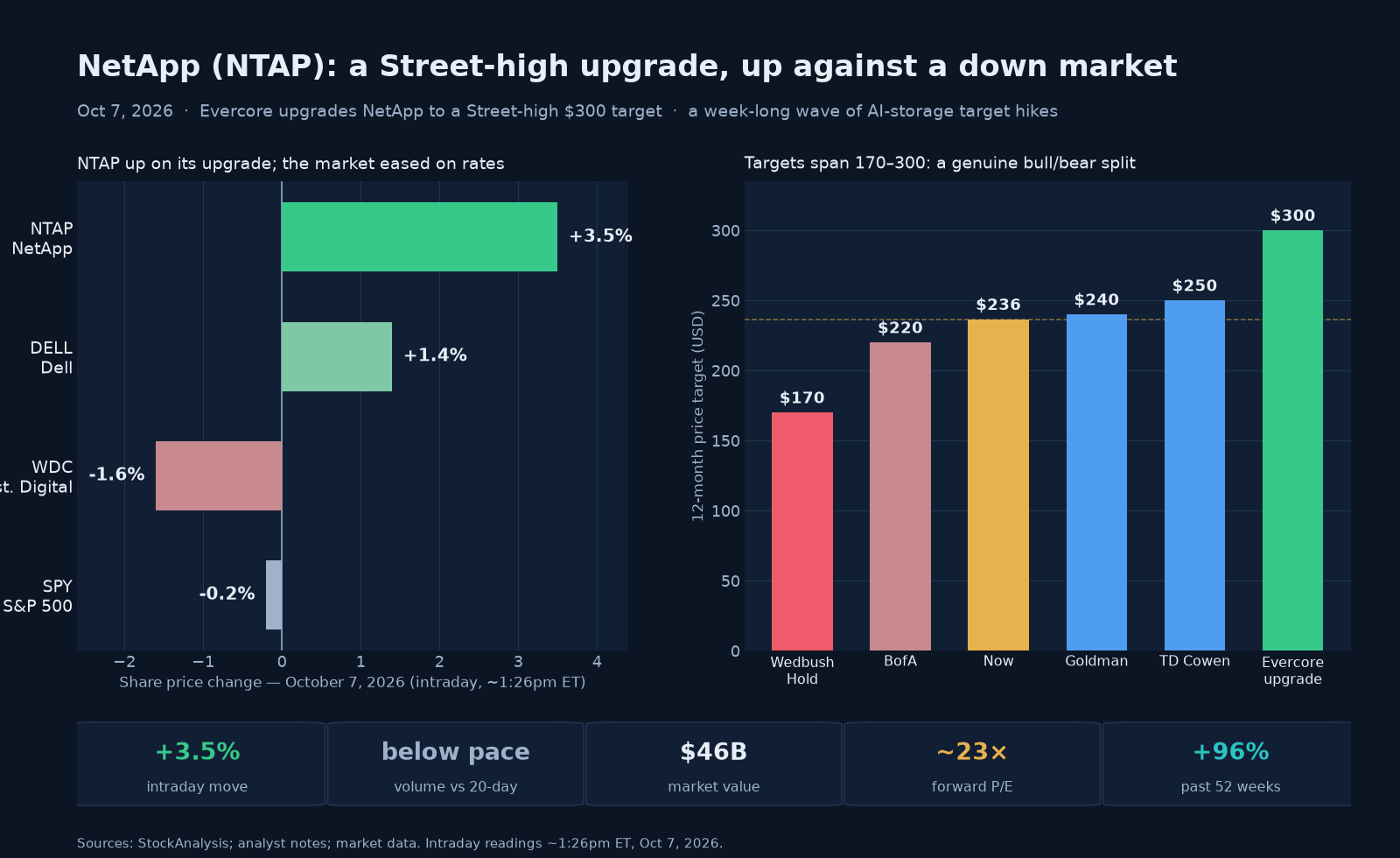
NetApp outperformed a weaker broader market on October 7, rising about 3.5% to roughly $236.50 after Evercore ISI's Amit Daryanani upgraded the stock from In Line to Outperform and set a Street-high $300 price target, up from $210. The move was less about one call than the cluster behind it: over roughly a week, Loop Capital went to $260, TD Cowen to $250, and Goldman to $240, and Evercore has now leapfrogged them all with a rating upgrade — a sell-side re-rating of NetApp as an AI-storage beneficiary, its all-flash arrays and ONTAP software positioned for the data pipelines that feed GPU clusters (a story reinforced by its late-September deal to buy PEAK:AIO and its Novus launch, both earlier developments rather than a fresh catalyst). NetApp rose even as long-dated Treasury yields hit their highest since 2002 in a rates- and oil-driven risk-off that pressured high-multiple shares. But the stock is not cheap: up roughly 96% over the past year, it trades near 23 times forward earnings and 6 times sales for a business growing revenue in the low-double-digits, so the upgrades are betting AI lifts both growth and the multiple. And the Street is genuinely split — the published average target near $206 sits below the price, reflecting both the lag before the newest hikes propagate and real disagreement: a camp of fresh below-price targets (Wedbush's Hold at $170, plus Citi, Barclays and Bank of America in the $190–$220 range) against the bulls at $240–$300. Without an unusually heavy-volume surge, this is a sell-side re-rating; the fundamentals arrive with December 1 earnings.

Why NetApp stock rose — a Street-high upgrade in an AI-storage re-rating
On Wednesday, October 7, 2026, NetApp (NASDAQ: NTAP) rose about 3.5%, trading near $236.50 intraday, up from a $228.45 prior close and pushing fresh highs for the day [1]. The catalyst was an analyst call: Evercore ISI's Amit Daryanani upgraded NetApp from In Line to Outperform and raised his price target to $300 (from $210), the new high on the Street [2]. It was not an isolated move but the latest in a week-long wave of target increases as bullish analysts re-rate NetApp around an expanding AI-storage opportunity. Notably, the stock rose on a day the broad market fell: in a rates- and oil-driven risk-off session, long-dated Treasury yields pushed to their highest since 2002 (the 30-year near 5.7%), pressuring high-multiple shares — yet NetApp advanced on its own upgrade [5].
A single upgrade rarely moves a $46 billion company by itself; what matters here is the cluster. Over roughly a week, Loop Capital went to $260, Goldman Sachs to $240, and TD Cowen to $250, and now Evercore has leapfrogged them all to $300 with a rating upgrade [6]. Evercore's specific argument is not merely "AI storage": it contends NetApp's own guidance understates its trajectory — that the roughly 17% growth guided for the coming fiscal year is conservative and assumes a second-half slowdown, with an upside case of low-20s-percent growth and earnings near $11 a share [2]. Still, this is a bull cluster, and it sits against real disagreement: the published average target near $206 is actually below where the stock trades — partly because the newest hikes have not propagated through every firm's number, but also because of genuine dispersion. Alongside the bulls, several analysts carry fresh targets well below the stock, from Wedbush's Hold at $170 to Citi's roughly $190, Barclays' $219 and Bank of America's roughly $220 [6]. The live debate spans the full range, from the $170s to $300.
What the Street is re-rating
The thesis is AI storage. Training and serving large AI models requires moving enormous volumes of data to and from GPU clusters, and NetApp's all-flash arrays and its ONTAP data-management software are being positioned as infrastructure for that pipeline — a story the company reinforced in late September with its agreement to acquire PEAK:AIO, a high-performance metadata and parallel-file-system specialist built to scale storage alongside GPU clusters, and its launch of Novus, an AI-infrastructure architecture — both announced before this week, and background to the thesis rather than Wednesday's catalyst [2]. The financial backdrop is genuinely strong for a hardware-and-software vendor: revenue grew about 12% over the past year to roughly $7.4 billion, with a 70% gross margin, a 26% operating margin, about $1.65 billion of free cash flow, and a dividend [3]. This is a profitable, cash-generative business — not a speculative one — which is part of why the Street is willing to pay up for the AI-storage optionality.
A stock that has already doubled
Context is essential here, because NetApp is not cheap on the news. The shares are up roughly 96% over the past year, and even after the run they trade at about 23 times forward earnings and 6 times sales — rich for a company growing revenue in the low-double-digits [3]. The upgrades are not arguing that NetApp is a bargain; they are arguing that AI demand lifts both the growth rate and the multiple the market is willing to assign. That is a legitimate thesis, but it is also the crux of the risk: a premium multiple on a mature storage franchise depends on the AI-storage narrative staying intact, and on rates — which were working against high-multiple stocks the very day NetApp rose — not forcing a broad de-rating. The move up on an upgrade, without an unusually heavy-volume surge, is a sell-side re-rating rather than a reaction to fresh company news; the fundamentals arrive with the next earnings report on December 1 [1].
Why it matters
The episode is a clean illustration of a theme re-rating meeting a hostile macro tape. NetApp rose because the AI-storage narrative is strengthening on the sell side, even as the broader market fell on the day: long-dated Treasury yields hit their highest since 2002, in a rates- and oil-driven risk-off session of the kind that usually punishes exactly the high-multiple, long-duration equities NetApp has become [5]. That NetApp advanced anyway says the stock is trading on its own story right now, not the index's. The storage group was split on the day — Dell rose about 1.4% while Western Digital fell about 1.6% — underscoring that this was an AI-software-and-systems re-rating, not a blanket bid for anything labeled "storage" [5]. For a name that has already doubled, the question the upgrades raise is less about direction than about durability: whether the AI-storage premium can keep expanding against a backdrop of rising rates.
The move, in one cross-section
The same-session tape shows a stock-specific move against a soft market [5]:
| Name (ticker) | Oct 7, 2026 (intraday) | Read-through |
|---|---|---|
| NTAP — NetApp | ≈+3.5% | Evercore upgrade to a Street-high $300; an AI-storage re-rating [1][2] |
| DELL — Dell Technologies | ≈+1.4% | Enterprise storage and AI servers — modestly higher in sympathy [5] |
| WDC — Western Digital | ≈−1.6% | Hard-drive hardware — lower; the storage group was split [5] |
| SPY — SPDR S&P 500 ETF | ≈−0.2% | The broad market eased as long-dated yields rose [5] |
NetApp rising on an upgrade while the market fell and a hardware peer declined points to a company-specific, sentiment-driven move — an AI-storage re-rating — rather than a sector or market move [5].
What the Street thinks
The analyst rating is itself mixed — it ranges from Hold/Neutral to a moderate Buy depending on the provider (one major aggregator counts roughly nine buy-equivalent ratings against thirteen neutral and one sell) — and the published average target near $206 sits below the share price, a figure reflecting both the lag before the newest hikes propagate and genuine disagreement [6]. The bullish side is the recent cluster: on October 7, Evercore ISI's Amit Daryanani upgraded the stock from In Line to Outperform and set a Street-high $300 target (from $210); days earlier, Loop Capital's Ananda Baruah went to $260 (from $215), TD Cowen's Krish Sankar to $250 (from $200), and Goldman Sachs's Katherine Murphy to $240 (from $210) [6]. But the skeptics are fresh too, not stale: Wedbush's Steven Wahrhaftig holds a Hold with a $170 target, and recent marks from Citi (around $190), Barclays ($219) and Bank of America (around $220) all sit below the stock [6]. The pattern — a fast cluster of raises toward $240–$300 against a real camp of below-price targets — is a genuine two-sided debate, not a one-way re-rating; the sub-price average captures both.
What to watch
- December 1 earnings. The next fundamental test — whether revenue growth and AI-related storage demand support the re-rating, or whether the premium multiple runs ahead of the numbers [1].
- Rates. With long-dated yields at their highest since 2002, whether the rates- and oil-driven macro backdrop keeps pressuring high-multiple names like NetApp regardless of company news [5].
- The PEAK:AIO integration. How quickly NetApp folds the acquired metadata and parallel-file-system technology into ONTAP, and what it means for AI-storage positioning [2].
- Target convergence. Whether the lagging consensus catches up toward the recent $240–$300 cluster, or the bulls' numbers come back down. Moves are tracked on the NTAP stock page [1].
Illustrative valuation sensitivity
The scenarios below are anchored to the analyst target distribution — from Wedbush's $170 skeptic to Evercore's Street-high $300 — and to NetApp's forward earnings (about 23× before the move) [6], turning on how much of the AI-storage re-rating proves durable against a mature growth rate and a high-rate backdrop. They are a descriptive, author-weighted exercise — not a forecast, target, recommendation, or fair-value calculation — with subjective weights that sum to 100%.
| Scenario | Illustrative price | Weight | Key drivers |
|---|---|---|---|
| Upside | ~$280 | 30% | The AI-storage thesis plays out, all-flash and ONTAP capture data-pipeline demand, estimates rise, and the stock moves toward the high end of the new target cluster [6]. |
| Middle | ~$240 | 45% | NetApp executes steadily, the re-rating holds but revenue growth stays in the low-double-digits, and the stock drifts toward the cluster of ~$240–$260 targets [6]. |
| Downside | ~$185 | 25% | The AI-storage premium compresses as growth proves more cyclical or competitive, or high rates force a de-rating of expensive names, and the stock gives back toward the skeptics' range [3]. |
Weighting those (0.30 × $280 + 0.45 × $240 + 0.25 × $185) gives an author-weighted reference value near $238 — an illustrative, probability-weighted scenario output mechanically derived from the weights above, and not a price target or fair-value estimate — essentially in line with Wednesday's ~$236.50 level, below Evercore's $300 and above Wedbush's $170 [1][6], reflecting a profitable storage leader whose AI-driven re-rating is already largely priced, with wide dispersion around how far it can run. This is a Street-target-and-earnings-based scenario exercise and descriptive analysis of an analyst-driven move, not investment advice.
NTAP data snapshot — October 7, 2026
| Figure | Value | As-of / source |
|---|---|---|
| Intraday quote | ~$236.50 (+~3.5%) — an intraday reading (the session was open) | Wed, Oct 7, 2026, ~1:26pm ET — StockAnalysis [1] |
| Prior close / open / range | $228.45 prior close; opened $232.00; intraday low $230.83, pushing fresh intraday highs near $237 | Oct 7, 2026 [1] |
| Volume | ≈1.34M shares by ~1:26pm — tracking below the pace implied by its ~2.5M full-day 20-day average, i.e. not an unusually heavy session (a sell-side-driven move rather than a fresh company-news shock) | Oct 7 — StockAnalysis [1] |
| 52-week trend | up ~96% over 52 weeks (a large AI-storage run); beta ≈1.45 | As of Oct 7 [3] |
| Market cap | ≈$46.5B (≈196.4M shares) | Oct 7 — StockAnalysis [3] |
| Valuation | At ~$236.50: trailing P/E ≈32–33×; forward P/E ≈23×; price-to-sales ≈6.2×; dividend $2.08 (~0.9% yield) | Oct 7 — StockAnalysis [3] |
| Financials (TTM) | Revenue ≈$7.39B (+12.2%); net income ≈$1.42B; gross margin ≈71%; operating margin ≈26%; free cash flow ≈$1.65B | TTM — StockAnalysis [3] |
| Catalyst | Evercore ISI's Amit Daryanani upgraded NetApp from In Line to Outperform and raised his target to $300 (from $210) — a new Street high — arguing NetApp's ~17% fiscal-year growth guide is conservative (upside low-20s% growth, ~$11 EPS). The latest in a wave of hikes (Loop $260, TD Cowen $250, Goldman $240). PEAK:AIO (announced Sept 25) and Novus (Sept 29) are background, not today's catalyst | Oct 7, 2026 — analyst notes [2] |
| Same-day cross-section | DELL +1.4% (storage/AI servers), WDC −1.6% (HDD hardware), SPY −0.2% (market down in a rates- and oil-driven risk-off, 30-yr yield ~5.7%) — an NTAP-specific, upgrade-led move | Oct 7 intraday [5] |
| Analyst view | Mixed consensus (Hold/Neutral to moderate Buy by provider; ~9 buy / 13 neutral / 1 sell at IBD), avg target ~$206 below the price (lag + genuine dispersion). Bull cluster: Evercore $300 (upgrade, Oct 7), Loop $260 (Oct 2), TD Cowen $250, Goldman $240 (Oct 6). Fresh below-price targets too: Wedbush Hold $170 (Oct 1), Citi ~$190, Barclays $219, BofA ~$220 | Oct 7, 2026 — StockAnalysis / analyst notes [6] |
NetApp (NTAP) stock FAQ
Why did NetApp (NTAP) stock rise on October 7, 2026?
NetApp rose about 3.5% to roughly $236.50 after Evercore ISI's Amit Daryanani upgraded the stock from In Line to Outperform and raised his price target to $300, up from $210 — the highest target on Wall Street. It was the latest in a week-long wave of target increases (Loop Capital to $260, TD Cowen to $250, Goldman to $240) as bullish analysts re-rate NetApp around an expanding AI-storage opportunity. The stock notably rose on a day the broad market fell, with long-dated Treasury yields at their highest since 2002 in a rates- and oil-driven risk-off pressuring high-multiple shares, so NetApp was trading on its own story rather than the market's. It was a sell-side-driven move without an unusually heavy-volume surge, rather than a reaction to fresh company news (NetApp had no new corporate announcement that day).
What is the AI-storage thesis for NetApp?
Training and running large AI models requires moving huge volumes of data to and from GPU clusters, and storage has become a bottleneck. The bull case is that NetApp's all-flash storage arrays and its ONTAP data-management software are well positioned to serve those AI data pipelines, turning a mature enterprise-storage franchise into an AI-infrastructure growth story. NetApp reinforced that narrative in late September by agreeing to acquire PEAK:AIO, a specialist in high-performance metadata and parallel file systems designed to scale shared storage alongside growing GPU clusters. The recent analyst upgrades are effectively a bet that AI demand lifts both NetApp's growth rate and the valuation multiple the market assigns it.
Is NetApp stock cheap after the upgrade?
No — the upgrades are not a value call. NetApp shares are up roughly 96% over the past year, and even after the run they trade at about 23 times forward earnings and 6 times sales, which is rich for a company growing revenue in the low-double-digits. The business is genuinely high-quality — a roughly 71% gross margin, a 26% operating margin, about $1.65 billion of free cash flow, and a dividend — but the valuation already embeds meaningful AI-storage optimism. The analyst targets toward $240–$300 are arguing that AI demand justifies a premium multiple on a faster growth rate, not that the stock is inexpensive; the risk is that a mature storage business cannot grow into that premium, or that high rates force expensive stocks lower regardless.
Why did NetApp rise when the market fell?
October 7 was a risk-off down day driven by rates and oil: long-dated Treasury yields pushed to their highest since 2002 (the 30-year near 5.7%) and oil traded above $100, the kind of backdrop that typically pressures high-multiple, long-duration stocks — a category NetApp now belongs to after doubling in a year. NetApp rose anyway because it had a specific, positive catalyst that day (Evercore's upgrade to a Street-high $300), so it traded on its own story rather than the macro. That divergence — a stock up on an upgrade while the index is down on rates — is a sign the move was idiosyncratic. It also cuts both ways: the same high-rate backdrop that NetApp shrugged off on the day is one of the main risks to its premium valuation over time.
What do analysts think of NetApp now?
The ratings picture is moving fast but genuinely split. The consensus rating itself is mixed — it ranges from Hold/Neutral to a moderate Buy depending on the provider (one aggregator shows roughly nine buy-equivalent ratings versus thirteen neutral and one sell) — and the published average target near $206 sits below the share price, reflecting both the lag before the newest hikes propagate and real disagreement. The bull cluster is in the recent notes: on October 7, Evercore ISI's Amit Daryanani upgraded NetApp from In Line to Outperform and set a Street-high $300 target (from $210); in the days before, Loop Capital's Ananda Baruah went to $260 (from $215), TD Cowen's Krish Sankar to $250 (from $200), and Goldman Sachs's Katherine Murphy to $240 (from $210). But a real camp of below-price targets is just as fresh: Wedbush's Steven Wahrhaftig holds a Hold at $170, and recent marks from Citi (around $190), Barclays ($219) and Bank of America (around $220) all sit below the stock. So the sub-price average is not simply a lagging number; it captures a two-sided debate between bulls at $240–$300 and skeptics in the $170–$220 range.
What is the biggest risk for NetApp stock now?
That the AI-storage re-rating runs ahead of the fundamentals. NetApp has already doubled in a year and trades at a premium multiple on low-double-digit revenue growth, so much of the AI upside may be priced in, and the move higher came on an upgrade, without a heavy-volume surge, rather than on new financial results. Two things could pressure the premium: company-specific disappointment — if AI-related storage demand does not translate into accelerating revenue when NetApp reports on December 1 — or the macro, with long-dated rates at their highest since 2002 weighing on exactly the kind of expensive, long-duration equity NetApp has become. The offsetting strengths are a profitable, cash-generative model, a strong balance sheet with a dividend, and a credible seat at the AI-infrastructure table; the debate is about valuation and durability, not business quality.