Stock Analysis
Vaxcyte (PCVX) Surges ~35% as VAX-31 Meets All Primary Endpoints in Pivotal Phase 3 Trial
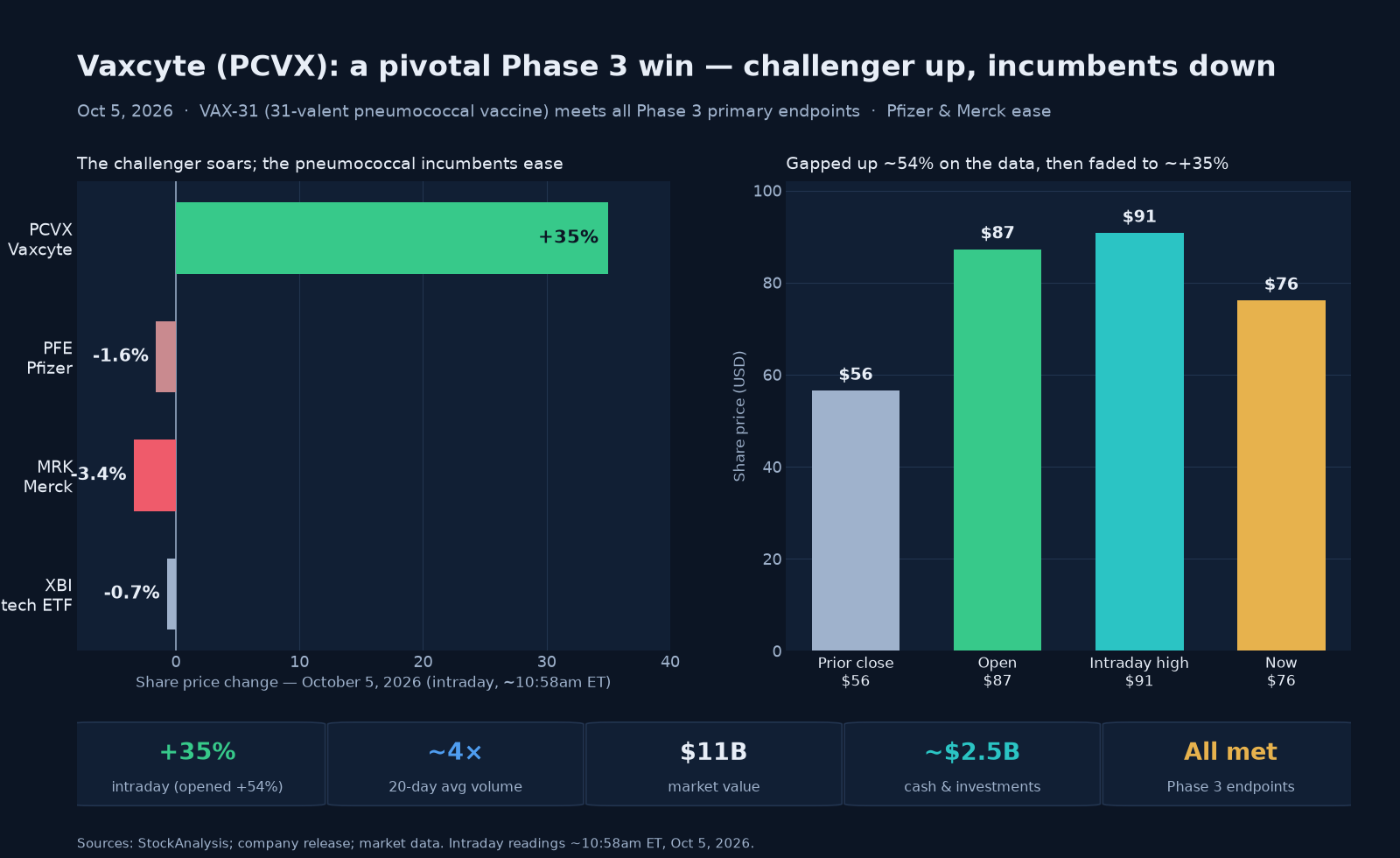
Vaxcyte surged to roughly $76 on October 5 — up about 35% after opening near $87 (about +54%) — when it reported positive topline data from OPUS-1, the pivotal adult Phase 3 trial of VAX-31, its 31-valent pneumococcal conjugate vaccine. The trial met all of its prespecified primary endpoints on immune-response and safety measures: in adults 50 and older, VAX-31 met non-inferiority on all 20 serotypes it shares with Pfizer's Prevnar 20 and 17 of the 19 it shares with Merck's Capvaxive (the two exceptions cleared only a less-stringent historical bar), and superiority on the three serotypes unique to VAX-31, with safety similar to the incumbents. It is the profile a broader, 31-valent shot needs to take share in a multi-billion-dollar adult pneumococcal market — and the market priced it as a transfer of value, with Pfizer down about 1.6% and Merck about 3.4% while the biotech index was flat. Vaxcyte is still a clinical-stage, pre-revenue company — a roughly $1 billion annual loss, no P/E, and years from revenue, with two more Phase 3 trials due in 2027 and a planned filing in 2028 — but about $2.5 billion of cash and investments gives it runway, and sell-side targets sit well above the current price (Guggenheim raised its target to $125 the same day; Mizuho and Jefferies reiterated standing Buys at $163 and $146). The stock's gap-up-then-fade captures the tension between clearly good data and the execution still ahead.

Why Vaxcyte stock surged — a pivotal Phase 3 win
On Monday, October 5, 2026, Vaxcyte (NASDAQ: PCVX) surged, trading near $76.07 in late-morning trading — up about 35% from a $56.48 prior close, after opening near $87 (up roughly 54%) and then easing back [1]. The catalyst was the kind biotech investors wait years for: Vaxcyte reported positive topline results from OPUS-1, the pivotal adult Phase 3 trial of VAX-31, its 31-valent pneumococcal conjugate vaccine candidate [2]. The trial met all of its prespecified primary endpoints, de-risking the company's lead program and sending the stock sharply higher on roughly four times its normal volume [1].
The clinical result is what matters — and the detail matters too, because these are immune-response (immunogenicity) and safety measures, not a demonstration of real-world disease prevention. In adults aged 50 and older, VAX-31 met the non-inferiority bar on all 20 serotypes it shares with Prevnar 20 (PCV20) and on 17 of the 19 it shares with Merck's Capvaxive (PCV21) at the study's stricter threshold — the two exceptions, serotypes 3 and 12F, cleared only a less-stringent historical bar against Capvaxive — while the three serotypes unique to VAX-31, plus a cross-reactive one, met the higher superiority bar [2]. Safety looked similar to the established vaccines. In plain terms, VAX-31 matched the incumbents on immune response where they overlap and did better where it is broader — the profile a 31-valent shot needs to displace 20- and 21-valent ones. That is why a clinical-stage company with no product revenue added billions in market value in a morning.
Why it is a threat to the incumbents
Pneumococcal vaccines are a multi-billion-dollar franchise dominated by Pfizer's Prevnar line, with Merck's Capvaxive a newer entrant. The whole pitch of VAX-31 is breadth: covering 31 serotypes versus 20 and 21, it is designed to protect against a larger share of invasive pneumococcal disease as strain coverage becomes the competitive battleground [2]. A clean pivotal win makes that threat credible, and the market priced it as a transfer of future value: the incumbents eased on the read-through — Pfizer slipped about 1.6% and Merck about 3.4% — while the broad biotech index was roughly flat [5]. The challenger soared and the entrenched players dipped: the signature of a disruptive data readout rather than a sector move.
A clinical-stage stock — valued on the pipeline, not earnings
It is worth being clear about what Vaxcyte is. This is a clinical-stage, pre-revenue company: it has no approved product, posted a net loss of about $1.06 billion over the past year, and burned roughly $920 million of cash [3]. There is no price-to-earnings ratio to anchor on; the roughly $11 billion market value reflects the market's estimate of VAX-31's probability of approval and its eventual share of a large vaccine market, not current financials. The balance sheet is a genuine strength — about $2.5 billion of cash, equivalents and investments at mid-year, against only about $115 million of operating-lease liabilities and no material traditional debt, gives multiple years of runway — but even after a pivotal win, VAX-31 is years from revenue: Vaxcyte expects topline data from two more adult Phase 3 trials (OPUS-2 and OPUS-3) in the first half of 2027, supporting a planned regulatory filing in the first half of 2028 [2]. A single pivotal trial de-risks the story materially; it does not finish it.
Why it matters
The episode is a clear example of how binary clinical events reprice an entire sub-sector. The adult pneumococcal market is a contest over serotype coverage, and a credible 31-valent entrant clearing its pivotal trial shifts the expected competitive balance — which is why the move was not confined to Vaxcyte. Pfizer and Merck both eased as investors trimmed the incumbents' long-term franchise value, while the broad biotech tape (XBI) barely moved, confirming a company- and theme-specific event rather than a risk-on day for biotech [5]. It is also a reminder of the asymmetry in clinical-stage names: the same stock that doubled intraday on good data would have fallen by more than half on a miss. Pivotal binary events do not nudge these stocks — they re-rate them, in one direction or the other.
The move, in one cross-section
The same-session tape shows a data-driven move, challenger up and incumbents down [5]:
| Name (ticker) | Oct 5, 2026 (intraday) | Read-through |
|---|---|---|
| PCVX — Vaxcyte | ≈+35% (opened ~+54%) | VAX-31 met all Phase 3 primary endpoints; pivotal de-risking [1][2] |
| PFE — Pfizer | ≈−1.6% | Maker of Prevnar 20 (PCV20), the incumbent — eased on the competitive read [5] |
| MRK — Merck | ≈−3.4% | Maker of Capvaxive (PCV21) — also lower; a broader-coverage rival advanced [5] |
| XBI — SPDR Biotech ETF | ≈−0.7% | Biotech broadly flat — this was company-specific, not a sector move [5] |
Vaxcyte soaring while the two pneumococcal incumbents dipped and the biotech ETF was flat points to a company- and franchise-specific event — a pivotal vaccine readout — rather than a broad biotech move [5].
What the Street thinks
The sell-side reaction was emphatically positive, and several firms moved the same day. The consensus rating is a Strong Buy, with an average 12-month target near $109 — well above the current price even after the surge [6]. Following the data, Guggenheim's Seamus Fernandez raised his target to $125 (from $116) — a genuine same-day move — while Mizuho's Salim Syed (Buy, $163) and Jefferies' Roger Song (Buy, $146) reiterated their already-standing targets and commented positively, Song framing the OPUS-1 outcome as a 'blue-sky' result [6]. The through-line: analysts read OPUS-1 as validating VAX-31's best-in-class coverage profile and see substantial upside to a successful filing and launch, though their targets — and the gap between them and the current price — also reflect how much execution still lies ahead.
What to watch
- OPUS-2 and OPUS-3. Topline data from the two remaining adult Phase 3 trials, expected in the first half of 2027 — the next de-risking (or risk) milestones [2].
- The filing timeline. Whether the data supports the planned regulatory submission in the first half of 2028, and how the FDA and the CDC's ACIP ultimately position a 31-valent shot [2].
- The incumbents' response. How Pfizer and Merck advance their own next-generation, higher-valency pneumococcal candidates in reply [5].
- Cash and dilution. With about $2.5 billion of cash and investments and roughly $1 billion of annual burn, whether Vaxcyte raises capital — common after a stock pop — ahead of a commercial build. Moves are tracked on the PCVX stock page [3].
Illustrative valuation sensitivity
For a pre-revenue, clinical-stage company, value turns on the probability and size of eventual approval, not current earnings. The scenarios below are anchored to the analyst target distribution after the readout (fresh Buys from $125 to $163, a ~$109 average) and to the stock's pre-data level near $56 [6], turning on whether VAX-31 converts a pivotal win into a filing, approval, and commercial share. They are a descriptive, author-weighted exercise — not a forecast, target, recommendation, or probability-of-approval estimate — with subjective weights that sum to 100%.
| Scenario | Illustrative price | Weight | Key drivers |
|---|---|---|---|
| Upside | ~$150 | 35% | OPUS-2 and OPUS-3 confirm, the filing proceeds, and VAX-31 launches as the broadest-coverage adult PCV and takes meaningful share — the stock re-rates toward the high end of the fresh targets [6]. |
| Middle | ~$108 | 40% | The approval path proceeds, but uptake is gradual against entrenched incumbents and the years-to-revenue timeline tempers the re-rating; the stock holds near the consensus target [6]. |
| Downside | ~$60 | 25% | A later trial disappoints, a regulatory or manufacturing setback appears, or the commercial opportunity proves smaller, and the stock gives back much of the pivotal-data move toward its pre-data level [1]. |
Weighting those (0.35 × $150 + 0.40 × $108 + 0.25 × $60) gives an author-weighted reference value near $110 — an illustrative, probability-weighted scenario output mechanically derived from the weights above, and not a price target, fair value, or probability-of-approval estimate — above Monday's ~$76 level and near the ~$109 analyst consensus, while below the Street's high targets [1][6], reflecting a materially de-risked but still pre-revenue asset whose value depends on execution over the next several years. This is a Street-target-anchored scenario exercise and descriptive analysis of a clinical readout, not investment advice.
PCVX data snapshot — October 5, 2026
| Figure | Value | As-of / source |
|---|---|---|
| Intraday quote | ~$76.07 (+~35%) — an intraday reading (the session was open); it opened ~$87.21 (~+54%) and faded | Mon, Oct 5, 2026, ~10:58am ET — StockAnalysis [1] |
| Prior close / open / range | $56.48 prior close; opened $87.21; day range $75.26–$90.75 (gapped up on the data, then eased) | Oct 5, 2026 [1] |
| Volume vs average | ≈7.5M shares by ~11am vs a ≈1.6–1.8M 20-day average for a full session (source-dependent) — roughly 4× a full day's volume by late morning | Oct 5 — StockAnalysis [1] |
| Market cap | ≈$11.3B (≈148.8M shares); beta ≈1.23 — a clinical-stage, pre-revenue valuation | Oct 5 — StockAnalysis [3] |
| Balance sheet | ≈$2.5B of cash, equivalents and investments (mid-year) vs ~$115M of operating-lease liabilities and no material traditional debt — multiple years of runway | Latest 10-Q [3] |
| Financials (TTM) | No product revenue; net loss ≈$1.06B; free cash flow ≈−$921M (annual burn near $1B) — no P/E; valued on the pipeline | TTM — StockAnalysis [3] |
| Catalyst | Positive topline data from OPUS-1, the pivotal adult Phase 3 trial of VAX-31 (31-valent pneumococcal conjugate vaccine): met all primary endpoints (immunogenicity/safety, not clinical efficacy) — non-inferiority on all 20 serotypes shared with PCV20 and 17 of 19 shared with PCV21 at the stricter margin (serotypes 3, 12F met only the looser bar), superiority on the 3 unique (plus cross-reactive 20B); safety similar to the incumbents. Next: OPUS-2/OPUS-3 topline in H1 2027; planned BLA filing H1 2028 | Oct 5, 2026 — company release [2] |
| Same-day cross-section | PFE −1.6% (Prevnar 20 maker), MRK −3.4% (Capvaxive maker; decline consistent with the read-through, may partly reflect other factors), XBI −0.7% (biotech ETF) — incumbents eased; biotech broadly flat | Oct 5 intraday [5] |
| Analyst view | Consensus Strong Buy, avg target ~$109; Oct 5: Guggenheim raised to $125 (from $116); Mizuho ($163) and Jefferies ($146) reiterated standing Buys — all above the current price | Oct 5, 2026 — StockAnalysis / analyst notes [6] |
Vaxcyte (PCVX) stock FAQ
Why did Vaxcyte (PCVX) stock surge on October 5, 2026?
Vaxcyte reported positive topline data from OPUS-1, the pivotal adult Phase 3 trial of VAX-31, its 31-valent pneumococcal conjugate vaccine candidate. The trial met all of its prespecified primary endpoints, a major de-risking event for the company's lead program, and the stock surged — opening near $87 (up about 54% from the $56.48 prior close) before easing to roughly $76 (about +35%) by late morning, on about four times its normal volume. For a clinical-stage company whose value rests on whether its vaccine reaches market, a clean pivotal win is one of the most value-creating events possible, which is why a pre-revenue stock added billions in market value in a morning.
What did the VAX-31 Phase 3 data actually show?
In the OPUS-1 trial in adults aged 50 and older, VAX-31 met all prespecified primary endpoints — on immune-response (immunogenicity) and safety measures, which is what these pivotal pneumococcal trials test rather than real-world disease prevention. VAX-31 met the non-inferiority criterion on all 20 serotypes it shares with Pfizer's Prevnar 20 (a 20-valent shot) and on 17 of the 19 it shares with Merck's Capvaxive (21-valent) at the study's stricter threshold; the two exceptions, serotypes 3 and 12F, cleared only a less-stringent historical bar against Capvaxive. On the three serotypes unique to VAX-31, plus a cross-reactive serotype, it met the higher superiority bar, and safety looked similar to the established vaccines. That combination — matching the incumbents on immune response where they overlap and doing better where it is broader — is the profile a 31-valent vaccine needs to displace 20- and 21-valent ones.
Why did Pfizer and Merck stock fall when Vaxcyte rose?
Because VAX-31 is a direct competitive threat to their pneumococcal franchises. Pfizer makes Prevnar 20 and Merck makes Capvaxive, the current standard adult pneumococcal vaccines, and a credible 31-valent entrant clearing its pivotal trial shifts the expected long-term competitive balance toward broader coverage. Investors priced that as a transfer of future value, trimming the incumbents: Pfizer eased about 1.6% and Merck about 3.4%, while the broad biotech index was roughly flat. The challenger soaring while the entrenched players dip — against a flat sector backdrop — is the signature of a disruptive data readout rather than a market-wide move (Merck's larger decline may also reflect other factors, but the direction fits the read-through).
Is Vaxcyte profitable, and how is it valued?
No — Vaxcyte is a clinical-stage, pre-revenue company with no approved product. It posted a net loss of about $1.06 billion over the past year and burned roughly $920 million of cash, so there is no price-to-earnings ratio to anchor on. Its roughly $11 billion market value reflects the market's estimate of VAX-31's probability of approval and its eventual share of a large vaccine market, not current financials. The balance sheet is a real strength — about $2.5 billion of cash, equivalents and investments at mid-year, against only about $115 million of operating-lease liabilities and no material traditional debt — which gives multiple years of runway, but even after a pivotal win the product is years from revenue, so the valuation is a probability-weighted bet on the future rather than a multiple of today's results.
What are the next milestones for VAX-31?
Vaxcyte expects topline data from two more adult Phase 3 trials, OPUS-2 and OPUS-3, in the first half of 2027 — the next de-risking (or risk) events. Positive results there would support a planned regulatory filing (a Biologics License Application) in the first half of 2028, after which the vaccine would need FDA approval and a recommendation from the CDC's Advisory Committee on Immunization Practices (ACIP) before a commercial launch. In short, a single pivotal trial de-risks the story materially but does not finish it; there are several more clinical, regulatory, and commercial steps — and well-capitalized incumbents developing their own next-generation shots — between here and revenue.
Why did the stock give back part of its gain during the day?
Vaxcyte opened up about 54% and then faded to around 35% by late morning — a common pattern for a clinical-stage stock on a big binary event. The initial spike reflects the immediate re-rating on clearly positive data; the fade reflects the market debating how much of a still-years-away opportunity to credit today, some profit-taking after a sharp move, and the reality that a pre-revenue biotech priced on a probability-weighted future reprices quickly in both directions. The move is best read as a large, genuine step up on de-risking data, with the intraday give-back a normal part of how these names trade, not a verdict on the data itself.