Stock Analysis
Fair Isaac (FICO) Crashes ~26% as FHFA Moves to Equalize VantageScore Mortgage Pricing
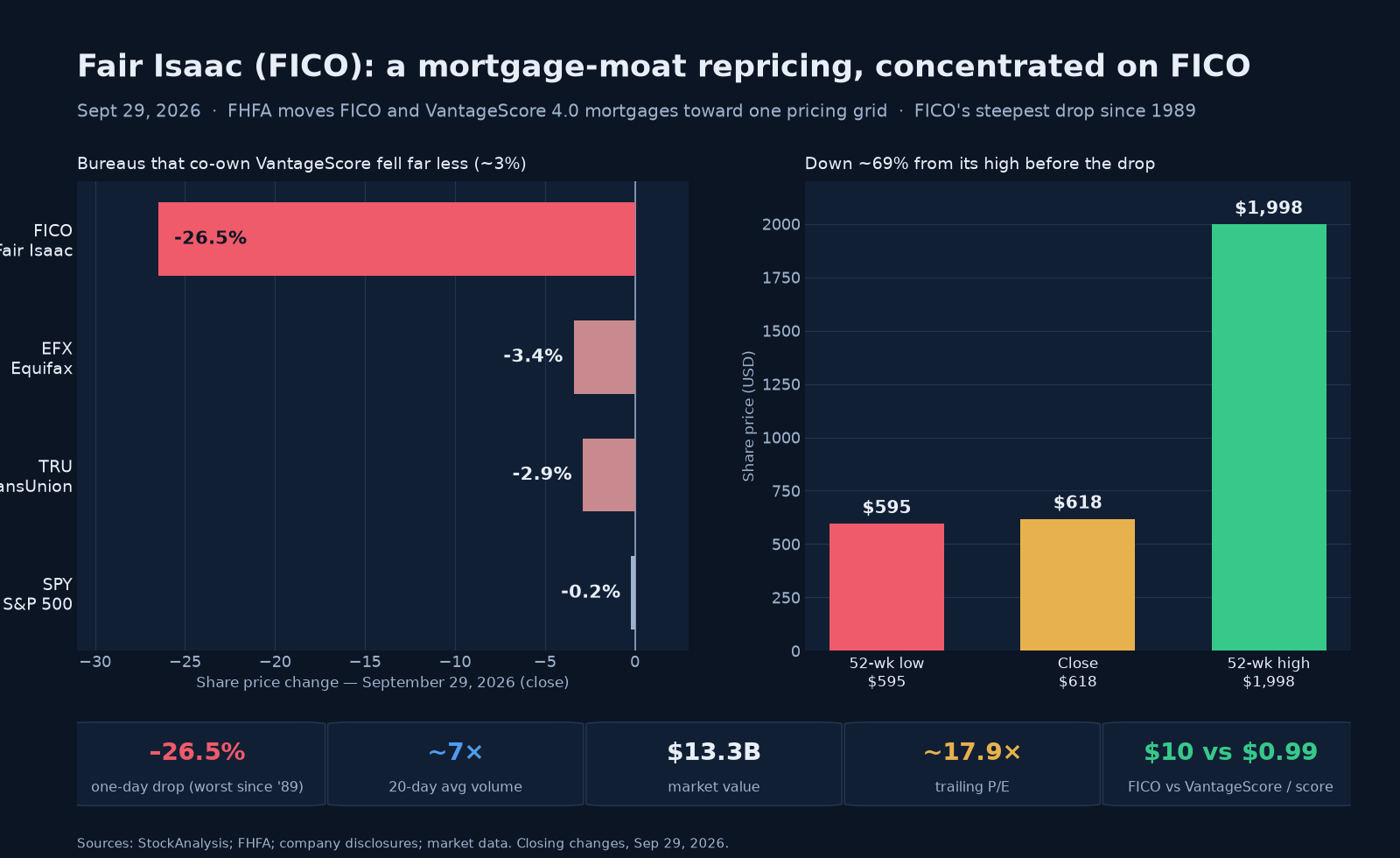
Fair Isaac fell about 26.5% to $617.87 on September 29 — its steepest single-day decline in decades — after FHFA Director Bill Pulte said, in a post late the prior evening, that Fannie Mae and Freddie Mac will move to a single mortgage pricing grid that treats loans scored with Classic FICO and rival VantageScore 4.0 equally, removing the 20-point adjustment that had kept FICO the default. The move strikes FICO's most profitable franchise: its Scores segment runs ~90% operating margins, and the company had just doubled its wholesale mortgage royalty to about $10.00 per score for 2026, while VantageScore 4.0's mortgage score is $0.99 (TransUnion committed through 2028) — so lenders now face a rival score that is roughly ten times cheaper and, once the change takes effect, priced identically by the GSEs. The repricing landed predominantly on FICO: the two publicly traded bureaus that jointly own VantageScore, Equifax and TransUnion, fell materially less — about 3% — and the S&P 500 was flat. Volume ran about seven times normal, and the stock is now down roughly 69% from its 52-week high. Analyst targets are splitting between a stale ~$1,435 consensus and fresh, event-aware resets — Huber Research downgraded to Underweight at $710, while Goldman cut to $1,322 but kept a Buy — capturing how uncertain the migration path is. After the drop FICO trades near 12 times forward earnings, but the multiple now hinges on how fast lenders actually switch.

Why FICO stock crashed — the mortgage moat cracked
On Tuesday, September 29, 2026, Fair Isaac (NYSE: FICO) closed at $617.87, down $223.02, or about 26.5%, from an $840.89 prior close — its steepest single-day decline in decades and a fresh 52-week low [1]. The catalyst had landed the evening before: in a post late Monday, September 28, Federal Housing Finance Agency (FHFA) Director Bill Pulte said Fannie Mae and Freddie Mac — which together back roughly 70% of the U.S. mortgage market — will move to a single mortgage pricing grid that treats loans scored with Classic FICO and its rival VantageScore 4.0 equally [2]. With one post, the government-sponsored enterprises' longstanding preference for FICO — the structural advantage behind FICO's pricing power in mortgages — was set to be erased, even though no effective date or replacement pricing matrix had yet been published.
To see why the reaction was this violent, it helps to separate this week's news from what changed earlier. In early September, the FHFA had directed the GSEs to make VantageScore 4.0 available to all lenders — Fannie Mae formally announced broad availability on September 9 — but the two scores still sat on separate pricing grids, with VantageScore carrying a 20-point downward adjustment that kept FICO the default. That earlier step barely dented the stock; analysts argued FICO would retain nearly all of its share because switching still carried a pricing penalty [2]. Pulte's Monday-evening post removed that last protection: it scrapped the 20-point adjustment and put both scores on one grid, calling separate grids something that "makes zero sense" [2]. The door had been opened weeks earlier; the pricing wall behind it was now coming down, and the stock repriced in the next session.
The economics the market repriced
What makes this a genuine threat, not a headline, is FICO's own pricing history. Fair Isaac had roughly doubled its wholesale mortgage royalty to about $10.00 per score for 2026, up from $4.95 — a move aggressive enough to draw a Senate oversight inquiry earlier this year [2]. VantageScore 4.0's mortgage-origination score, meanwhile, is priced at $0.99 — a level TransUnion has committed to hold through December 2028 [2]. Lenders now face a competitor score that is roughly ten times cheaper and, once the change takes effect, priced identically by the GSEs. FICO's Scores segment is the crown jewel — it carries operating margins around 90% — and mortgage originations are its most lucrative, fastest-growing slice [2]. The market's message on Tuesday was blunt: the pricing power that drove FICO's ~24% revenue growth is now contestable in exactly the product where it mattered most.
A stock that had already been falling
Monday's crash did not come out of a clear sky. FICO had already dropped from a 52-week high near $1,998 to the $840 area as the VantageScore threat built through the year; the $617.87 close leaves it down roughly 69% from that high and far below both its ~$1,063 50-day and ~$1,236 200-day moving averages [1]. Conviction behind the move was heavy: volume ran to about 4.9 million shares, roughly seven times the ~674,000-share 20-day average [1]. After the drop the stock trades near 18 times trailing earnings and about 12 times forward estimates — optically cheap for a business with 85% gross margins and roughly $1 billion of free cash flow, but the multiple now hinges on an unknowable: how fast lenders actually migrate away from a score they have used for decades [3].
Why it matters
The same-day tape suggests this was predominantly a FICO-specific repricing rather than a broad-market selloff. VantageScore is jointly owned by the three credit bureaus, two of which are publicly traded — and while Equifax fell about 3.4% and TransUnion about 2.9%, those declines were a small fraction of FICO's collapse, and the S&P 500 was essentially flat [5]. The bureaus did fall materially, so this was not purely idiosyncratic; but if anything, wider VantageScore adoption is a potential positive for the bureaus that own it, and their moves likely reflect broad uncertainty about how a mortgage-pricing overhaul ripples through credit-data economics rather than a shared loss. The gap between FICO's −26.5% and the bureaus' ~3% is the clearest evidence that Tuesday's event fell overwhelmingly on FICO — a largely idiosyncratic, structural shock to one company's pricing power rather than a broad sector move.
The move, in one cross-section
The September 29 closes show the move fell overwhelmingly on Fair Isaac [5]:
| Name (ticker) | Sept 29, 2026 | Read-through |
|---|---|---|
| FICO — Fair Isaac | ≈−26.5% | The GSEs will price FICO and VantageScore 4.0 equally — its mortgage moat repriced [1][2] |
| EFX — Equifax | ≈−3.4% | Co-owns VantageScore; fell materially but a fraction of FICO's move [5] |
| TRU — TransUnion | ≈−2.9% | Co-owns VantageScore; likewise a much smaller decline [5] |
| SPY — SPDR S&P 500 ETF | ≈−0.2% | The market was essentially flat [5] |
FICO down 26.5% while the VantageScore-owning bureaus fell about 3% and the market was flat points to a repricing that landed overwhelmingly on FICO's pricing power, even as the bureaus declined too [5].
What the Street thinks
Analyst targets are bifurcating between stale pre-crash numbers and fresh, event-aware resets — a reader should weight the recent ones. The headline consensus still reads Buy with an average target near $1,435, but that figure is largely a pre-event artifact more than double the current price and will compress as estimates are cut [6]. The most telling reaction on September 29 came from Craig Huber of Huber Research, who downgraded FICO to Underweight (from Overweight) with a $710 target — the first target set explicitly around the new pricing reality [6]. Others trimmed but held their bullish stance: Goldman Sachs's George Tong reiterated a Buy while cutting his target from $1,548 to $1,322, and Jefferies's Surinder Thind reiterated a Buy at $1,675 the same day, betting that switching inertia protects FICO's revenue [6]. That spread — a fresh downgrade to Underweight at $710 against reiterated Buys above $1,300 — captures exactly how uncertain the migration path is.
What to watch
- An effective date and the final grid. Pulte's announcement did not specify when the single grid takes effect; the timeline and mechanics will shape how fast lenders can switch [2].
- Lender migration. Whether large originators actually adopt the ~$0.99 VantageScore now that the GSE pricing penalty is gone, or default to FICO out of operational inertia [2].
- FICO's fiscal-year results. Fair Isaac's fiscal year ends September 30; management's commentary on mortgage-royalty exposure and pricing at the results it typically reports in early November will be pivotal [3].
- Estimate and target revisions. How far the stale ~$1,435 consensus falls toward event-aware levels as analysts model the royalty risk. Moves are tracked on the FICO stock page [1].
Illustrative valuation sensitivity
The scenarios below are anchored to FICO's post-crash forward earnings power (about 12× the forward estimate) and to the emerging, event-aware target range — from Huber Research's fresh $710 Underweight to reiterated Buys above $1,300 [6] — and turn on how quickly lenders migrate to the far cheaper VantageScore now that the GSE pricing penalty is gone. They are a descriptive, author-weighted exercise — not a forecast, target, recommendation, or intrinsic fair-value calculation — with subjective weights that sum to 100%.
| Scenario | Illustrative price | Weight | Key drivers |
|---|---|---|---|
| Upside | ~$780 | 30% | Switching inertia proves powerful, near-term mortgage royalties hold, the non-mortgage Scores and Software businesses keep growing, and the stock recovers toward the low end of event-aware targets [6]. |
| Middle | ~$640 | 40% | Mortgage-royalty erosion is real but gradual and partly offset by the rest of the business; the stock stabilizes near the post-crash level as the market waits for hard migration data [3]. |
| Downside | ~$480 | 30% | Lenders move quickly to the ~10×-cheaper VantageScore, mortgage royalties compress sharply, and both estimates and the multiple come down [2]. |
Weighting those (0.30 × $780 + 0.40 × $640 + 0.30 × $480) gives an author-weighted reference value near $634 — a figure mechanically derived from the scenarios and weights above, not a price target or fair-value estimate — just above Tuesday's $617.87 close and far below the stale ~$1,435 consensus target [1][6], reflecting a franchise whose mortgage pricing power is now contestable, with an unusually wide range around how fast that erosion plays out. This is a Street-target-and-earnings-based scenario exercise and descriptive analysis of a news move, not investment advice.
FICO data snapshot — September 29, 2026
| Figure | Value | As-of / source |
|---|---|---|
| Closing quote | $617.87 (−$223.02, −26.52%) — a settled close; after-hours $611.27 (−1.07%) | Tue, Sep 29, 2026, 4:00pm ET — StockAnalysis [1] |
| Prior close / open / range | $840.89 prior close; opened $668.08; day range $595.19–$685.00 (a fresh 52-week low) | Sep 29, 2026 [1] |
| Volume vs average | ≈4.91M shares vs a ≈674K 20-day average — roughly 7× normal | Sep 29 — StockAnalysis [1] |
| 52-week range / trend | $595.19–$1,998.01; down ~69% from the ~$1,998 high (−59% over 52 weeks); far below its ~$1,063 50-day and ~$1,236 200-day | As of Sep 29 [1] |
| Market cap | ≈$13.34B (≈21.6M shares); beta ≈1.32 | Sep 29 — StockAnalysis [3] |
| Valuation | At $617.87: trailing P/E ≈17.9× (EPS ttm $34.47); forward P/E ≈12.4×; price-to-sales ≈5.6× | Sep 29 — StockAnalysis [3] |
| Financials (TTM) | Revenue ≈$2.39B (+24.1%); net income ≈$815M; gross margin ≈85%; operating margin ≈52%; free cash flow ≈$996M | TTM — StockAnalysis [3] |
| Catalyst | FHFA Director Bill Pulte said Fannie Mae and Freddie Mac will use a single mortgage pricing grid treating Classic FICO and VantageScore 4.0 equally, removing VantageScore's 20-point penalty (announced; no effective date or replacement grid published yet). VantageScore 4.0's mortgage-origination score is $0.99 (TransUnion committed to hold it through Dec 2028) versus FICO's ~$10.00 wholesale mortgage royalty for 2026 | Posted late Mon Sep 28; −26.5% reaction Tue Sep 29 — FHFA / press [2] |
| Same-day peers | EFX −3.4%, TRU −2.9% (both co-own VantageScore), SPY −0.2% — a repricing that landed predominantly on FICO, though the bureaus fell too | Sep 29 close [5] |
| Analyst view | Stale consensus Buy, avg target ~$1,435 (>2× the price, pre-crash); fresh Sep 29 actions: Huber Research Underweight $710 (downgrade from Overweight), Goldman Buy $1,322 (cut from $1,548), Jefferies Buy $1,675 (reiterated). RBC's Outperform/$1,525 is a standing target dating from July 30 | Sep 29, 2026 — StockAnalysis / analyst notes [6] |
Fair Isaac (FICO) stock FAQ
Why did FICO stock crash on September 29, 2026?
Fair Isaac fell about 26.5% to $617.87 — its steepest single-day decline in decades — after FHFA Director Bill Pulte announced, in a post late the prior evening (Monday, September 28), that Fannie Mae and Freddie Mac will move to a single mortgage pricing grid that treats loans scored with Classic FICO and rival VantageScore 4.0 equally. Previously, VantageScore 4.0 carried a 20-point downward adjustment that kept FICO the default score for loans sold to the government-sponsored enterprises; removing it, and putting both scores on one grid, erased the structural advantage behind FICO's mortgage-score pricing power. The market read it as a permanent change to FICO's most profitable business, and the stock repriced accordingly on roughly seven times its normal volume.
What exactly did the FHFA change?
FHFA Director Bill Pulte said Fannie Mae and Freddie Mac will use a single loan-level pricing grid for mortgages regardless of whether they were scored with Classic FICO or VantageScore 4.0, calling the prior system of separate grids something that 'makes zero sense.' The key mechanical change is the removal of a 20-point downward adjustment that had been applied to VantageScore 4.0 scores — so the two models are now priced identically by the GSEs. This built on an earlier step in early September, when the FHFA directed the GSEs to make VantageScore 4.0 available to all lenders (Fannie Mae announced broad availability on September 9); that move drew a muted reaction because the separate pricing grids still favored FICO. The unified-grid announcement, posted late Monday, September 28, removed that last protection, though Pulte did not specify an effective date or publish a replacement pricing matrix.
How big is the mortgage business to FICO?
It is central to FICO's profitability. FICO's Scores segment — the credit-score royalty business — carries operating margins around 90%, and mortgage originations are its most lucrative and fastest-growing slice. The company had roughly doubled its wholesale mortgage royalty to about $10.00 per score for 2026, up from $4.95, a hike aggressive enough to draw a Senate oversight inquiry. VantageScore, by contrast, will hold its mortgage-score price at $0.99 through December 2028. That combination — a rival roughly ten times cheaper that the GSEs now price identically — is why the market treated the FHFA's decision as a direct threat to the pricing power that drove FICO's roughly 24% revenue growth.
Did other credit-score or bureau stocks fall too?
They fell far less than FICO, which is the key tell. VantageScore is jointly owned by the three big credit bureaus, and the two publicly traded ones dropped only modestly: Equifax was down about 3.4% and TransUnion about 2.9% on September 29, while the S&P 500 was essentially flat. Wider VantageScore adoption is arguably a potential positive for the bureaus that own it, so their declines likely reflect broad uncertainty about how a mortgage-pricing overhaul ripples through credit-data economics rather than a shared loss. The bureaus did fall materially, so the day was not purely idiosyncratic — but the gap between FICO's roughly 26.5% drop and the bureaus' roughly 3% is the clearest sign that the repricing fell overwhelmingly on FICO's pricing power rather than being a broad sector-wide selloff.
Is FICO stock cheap after the crash?
On the multiple it looks inexpensive, but the multiple is the wrong anchor here. After the drop FICO trades near 18 times trailing earnings and about 12 times forward estimates, for a business with roughly 85% gross margins and about $1 billion of free cash flow. The problem is that forward estimates were set before the pricing change and will likely be cut; the real question is how much mortgage-royalty revenue FICO loses and how quickly. If switching inertia protects near-term royalties, the shares are cheap; if lenders migrate quickly to the far cheaper VantageScore now that the GSE pricing penalty is gone, both estimates and the multiple can fall further. That uncertainty, not the current ratio, is what the stock is pricing.
What do analysts think of FICO now?
Their targets are splitting between stale pre-crash numbers and fresh, event-aware resets, and the recent ones matter more. The headline consensus still reads Buy with an average target near $1,435, but that figure predates the decision and sits at more than double the current price, so it will compress. The most telling September 29 action came from Craig Huber of Huber Research, who downgraded FICO to Underweight (from Overweight) with a $710 target — the first set explicitly around the new pricing reality. Others trimmed but stayed bullish: Goldman Sachs's George Tong reiterated a Buy while cutting his target from $1,548 to $1,322, and Jefferies's Surinder Thind reiterated a Buy at $1,675 the same day, betting switching inertia protects FICO's revenue (RBC Capital's Ashish Sabadra kept an Outperform, though its $1,525 target predates the event). That spread captures how wide the range of outcomes is.