Stock Analysis
Intel (INTC) Jumps on a Report SK Hynix May Make Memory at Its Delayed Ohio Fab
Intel rose about 4% to roughly $101 on September 16 after Reuters reported, citing sources, that SK Hynix is in early talks to manufacture memory chips in the United States for the first time — possibly by leasing part of Intel's long-delayed Ohio megafab, or through a joint venture with Intel and cloud hyperscalers. Crucially, no deal is confirmed: the shares spiked toward +6% then pared to +4% as SK Hynix said nothing had been decided and Intel declined to comment, so the honest read is a market pricing a possibility. It matters because Intel's Ohio project — announced in 2022 and delayed roughly five to six years (construction now finishing around 2030–2031) — could turn from a symbol of the company's troubles into a proof point if a marquee partner pays to use it. The move landed on a stock already up roughly 300% over the past year, still unprofitable on a trailing GAAP basis and trading near 66 times its fiscal-2026 adjusted (non-GAAP) earnings estimate, so it trades on narrative — and chips were broadly higher on the day, meaning only part of the pop was Intel-specific.

Why Intel stock jumped — a report, not a deal
On Wednesday, September 16, 2026, Intel (NASDAQ: INTC) rose about 4% to roughly $101 in early trading, up from a $97.14 prior close [1]. The move is worth stating carefully, because the catalyst is a news report, not a signed agreement: Reuters reported, citing multiple sources, that SK Hynix is in early talks with Intel about manufacturing memory chips in the United States for the first time [2]. The shares had spiked toward +6% (near $103) on the headline before paring to about +4%, with SK Hynix emphasizing that nothing had been decided — a partial give-back consistent with the market repricing a report rather than a signed deal [1].
No deal is confirmed. The discussions, reported by Reuters, are described as exploratory, with no decision on structure or even which memory chips would be made. SK Hynix said it was "reviewing various options" to strengthen its memory business but that nothing was settled; Intel declined to comment on the talks while reiterating it remains committed to its Ohio site [2]. This article treats the news as what it is — a credible Reuters report of early-stage talks that neither company has confirmed as a deal — and the stock's partial give-back as the market doing the same.
Why the report matters anyway
Two scenarios were floated. In one, SK Hynix would lease part of Intel's long-delayed megafab in New Albany, Ohio. In the other, it would form a joint venture with Intel and major cloud companies — the AI "hyperscalers" — seeking to lock in memory supply [2]. Either would matter for a specific reason: Intel's Ohio project, announced in 2022 at more than $20 billion (a figure later raised to more than $28 billion, within a site Intel has framed as potentially ~$100 billion over time), once targeted production by the end of 2025 and has since been delayed roughly five to six years — the first fab now due to finish construction around 2030 (operations beginning 2030–31) and the second around 2031 (operations 2032) — a "slow-burn" buildout Intel paced to demand and capital discipline [3]. A marquee tenant or partner would help put a delayed, capital-hungry asset to work, and would validate Intel's pitch that its U.S. manufacturing footprint is an asset others will pay to use. For SK Hynix, U.S.-made memory would be a first — and a hedge on supply as AI demand strains the memory market and Washington presses chipmakers to build domestically [2].
A re-rated turnaround, valued on the future
The reaction lands on a stock that has already run enormously. Intel is up roughly 300% over the past year — from about $25 to roughly $101 — one of the most dramatic mega-cap re-ratings of 2026, on a turnaround story that has drawn outside capital and government interest [3]. The financials have not caught up: Intel is still unprofitable on a trailing basis (a net loss of about $11 billion over the last twelve months, so there is no meaningful trailing P/E), even as revenue grew about 7.5% to roughly $57 billion and free cash flow turned positive at about $2.8 billion [3]. The market is paying for the recovery, not the present: at ~$101 the shares trade near 66 times the roughly $1.52 of adjusted (non-GAAP) earnings analysts see for fiscal 2026 — and about 49 times the ~$2.06 penciled in for 2027 — a forward, non-GAAP basis, set against a trailing GAAP loss [3]. On that kind of multiple, a stock moves on narrative — and a report that validates the manufacturing strategy is exactly the kind of narrative that moves it.
Why it matters
Strip away the day's tape and the episode is a reminder of two things. First, that at Intel's current valuation the stock is a narrative instrument: with no trailing earnings to anchor it, headlines about partnerships, customers and government support do the pricing, which cuts both ways — the same shares that jumped on the SK Hynix report gave back part of the move the moment SK Hynix qualified it. Second, that Intel's underused U.S. manufacturing — the very Ohio project whose delays have been a symbol of the company's troubles — could become an asset if others pay to use it. A memory partner would turn a liability into a proof point. But none of that is settled, and the honest read of the day is a market pricing a possibility, not a plan.
The move, in one cross-section
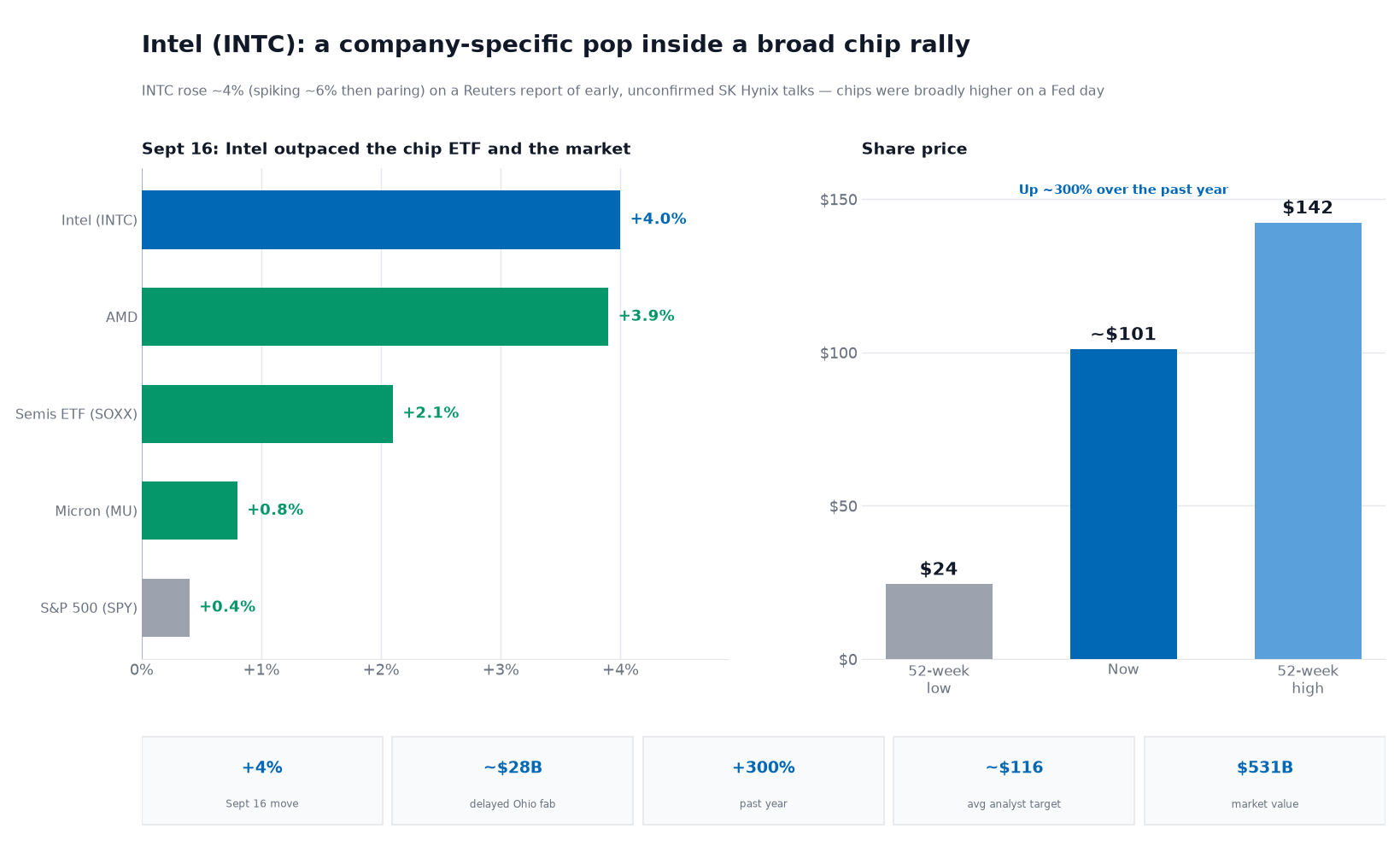
The same-day tape shows chips broadly higher, with Intel's report-driven pop layered on top [5]:
| Name (ticker) | Sept 16, 2026 | Read-through |
|---|---|---|
| INTC — Intel | ≈+4.0% | Reported SK Hynix talks (unconfirmed); spiked ~+6% then pared [1][2] |
| AMD — Advanced Micro Devices | ≈+3.9% | Rose with the broad chip rally, no shared catalyst [5] |
| SOXX — Semiconductor ETF | ≈+2.1% | Chips broadly higher on a Fed-decision day [5] |
| MU — Micron | ≈+0.8% | The U.S. memory maker lagged — a muted read-through [5] |
| SPY — SPDR S&P 500 ETF | ≈+0.4% | The market was only modestly higher [5] |
Intel outran the semiconductor ETF and the market, but the sector was broadly up, so only part of the ~4% is Intel-specific — the cleaner evidence is the intraday spike-and-fade on the SK Hynix headline itself [5].
What the Street thinks
Coverage leans positive but is far from unanimous. The consensus rating is a Buy, with an average 12-month target near $116 — about 14% above the price — but the range is unusually wide, from a low near $75 to a high near $200 [6]. The recent notes bracket the debate: Tigress Financial's Ivan Feinseth reiterated a Buy at $145 and Northland's Gus Richard upgraded to Buy at $120, while Bernstein's Stacy Rasgon and Piper Sandler's David O'Connor sit at Hold ($110), and Mizuho's Vijay Rakesh recently trimmed his target to $92 at Hold [6]. A $125 spread between the low and high targets, on a $101 stock, is the analytical version of what the tape showed: no one is sure how much of the turnaround to believe yet.
What to watch
- Confirmation. Whether Intel or SK Hynix confirms talks or a structure — a lease, a joint venture, or nothing — versus the report staying unconfirmed [2].
- The Ohio timeline. Whether a partner accelerates the delayed New Albany buildout, or the 2030–2031 schedule holds [3].
- The next print. Whether Intel's October 22 report shows the turnaround converting into sustained profit, the thing its forward multiple already assumes [3].
- Memory-market signals. How AI-driven memory demand and U.S. reshoring pressure evolve, which frame the logic of any deal. Moves are tracked on the INTC stock page [1].
Illustrative valuation sensitivity
The scenarios below are anchored to Intel's forward earnings power (about 66× a recovering fiscal-2026 adjusted, non-GAAP profit) and to the analyst target distribution (a low near $75, average ~$116, a high near $200) [6], turning on how far and fast the turnaround — and validators like a memory partner — actually go. They are a descriptive, author-weighted exercise — not a forecast, target, recommendation, or intrinsic fair-value calculation — with subjective weights that sum to 100%.
| Scenario | Illustrative price | Weight | Key drivers |
|---|---|---|---|
| Upside | ~$150 | 30% | The turnaround delivers sustained profit, deals like an SK Hynix partnership materialize and validate the manufacturing strategy, and the multiple re-rates toward the bullish targets [6]. |
| Middle | ~$110 | 40% | Intel keeps grinding higher on incremental wins and a returning profit, but the stock consolidates near the consensus while unconfirmed talks stay unconfirmed [3]. |
| Downside | ~$80 | 30% | Execution disappoints, the rich forward multiple compresses, and the shares drift back toward the low end of the analyst range as the 2026 run cools [3]. |
Weighting those (0.30 × $150 + 0.40 × $110 + 0.30 × $80) gives an author-weighted reference value near $113, just above Wednesday's ~$101 level and near the ~$116 consensus target [1][6] — reflecting a re-rated turnaround whose next leg depends on execution and on unconfirmed deals becoming real, not on the base business as it stands. This is a Street-target-and-earnings-based scenario exercise and descriptive analysis of a news move, not investment advice.
INTC data snapshot — September 16, 2026
| Figure | Value | As-of / source |
|---|---|---|
| Intraday quote | ~$101.08 (+~4%), after spiking to ~$103 (+6%) and paring — an intraday reading (the session was still open) | Wed, Sep 16, 2026, ~9:51am ET — StockAnalysis [1] |
| Prior close / open / high | $97.14 prior close; opened $101.37; ran to a $103.39 intraday high (~+6%) before paring toward $101 | Sep 16, 2026 [1] |
| Volume | ≈27.7M shares in the first ~20 minutes — a brisk open against a ≈86M-share full-day 20-day average | Sep 16 — StockAnalysis [1] |
| 52-week range / trend | $24.45–$142.35; up ~300% over the past year (a dramatic re-rating); above its ~$97 50-day and ~$76 200-day averages | As of Sep 16 [3] |
| Market cap / EV | ≈$531B (≈5.25B shares); enterprise value ≈$552B; beta ≈2.23 | Sep 16 — StockAnalysis [3] |
| Valuation | Trailing P/E n/a (GAAP net loss); ≈66× the ~$1.52 FY26 adjusted (non-GAAP) EPS estimate (≈49× the ~$2.06 FY27; the vendor's blended NTM forward P/E reads ~58×); ≈9× sales; price-to-book ≈5.6× (per-share ratios near the prior close) | Sep 16 — StockAnalysis [3] |
| Financials (TTM) | Revenue ≈$57B (+7.5%); net loss ≈$11B; gross margin ≈39%; GAAP operating margin ≈7.8%; free cash flow ≈+$2.8B; FY26 revenue seen ≈$63B (+19%) | TTM / estimates — StockAnalysis [3] |
| Catalyst | Reuters reported (citing sources) SK Hynix is in early, unconfirmed talks with Intel to make memory chips in the U.S. — possibly leasing Intel's delayed Ohio fab or a JV with cloud firms; SK Hynix said nothing was decided, Intel declined to comment | Sep 16, 2026 — Reuters via press reports [2] |
| Same-day peers | AMD +3.9%, SOXX +2.1%, MU +0.8%, SPY +0.4% — chips broadly higher (Fed-decision day); Intel outpaced the ETF on its own report | Sep 16 [5] |
| Analyst view | Consensus Buy, avg target ≈$116 (~14% above the price), wide range ~$75 to ~$200; recent: Tigress $145 (Buy), Northland $120 (Buy, upgrade), Bernstein/Piper Sandler $110 (Hold), Mizuho $92 (Hold) | Sep 2026 — StockAnalysis / analyst notes [6] |
Intel (INTC) stock FAQ
Why did Intel (INTC) stock jump on September 16, 2026?
Intel rose about 4% to roughly $101 after Reuters reported, citing multiple sources, that SK Hynix is in early talks with Intel to manufacture memory chips in the United States for the first time — possibly by leasing part of Intel's long-delayed Ohio megafab, or through a joint venture with Intel and major cloud companies. It is important that this is a news report, not a signed deal: the shares spiked toward +6% then pared to about +4% within the hour after SK Hynix said nothing had been decided and Intel declined to comment. Chips were also broadly higher on the day, so only part of the move was Intel-specific.
Is the Intel–SK Hynix deal confirmed?
No. As of the report, the talks are described as exploratory, with no decision on the structure of any deal or even which memory chips would be produced. SK Hynix said it was 'reviewing various options' to strengthen its memory business but that nothing had been decided, and Intel declined to comment on the talks while saying it remains committed to its Ohio site. Neither company has confirmed a definitive agreement — which is exactly why Intel's stock gave back part of its initial jump once SK Hynix qualified the report.
Why does Intel's Ohio fab matter to this story?
Intel's chip project in New Albany, Ohio was announced in 2022 at more than $20 billion, a figure later raised to more than $28 billion (within a site Intel has described as potentially around $100 billion over time), and once targeted production by the end of 2025. It has since been delayed roughly five to six years — the first fab now finishing construction around 2030 (operations 2030–31) and the second around 2031 (operations 2032) — a slow-burn buildout Intel paced to demand. A marquee tenant or partner like SK Hynix would help put that delayed, capital-intensive asset to work and would validate Intel's argument that its U.S. manufacturing footprint is something other companies will pay to use.
Is Intel stock expensive after its run?
By conventional measures, yes — but Intel is a turnaround valued on the future, not the present. The stock is up about 300% over the past year, yet the company is still unprofitable on a trailing basis (a net loss of roughly $11 billion over the last twelve months), so there is no meaningful trailing P/E. Investors are paying for the recovery: at ~$101 the shares trade near 66 times the roughly $1.52 of adjusted (non-GAAP) earnings analysts expect for fiscal 2026, and roughly 49 times the ~$2.06 penciled in for 2027 — a forward, non-GAAP basis, against a trailing GAAP loss. On that kind of multiple the stock moves on narrative, which is why a single report can swing it several percent.
What do analysts think of Intel stock now?
Coverage leans positive but is unusually split. The consensus rating is a Buy, with an average 12-month price target near $116 — about 14% above the price — but the range is wide, from a low near $75 to a high near $200. Recent notes bracket the debate: Tigress Financial's Ivan Feinseth reiterated a Buy at $145 and Northland's Gus Richard upgraded to Buy at $120, while Bernstein's Stacy Rasgon and Piper Sandler's David O'Connor sit at Hold ($110), and Mizuho's Vijay Rakesh recently trimmed his target to $92 at Hold. That $125 spread between the low and high targets captures how uncertain the turnaround's payoff still is.
What is the biggest risk for Intel now?
That execution fails to justify a valuation that already assumes a lot. Intel trades in the mid-60s times its fiscal-2026 adjusted (non-GAAP) earnings estimate while still losing money on a trailing GAAP basis, after a roughly 300% run, so any stumble in the turnaround — softer demand, delayed foundry milestones, or deals like the SK Hynix talks not materializing — could compress the multiple sharply. The stock's sensitivity cuts both ways: it jumped on an unconfirmed report and gave part of it back the same hour. The offsetting strengths are a returning profit outlook, positive free cash flow, government and partner interest, and underused U.S. manufacturing that a memory partner could help monetize.