Technology
Intel (INTC) Jumps on a High-NA EUV Milestone, Ahead of TSMC in Deployment
Intel rose about 8% to roughly $103 on September 8 after it and lithography partner ASML announced they have processed more than one million wafers using High-NA EUV — the newest, most advanced chipmaking lithography, by industry accounts more than any rival has run. Intel is deploying the technology on select layers of certain 18A products (chips such as Panther Lake), and reports throughput and yields meeting expectations, giving it a multi-year lead in High-NA production experience — TSMC is generally expected to bring High-NA into high-volume production around 2030, and Samsung targets it for DRAM around 2028. The milestone was the headline, though the stock also had a same-day analyst upgrade and reports of possible processor price increases. For a company whose whole case rests on rebuilding a credible foundry business, it was tangible proof the turnaround is producing real capability. The move caps a staggering ~322% one-year run — yet the fundamentals lag: Intel is still GAAP-unprofitable, and the Street stays cautious, with a Hold consensus (roughly two-thirds of covering analysts on the sidelines) and an average target only about 12% above the price. One firm (Northland) upgraded to Buy on the news; most are waiting for the manufacturing lead to become profit.
Why Intel stock jumped — a concrete lead in next-generation chipmaking
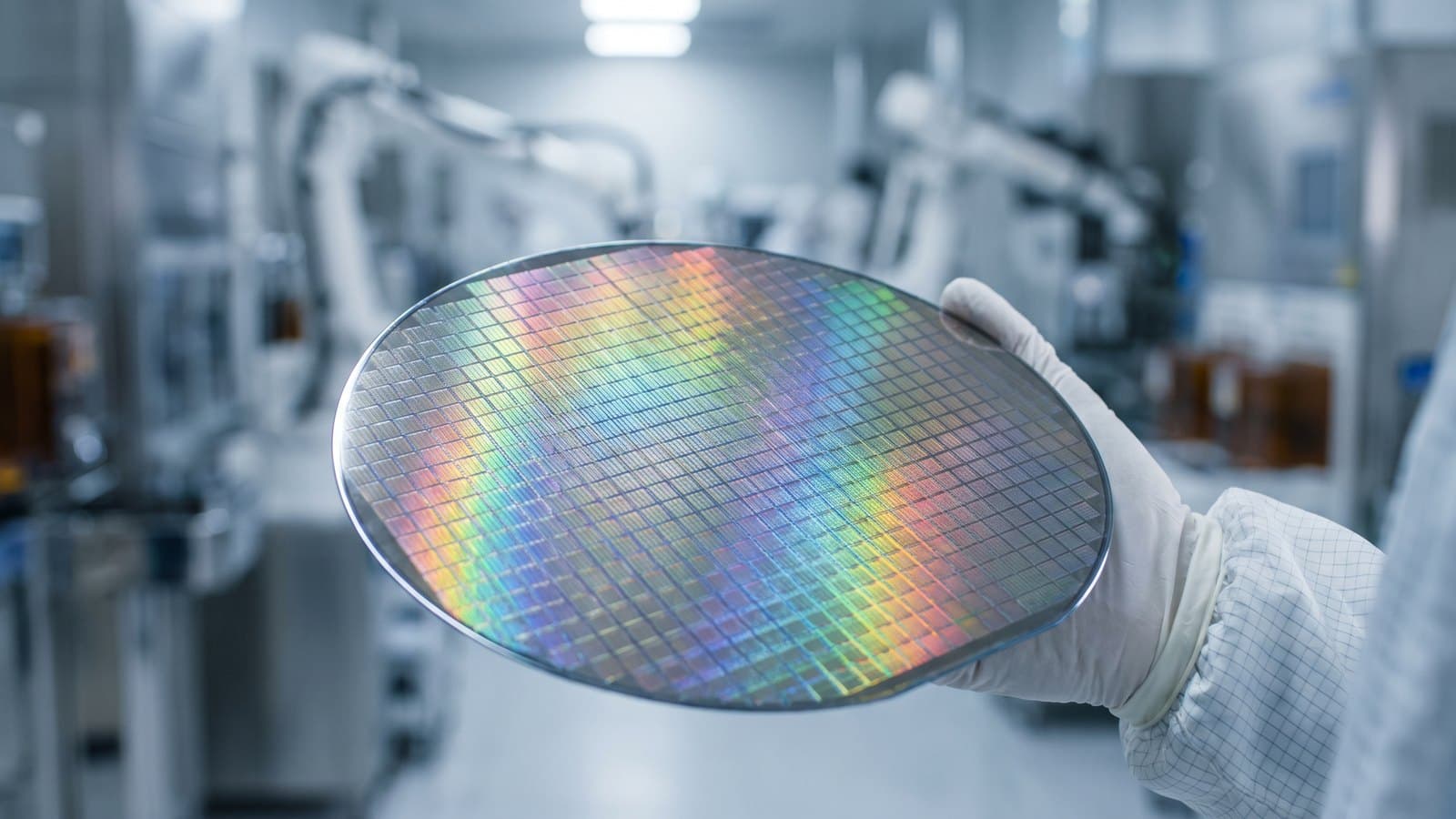
On Tuesday, September 8, 2026, Intel (NASDAQ: INTC) rose about 8% to roughly $103 in intraday trading, up from a $95.80 prior close (its last close before the Labor Day weekend) on heavy volume [1]. The headline catalyst was a manufacturing milestone with its lithography partner: Intel and ASML announced they have now processed more than one million wafers using High-NA EUV — the newest, most advanced chipmaking lithography, by industry accounts more than any rival has run [2]. It landed alongside other positives the same day — a fresh analyst upgrade to Buy, and reports that Intel may raise some processor prices later this year [6] — but the milestone was the substantive one: for a company whose entire investment case rests on rebuilding a credible contract-manufacturing (foundry) business, it was exactly the kind of tangible proof point investors had been waiting for [2].
Years ahead on the tool that matters most
High-NA EUV is the successor to the extreme-ultraviolet lithography that prints today's most advanced chips, and it is central to squeezing more transistors onto future nodes. Intel has bet heavily and early on the technology, and the milestone quantifies that lead in production experience: it is deploying High-NA EUV on select layers of certain 18A products — chips such as Panther Lake — and reports that overlay, throughput and availability are meeting its expectations, with those layers performing in line with or better than the prior-generation tools [2]. Rivals are further behind on this specific tool: TSMC is generally expected to bring High-NA EUV into high-volume production around 2030, while Samsung targets High-NA for DRAM (memory) around 2028 [2]. That gives Intel a genuine multi-year head start on running the newest lithography at scale — a rare instance of Intel being first. It is a lead on one critical tool, not proof of overall foundry or process leadership; but it is the clearest evidence yet that Intel's costly turnaround is producing real manufacturing capability, not just promises.
A staggering run meets a skeptical Street
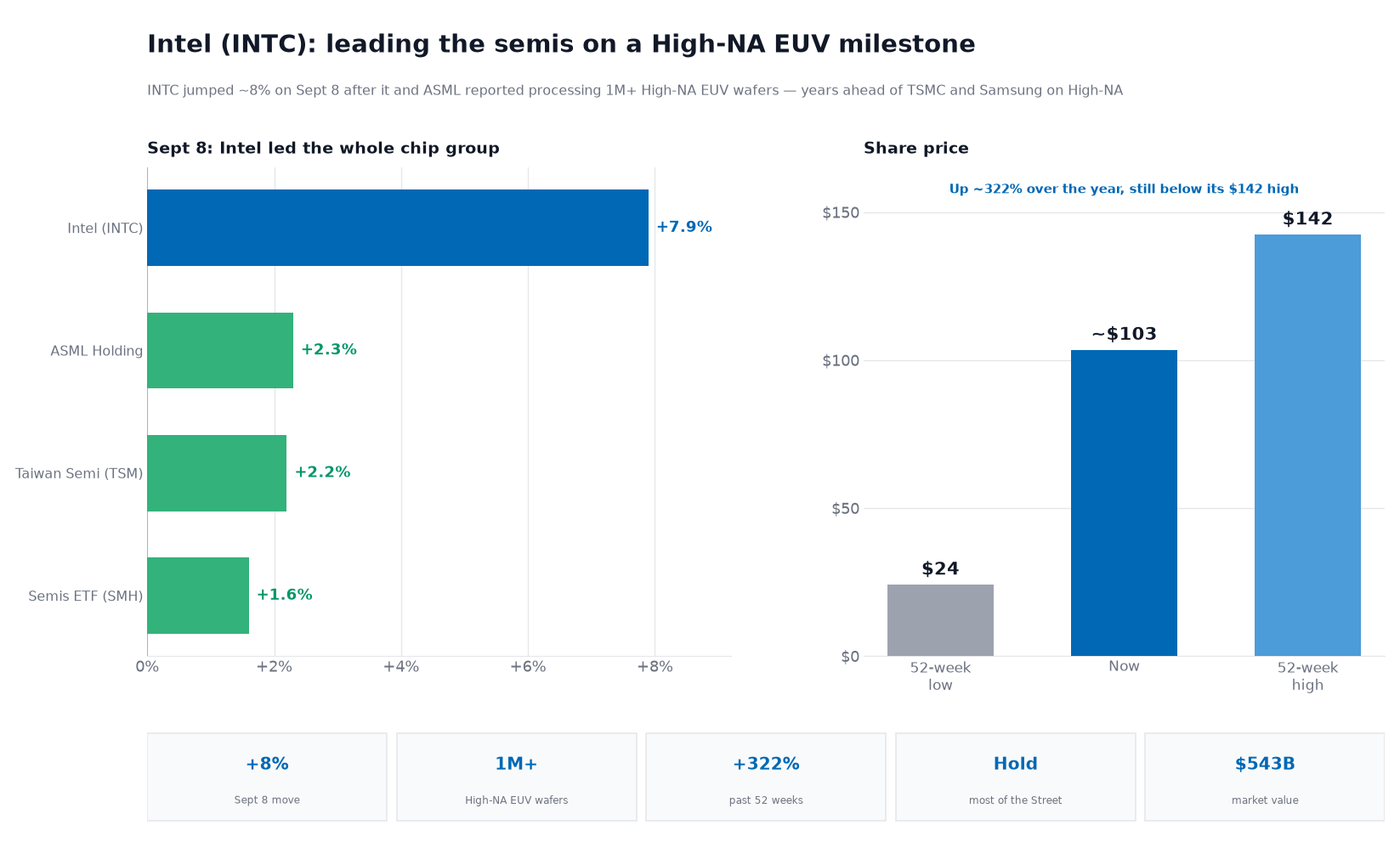
The move caps one of the market's most remarkable recoveries: Intel is up roughly 322% over the past year — the stock traded near $24 as recently as a year ago — as investors bought into a turnaround backed by fresh capital and government support [3]. Yet the fundamentals have not caught up. Intel is still unprofitable on a GAAP basis — a trailing net loss of about $11 billion — with a thin operating margin and a forward earnings multiple near 58 times, reflecting deeply depressed profits [3]. The bull case is that manufacturing leadership like this milestone eventually converts into foundry customers and a return to real profitability; the bear case is that the stock has already priced in a turnaround that has yet to show up in the financials. That tension is why a genuinely good headline sent the shares up 8% — and why the Street remains far from convinced.
Why it matters
For years, the knock on Intel was that it had lost its manufacturing edge — the very thing that once made it the most valuable chipmaker in the world — to Taiwan's TSMC. This milestone is a direct rebuttal. Leading-edge chipmaking now hinges on a handful of impossibly complex, hugely expensive machines from a single supplier, ASML, and being first to master the newest generation of them is a genuine competitive advantage — one that could attract the external foundry customers Intel needs to make its capital spending pay off. It also carries strategic weight beyond Intel: with governments treating advanced-chip manufacturing as a national-security priority, a credible American alternative to TSMC has value that extends past the income statement. The market's enthusiasm reflects that dual promise — commercial and strategic — even as the profits remain a work in progress.
Leading the semis, in one cross-section
The same-day tape shows the milestone was Intel-specific — it led the whole semiconductor group [5]:
| Name (ticker) | Sept 8, 2026 | Read-through |
|---|---|---|
| INTC — Intel | ≈+7.9% | The exclusive High-NA EUV milestone — a foundry-lead proof point [1][2] |
| ASML — ASML Holding | ≈+2.3% | The lithography maker whose tools the milestone validates [5] |
| TSM — Taiwan Semiconductor | ≈+2.2% | The foundry leader Intel is trying to catch, up with the group [5] |
| SMH — Semiconductor ETF | ≈+1.6% | The broad chip group rose, but Intel led it [5] |
Intel up ~8% while its supplier, its chief rival and the broad chip ETF rose roughly 1.6–2.3% (intraday readings) is the signature of a company-specific catalyst, not a sector-wide move [5].
What the Street thinks
Wall Street is unusually cautious for a stock that has tripled. The consensus is a Hold, and even after the run the average 12-month target of about $116 sits only ~12% above the price, in a wide range from a low near $75 to a Street high near $200 [6]. The milestone did move one analyst: Northland Securities' Gus Richard upgraded Intel to Buy with a $120 target on the news [6]. Others remain skeptical: Bank of America's Vivek Arya is a bull at $145, but in recent weeks Mizuho's Vijay Rakesh cut his target (to $92, keeping a Hold) and UBS's Timothy Arcuri trimmed his to $112, also at Hold [6]. With roughly two-thirds of the covering analysts at Hold and a handful at Sell, the message is clear: the Street wants to see the manufacturing lead become foundry revenue and profit before it re-rates the stock further.
What to watch
- 18A ramp and yields. Whether Intel's 18A node ramps to volume with competitive yields, the real test of the manufacturing lead [2].
- External foundry customers. Signed, named customers for Intel Foundry — the proof that the capability translates into revenue [2].
- The path to profit. Progress toward narrowing GAAP losses and improving margins, the gap between the story and the financials [3].
- Valuation versus targets. Whether the milestone justifies a stock already near its average target after a 322% run. Moves are tracked on the INTC stock page [1].
Illustrative valuation sensitivity
The scenarios below are anchored to the analyst target distribution (a low near $75, an average ~$116, and a Street high near $200) [6] and to how convincingly the foundry turnaround converts into profit. The three illustrative prices below ($145 / $116 / $80) are selected scenario anchors, not the full analyst range. They are a descriptive, author-weighted exercise — not a forecast, target, recommendation, or intrinsic fair-value calculation — with subjective weights that sum to 100%. (Standard earnings multiples are of limited use here because Intel is currently lossmaking on a GAAP basis, so the exercise leans on the Street's targets.)
| Scenario | Illustrative price | Weight | Key drivers |
|---|---|---|---|
| Upside | ~$145 | 30% | The manufacturing lead wins named external foundry customers, 18A ramps well, and profitability recovers — the stock re-rates toward the bullish targets [6]. |
| Middle | ~$116 | 40% | Steady technical progress but slow commercial proof; the stock consolidates near the average analyst target after its run [6]. |
| Downside | ~$80 | 30% | Foundry economics disappoint and GAAP losses persist, and the elevated valuation compresses toward the low end of the analyst range [3]. |
Weighting those (0.30 × $145 + 0.40 × $116 + 0.30 × $80) gives an author-weighted reference value near $114, close to Tuesday's ~$103 level and roughly in line with the ~$116 consensus target [1][6] — reflecting a turnaround the market has already rewarded handsomely, where the next leg depends on the manufacturing lead becoming visible profit. This is a Street-target-based scenario exercise and descriptive analysis of a news move, not investment advice.
INTC data snapshot — September 8, 2026
| Figure | Value | As-of / source |
|---|---|---|
| Intraday quote | ~$103 (+~8%), below its 52-week high — an intraday reading (the session was still open) | Tue, Sep 8, 2026 — StockAnalysis [1] |
| Prior close / open / range | $95.80 prior close; opened $100.80; day range $100.35–$103.54 | Sep 8, 2026 [1] |
| 52-week range / trend | $24.05–$142.35; up ~322% over 52 weeks; above its ~$100 50-day and ~$75 200-day averages; RSI ≈61 | As of Sep 8 [3] |
| Market cap / EV | ≈$543B (5.25B shares); enterprise value ≈$564B; beta ≈2.23 (high) | Sep 8 — StockAnalysis [3] |
| Valuation / profitability | GAAP-unprofitable (trailing net loss ≈$11B, EPS −$2.30, profit margin ≈−20%); forward P/E ≈58× on depressed earnings; ≈9.5× sales; no dividend | Sep 8 — StockAnalysis [3] |
| Financials (TTM) | Revenue ≈$57B (+7.5%); gross margin ≈39%; operating margin ≈8%; free cash flow ≈$2.8B | TTM — StockAnalysis [3] |
| Catalyst | Intel and ASML reported processing more than 1 million wafers with High-NA EUV — years ahead of TSMC (~2030) and Samsung (~2028); deployed on select 18A layers (Panther Lake) | Sep 8, 2026 — company / ASML [2] |
| Same-day peers | ASML +2.3%, TSM +2.2% (semis rose with Intel); SMH semiconductor ETF +1.6% — Intel led on its own milestone | Sep 8 [5] |
| Analyst view | Consensus Hold (roughly two-thirds of ~48 analysts at Hold, only a handful of Buys, a few Sells), avg target ≈$116 — ~12% above the price, range ~$75–$200; Sep-8 Northland upgrade to Buy ($120); BofA a bull at $145 | Sep 2026 — StockAnalysis / analyst notes [6] |
Intel (INTC) stock FAQ
Why did Intel (INTC) stock jump on September 8, 2026?
Intel rose about 8% to roughly $103 after it and its lithography partner ASML announced they have processed more than one million wafers using High-NA EUV — the newest, most advanced chipmaking lithography, by industry accounts more than any rival has run. Intel is deploying the technology on select layers of certain 18A products (chips such as Panther Lake), a tangible proof point for its foundry-comeback strategy and a multi-year lead in High-NA production experience. The milestone was the headline, though the stock also had a same-day analyst upgrade and reports of possible processor price increases.
What is High-NA EUV, and why does the milestone matter?
High-NA EUV is the next generation of extreme-ultraviolet lithography — the technology used to print the finest features on advanced chips — supplied by ASML. It is central to making future, denser chip nodes. The milestone matters because Intel is first to run it at meaningful scale: it reports processing more than a million wafers with performance meeting expectations, while TSMC is generally expected to bring High-NA into high-volume production around 2030 and Samsung targets it for DRAM (memory) around 2028. That gives Intel a multi-year head start on running the most advanced lithography — a rare instance of Intel leading, and evidence its foundry turnaround is producing real capability, though it is a lead on this one tool rather than proof of overall process leadership.
Is Intel profitable?
No, not currently on a GAAP basis. Intel has a trailing net loss of about $11 billion, a thin operating margin, and a forward price-to-earnings ratio near 58 times that reflects deeply depressed earnings. It does generate modest free cash flow (about $2.8 billion) but has suspended its dividend. The investment case is a turnaround: the bet is that manufacturing milestones like this one eventually translate into foundry customers and a return to real profitability. That gap between an improving story and lagging financials is central to the debate over the stock.
How far ahead of TSMC and Samsung is Intel on High-NA EUV?
Several years, on this specific tool. Intel is already running High-NA EUV in development and production on select layers of certain 18A products, having processed more than a million wafers, while TSMC is generally expected to bring High-NA into high-volume production around 2030 and Samsung targets it for DRAM (memory) around 2028. Being first to master the newest generation of ASML's machines is a genuine competitive advantage in leading-edge chipmaking, and a key part of Intel's pitch to win external foundry customers. It is a lead in High-NA production experience rather than proof of overall foundry leadership, and it does not, by itself, guarantee commercial success — that depends on yields, cost and signing customers.
What do analysts think of Intel stock now?
Cautious, despite the stock's huge run. The consensus is a Hold — only a handful of the roughly four dozen covering analysts are at Buy, while roughly two-thirds sit at Hold and several are at Sell — and the average 12-month target of about $116 sits only around 12% above the price, in a wide range from a low near $75 to a Street high near $200. On the milestone, Northland Securities' Gus Richard upgraded Intel to Buy ($120), and Bank of America's Vivek Arya remains a bull at $145; but in recent weeks Mizuho's Vijay Rakesh cut his target to $92 and UBS's Timothy Arcuri trimmed his to $112, both at Hold. The Street wants the manufacturing lead to become foundry revenue and profit.
What is the biggest risk for Intel now?
That the technology lead does not translate into a profitable business. Intel is spending enormous sums to build out leading-edge capacity, and the payoff requires winning external foundry customers at competitive yields and cost — which it has yet to prove at scale. Meanwhile the stock has tripled over the past year, so much optimism is already priced in, and Intel remains GAAP-unprofitable. If foundry economics disappoint or losses persist, the elevated valuation is vulnerable. The offsetting strength is a genuine, now-quantified manufacturing lead and strategic importance as a domestic alternative to TSMC.