Semiconductors
Intel (INTC) Stock Falls: A ~$23 Billion Raise, a SoftBank Headline, and the Turnaround Bet
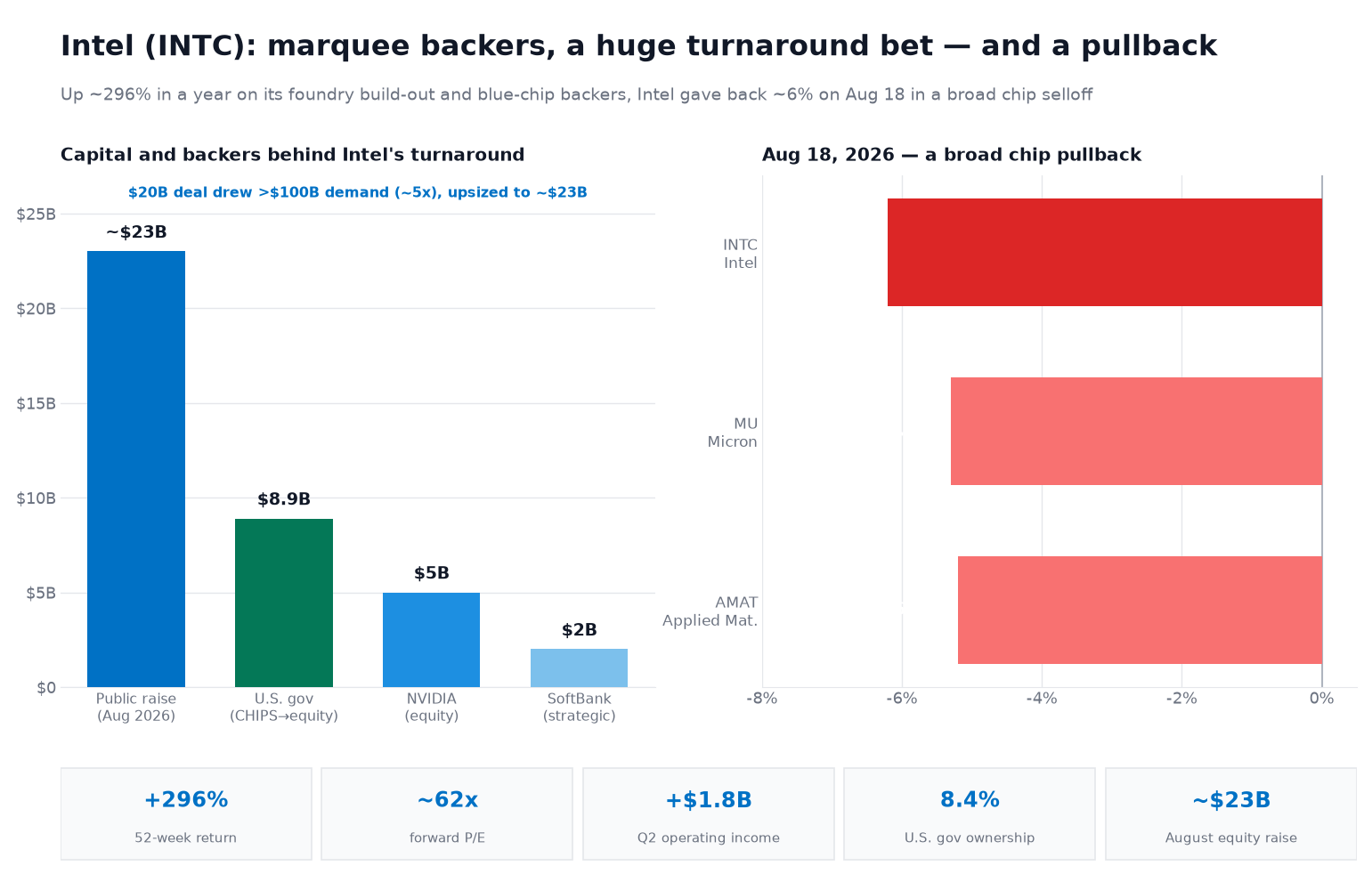
Intel fell about 6% to roughly $97 on August 18, mostly in a broad chip-sector pullback (Micron −5.3%, Applied Materials −5.2%), with two Intel-specific overhangs: dilution from a ~$23 billion stock offering (242.1M shares at $95, the original $20B deal ~5× oversubscribed) and a viral 'SoftBank put 67% of its portfolio in Intel' statistic that really reflects price appreciation, not new buying. The bigger picture: a stock up ~296% in a year on a foundry-turnaround thesis. Intel is operating-profitable (Q2 operating income +$1.8B; Products +$4.8B, Foundry −$2.1B) even though its ~$11B GAAP net loss looks alarming — that loss is dominated by a $12.5B non-cash charge on shares owed to the U.S. government, now its largest shareholder at ~8.4%. Analyst targets from $75 to $200 capture a high-uncertainty bet.
Why Intel stock dropped — and the bigger bet underneath it
On Tuesday, August 18, 2026, Intel (NASDAQ: INTC) fell about 6% to roughly $97, from a $103.49 prior close [1]. The clearest driver was not an Intel headline but a broad, same-day pullback across chip stocks — Micron dropped about 5.3% and Applied Materials about 5.2% on the day, as investors took profits in a group that has run hard all year [7]. Sitting behind that were two pieces of Intel-specific context that had been building for several days: the company had priced a large stock offering — ultimately about $23 billion — that dilutes existing holders, and a widely shared "SoftBank has bet its portfolio on Intel" statistic turned out to be less than it looked. The bigger picture is the stock itself: Intel has risen roughly 296% over the past year on a turnaround thesis, so a down day is as much about how much optimism is already priced in as about any single new development [3].
Intel is not a pure-play anything: it is an integrated device manufacturer that both designs and builds chips. Its large Products business (PC and data-center processors) is solidly profitable, and it is using those profits — plus outside capital — to fund an expensive push into foundry, contract-manufacturing chips for other companies around its new 18A process, in competition with TSMC and Samsung. That build-out is why the headline financials look strange: Intel reported a trailing GAAP net loss of about $11.3 billion, yet its underlying business is far healthier than that number suggests — it was operating-profitable in the latest quarter and generated roughly $8.1 billion of operating cash flow in the first half of 2026. The net loss is dominated by a non-cash accounting charge, explained below, rather than by operating losses [3][8].
The ~$23 billion raise: dilution, and a vote of demand
The concrete corporate event behind the recent volatility is Intel's equity sale. On August 10 the company priced 210.5 million shares at $95 — below the market price — upsizing the deal to about $20 billion from an initially planned $15 billion. Demand was strong enough that underwriters fully exercised their option for roughly 31.6 million more shares, bringing the total to about 242.1 million shares and ~$23 billion of gross proceeds (net proceeds near $22.6 billion) [2]. Intel's disclosed use of proceeds is deliberately broad: general corporate purposes, including capital expenditures and working capital. Management has separately guided 2026 capital spending above $20 billion, which supports both its products and its foundry capacity — but that capex plan is not the same thing as an earmark for this specific offering [2][5].
The market read the deal two ways, and both are in the tape. Issuing 240-plus million new shares increases shares outstanding by roughly 4.8% against the pre-offering count, diluting existing holders, and pricing below the market weighed on the stock. At the same time, the originally marketed $20 billion deal drew more than $100 billion of institutional demand — roughly five times oversubscribed — and Bank of America's Vivek Arya, reiterating a Buy while trimming his target to $145 from $160, framed the raise as evidence of confidence in Intel's foundry ambitions rather than a defensive scramble [2][6]. Strong demand at $95 shows investors were willing to fund the build-out on those terms; it does not, by itself, prove the turnaround will work. Intel is asking shareholders to finance a multi-year effort before the foundry profits arrive.
The government stake — a backer, and the reason for that "loss"
One of the least-understood parts of Intel's story is that, in its 2026 proxy, the U.S. government is listed as its largest disclosed beneficial owner — 433.3 million shares, about 8.4% (as of March 20, assuming full release of escrowed shares), ahead of Vanguard and BlackRock; after the August issuance, that stake is closer to 8.2% of the enlarged share base. It stems from a 2025 deal that converted roughly $8.9 billion of CHIPS Act grants and Secure Enclave funding into equity at $20.47 a share. The stake is passive: no board seat, and the government agrees to vote with Intel's board on most matters [9]. That same arrangement is why Intel's GAAP results look alarming at first glance. A portion of those shares sits in escrow and is accounted for as a derivative liability that is marked to market each quarter. As Intel's stock soared, the fair value of that derivative liability rose with it, producing a $12.5 billion non-cash mark-to-market charge in the second quarter alone. Strip it out and Intel's Q2 operating income was positive at about $1.8 billion — its Products business earned roughly $4.8 billion of operating income while Intel Foundry lost about $2.1 billion — and although trailing operating income was only roughly breakeven, the company still generated about $8.1 billion of operating cash flow in the first half [8]. In other words, the headline "$11 billion loss" is largely an artifact of a rising stock price inflating a government-share obligation, not a company burning cash.
The SoftBank headline that isn't quite what it looks
Part of this week's Intel narrative was a striking statistic: SoftBank's Masayoshi Son had 66.81% of his firm's disclosed U.S. equity holdings in a single stock — Intel, a roughly $12 billion position within an ~$18 billion 13F [4]. Read quickly, it sounds like one of the world's most famous investors making an all-in bet. Read carefully, it is more mundane: the figure covers only SoftBank's U.S.-listed, 13F-reportable holdings, not its entire portfolio, and SoftBank reported the same 86,956,522 Intel shares at both recent quarter-ends — so the Intel position's jump in value came from price appreciation, not fresh Intel buying [4]. SoftBank does have real skin in the game — a $2 billion strategic investment that closed in 2025, alongside NVIDIA's $5 billion equity stake — but the "67% of the portfolio" figure is a byproduct of the rally, not a new vote of confidence, which is part of why the headline lost its lift.
Why it matters
Intel is the largest listed bet on whether the United States can build a leading-edge chip manufacturer to rival TSMC — and, with the U.S. government now among its largest shareholders, it is unusually entangled with national industrial policy. A ~$23 billion raise, marquee strategic backers, and a near-quadrupling in a year all say the market is taking the turnaround seriously; the size of the Foundry losses and the capital bill say it is far from finished. That is why a day like August 18 matters beyond Intel: when a group that has priced in years of AI and turnaround success gives back 5–6% together, it is a reminder of how much optimism is embedded across the semiconductor complex, from memory to equipment to foundry.
How the sector traded the same day
Intel's decline was part of a broad, single-day pullback in semiconductors — a profit-taking rotation rather than an Intel-specific verdict [7]:
| Name (ticker) | Aug 18, 2026 (intraday) | Read-through |
|---|---|---|
| INTC — Intel | ≈−6.2% | The chip selloff, plus dilution from the ~$23B raise and the deflating SoftBank headline [1][2] |
| MU — Micron | ≈−5.3% | Profit-taking after a multi-month memory rally [7] |
| AMAT — Applied Materials | ≈−5.2% | Rotation out of chip-equipment names after a big run [7] |
That the biggest AI-era winners fell together points to a group-wide rotation. Intel dropped a little more than its peers, consistent with its added Intel-specific overhangs — the dilution and the SoftBank re-read — layered on the same profit-taking [7].
What the Street did with it
The notable analyst move around the raise came from Bank of America's Vivek Arya, who reiterated a Buy but trimmed his target to $145 from $160, treating the capital raise as evidence of foundry ambition rather than distress [6]. More broadly, the Street is split: the consensus 12-month target sits near $115, above the ~$97 price, but the range runs from about $75 to $200 [6]. Few large-cap stocks carry a target spread that wide, and it captures the core disagreement — how quickly Intel's foundry arm can turn from loss to profit, and how much to pay today for that possibility.
What to watch
- Foundry customers. The turnaround thesis needs external customers committing volume to Intel's 18A process; watch for named design wins and capacity commitments [2].
- Foundry losses narrowing. Intel Products is profitable; Intel Foundry lost about $2.1 billion in the quarter. Watch the Foundry operating loss, its gross margin, and any timeline toward break-even [8].
- Capital needs and further dilution. This ~$23 billion raise, plus its roughly net-cash balance sheet after the deal, funds the near-term plan; watch whether Intel needs to raise again, which would dilute holders further [2].
- The backers — including Washington. The U.S. government (~8.4%), NVIDIA and SoftBank are part of the bull case; watch whether their involvement deepens into commercial relationships, and how the government-share accounting swings future GAAP results. Moves are tracked on the INTC stock page and the earnings calendar [9].
Illustrative valuation sensitivity
The scenarios below are a descriptive, author-weighted exercise — not a forecast, target, recommendation, or intrinsic fair-value calculation. Because Intel's GAAP earnings are distorted by the government-share charge and its Foundry arm is pre-profit, the price points are a Street-target-based scenario exercise, anchored to the analyst target distribution (average ~$115; range ~$75–$200) and to turnaround milestones rather than to an earnings multiple [6]. The weights are the author's subjective assumptions and sum to 100%.
| Scenario | Illustrative price | Weight | Key drivers |
|---|---|---|---|
| Upside | ~$200 | 30% | The foundry pivot gains traction: named external customers commit to 18A, Foundry losses narrow toward break-even, and the market pays up for a credible U.S. leading-edge manufacturer — toward the Street-high [6]. |
| Middle | ~$115 | 45% | Intel executes but the turnaround takes time and capital; the stock consolidates near the consensus target — above today's price but well below the bull case [6]. |
| Downside | ~$75 | 25% | Foundry customer traction disappoints, losses persist, further dilution follows, and a richly valued stock de-rates toward the low end of the target range [3][6]. |
Weighting those (0.30 × $200 + 0.45 × $115 + 0.25 × $75) gives an author-weighted scenario value near $130, above the ~$97 quote [1]. The point is the width of the band, from $75 to $200: analysts disagree sharply on how Intel's foundry bet resolves, and the same capital that funds the bull case is the dilution that deepens the bear case. This is a Street-target-based scenario exercise and descriptive analysis of a corporate event, not investment advice or a valuation substitute.
INTC data snapshot — August 18, 2026 (intraday, session open)
| Figure | Value | As-of / source |
|---|---|---|
| Intraday quote | $97.08 (−6.19%) | Aug 18 — StockAnalysis; ~$99.29 (−4.06%) at 9:30 a.m. ET [1] |
| Prior close | $103.49 | Mon, Aug 17, 2026 [1] |
| 52-week performance | Up ≈296% | As of Aug 18 [3] |
| Market cap | ≈$513B (≈5.29B shares post-offering) | Aug 18 — StockAnalysis [3] |
| Balance sheet (pre-offering) | Total debt ≈$50.5B, cash ≈$29.7B → net debt ≈$20.6B; ≈net cash after the ~$22.6B net raise | As of Jun 27; raise Aug 2026 [2][3] |
| Profitability | Q2 operating income +$1.8B (Products +$4.8B, Foundry −$2.1B); TTM operating income ≈breakeven; H1 2026 operating cash flow ≈$8.1B; Q2 GAAP net loss −$11.0B driven by a $12.5B non-cash escrowed-share charge | Q2 2026 — 10-Q / earnings [8] |
| Valuation / earnings | Forward P/E ≈62×; trailing P/E n/a (GAAP net loss); TTM net loss ≈$11.3B (−$2.30/sh) on ≈$57B revenue; no dividend | Aug 18 — StockAnalysis [3] |
| Equity raise | Priced 210.5M shares at $95 (upsized to ~$20B from $15B); option fully exercised → 242.1M shares, ~$23.0B gross / ~$22.6B net; ~4.8% dilution; >$100B demand (~5× oversubscribed) on the original $20B deal | Aug 2026 — offering filings [2] |
| U.S. government stake | 433.3M shares (≈8.4% per proxy; ≈8.2% of the post-offering base), largest disclosed holder; from converting ~$8.9B CHIPS/Secure-Enclave funding at $20.47; passive, votes with board | 2026 proxy (as of Mar 20) [9] |
| SoftBank 13F | 86.96M Intel shares (~$12.1B), 66.81% of a ~$18B 13F-reportable U.S. portfolio — from price appreciation, not new buying | Filed Aug 14 (holdings Jun 30) [4] |
| Other strategic backers | NVIDIA $5B equity investment; SoftBank $2B strategic (closed 2025) | 2025–2026 — company disclosures [4] |
| Analyst reaction | BofA reiterated Buy, target $145 (from $160); consensus avg ≈$115 (range ~$75–$200) | Aug 2026 — market coverage [6] |
The August 18 figures are intraday snapshots that moved through the session, not closing prices; Intel was down about 4% at the open and roughly 6% later in the morning.
The setup at a glance
| Question | Answer |
|---|---|
| Why did Intel stock fall on August 18? | Mainly a broad, same-day chip-sector pullback (Micron −5.3%, Applied Materials −5.2%), with two Intel-specific overhangs that had built over the prior week: dilution from a ~$23 billion stock offering, and the realization that the "SoftBank owns 67% of its portfolio in Intel" headline reflects price appreciation, not new buying [1][2][7]. |
| What is the ~$23 billion raise for? | Intel's disclosed use of proceeds is general corporate purposes, including capital expenditures and working capital. It priced 210.5M shares at $95 (upsized to ~$20B from $15B); underwriters fully exercised their option, taking the total to 242.1M shares and ~$23B gross. Management separately guides 2026 capex above $20B, supporting products and foundry [2][5]. |
| Who is Intel's biggest shareholder? | The U.S. government, at about 8.4% (433.3M shares), after converting ~$8.9B of CHIPS Act grants and Secure Enclave funding into equity in 2025. The stake is passive. The escrowed portion of those shares is also what drove Intel's large non-cash Q2 accounting charge [9]. |
| Is Intel profitable? | At the operating level, yes — Q2 operating income was +$1.8 billion (Products +$4.8B, Foundry −$2.1B). At the GAAP net level it reported a ~$11 billion loss, but that is dominated by a $12.5 billion non-cash mark-to-market charge on shares owed to the U.S. government, not by cash losses. There is no meaningful trailing P/E; the stock trades near 62× forward earnings [3][8]. |
| Why has the stock risen so much? | Intel has climbed roughly 296% over the past year on optimism about its foundry turnaround (its 18A process), its fastest revenue growth in nearly 15 years, and backing from the U.S. government, NVIDIA and SoftBank [3][4]. |
| What do analysts think? | Split: a consensus target near $115 (above the price), but a range from about $75 to $200 — reflecting high uncertainty about the foundry turnaround. BofA reiterated Buy at $145 [6]. |
Intel (INTC) stock FAQ
Why did Intel (INTC) stock fall on August 18, 2026?
Intel fell about 6% to roughly $97 (from a $103.49 prior close). The clearest driver was a broad, same-day pullback across semiconductor stocks — Micron dropped about 5.3% and Applied Materials about 5.2% — as investors took profits in a group that has run hard all year. Behind that sat two Intel-specific overhangs that had built over the prior week: dilution from a roughly $23 billion stock offering, and a widely shared statistic that SoftBank had 67% of its U.S. portfolio in Intel, which turned out to reflect Intel's price appreciation rather than fresh buying. Underneath it all, the stock had risen about 296% over the prior year, so a down day partly reflects how much optimism was already priced in.
What is Intel's ~$23 billion stock offering for?
Intel priced 210.5 million shares at $95 and, on strong demand, upsized the deal to about $20 billion from an initially planned $15 billion; underwriters then fully exercised their option, bringing the total to about 242.1 million shares and roughly $23 billion in gross proceeds (about $22.6 billion net). Intel's disclosed use of proceeds is general corporate purposes, including capital expenditures and working capital — not a specific earmark. Separately, management has guided 2026 capital spending above $20 billion, which supports both its products and its foundry build-out. The originally marketed $20 billion deal drew more than $100 billion of institutional demand — about five times oversubscribed — which some analysts read as a confidence signal; the flip side is that issuing so many new shares dilutes existing holders by roughly 4.8%.
Is Intel actually losing money?
It depends which line you read. At the operating level Intel was profitable in its latest quarter: second-quarter operating income was about +$1.8 billion, with its Products business earning roughly $4.8 billion of operating income while Intel Foundry lost about $2.1 billion (over the trailing twelve months, operating income was roughly breakeven). At the GAAP net level it reported a loss of about $11 billion, but that figure is dominated by a $12.5 billion non-cash mark-to-market charge on shares Intel owes the U.S. government under its CHIPS Act deal — as Intel's stock rose, the accounting value of that obligation rose with it. Tellingly, Intel still generated about $8.1 billion of operating cash flow in the first half of 2026, so the headline loss is largely an accounting artifact of a rising share price, not the company burning cash. Because of the GAAP loss there is no meaningful trailing P/E; the stock trades near 62 times forward earnings.
Why is the U.S. government Intel's largest shareholder?
In 2025 the Trump administration and Intel converted roughly $8.9 billion of CHIPS Act grants and Secure Enclave funding into Intel equity at $20.47 per share. Intel's 2026 proxy lists the U.S. government with 433.3 million shares, about 8.4% (roughly 8.2% of the enlarged share base after the August offering) — the largest disclosed holder, ahead of Vanguard and BlackRock. The stake is passive: the government has no board seat and agrees to vote with Intel's board on most matters. A portion of those shares is held in escrow and accounted for as a derivative marked to market each quarter, which is what produced Intel's large non-cash accounting charge in the second quarter.
Did SoftBank make a huge new bet on Intel?
Not exactly. SoftBank's 13F disclosed that Intel made up 66.81% of its roughly $18 billion U.S. 13F-reportable portfolio — a striking headline — but that covers only its U.S.-listed holdings, and SoftBank reported the same 86,956,522 Intel shares at both recent quarter-ends. That means the position's swelling weight came from Intel's own stock appreciation, not new purchases. SoftBank does have real exposure through a $2 billion strategic investment that closed in 2025, alongside NVIDIA's $5 billion equity stake, but the '67% of the portfolio' figure is a byproduct of the rally rather than a fresh vote of confidence.
What is Intel's foundry turnaround?
Intel is an integrated device manufacturer — it both designs chips and makes them. Its established Products business (PC and data-center processors) is profitable, and Intel is using that, plus outside capital, to build Intel Foundry: a business that contract-manufactures chips for other companies around its new 18A process, competing with TSMC and Samsung. Intel describes itself as the only company undertaking both next-generation logic R&D and leading-edge, high-volume logic manufacturing in the United States, which is why it has attracted the U.S. government, NVIDIA and SoftBank as backers and aligns with U.S. supply-chain policy. The foundry build-out is enormously capital-intensive (2026 capex is guided above $20 billion) and still loss-making at the segment level, which is why the stock swings hard on news.