Semiconductors
Micron (MU) Stock Jumps on China-Memory Policy and a Bet That the Cycle Has Changed
Micron jumped about 5% on August 17 to roughly $1,023, joining a memory-and-storage rally after Commerce Secretary Lutnick said the U.S. 'does not approve' of Apple buying Chinese memory — a policy signal supportive for non-Chinese suppliers like Micron — building on New Street's Friday upgrade to Buy ($1,250) on a thesis that HBM has structurally shallowed memory's boom-and-bust cycle. Yet the stock trades at just ~7x forward earnings versus ~23x trailing: a durability discount, not a forecast of falling profits (consensus EPS actually rises from ~$73 to ~$155). With analyst targets spanning $361 to $2,200, the whole debate is whether today's elevated earnings prove durable through the cycle.

Why Micron stock jumped: a policy tailwind and a bet that memory has stopped being cyclical
On Monday, August 17, 2026, Micron Technology (NASDAQ: MU) jumped about 5.3% to roughly $1,023 intraday, from a $971.66 prior close, joining a broad memory-and-storage rally [1]. The immediate spark was policy: over the weekend, U.S. Commerce Secretary Howard Lutnick told The Wall Street Journal that the administration "does not approve" of Apple turning to Chinese memory, saying the shortage "has to be solved another way, but not by having America's premier companies use memory made in mainland China" — a stance that reduces a potential Chinese sourcing avenue for Apple (which could still proceed) and is supportive for non-Chinese suppliers including Micron [2]. That landed on top of Friday's provocative call from New Street Research, whose Pierre Ferragu had upgraded Micron to Buy with a $1,250 target, arguing that memory has broken out of its notorious boom-and-bust cycle [3]. Micron is now a $1.16 trillion company, up more than tenfold from its April 2025 lows [1].
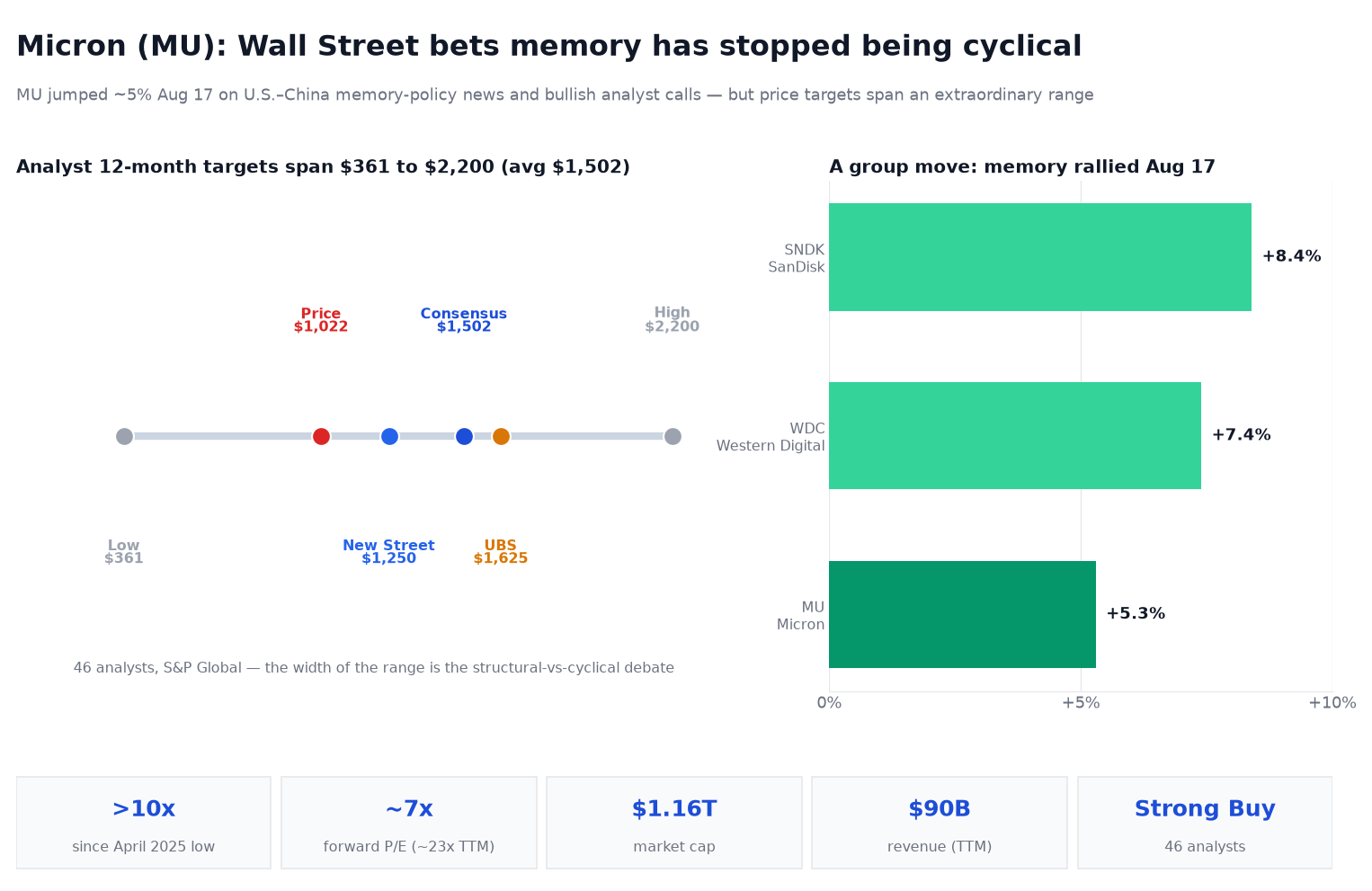
Micron is the largest U.S. memory maker — DRAM and NAND flash — and, alongside South Korea's SK Hynix and Samsung, a key supplier of the high-bandwidth memory (HBM) stacked next to AI accelerators. The policy news gave the whole group a same-day lift, but the reason Micron keeps climbing is a bigger debate, the one that has defined memory investing for decades: is this a durable, structurally different business, or a cyclical peak that will eventually mean-revert? The clearest expression of that debate is the analysts' own price targets, which fan out across an exceptionally wide range.
The bull case: why an analyst says the cycle has changed
Ferragu's upgrade is not a momentum call; it is an argument that the structure of the memory industry has changed, with HBM at the center [3][4]:
- HBM soaks up capacity. Current-generation HBM (HBM3E) uses roughly three times the wafer capacity per bit of conventional DDR5 DRAM and requires advanced packaging. As AI demand pulls HBM production higher, it consumes wafers that would otherwise make commodity DRAM — which constrains non-HBM supply and, the argument goes, prolongs the shortage beyond a normal cycle [3].
- A shallower cycle. The core claim is that Micron can stay highly cash-generative even through a milder multi-year downturn, so the amplitude of the memory cycle is shrinking — memory becoming less of a boom-and-bust commodity and more of a structurally profitable business [3].
- Price versus production value. Micron's stock has risen more than tenfold since its April 2025 low while its cost of goods sold is up only about 25% over the same span — which the bull case reads as pricing and mix driving durable value creation rather than a purely cyclical bounce [3].
- A bold long-term scenario. In the most aggressive version, Ferragu sketches peak figures of roughly $150 billion of annual free cash flow and $600 billion of cash by 2030, consistent with a $2–3 trillion valuation — explicitly a long-term scenario if everything lines up, with a materially milder downcycle assumed thereafter, not a base case [3].
The trailing numbers are, for now, spectacular: twelve-month revenue of about $90 billion (up ~167% year over year) and net income near $50 billion [1]. The question is whether those results are a new baseline or a peak.
The bear case is hiding in the valuation
Here is the tension at the heart of Micron today: despite a more-than-tenfold run, the stock trades at only about 7x forward earnings (versus roughly 23x trailing) [1]. That is a striking multiple, but it is important not to over-read it. Consensus earnings estimates are still rising — S&P Global data show adjusted EPS climbing from roughly $73 in fiscal 2026 to about $155 in fiscal 2027 — so the low forward multiple does not mean the market expects earnings to fall next year [1]. What it does reflect is that investors are discounting the durability of those forecast earnings: after decades of memory being a boom-and-bust commodity, the market is unwilling to pay a high multiple for exceptionally elevated forecast profits whose through-cycle durability it doubts. New Street's argument is precisely that this caution is a mispricing — that if the cycle is genuinely shallower, memory earnings deserve a higher, more stable multiple than the market is granting. The opposing view, which we laid out when Micron sold off earlier this summer on DRAM peak-margin concerns, is that memory has looked structurally different at the top of every cycle and always mean-reverted. The low forward multiple is the market keeping that skepticism alive.
Why it matters
Micron is one of the clearest large-cap bets on whether AI has structurally changed memory economics. If the bulls are right, a business the market has long valued at low multiples deserves a structural re-rating, and the direct memory suppliers — SanDisk in NAND, plus SK Hynix and Samsung — re-rate with it. If the skeptics are right, today's exceptionally elevated forecast profits eventually normalize sharply, and the low forward multiple is the market's caution rather than an opportunity missed. The weekend policy news adds a second, more concrete tailwind: reducing a potential Chinese sourcing avenue for Apple is supportive for non-Chinese suppliers like Micron. The stakes are unusually high because the stock has already moved so far — a $1.16 trillion valuation leaves little room for the thesis to be wrong.
How the peers and sector traded the same day
Micron's jump was part of a broad rally across memory and storage on August 17, which tells you the move was about the sector-wide policy and demand narrative, not a single-stock catalyst [6]:
| Name (ticker) | Aug 17, ~10:46 a.m. ET | Read-through |
|---|---|---|
| SNDK — SanDisk | ≈+8.4% | NAND-memory maker; a direct memory read-through and the day's biggest mover [6] |
| MU — Micron | ≈+5.3% | DRAM/HBM bellwether; the policy news plus Friday's New Street upgrade [2][3] |
| WDC — Western Digital | ≈+7.4% | Now essentially a pure-play HDD/storage company (it spun off SanDisk in February 2025) — an adjacent AI-storage sympathy move rather than a direct memory peer [6] |
The direct memory read-through runs through SanDisk (NAND) and the Korean DRAM makers SK Hynix and Samsung; Western Digital rallied in sympathy but is a storage, not a memory, play after the SanDisk spin-off. The whole complex moving together on a supply-and-policy narrative is what you would expect if the market is re-rating the AI-memory trade as a group, with the New Street upgrade an extra tailwind specific to Micron [6].
What the Street did with it
The analyst reaction has been overwhelmingly bullish, even as the targets fan out. Friday's New Street upgrade to Buy carried a $1,250 target (about 32% above the pre-upgrade price) [3]. The Street-high sits even higher: UBS's $1,625 target, set back in May by analyst Timothy Arcuri (a more-than-tripling from $535) and maintained since [7]. Across roughly 46 analysts the stock holds a consensus "Strong Buy" with an average target near $1,502 — but a low estimate of $361 and a high of $2,200 [5]. That dispersion, more than any single target, is the useful signal: the sell side is broadly bullish on near-term demand but deeply split on how much of the current earnings power is durable.
What to watch
- HBM supply and pricing. The bull thesis rests on HBM staying structurally short. Watch capacity announcements from Micron, SK Hynix and Samsung, and any sign that HBM supply is catching up to demand [3].
- Margins through a soft patch. The "shallower cycle" claim will be tested the first time DRAM pricing weakens; watch whether Micron's gross margin and cash flow hold up far better than in past downturns [3].
- China policy follow-through. The weekend signal discouraging Apple from Chinese memory is supportive for non-Chinese suppliers like Micron; watch whether it hardens into broader, formal restrictions or fades [2].
- The forward multiple. A re-rating of the ~7x forward P/E toward a higher, mid-cycle multiple would be the market conceding the durability case; a multiple that stays low even as earnings rise says the skepticism persists. Moves are tracked on the MU stock page and the earnings calendar [1].
Illustrative valuation sensitivity
The scenarios below are a descriptive, author-weighted exercise — not a forecast, target, recommendation, or intrinsic fair-value calculation. The upside and middle cases sit near published analyst targets (which are 12-month), while the downside is the author's own cyclical case; note that those 12-month targets and the structural bull thesis (centered on 2030 economics) are different horizons, so this is a rough sensitivity, not a precise model [5]. The weights are the author's subjective assumptions. The percentages are illustrative and sum to 100%.
| Scenario | Illustrative price | Weight | Key drivers |
|---|---|---|---|
| Upside (structural) | ~$1,625 | 30% | The cycle proves genuinely shallower: HBM stays short, pricing holds, Micron compounds cash flow, and the forward multiple re-rates upward toward the UBS/high-end targets [5][7]. |
| Middle | ~$1,250 | 40% | Earnings stay strong and HBM demand is real, but the market keeps a durability discount on the multiple, holding the stock around the New Street target and below the consensus average [3]. |
| Downside (cyclical) | ~$500 | 30% | Supply catches up, DRAM/HBM pricing rolls over, record earnings normalize, and the low forward multiple proves prescient — a de-rating well down from here, though still above the Street's $361 low [5]. |
Weighting those (0.30 × $1,625 + 0.40 × $1,250 + 0.30 × $500) gives an author-weighted scenario value near $1,138, close to the ~$1,023 quote [1]. But the point of Micron is not a point estimate — it is the width of the band, from around $500 to above $1,600. Few mega-caps carry that much unresolved disagreement about whether their current earnings are a floor or a ceiling. This is descriptive analysis of a corporate event, not investment advice.
MU data snapshot — August 17, 2026 (intraday, session open)
| Figure | Value | As-of / source |
|---|---|---|
| Intraday quote | $1,022.70 (+$51.04, +5.25%) | Aug 17, ~10:46 a.m. ET — StockAnalysis [1] |
| Day's range (Aug 17) | $995.26 – $1,024.99 (prior close $971.66) | Aug 17 session, still open [1] |
| 52-week range | $113.46 – $1,255.00 (up >10× since the April 2025 low) | As of Aug 17 [1][3] |
| Market cap | ≈$1.16T (1.13B shares) | Aug 17 — StockAnalysis [1] |
| Valuation | ≈23x trailing / ≈7x forward P/E (FY26 EPS ≈$73 → FY27 ≈$155); dividend yield ≈0.06% ($0.60) | Aug 17 — StockAnalysis / S&P Global [1] |
| Trailing fundamentals | Revenue (TTM) ≈$90.3B (+167% YoY); net income ≈$50.5B; EPS (TTM) $44.31 | TTM — StockAnalysis [1] |
| Aug 17 catalyst | Commerce Secretary Lutnick told the WSJ the U.S. "does not approve" of Apple buying Chinese memory | Weekend of Aug 15–16 — WSJ / Barron's [2] |
| New Street Research | Upgrade to Buy from Neutral; target $1,250 (≈+32% vs pre-upgrade) | Aug 14 — New Street (P. Ferragu) [3] |
| UBS (Street-high) | Buy; $1,625 target (set May 2026 by T. Arcuri, from $535; maintained) | May 26, 2026 — UBS [7] |
| Analyst consensus | Strong Buy; avg target ≈$1,502 (range ~$361–$2,200) | ~46 analysts — S&P Global [5] |
The August 17 figures are intraday snapshots that moved through the session, not closing prices; the multiples are quoted at the current price rather than Friday's close.
The setup at a glance
| Question | Answer |
|---|---|
| Why did Micron stock jump on August 17? | MU rose ~5%, joining a memory-and-storage rally after Commerce Secretary Lutnick said the U.S. "does not approve" of Apple buying Chinese memory — a signal supportive for non-Chinese suppliers like Micron — building on Friday's New Street upgrade to Buy ($1,250) [2][3]. |
| What is the bull thesis? | That HBM has structurally shallowed the memory cycle: current-generation HBM3E uses ~3× the wafer capacity per bit of DDR5, so AI demand soaks up supply and prolongs the shortage, and Micron stays cash-generative even through a milder downturn [3]. |
| What is the bear case? | Memory has looked structurally different at the top of every cycle and always mean-reverted; the ~7× forward P/E shows the market is unwilling to pay up for elevated forecast earnings whose through-cycle durability it doubts [1]. |
| Why is the forward P/E so low? | At ~7× forward (vs ~23× trailing), the low multiple is a durability discount, not a forecast of falling earnings — consensus EPS actually rises from ~$73 (FY26) to ~$155 (FY27). The bull case is that the discount is a mispricing [1]. |
| Was it a sector move? | Yes — memory and storage rallied as a group (SanDisk ≈+8.4%, Western Digital ≈+7.4%) on the policy news, with the New Street upgrade an extra tailwind specific to Micron [6]. |
| What do analysts think? | Consensus "Strong Buy," average target ~$1,502, but an exceptionally wide $361–$2,200 range — bullish on near-term demand, split on durability [5]. |
Micron (MU) stock FAQ
Why did Micron (MU) stock jump on August 17, 2026?
Micron rose about 5.3% to roughly $1,023, leading a broad memory rally. The immediate catalyst was policy: over the weekend, U.S. Commerce Secretary Howard Lutnick told The Wall Street Journal that the administration 'does not approve' of Apple turning to Chinese memory, a stance that steers demand toward U.S. and Korean suppliers and benefits Micron directly. That built on Friday's New Street Research upgrade to Buy with a $1,250 target, which argued that high-bandwidth memory has structurally shallowed memory's traditional boom-and-bust cycle. Micron is now a roughly $1.16 trillion company, up more than tenfold since its April 2025 lows.
What is the bull case that memory is no longer cyclical?
The argument, made most directly by New Street's Pierre Ferragu, is that HBM changes the industry's structure. Current-generation HBM (HBM3E) uses roughly three times the wafer capacity per bit of conventional DDR5 DRAM and needs advanced packaging, so as AI pulls HBM production higher it consumes wafers that would otherwise make commodity memory — constraining non-HBM supply and prolonging the shortage. The claim is that Micron can stay highly cash-generative even through a milder multi-year downturn, so the amplitude of the memory cycle is shrinking. In the most aggressive version, Ferragu sketches peak figures of roughly $150 billion of annual free cash flow and $600 billion of cash by 2030, framed as a long-term scenario, not a base case.
Why is Micron's forward P/E so low if the stock has risen so much?
Despite a more-than-tenfold run, Micron trades at only about 7x forward earnings versus roughly 23x trailing. It is important not to over-read that: consensus estimates actually have earnings rising, from about $73 of EPS in fiscal 2026 to about $155 in fiscal 2027, so the low multiple does not mean the market expects earnings to fall. What it reflects is that investors are discounting the durability of those forecast earnings — after decades of memory being a boom-and-bust commodity, the market is unwilling to pay a high multiple for peak-cycle profits it is not sure will last. The bull case is that this caution is a mispricing.
Is Micron a buy at these levels?
That is exactly what analysts cannot agree on, which is why their price targets span an exceptionally wide range — from about $361 to $2,200, around a $1,502 average, across roughly 46 analysts with a consensus Strong Buy rating. Bulls like New Street ($1,250) and UBS ($1,625, a Street-high set in May) underwrite a structural break in the memory cycle; skeptics anchor to decades of memory cyclicality and a forward multiple that already embeds caution. Near-term AI demand for HBM is, at least, exceptionally strong; the debate is durability, and it will be settled by how Micron's margins and cash flow behave the next time supply catches up. This is descriptive analysis, not a recommendation to buy, sell, or hold.
What does Micron do, and how does the China-memory news help it?
Micron Technology is the largest U.S. maker of memory chips — DRAM and NAND flash — and, alongside South Korea's SK Hynix and Samsung, one of only three major suppliers of high-bandwidth memory (HBM) used with AI accelerators. Memory has historically been a highly cyclical commodity business. The August policy news matters because Commerce Secretary Lutnick signaled the U.S. does not want its 'premier companies' like Apple sourcing memory from mainland China; reducing a potential Chinese sourcing avenue is supportive for non-Chinese suppliers including Micron, a concrete tailwind on top of the AI-driven HBM shortage (though Apple could still proceed).