Semiconductors
SanDisk (SNDK) Stock Jumps After 2026 Investor Day: The 80% Gross-Margin Model Behind the Rally
SanDisk closed up 13.67% on August 13 after its 2026 Investor Day unveiled a 2028–2030 model targeting ~80% non-GAAP gross margin, ~75% operating margin and a contracted book of ~$91.1 billion in remaining performance obligations. It led a memory-wide rally and extended the next day on fresh sell-side support, led by J.P. Morgan. At ~7.6x forward earnings the stock looks cheap — but that multiple rests on an FY2027 consensus EPS near $213, so the cheapness is a bet the model survives a historically brutal NAND cycle, which is why analyst targets range from $1,000 to $3,600.

Why SanDisk stock jumped after its 2026 Investor Day
On Thursday, August 13, 2026, SanDisk (NASDAQ: SNDK) closed up 13.67%, at $1,528.11 from a $1,344.29 prior close, after its 2026 Investor Day laid out a long-term financial model more aggressive than the Street expected [1][4]. The move extended into the next session — on the morning of Friday, August 14, with the market open, SNDK was up roughly 6.2% to about $1,623, and the figure moved by the minute [2]. Friday's continuation also had fresh sell-side support, led by J.P. Morgan resuming coverage at Overweight with a $2,250 target [10]. On a stock that entered Thursday up roughly 544% year to date and reached about 584% intraday on Friday, a two-day gain approaching a fifth of its value was a striking repricing [2][11].
The move is easier to read as a short chronology: SanDisk reported a record fiscal Q4 in early August; the stock fell the next session as its near-term outlook failed to clear a very high bar; it drifted back up about 5.8% on August 12, the day before the Investor Day; then jumped 13.7% on August 13 on the long-term model, and extended on August 14 [5]. So the catalyst was not a quarter. What the Investor Day added was a 2028–2030 model: non-GAAP gross margin of about 80%, operating margin near 75%, an adjusted free-cash-flow margin around 50%, and a commitment to return 100% of excess cash [1]. Because SanDisk had just posted an 84.6% gross margin in Q4, the striking claim is not that it can reach 80% — it is that it can sustain roughly 80% through 2030, in a NAND-flash business that has been one of the most violently cyclical in technology [5]. Whether that durability holds is the entire debate.
What was actually new at the Investor Day
SanDisk makes NAND flash — the non-volatile memory in SSDs, phones and, increasingly, the data-center storage tier feeding AI training and inference. Much of what drew headlines was backdrop the company had already disclosed with its Q4 results: the contracted "New Business Model" (NBM) book. What was genuinely incremental on August 13 was the long-term financial model and the detail on how the contracts underpin it [1][5].
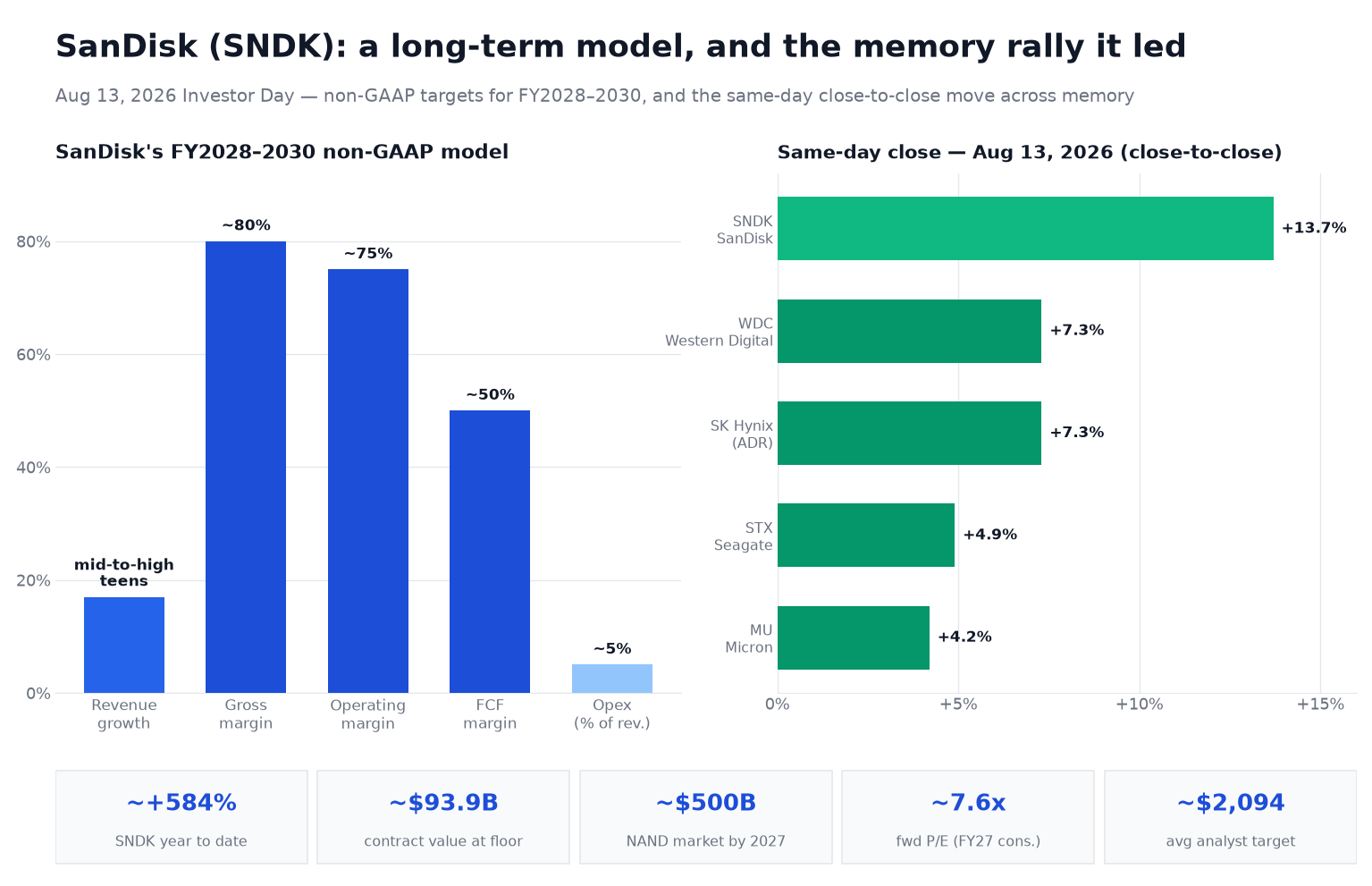
- The new long-term model (FY2028–FY2030). Revenue growth in the mid-to-high teens, "consistent with bit growth"; non-GAAP gross margin around 80%; non-GAAP operating margin near 75%; operating expenses near 5% of revenue; and an adjusted free-cash-flow margin around 50% after taxes, working capital and mid-single-digit gross capex. The pieces tie together cleanly: about 80% gross margin less ~5% operating expenses is ~75% operating margin, which — after taxes, working capital and mid-single-digit capital intensity — lands near a 50% adjusted free-cash-flow margin [1].
- The contracted "New Business Model" (backdrop, disclosed with Q4). Management disclosed roughly $93.9 billion of minimum contracted revenue at floor pricing, of which about $91.1 billion remained as remaining performance obligations, plus $16.5 billion of financial guarantees supporting the agreements — signed with eight customers (across ten agreements) covering roughly 50% of FY2027 bit output and about two-thirds of FY2028 [1][9]. Pricing varies by agreement: some contracts are fixed, while others include variable pricing subject to floors and ceilings, and the weighted-average contract duration exceeds four years [9]. The floors put a base under revenue; the ceilings cap how much SanDisk captures if spot NAND spikes.
- A market big enough to matter. CFO Luis Visoso sized the total NAND market at roughly $300 billion in 2026 and about $500 billion in 2027, with supply "tight into 2028," and pointed to enterprise data-center flash demand of about 1.2 zettabytes by 2030 [1][4].
- The earnings backdrop. The model sat on top of a record fiscal Q4: revenue of $8.96 billion (up about 372% year over year), non-GAAP EPS of $39.25 against a $33.28 estimate, and a non-GAAP gross margin of 84.6% (up from 26.4% a year earlier). Data-center revenue reached $2.98 billion, up 103% sequentially (full-year FY2026 data-center revenue rose about 437%, to roughly $5.2 billion from $960 million) [5]. On August 3, SanDisk and SK Hynix released the first OCP High Bandwidth Flash (HBF) technical specification, building on an AI-memory collaboration first announced in August 2025 [12].
Put together, the message was that SanDisk's economics are being re-rated from "commodity supplier at the mercy of the cycle" to "structurally short-supplied AI-infrastructure vendor with contracted, collar-protected demand." That is why a model, not a quarter, moved the stock this much.
What SanDisk's 80% gross-margin model actually assumes
Sustaining a roughly 80% non-GAAP gross margin through 2030 would be extraordinary for a historically cyclical NAND business — SanDisk itself ran at just 26.4% as recently as a year ago before this AI-memory upcycle lifted Q4 to 84.6% [5]. SanDisk's argument is that the swing is dampened by an AI-driven demand curve steeper than prior cycles, disciplined mid-single-digit capital intensity, and its contracted book, whose floors put a base under pricing [1]. The counter-argument is that the collars cut both ways: price ceilings cap how much SanDisk captures if spot NAND spikes, and in a genuine downturn realized pricing drifts toward the contract floors while the ~80% assumption is tested. Goldman Sachs, which kept a Buy rating and a $2,200 target, made the narrower point that the NBMs could reduce cyclicality but that the model still has to prove itself [7]. A long-term model is a set of assumptions, not results.
Why it matters
SanDisk has become a prominent public test of a thesis running through the whole AI-infrastructure complex: that memory, long the commodity floor of the tech stack, is being pulled into structural shortage by AI workloads. If that holds, the businesses that supply bits capture durable, high-margin economics; if it is another cycle in disguise, the re-rating unwinds. The Investor Day model is management's bet on the first outcome, and the collar-protected contracted book is its attempt to make that bet more resilient by putting floors under demand and price. The same question — how much to pay for contracted future demand that has not yet been delivered through a full cycle — is one we track across the AI build-out, from Micron's DRAM margin debate to the neocloud backlogs at CoreWeave.
How the peers and sector traded the same day
This was not a SanDisk-only event. The Investor Day lifted the entire memory and storage complex on August 13, a move consistent with the market reading it as a statement about industry supply and pricing rather than one company's guidance — though correlated moves are supportive evidence, not proof of causation [5][11]. On a close-to-close basis (matching SanDisk's close-to-close figure):
| Name (ticker) | Aug 13, 2026 close | Read-through |
|---|---|---|
| SNDK — SanDisk | +13.7% | The catalyst: its own Investor Day and long-term model [1][4] |
| WDC — Western Digital | +7.3% | Closest NAND/HDD comparable; direct read-through on supply and pricing [11] |
| SK Hynix (ADR) | +7.3% | HBF partner and NAND/DRAM peer; tight-supply thesis [11] |
| STX — Seagate | +4.9% | Storage peer; group bid [11] |
| MU — Micron | +4.2% | DRAM/NAND bellwether; sector-wide bid [11] |
SanDisk led by a wide margin, on its own news, but the group move is consistent with a broader memory-supply/AI-demand read-through rather than an isolated single-stock pop. Measured to the same August 13 close, the complex has run hard year to date: SanDisk about +544%, Seagate about +235% and Micron about +233% [5][11].
What the Street did with it
Analysts are broadly, and in places extremely, bullish, but the actions are spread across two weeks — several predate the Investor Day and should not be read as reactions to it [7]:
| Firm | Action (date) | Rating / target |
|---|---|---|
| Evercore ISI | Target trimmed $3,100 → $2,800 (Aug 6, pre-Investor Day) | Outperform [6] |
| Argus Research | Upgrade to Buy (Aug 10) | Buy, $1,600 [8] |
| Goldman Sachs | Reiterated after Investor Day | Buy, $2,200 [7] |
| J.P. Morgan | Resumed coverage (Aug 14) | Overweight, $2,250 [10] |
Across roughly two dozen analysts the consensus is a "Buy" with an average target near $2,094 (median about $2,000) — above the current price — but the range runs from about $1,000 to $3,600 [7]. That spread, more than any single target, is the useful signal: even the bulls disagree by more than three-to-one on what SanDisk is worth, precisely because they disagree on whether the ~80% gross-margin model is a new baseline or a cycle peak.
What to watch
- Gross-margin durability. The ~80% non-GAAP gross-margin target for FY2028–2030 is the load-bearing assumption. Q4 was already 84.6%; the tell will be the first sequential decline in a strong-demand quarter, which would suggest the cycle still governs [1][5].
- The contracted book's terms. The ~$91.1 billion of remaining performance obligations and the floor-and-ceiling pricing de-risk volume, but the collars matter: watch disclosure on where realized prices sit within the collars, repricing cadence and customer concentration across the eight NBM customers [1][9].
- NAND supply discipline. The whole thesis rests on supply staying "tight into 2028." Watch industry capex from SanDisk, Micron, SK Hynix and Samsung; a capex race would break the pricing story [1].
- HBF as optionality. Management said High Bandwidth Flash revenue is not embedded in the long-term model, so the SK Hynix HBF effort — now with a published OCP specification — is potential upside rather than something needed to hit the targets; watch for design wins and a revenue timeline. Moves are tracked on the SNDK stock page and the earnings calendar [1][12].
Illustrative valuation sensitivity
The scenarios below are a descriptive, author-weighted exercise — not a forecast, target, or recommendation. The weights and endpoints are author-selected and are not derived from a formal cash-flow model; they are anchored to the analyst target distribution (average ~$2,094, median ~$2,000; range ~$1,000–$3,600) and expressed against a forward-earnings bridge so the levels are not arbitrary [3][7]. The single most important input is whether the Investor Day gross-margin model holds, because that is what a ~7.6x forward multiple is implicitly pricing. The percentages are illustrative and sum to 100%.
| Scenario | Illustrative price | Weight | Earnings bridge & key drivers |
|---|---|---|---|
| Upside | ~$2,800 | 30% | ≈13x a durable ~$213 FY2027 EPS: the ~80% gross-margin model holds, the collar-protected book converts near its ceilings, HBF adds upside, and NAND supply stays tight — into the Evercore/JPM target zone [6][10]. |
| Middle | ~$2,050 | 45% | ≈9.5x that same ~$213 EPS: growth and margins land strong, but the market keeps a cyclicality discount on the multiple, holding the stock near the consensus target — still above today's price [7]. |
| Downside | ~$1,150 | 25% | The cycle reasserts: bit demand cools, realized prices drift toward the contract floors, gross margin normalises, and forward EPS resets toward the FY2026 base (~$71) — a de-rate toward the low end of the target range [7]. |
Weighting those (0.30 × $2,800 + 0.45 × $2,050 + 0.25 × $1,150) gives an illustrative probability-weighted price near $2,050, about 26% above the ~$1,623 quote [2]. Read literally, that says the market is not yet fully crediting the Street's own targets — but the honest takeaway is the width of the band, from below $1,200 to nearly $2,800, which reflects genuine disagreement about whether AI has permanently changed NAND economics or merely stretched another cycle. This is descriptive analysis of a corporate event, not investment advice.
SNDK data snapshot — August 14, 2026 (intraday, session open)
| Figure | Value | As-of / source |
|---|---|---|
| Investor Day close | $1,528.11 (+13.67%) | Thu, Aug 13, 2026 — prior close $1,344.29 [4] |
| Primary intraday quote | $1,623.13 (+$95.02, +6.22%) | Aug 14, 9:50 a.m. ET — StockAnalysis [2] |
| Corroborating quote | $1,622.74 (+6.19%) | Aug 14 intraday — BestStocks event page [8] |
| Day's range (Aug 14) | $1,583.56 – $1,647.90 | Aug 14 session, still open [2] |
| Year-to-date | ≈+544% through Aug 13; ≈+584% at the Aug 14 quote | Dec 31, 2025 close $237.38 [11] |
| 52-week range | $42.82 – $2,354.39 | As of Aug 14 [2] |
| Market cap | ≈$241.85B (149.0M shares × $1,623.13) | Aug 14, 9:50 a.m. ET [2][3] |
| Balance sheet / EV | ≈$4.76B cash & equivalents, no debt; enterprise value ≈$237B (market cap less cash) | Aug 14 — StockAnalysis [3] |
| Valuation | ≈21.9x trailing GAAP (EPS $73.76) vs ≈7.6x FY2027 consensus/adjusted (EPS ≈$213); spot ÷ FY2026 non-GAAP EPS ≈22.9x | Aug 14 — StockAnalysis [3] |
| Volume (Aug 13) | ≈21.9M shares, ≈36% above the ≈16.1M 20-day average | Aug 13 — StockAnalysis [3] |
| Analyst consensus | Buy; avg target ≈$2,094, median ≈$2,000 (range ~$1,000–$3,600) | ~23 analysts — StockAnalysis / S&P Global [7] |
Two independent feeds agree on the ~$1,623 intraday price and the ~6.2% Aug 14 gain; the exact figure differed by the minute because the session was open. Price-derived figures (market cap, enterprise value, year-to-date) are frozen at the $1,623.13 / 9:50 a.m. quote. Aug 14 prices are intraday snapshots, not closing prices; the $1,528.11 Aug 13 figure is a settled close.
The setup at a glance
| Question | Answer |
|---|---|
| What was the news? | SanDisk's 2026 Investor Day (Aug 13) unveiled a FY2028–2030 model: ~80% non-GAAP gross margin, ~75% operating margin, ~50% adjusted FCF margin and mid-to-high-teens revenue growth, with additional detail on the contracted "New Business Model" (~$93.9B minimum contracted revenue at floor pricing, of which ~$91.1B is remaining performance obligations) that had been disclosed with Q4 [1][9]. |
| How big was the move? | +13.67% on Aug 13 (to $1,528.11), extending ~6.2% to ~$1,623 intraday on Aug 14 — helped by a fresh J.P. Morgan Overweight resumption — on a stock up ~544% year to date into Thursday [2][10]. |
| Was it a sector move? | SanDisk led by far, but the whole complex rallied (close-to-close: WDC +7.3%, SK Hynix +7.3%, STX +4.9%, MU +4.2%) — consistent with a supply-narrative read-through [11]. |
| Why is the ~80% margin target contested? | NAND is historically brutally cyclical (SanDisk ran at 26.4% a year before Q4's 84.6%); sustaining ~80% through 2030 assumes a benign AI-driven cycle. The contracted book's floors protect the downside, but its ceilings cap upside and a real downturn would test the model [1][9]. |
| Is the stock expensive after the run? | ~21.9x trailing GAAP, but only ~7.6x forward — because FY2027 consensus EPS (~$213) is far above FY2026 (~$71), so the cheapness is a bet the elevated forward-earnings base proves durable, not a margin of safety [3]. |
| What do analysts think? | Consensus "Buy," average target ~$2,094 (median ~$2,000, above the price), but a very wide $1,000–$3,600 range — the dispersion reflects disagreement over whether AI has permanently changed NAND economics [7]. |
SanDisk (SNDK) stock FAQ
Why did SanDisk (SNDK) stock jump on August 13, 2026?
SanDisk closed up 13.67% at $1,528.11 (from a $1,344.29 prior close) after its 2026 Investor Day unveiled a long-term financial model more aggressive than the Street expected — non-GAAP gross margin around 80%, operating margin near 75% and an adjusted free-cash-flow margin around 50% for fiscal 2028–2030. The catalyst was the long-term model, not the quarter: SanDisk had already reported a record fiscal Q4 in early August, after which the stock had actually fallen on a cautious near-term outlook. The rally extended on August 14 with fresh sell-side support, led by J.P. Morgan resuming coverage at Overweight with a $2,250 target.
What gross margin is SanDisk targeting through 2030?
SanDisk's long-term model guides to a non-GAAP gross margin of about 80% for fiscal 2028–2030, alongside an operating margin near 75%, operating expenses near 5% of revenue and an adjusted free-cash-flow margin around 50%. Because the company already posted an 84.6% non-GAAP gross margin in fiscal Q4 2026 (up from 26.4% a year earlier), the notable claim is not reaching 80% but sustaining roughly 80% through 2030 — an unusual assumption for a historically cyclical NAND-flash business, which is exactly what the market is debating.
Are SanDisk's New Business Model contracts fixed-price?
No. Management described the New Business Model agreements as varying by contract — some are fixed-price, while others include variable pricing subject to floor-and-ceiling collars, with a weighted-average duration exceeding four years. SanDisk disclosed roughly $93.9 billion of minimum contracted revenue at floor pricing, of which about $91.1 billion is remaining performance obligations, plus $16.5 billion of financial guarantees supporting the agreements across eight customers (covering ~50% of FY2027 bits and ~two-thirds of FY2028). The floors protect the downside while the ceilings cap how much SanDisk captures if spot NAND prices spike.
Why is SanDisk's forward P/E so low after the stock's run?
SanDisk trades at about 21.9x trailing GAAP earnings but only ~7.6x forward — a gap that is an artifact of the denominator. Trailing GAAP EPS is about $73.76, but FY2027 consensus (adjusted) EPS sits near $213, so the forward multiple looks low precisely because the market has already penciled in an enormous jump in earnings (the current price divided by FY2026 non-GAAP EPS of about $71 is closer to 22.9x). That low forward multiple is therefore not a margin of safety — it is a bet that an unusually elevated forward-earnings base proves durable through the NAND cycle.
Is High Bandwidth Flash (HBF) included in SanDisk's long-term forecast?
No. Management said HBF revenue is not embedded in its long-term revenue model, which makes the SanDisk–SK Hynix HBF effort potential upside rather than something needed to hit the FY2028–2030 targets. The two companies released the first OCP HBF technical specification on August 3, 2026, building on a collaboration first announced in August 2025. For investors, that means the model's ~80% gross-margin and mid-to-high-teens growth targets do not depend on HBF succeeding — but a successful HBF ramp would be incremental to them.