Stock Analysis
Why Micron (MU) Stock Fell 5.9% on July 31, 2026 — and Why Bullish Memory News Made It Worse
Micron opened higher and rose 6.4% intraday on July 31, 2026 after Amazon raised 2026 capex to $220 billion citing memory costs and Apple flagged a shortage — then closed down 5.90% at $823.03, near its low. The tape shows why: the S&P 500 and Nasdaq rose, the semiconductor index was flat, and hard-disk peers Western Digital and Seagate closed higher. Only DRAM and NAND names fell. The debate has moved from whether memory demand is real to when Micron's margins peak — and no analyst has cut a target through a 34% drawdown.
Summary
Micron Technology (NASDAQ: MU) closed Friday, July 31, 2026 at $823.03, down $51.63 or 5.90% from Thursday's $874.66 close [1][2][3]. What makes the session worth explaining is not the size of the drop but its direction. Micron opened higher at $919.65 and ran to $930.88 — up 6.4% intraday — on the back of demand news that could hardly have been better for a memory maker [5][20]. Amazon had raised its 2026 capital-expenditure plan to roughly $220 billion from about $200 billion the evening before, explicitly blaming the "inflated price" of memory, and said it still would not have enough capacity [6][8]. Apple beat on the quarter but guided below consensus on supply constraints, citing a memory shortage severe enough that it is raising Mac and iPad prices [7]. Micron then gave all of it back and more, closing $107.85 below its intraday high, a hair above the $818.00 low [2]. The move was not macro and not a chip selloff: the S&P 500 rose 0.7% and the Nasdaq Composite 1.0%, the PHLX Semiconductor Index was flat at +0.07%, and storage peers Western Digital (WDC) and Seagate (STX) closed up 2.21% and 0.52% [13][14][16][17]. Only the DRAM and NAND names fell.
What changed
Nothing about demand — and that is precisely the point. The week's news flow was a steady drumbeat of confirmation that memory is scarce and getting scarcer. Samsung, reporting on July 30, posted a record quarterly operating profit of about $62.1 billion and told investors it expects the global memory shortage to deepen in 2027 and persist through 2028, with multiyear contracts potentially covering up to 70% of planned high-bandwidth-memory capacity [9]. That guidance is what drove Micron's extraordinary 18.36% surge on July 30, the largest single-session gain in the stretch [5]. Then Amazon and Apple, reporting after Thursday's close, supplied the demand-side corroboration from the customers' own mouths, and memory names jumped in after-hours trading [6][7][24].
Friday reversed all of it. The mechanism is not mysterious once you separate two questions the market had been treating as one. The first is whether memory demand is real and durable; on that, the evidence is now overwhelming and the bulls have won. The second is when Micron's margins peak — and on that question, a hyperscaler announcing it must spend $20 billion more than planned because memory is expensive is not reassuring. It is a description of a cost problem large enough to summon a supply response. Three things feed that worry: China's CXMT and other domestic Chinese producers ramping DRAM yields, Samsung and SK Hynix both expanding capacity into the shortage, and the arithmetic that today's pricing is what invites tomorrow's competition [22]. SK Hynix had already demonstrated the pattern on July 29, when it posted record quarterly results and its shares fell anyway because the growth failed to clear an even higher bar [10].
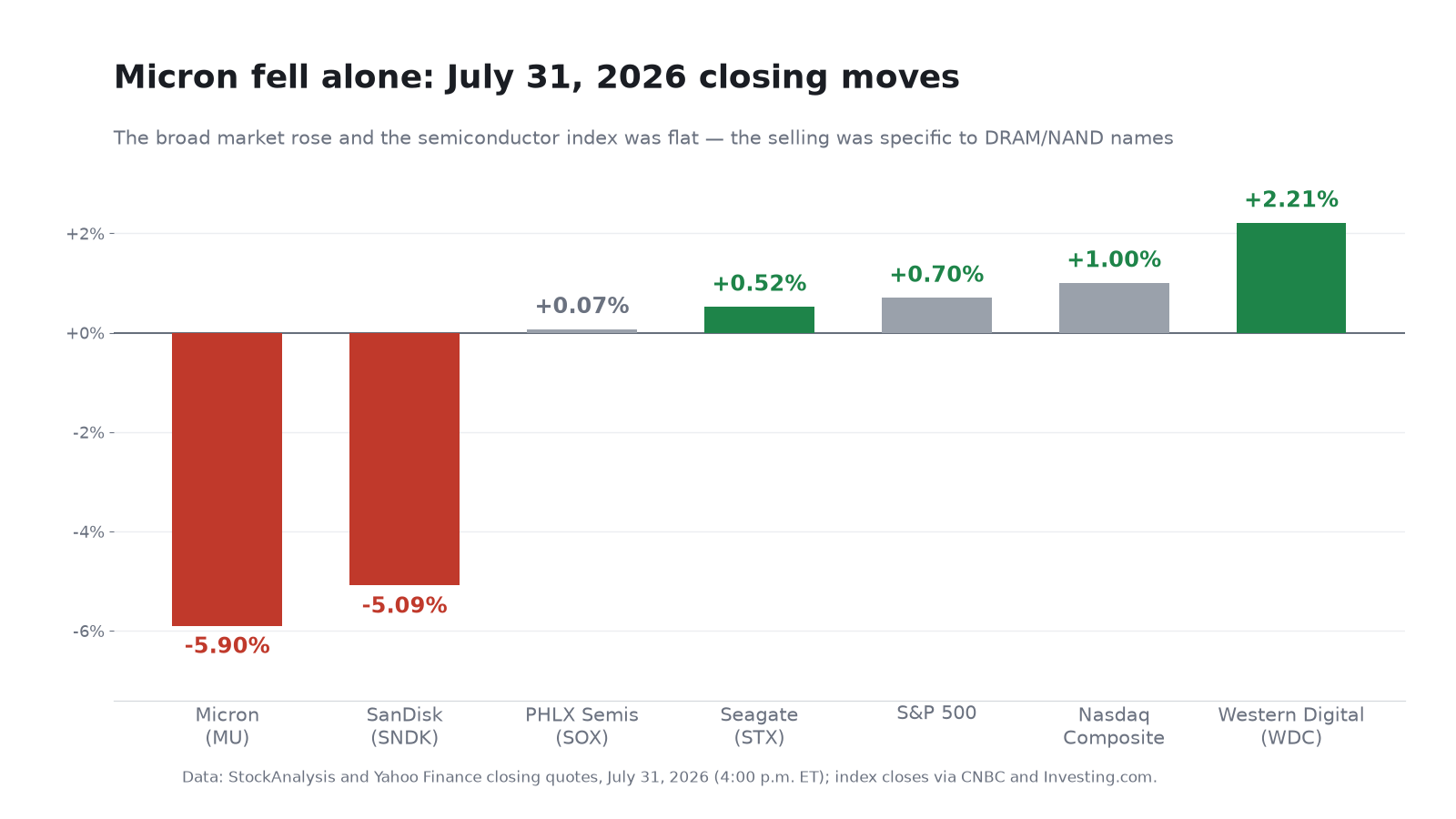
The peer split is the cleanest evidence available that this was a repricing of memory economics rather than a risk-off day. SanDisk (SNDK), a NAND pure-play, fell 5.09% alongside Micron [15]. Western Digital and Seagate — which sell hard drives into the same data centers, benefit when scarce and expensive flash pushes cold storage back toward spinning disks, and trade on far lower multiples — both rose [16][17]. If Friday had been about interest rates or AI sentiment, that spread would not exist. Long-term Treasury yields did hit a 19-year high this week — the 30-year rose 12 basis points to 5.21% after the Federal Reserve held rates at 3.50%–3.75% on July 29 in a 9–3 vote with three dissents — but that was a Wednesday and Thursday story, and by Friday equity investors were, in the market wrap's phrase, looking past it [11][12][13].
Why it matters
Micron is now the clearest test case for a question that runs through the whole AI trade: what is a cyclical business worth at the top of the best cycle it has ever had? The fundamentals are genuinely extraordinary — trailing revenue of $90.27 billion, net income of $50.47 billion, a 55.9% net margin, 66.6% return on equity and a debt-to-equity ratio of 0.06 [4]. The stock is still up more than 600% over 52 weeks [4]. And yet it has lost roughly a third of its value in five weeks while every one of those fundamentals improved. Nothing about that is contradictory. Memory has always been a business where the peak of the earnings cycle and the peak of the equity coincide only by accident, and where the market pays its lowest multiple at the moment of maximum profitability.
The read-through for the rest of the complex is narrower than it looks. Rising memory prices are a straightforward cost pass-through for hyperscalers, a margin headwind for device makers like Apple and for server builders such as Dell (DELL), and a tailwind for the storage alternatives. That is why Nvidia (NVDA) and Broadcom (AVGO) did not follow Micron down and the semiconductor index finished flat [14]. The stocks that moved together on Friday were the ones whose earnings are levered directly to the DRAM and NAND price curve — the same dynamic that drove SanDisk's mid-July decline and that separates memory from the rest of the AI supply chain.
What to watch
First, the first target cut. With 45 analysts averaging $1,507 and none having moved during a 34% drawdown, the initial downgrade or material target reduction will matter more as a signal than as arithmetic — it marks the point at which the sell-side concedes the cycle question [19][21]. Second, contract pricing rather than spot: Samsung's claim that multiyear agreements could lock up as much as 70% of planned HBM capacity is the single best defense against a 2027 air pocket, and evidence that Micron is signing similar terms would blunt the bear case materially [9]. Third, Chinese supply — concrete yield and capacity disclosures from CXMT, as opposed to reported estimates, are what would convert the oversupply worry from a narrative into a number [22]. Fourth, hyperscaler capex durability into 2027: Amazon's $220 billion is a 2026 figure, and the 2027 guide is what tests whether this is a plateau or a step function [6]. Finally, Micron's own next report, where fiscal-2026 revenue is expected near $129.78 billion and EPS near $73.44 — and where management's gross-margin commentary will speak directly to the peak-margin question the stock is actually trading on [19].
Why did Micron (MU) stock drop on July 31, 2026?
Micron fell 5.90% to $823.03 even though the news that day was bullish for memory demand. Amazon raised 2026 capital spending to about $220 billion from roughly $200 billion, blaming high memory prices, and Apple flagged a memory shortage severe enough to raise Mac and iPad prices [6][7]. The stock opened at $919.65 and rose 6.4% intraday before reversing to close near its $818.00 low [2][20]. The selling reflected concern about the timing of peak margins rather than demand: hyperscalers paying more for memory signals a cost problem that invites new supply, particularly from China's CXMT and from Samsung and SK Hynix capacity expansions [22]. The move was memory-specific — the S&P 500 rose 0.7%, the Nasdaq 1.0% and the semiconductor index was flat [13][14].
Was July 31 a semiconductor sector selloff?
No. The PHLX Semiconductor Index closed at 11,311.1, up 0.07% — essentially unchanged — while the S&P 500 gained 0.7% and the Nasdaq Composite 1.0% [13][14]. Within storage and memory the split was sharp: Micron fell 5.90% and SanDisk 5.09%, but Western Digital rose 2.21% and Seagate 0.52% [15][16][17]. Hard-disk makers benefit when flash is scarce and expensive, and they carry much lower multiples. Widely circulated figures showing Seagate down more than 8%, Western Digital down nearly 7% and SanDisk off 14% describe July 28, a different session, and do not apply to July 31.
The July 31 move in numbers
| Measure | Value | As of / source |
|---|---|---|
| MU prior close, Thu Jul 30 | $874.66 | Jul 30 2026 close — StockAnalysis [2][5] |
| MU close, Fri Jul 31 | $823.03 (−$51.63, −5.90%) | Jul 31 2026, 4:00 p.m. ET — StockAnalysis and Yahoo Finance [2][3] |
| Open / intraday high / low | $919.65 / $930.88 / $818.00 | Jul 31 2026 session — StockAnalysis [2][5] |
| Reversal from intraday high | −$107.85 (−11.6%) | Computed from the $930.88 high to the $823.03 close [2] |
| Volume vs. average | 52.85M vs. 46.53M 20-day avg (~1.14x); 53.4M 3-month avg (~1.0x) | Jul 31 2026 — Yahoo Finance and StockAnalysis statistics [3][4] |
| Drawdown from 52-week high | −34.4% from $1,255.00 | 52-week range $103.38–$1,255.00 [3][4] |
| Market capitalization | ~$929.52 billion (1.13B shares) | Jul 31 2026 — StockAnalysis [3][4] |
| Trailing / forward P/E | 18.57x / 5.74x (EPS ttm $44.31) | Jul 31 2026 — StockAnalysis statistics [4] |
| After-hours | $812.50 (−1.28%) | Jul 31 2026 post-close — StockAnalysis [2] |
How did memory peers and the market trade on July 31, 2026?
| Name | Jul 31 close | Change | Exposure |
|---|---|---|---|
| Micron (MU) | $823.03 | −5.90% | DRAM / HBM / NAND [2] |
| SanDisk (SNDK) | $1,214.83 | −5.09% | NAND pure-play [15] |
| PHLX Semiconductor Index (SOX) | 11,311.1 | +0.07% | Broad semiconductors [14] |
| Seagate (STX) | $856.13 | +0.52% | Hard-disk drives [17] |
| S&P 500 | 7,489.72 | +0.70% | Broad market [13] |
| Nasdaq Composite | 25,373.85 | +1.00% | Broad market [13] |
| Western Digital (WDC) | $544.84 | +2.21% | Hard-disk drives [16] |
What are analysts saying about Micron stock?
Uniformly bullish, and conspicuously unchanged. The consensus across 45 analysts is a Strong Buy with an average target of $1,507 and a median of $1,550, against a low of $361 and a high of $2,200 [19]. Individual recent actions, each maintaining or raising: Bernstein's Mark Li, Buy, $1,300, July 28; Bank of America's Vivek Arya, Buy, $1,550, July 21; KeyBanc's John Vinh, Buy, raised to $1,750 from $1,600, July 14; J.P. Morgan's Harlan Sur, Buy, $1,540, July 10; TD Cowen's Krish Sankar, Buy, $1,600, July 10; DBS's Jim Hin Kwong Au, Buy, raised to $1,400 from $1,200, June 30; Cantor Fitzgerald's C.J. Muse, Buy, raised to $2,000 from $1,500, June 29; and Phillip Securities' Yik Ban Chong, Buy, raised to $1,870 from $530, June 28 [18]. Barclays moved to $2,000 from $1,175 on June 26 [23]. Not one firm has cut a target during the 34% decline from the highs, which is the main reason the consensus should be treated as stale rather than as upside [21].
What is Micron stock worth after the July 2026 selloff?
The table below is the author's illustrative scenario framework, anchored to the published consensus range, Micron's own forward estimates and the industry supply commentary cited throughout. The probabilities are judgments, not forecasts.
| Scenario | Price | Probability | Key drivers |
|---|---|---|---|
| Bull | ~$1,400 | 25% | Samsung's shortage-through-2028 view proves right; multiyear HBM contracts lock in pricing; fiscal-2027 EPS approaches the ~$143 implied by the 5.74x forward multiple and the market pays ~10x [4][9] |
| Base | ~$900 | 45% | Shortage persists into 2027 but margins peak during it; EPS lands nearer $95–105 than $143; the market pays ~9x peak-cycle earnings [19] |
| Bear | ~$450 | 30% | CXMT plus Samsung and SK Hynix expansion flips DRAM toward balance in late 2027; earnings mean-revert and a trough multiple applies — near the $361 Street low [19][22] |
| Weighted | ~$890 | 100% | About 8% above the $823.03 close and 41% below the $1,507 consensus |
The blend implies the stock is roughly fairly valued for the risk it carries — not the bargain a 5.7x forward multiple superficially suggests, and not the 83% upside the consensus implies. With a beta of 2.14, the distribution around that midpoint is unusually wide [4]. This is descriptive analysis, not investment advice.
Frequently asked questions
Why did Micron (MU) stock fall on July 31, 2026?
Micron closed at $823.03, down 5.90%, after opening higher at $919.65 and rising as much as 6.4% intraday to $930.88. The reversal happened despite bullish demand news: Amazon had raised its 2026 capital budget to roughly $220 billion from about $200 billion the previous evening, explicitly citing the inflated price of memory, and Apple guided below consensus because of a memory shortage severe enough to force Mac and iPad price increases. The market read that news as evidence of a cost problem that invites new supply rather than as a reason to pay more for Micron's earnings. The concern is the timing of peak margins — driven by China's CXMT ramping DRAM output and by Samsung and SK Hynix expanding into the shortage — not whether demand is real.
Was the July 31 drop part of a semiconductor selloff?
No, and the tape is unusually clear on this. The S&P 500 rose 0.7% to 7,489.72, the Nasdaq Composite rose 1.0% to 25,373.85, and the PHLX Semiconductor Index closed at 11,311.1, up just 0.07% — essentially flat. Within storage, the split was sharp: Micron fell 5.90% and NAND pure-play SanDisk fell 5.09%, while hard-disk makers Western Digital and Seagate rose 2.21% and 0.52%. Only companies whose earnings are directly levered to DRAM and NAND pricing declined. Figures circulating that show Seagate down 8% and SanDisk down 14% are from the July 28 session, not July 31.
Why would good memory demand news push Micron stock down?
Because the market had already resolved the demand question and moved on to a harder one. Samsung, reporting July 30, said it expects the memory shortage to deepen in 2027 and persist through 2028 — guidance that drove Micron up 18.36% that day. When Amazon then said it must spend $20 billion more than planned because memory is expensive, that confirmed demand but also described exactly the kind of cost pressure that pulls new capacity into the market. SK Hynix had shown the same pattern on July 29, when record results were met with a falling share price. In cyclical businesses, the peak of reported earnings and the peak of the equity rarely coincide.
What does Micron's forward P/E of 5.74 mean?
It means the market does not believe the forward earnings estimate will prove durable. Micron trades at 18.57 times trailing earnings on EPS of $44.31, but only 5.74 times forward earnings — implying a forward EPS near $143, against a fiscal-2026 consensus of $73.44. A single-digit forward multiple on a company with a 55.9% net margin and 66.6% return on equity is not the market calling the stock cheap; it is the market refusing to capitalize earnings it considers cyclically peaking. This is the classic memory-industry signature: the multiple compresses hardest precisely when the profitability looks best.
What do analysts think Micron stock is worth?
The consensus is a Strong Buy across 45 analysts with an average target of $1,507 and a median of $1,550 — 83% above the July 31 close — with a low of $361 and a high of $2,200. The important detail is that no covering firm cut a target during the 34% decline from the $1,255.00 high. The most recent action was Bernstein maintaining Buy at $1,300 on July 28; KeyBanc actually raised its target to $1,750 from $1,600 on July 14, and Cantor Fitzgerald and Barclays both moved to $2,000 in late June. Because those targets were set at or near the highs and none has been revised downward, the consensus should be read as stale rather than as available upside.
Is Micron stock cheap after the July 2026 selloff?
On the author's illustrative probability-weighted framework, it looks roughly fairly valued rather than cheap. Blending a bull case near $1,400 at 25%, a base case near $900 at 45% and a bear case near $450 at 30% gives about $890 — some 8% above the $823.03 close, and about 41% below the $1,507 Street consensus. The bull case requires Samsung's shortage-through-2028 view to hold and multiyear HBM contracts to lock in pricing; the bear case assumes Chinese and Korean capacity flips DRAM toward balance in late 2027 and earnings mean-revert. With a beta of 2.14, the distribution around that midpoint is unusually wide. These figures are illustrative descriptive analysis, not investment advice.
How volatile has Micron stock been recently?
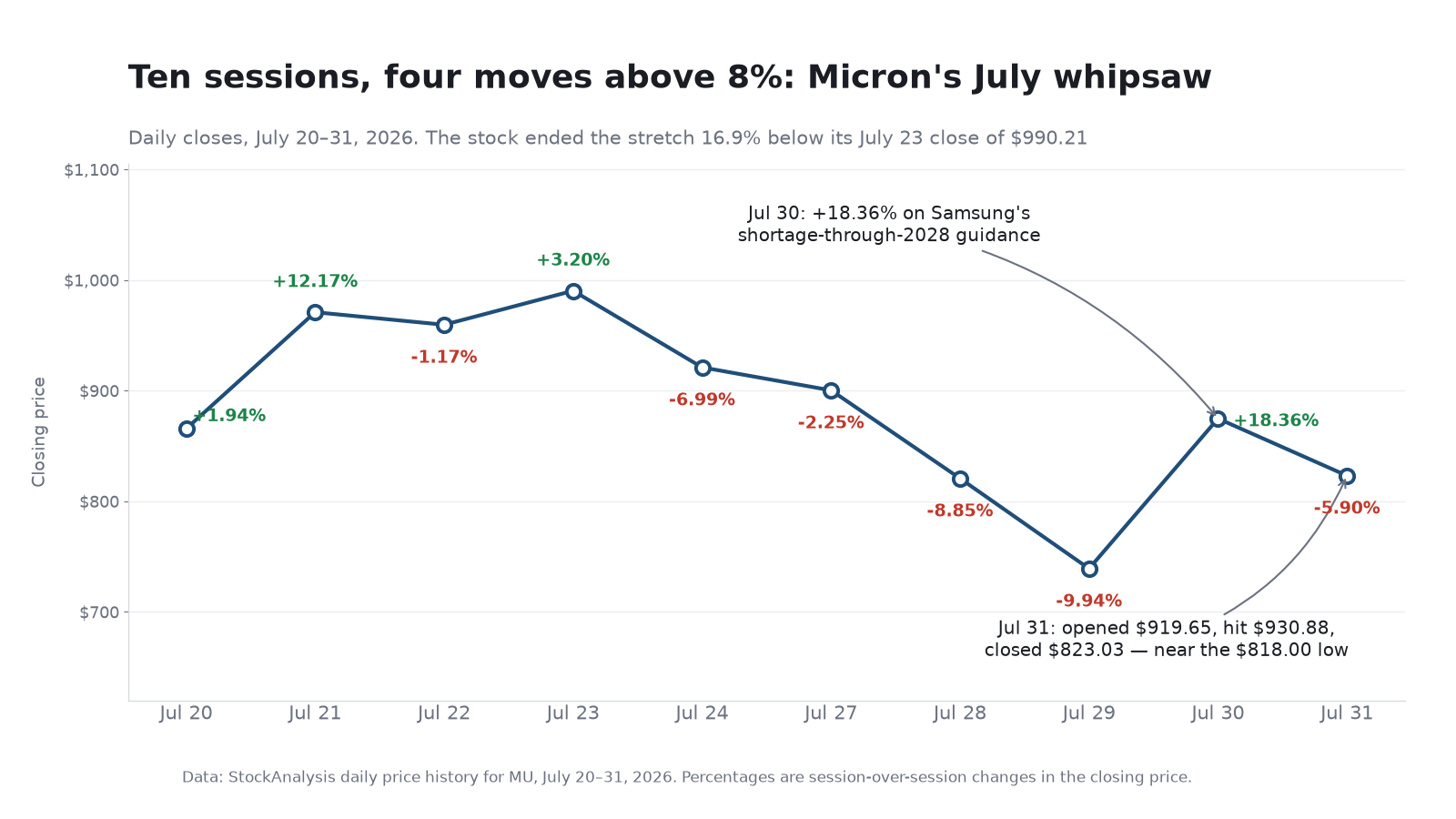
Extremely. In the ten sessions from July 20 to July 31, 2026, four moved more than 8%: −8.85% on July 28, −9.94% on July 29, +18.36% on July 30 and −5.90% on July 31, with a +12.17% session on July 21 as well. The stock closed July 31 at $823.03, some 16.9% below its July 23 close of $990.21 and 34.4% below its 52-week high of $1,255.00 — yet still more than 600% higher than a year earlier, against a 52-week low of $103.38. Friday's own range spanned $112.88, from $818.00 to $930.88, on roughly average volume.