Stock Analysis
Nucor (NUE) Drops ~6% as Q3 Guidance of $5.55–$5.65 Lands Below Street Estimates
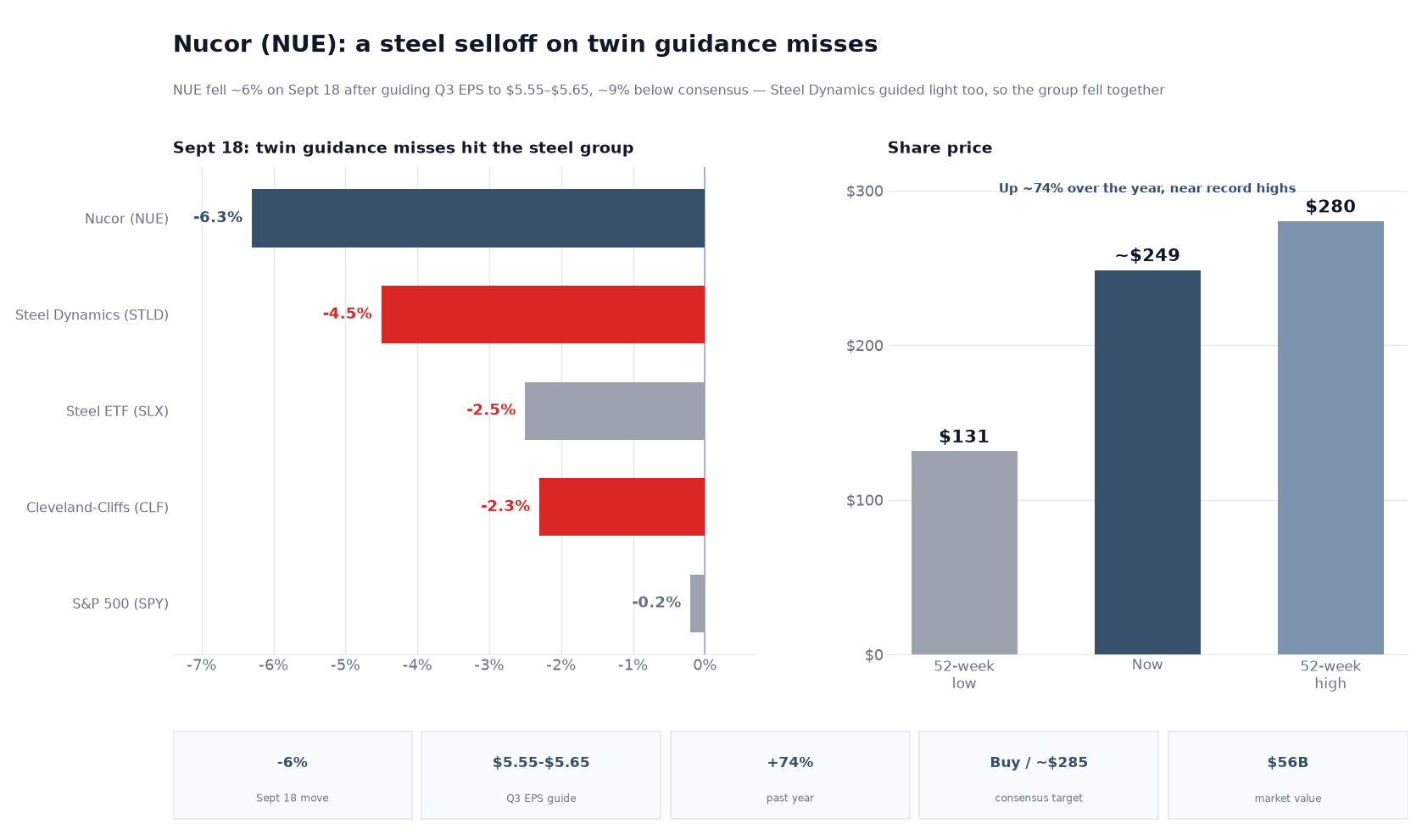
Nucor fell about 6% to roughly $249 on September 18 after guiding, on Thursday evening, to third-quarter earnings of $5.55–$5.65 a share — a strong number that nonetheless landed about 9% below the roughly $6.17 consensus. The miss is one of degree, not direction: the guide would still be a sequential increase from Q2's ~$5.04 and a huge jump from the $2.63 Nucor earned a year ago, with the core steel mills and steel products segments guided up, but a weaker raw-materials segment and the absence of two second-quarter tailwinds — a ~$130 million cash refund and a ~$61 million Helion valuation gain — drove the shortfall. On a cyclical up about 74% over the past year to near record highs, a guide below expectations was enough to trigger a pullback — and it was a sector signal, not just a Nucor one: Steel Dynamics guided its own Q3 below consensus the same evening, so the whole steel group sold off together, with Steel Dynamics off about 4.5% and the steel ETF lower while the S&P 500 barely moved. Analysts mostly trimmed targets but kept their Buys, leaving a consensus near $285, and the stock now trades near 13 times the 2026 earnings estimate. The real question the soft guide raises is whether the steel cycle is pausing or peaking, with 2027 earnings growth already seen slowing to low single digits.

Why Nucor stock dropped — a guidance miss, priced for perfection
On Friday, September 18, 2026, Nucor (NYSE: NUE) fell about 6%, trading near $248.53 intraday, down from a $265.14 prior close [1]. The catalyst was a pre-earnings guidance update the steelmaker issued after the close on Thursday: Nucor said it expects third-quarter earnings of $5.55 to $5.65 a share — a strong number in absolute terms, but about 9% below the roughly $6.17 consensus Wall Street was modeling [2]. For a stock that had run up about 74% over the past year to near record highs, a guide below expectations was enough to trigger a sharp pullback [1].
It is worth being precise about what "miss" means here. The guide would still be a sequential increase from the roughly $5.04 Nucor earned in the second quarter, and enormous growth year-over-year — it earned just $2.63 a share in the third quarter of 2025 [2]. So this is not a business falling apart, or even declining; the shortfall is purely versus what the Street had priced in. On a cyclical stock trading near its highs, that gap between very good and as-good-as-hoped is exactly what moves the shares.
What drove the shortfall
Nucor pointed to a mix inside the quarter. Earnings are expected to rise in the steel mills and steel products segments — the core business is still strengthening — but to fall in the raw materials segment [2]. Two prior-period tailwinds also do not repeat: the second quarter had benefited from about $130 million of cash refunds tied to earlier raw-material procurement costs, and from a roughly $61 million Helion valuation gain — their absence, plus higher intersegment eliminations, lifts corporate and eliminations expense in the third quarter [2]. In other words, the operating steel business is doing fine; the shortfall versus consensus is concentrated in raw materials and below-the-line items. Separately, on Friday morning, Nucor declared its 214th consecutive quarterly dividend — a reminder that this is one of the market's longest-running dividend growers, with 53 straight years of increases [2].
A cyclical that has already run a long way
Context matters because Nucor is a high-beta cyclical (a beta near 1.9) that had already delivered a huge move — up ~74% over the past year, from roughly $131 to near $280 at its peak, on a strengthening steel cycle helped by tariffs and reshoring demand [1]. The business is genuinely recovering: revenue grew about 17% over the past year to roughly $36 billion, and analysts see full-year 2026 earnings jumping to about $19 a share from a depressed prior year [3]. After the drop the stock trades near 13 times that 2026 estimate — not expensive for a market leader, but the key tell is what comes next: consensus has 2027 revenue roughly flat and earnings growing only modestly, to about $19.94 a share [3]. That is the real worry a soft third-quarter guide feeds — that the steel cycle is plateauing, and that a stock priced near its highs has less room for disappointment.
Why it matters
The episode is really a steel-sector signal, not just a Nucor one. On the same evening, the other big U.S. steel bellwether, Steel Dynamics, also guided its Q3 below consensus — $5.34 to $5.38 a share against a roughly $5.66 estimate — so both leaders flagged a lighter-than-hoped quarter at once [5]. That twin miss is why the whole group sold off on a day the S&P 500 barely moved: Steel Dynamics fell about 4.5% on its own guide, and Cleveland-Cliffs and the steel ETF followed in sympathy, with Nucor down the most. It is also a lesson in how cyclicals trade near a peak: the numbers can still be excellent and the stocks can still fall, because what is priced in is not the current quarter but the direction of the next several. Both companies guiding their core operations up while their shares drop is the whole story — the market is looking past a strong Q3 to what a cooling raw-materials backdrop and a slowing 2027 outlook imply about the cycle.
The move, in one cross-section
The same-day tape shows a steel-group selloff on twin guidance misses, not a broad-market move [5]:
| Name (ticker) | Sept 18, 2026 | Read-through |
|---|---|---|
| NUE — Nucor | ≈−6.3% | Guided Q3 EPS to $5.55–$5.65, ~9% below the ~$6.17 consensus [1][2] |
| STLD — Steel Dynamics | ≈−4.5% | Also guided Q3 below consensus ($5.34–$5.38 vs ~$5.66) the same evening [5] |
| SLX — Steel ETF | ≈−2.5% | The steel group broadly lower [5] |
| CLF — Cleveland-Cliffs | ≈−2.3% | Peer — a smaller decline with the group [5] |
| SPY — SPDR S&P 500 ETF | ≈−0.2% | The market was essentially flat [5] |
Nucor and Steel Dynamics both guiding below consensus, and the steel ETF falling while the market was flat, points to a steel-specific event — twin below-consensus guides — with Nucor down the most and the rest of the group following [5].
What the Street thinks
The reaction from analysts was measured: most trimmed targets but kept their Buys, treating the miss as digestible. The consensus rating is a Buy, with an average 12-month target near $285 — about 15% above the price — in a range from a low near $231 to a high near $310 [6]. On and just after the guide (September 17–18), J.P. Morgan's Bill Peterson reiterated a Buy at $308 and BMO's Katja Jancic a Buy at $295, while Goldman Sachs's Nick Cash (Buy, $302) and Wells Fargo's Timna Tanners (Buy, $280) shaved their targets modestly, and Freedom Capital's Vitaly Kononov sat at Hold — a rating some sources flag as a fresh downgrade — cutting his target to $285 [6]. The pattern — lower targets, unchanged ratings — says the Street sees a lighter quarter, not a broken thesis, and still values the stock well above where it trades.
What to watch
- The Q3 print. Whether the October 26 results land in the $5.55–$5.65 guided range and what management says about pricing and volumes into the fourth quarter [1].
- Steel prices and the cycle. Whether spot steel prices and the raw-materials drag stabilize, or point to the plateau the flat 2027 outlook implies [3].
- Peer reads. Whether the actual prints confirm the below-consensus guides from both Nucor and Steel Dynamics, and how the rest of the group's Q3 lands [5].
- The dividend and buyback. Whether Nucor keeps returning cash aggressively at these levels, a support for a cyclical. Moves are tracked on the NUE stock page [1].
Illustrative valuation sensitivity
The scenarios below are anchored to Nucor's forward earnings power (about 13× the 2026 estimate) and to the analyst target distribution (a low near $231, average ~$285, a high near $310) [6], turning on whether the steel cycle keeps strengthening or the soft guide marks a plateau. They are a descriptive, author-weighted exercise — not a forecast, target, recommendation, or intrinsic fair-value calculation — with subjective weights that sum to 100%.
| Scenario | Illustrative price | Weight | Key drivers |
|---|---|---|---|
| Upside | ~$300 | 30% | The soft guide proves a one-quarter blip, steel prices and volumes hold, and the stock re-rates back toward the analyst targets on continued cycle strength [6]. |
| Middle | ~$262 | 40% | The miss is digested, earnings stay strong but growth flattens as consensus expects, and the stock recovers part of the drop toward the middle of the analyst range [3]. |
| Downside | ~$225 | 30% | The guide signals a cyclical peak, steel prices soften into 2027, and the multiple compresses as earnings estimates come down [3]. |
Weighting those (0.30 × $300 + 0.40 × $262 + 0.30 × $225) gives an author-weighted reference value near $262, above Friday's ~$249 level and below the ~$285 consensus target [1][6] — reflecting a best-in-class cyclical whose next leg depends on whether the steel cycle is pausing or peaking, not on the strength of the current quarter. This is a Street-target-and-earnings-based scenario exercise and descriptive analysis of a news move, not investment advice.
NUE data snapshot — September 18, 2026
| Figure | Value | As-of / source |
|---|---|---|
| Intraday quote | ~$248.53 (−~6.3%) — an intraday reading (the session was still open) | Fri, Sep 18, 2026, ~12:58pm ET — StockAnalysis [1] |
| Prior close / open / range | $265.14 prior close; opened $254.26; day range $246.65–$259.00 | Sep 18, 2026 [1] |
| Volume vs average | ≈1.2M shares by early afternoon vs a ≈1.14M 20-day average for a full session — running roughly double the pace | Sep 18 — StockAnalysis [1] |
| 52-week range / trend | $131.32–$280.11; up ~74% over 52 weeks (near record highs before the drop); at its ~$254 50-day and above its ~$211 200-day | As of Sep 18 [1] |
| Market cap | ≈$56.4B (≈226.9M shares); beta ≈1.88 (cyclical) | Sep 18 — StockAnalysis [3] |
| Valuation | At ~$249: trailing P/E ≈19.9×; ≈13× the ~$19.11 FY26 EPS estimate; ≈1.56× sales; dividend yield ≈0.9% (Dividend King, ~18% payout) | Sep 18 — StockAnalysis [3] |
| Financials (TTM) | Revenue ≈$36.1B (+17.2%); net income ≈$2.87B; EPS $12.52; gross margin ≈16%; operating margin ≈12%; free cash flow ≈$1.58B; ROE ≈15% | TTM — StockAnalysis [3] |
| Catalyst | Guided Q3 2026 EPS to $5.55–$5.65, ~9% below the ~$6.17 consensus (still up sequentially from ~$5.04 in Q2 and from $2.63 a year ago); steel mills/products up, raw materials down; two Q2 tailwinds (a ~$130M cash refund, a ~$61M Helion gain) do not repeat. (The 214th consecutive dividend was declared separately Friday.) | Guidance after close Sep 17, reaction Sep 18 — company release [2] |
| Same-day peers | STLD −4.5% (also guided Q3 below consensus), CLF −2.3%, steel ETF (SLX) −2.5%; SPY −0.2% — a steel-group selloff on twin guidance misses | Sep 18 [5] |
| Analyst view | Consensus Buy, avg target ≈$285 (~15% above the price), range ~$231 to ~$310; on the guide (Sep 18) most trimmed targets but kept Buys: J.P. Morgan $308, Goldman $302, BMO $295, Wells Fargo $280; Freedom Capital Hold $285 | Sep 18, 2026 — StockAnalysis / analyst notes [6] |
Nucor (NUE) stock FAQ
Why did Nucor (NUE) stock drop on September 18, 2026?
Nucor fell about 6% to roughly $249 after issuing, on Thursday evening, third-quarter 2026 earnings guidance of $5.55 to $5.65 a share — about 9% below the roughly $6.17 analysts were expecting. It was a miss of degree, not direction: the guide would still be a sequential increase from Q2's roughly $5.04 and a large jump from the $2.63 Nucor earned a year earlier, but it came in cooler than the Street had priced into a stock that had already run up about 74% over the past year to near record highs. On a cyclical trading near its highs, guidance below expectations was enough to trigger a sharp pullback. (It was also a sector event: Steel Dynamics guided its own Q3 below consensus the same evening.)
What drove Nucor's lighter-than-expected guidance?
The shortfall was concentrated outside the core steel business. Nucor guided earnings to rise in its steel mills and steel products segments — the main operations are still strengthening — but to fall in its raw materials segment. Two second-quarter tailwinds also do not repeat: Q2 had benefited from about $130 million of cash refunds tied to earlier raw-material procurement costs, and from a roughly $61 million Helion valuation gain; their absence, plus higher intersegment eliminations, raises corporate and eliminations expense in the third quarter. So the operating steel business is doing well; the gap versus consensus came from raw materials and below-the-line items rather than a demand collapse. Separately, on Friday morning, Nucor declared its 214th consecutive quarterly dividend.
Why did other steel stocks fall when Nucor did?
Partly because they had their own bad news. On the same evening, Steel Dynamics — the other big U.S. steel bellwether — also guided its third quarter below consensus, to $5.34–$5.38 a share against a roughly $5.66 estimate, and fell about 4.5% on its own guide. So the steel group sold off on two simultaneous below-consensus guides, not simply a read-through from Nucor: Cleveland-Cliffs fell about 2.3% and the steel ETF about 2.5% in sympathy, while the S&P 500 was essentially flat. Nucor itself fell the most — about 6% — but the twin misses from the two largest steelmakers were read as a signal about the sector's third quarter, which is why the whole group moved.
Is Nucor stock cheap after the drop?
On the multiple, it is reasonable rather than cheap. After the pullback Nucor trades near 13 times its 2026 earnings estimate of about $19 a share, which is not demanding for the best-run U.S. steelmaker, with revenue up about 17% over the past year, roughly $1.6 billion of free cash flow, and one of the longest dividend-growth streaks in the market. The catch is the cycle: consensus has 2027 revenue roughly flat and earnings growing only modestly, so the low-looking multiple partly reflects the risk that earnings are near a peak. A cyclical can look inexpensive on trailing or current-year numbers right before the cycle turns, which is the debate the soft guide reopened.
What do analysts think of Nucor stock now?
The reaction was measured. Most analysts trimmed their price targets but kept their Buy ratings, treating the miss as digestible rather than thesis-breaking. The consensus rating is a Buy, with an average 12-month price target near $285 — about 15% above the current price — in a range from about $231 to $310. On and just after the guide (September 17–18), J.P. Morgan's Bill Peterson reiterated a Buy at $308 and BMO's Katja Jancic a Buy at $295, while Goldman Sachs's Nick Cash (Buy, $302) and Wells Fargo's Timna Tanners (Buy, $280) shaved their targets modestly, and Freedom Capital's Vitaly Kononov sat at Hold with a $285 target — a rating some sources report as a fresh downgrade. Lower targets with mostly unchanged ratings signal a lighter quarter, not a broken story.
What is the biggest risk for Nucor now?
That the steel cycle is peaking. Nucor is a high-beta cyclical whose earnings have recovered sharply, but consensus already sees 2027 revenue roughly flat and earnings growth slowing to low single digits, and a third-quarter guide below expectations — driven partly by a softer raw-materials segment — is the kind of signal that can precede a downturn. Because the stock had run up about 74% in a year, it has less room for disappointment, and cyclicals often de-rate before earnings actually fall. The offsetting strengths are a dominant, low-cost, diversified operating model, strong free cash flow, and a decades-long dividend-growth record that supports the shares through the cycle.