Stock Analysis
Chipotle (CMG) Surges ~6% on a Report Starbucks Explored a Takeover
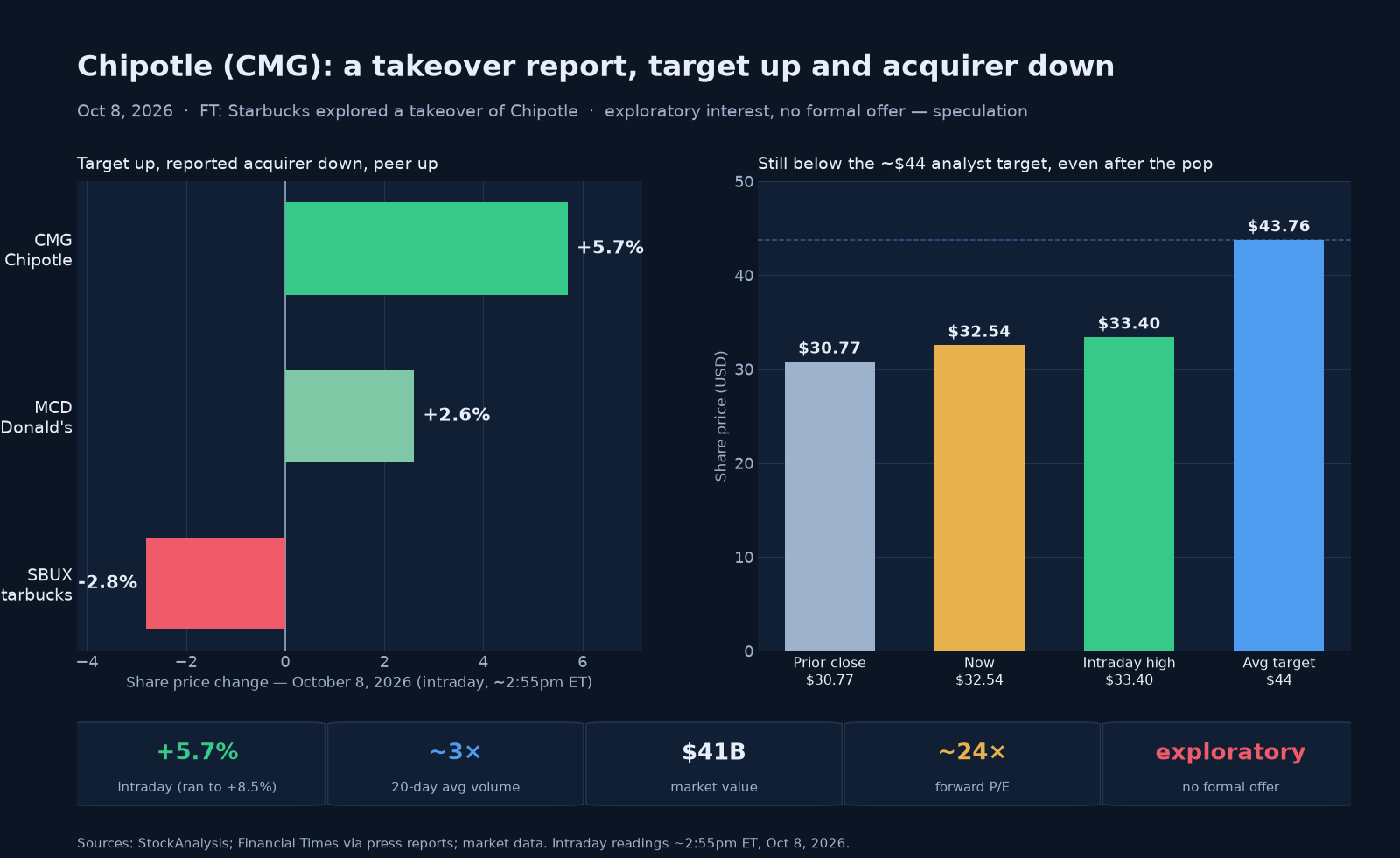
Chipotle jumped about 6% to roughly $32.54 on October 8 — after running as high as about $33.40 — on a Financial Times report that Starbucks has explored a potential takeover of the burrito chain. The key word is explored: the report describes preliminary, exploratory interest, not a formal offer, and neither company confirmed a deal, so this is a stock moving on takeover speculation that could reverse if the idea goes no further. The speculation still landed hard — volume ran about three times normal — because a Starbucks–Chipotle combination would be enormous (nearly $50 billion in combined sales, potentially the largest restaurant deal ever if completed) and would reunite Starbucks CEO Brian Niccol with the chain he ran from 2018 to 2024. It resonated partly because Chipotle had become cheap for Chipotle: down about 19% over the past year and trading below the ~$44 average analyst target even after the pop, a high-quality, cash-generative brand at a discount is exactly the profile that draws suitors. But skepticism is warranted: Starbucks fell about 3% on the prospect of a $45-billion-plus deal that would strain its balance sheet mid-turnaround, the strategic fit between coffee and fast-casual Mexican is debatable, and exploratory interest frequently never becomes an offer. The classic M&A-speculation cross-section — target up, acquirer down, McDonald's higher — tells the story; the next hard data is Chipotle's October 28 earnings.
Why Chipotle stock surged — a takeover report, not a takeover
On Thursday, October 8, 2026, Chipotle Mexican Grill (NYSE: CMG) jumped about 6%, trading near $32.54 intraday after running as high as $33.40 (about +8.5%) and paring the gain [1]. The catalyst was a Financial Times report that Starbucks has explored a potential takeover of Chipotle [2]. It is essential to be precise about what that is — and is not: the report describes preliminary, exploratory interest, with no formal offer publicly disclosed, and neither company has confirmed a deal — both declined to comment. This is a stock moving on takeover speculation, which is exactly the kind of move that can reverse if the idea goes no further.
That said, the speculation landed on fertile ground, which is why volume ran heavy — about 48 million shares, nearly three times the recent average [1]. A Starbucks–Chipotle combination would be enormous: together the two generate close to $50 billion in combined annual sales (combined revenue, not an acquisition price), so a completed combination could rank as the largest deal in restaurant-industry history [2]. And it carries an irresistible narrative hook — it would reunite Brian Niccol, now Starbucks' chief executive, with Chipotle, the chain he ran from 2018 to 2024 and turned into a growth machine before departing for Starbucks [2]. The market read it as credible enough to bid Chipotle up and mark Starbucks down.
Why Chipotle was a plausible target
The report resonates partly because Chipotle had become cheap for Chipotle. The stock is down about 19% over the past year, in a 52-week range of roughly $28 to $43, as same-store-sales growth slowed and the premium multiple the market long afforded it compressed [3]. Even after Thursday's pop, the shares trade below the average analyst price target near $44 — a sign that the Street already viewed the business as undervalued on fundamentals, before any takeover premium [6]. A high-quality, cash-generative brand trading at a discount to its own history is precisely the profile that attracts acquisition interest; the business itself remains strong, with roughly $12.4 billion in revenue, a 15% operating margin, and about $1.6 billion of free cash flow [3]. The weakness was in the stock, not the burritos.
The reasons for skepticism
For all the narrative appeal, a deal is far from a given, and the market's own reaction reflected doubt as much as enthusiasm. Starbucks shares fell about 3% — the typical response to an acquirer contemplating a very large, expensive purchase [5]. And it would be very large: buying Chipotle at a takeover premium would cost Starbucks on the order of $45 billion or more against its own market value near $100 billion, a transformative, balance-sheet-stretching move for a company already working through its own turnaround [5]. There are strategic questions, too: Starbucks (coffee, beverage-led, heavy franchising abroad) and Chipotle (company-owned fast-casual Mexican food) are different businesses, and the case for combining them rests more on operational playbooks and Niccol's familiarity than on obvious synergies. In short, the logic is plausible enough to move the stocks but speculative enough that the burden of proof sits with the dealmakers. The surge in bullish options activity — Chipotle call volume spiked relative to puts — says traders are positioning for a catalyst, not banking a certainty [2].
Why it matters
The episode is a textbook M&A-speculation move, and the cross-section shows it cleanly: the target rose, the reported acquirer fell, and a sector peer ticked up. Chipotle gained about 6% on the prospect of a premium; Starbucks fell about 3% on the prospect of paying one; and McDonald's rose about 2.6%, a read-through that restaurant-sector consolidation — or simply a defensive bid on a down-market day — can lift the group [5]. It is also a lesson in how much of a stock's price can hinge on a single report: a company whose shares had drifted lower for a year added billions in value in an afternoon on exploratory interest, with no offer on the table. That asymmetry cuts both ways — the same shares that gapped up on a report would give the gain back on a denial. The durable point beneath the speculation is that the market was reminded, forcibly, that it had been valuing Chipotle below where analysts peg its fundamentals.
The move, in one cross-section
The same-session tape shows the classic M&A-speculation pattern [5]:
| Name (ticker) | Oct 8, 2026 (intraday) | Read-through |
|---|---|---|
| CMG — Chipotle | ≈+5.7% (ran to ~+8.5%) | The reported takeover target; up on the prospect of a premium [1][2] |
| SBUX — Starbucks | ≈−2.8% | The reported acquirer — down on the prospect of a large, expensive deal [5] |
| MCD — McDonald's | ≈+2.6% | Sector peer — higher on the read-through (and a defensive bid on a down day) [5] |
The target up, the reported acquirer down, and a peer higher is the signature of takeover speculation — a report moving the stocks, not a completed transaction [5].
What the Street thinks
The analyst picture is bullish on fundamentals and predates the takeover report, so it is best read as the backdrop the speculation landed on, not a reaction to it. The consensus rating is a Buy, with an average target near $44 — well above where the stock trades even after the jump [6]. Recent marks, all set before Thursday, span a range: RBC Capital's Logan Reich at a Buy with a $45 target, J.P. Morgan's John Ivankoe at Overweight but trimming to $37 (from $40) on slower trends, and Seaport Global's Eric Gonzalez at a Hold with a $35 target [6]. The common thread is that Wall Street already saw Chipotle as worth more than its depressed price on the business alone; the Starbucks report adds takeover optionality on top of that, which is why the shares moved toward — but still below — the fundamental targets rather than toward a deal price.
What to watch
- Confirmation or denial. Whether Starbucks, Chipotle, or the reporting firms advance, confirm, or quash the story — the single biggest swing factor for the stock from here [2].
- A formal approach and price. Whether exploratory interest becomes an actual offer, and at what premium to the undisturbed ~$30.77 pre-report price [1].
- Chipotle's October 28 earnings. The next hard fundamental data point — comparable sales and traffic trends that drove the stock's year-long derating in the first place [3].
- Starbucks' posture. Any signal on whether a company mid-turnaround would stretch to a $45-billion-plus acquisition. Moves are tracked on the CMG stock page [5].
Illustrative takeover-outcome sensitivity
Because the move is driven by an unconfirmed takeover report, the scenarios below are anchored to deal outcomes and fundamental value, not a single valuation — the undisturbed pre-report price near $30.77, Chipotle's own fundamental value (where analysts peg it near $44), and the probability that exploratory interest becomes an actual, premium offer [6]. They are a descriptive, author-weighted exercise over roughly the coming six-to-twelve months as the takeover question resolves — not a forecast, target, recommendation, or merger-arbitrage advice — with subjective weights that sum to 100%.
| Scenario | Illustrative price | Weight | Key drivers |
|---|---|---|---|
| Offer materializes | ~$45 | 20% | Exploratory interest becomes a firm bid at a takeover premium, pushing the stock toward a deal price around its fundamental value and above [6]. |
| No deal, re-rates on value | ~$36 | 40% | No imminent offer, but the episode refocuses attention on a beaten-down, cash-generative brand, and the stock holds part of the gain toward its fundamental worth / stays "in play" [3]. |
| Speculation fades | ~$31 | 40% | A denial, silence, or stalled interest unwinds the speculative premium, and the stock reverts toward its undisturbed pre-report level [1]. |
Weighting those (0.20 × $45 + 0.40 × $36 + 0.40 × $31) gives an author-weighted reference value near $36 — an illustrative, probability-weighted scenario output mechanically derived from the weights above, and not a price target, fair-value estimate, or prediction that a deal occurs — above Thursday's ~$32.54 level and well below a takeover price [1][6], reflecting a beaten-down stock that carries both genuine fundamental value and new, uncertain takeover optionality. This is a deal-outcome-and-fundamentals scenario exercise and descriptive analysis of a news-driven move, not investment advice.
CMG data snapshot — October 8, 2026
| Figure | Value | As-of / source |
|---|---|---|
| Intraday quote | ~$32.54 (+~5.7%) — an intraday reading (the session was open); it ran to a $33.40 high (~+8.5%) and pared | Thu, Oct 8, 2026, ~2:55pm ET — StockAnalysis [1] |
| Prior close / open / range | $30.77 prior close; opened $30.68; day range $30.46–$33.40 | Oct 8, 2026 [1] |
| Volume vs average | ≈47.9M shares by ~2:55pm vs a ≈17.1M 20-day average — roughly 3× normal (a genuine-event move) | Oct 8 — StockAnalysis [1] |
| 52-week trend | 52-week range $28.04–$42.82; down ~19% over 52 weeks (a laggard before the report); beta ≈0.96 | As of Oct 8 [3] |
| Market cap | ≈$41.2B (≈1.27B shares, post 50-for-1 split) | Oct 8 — StockAnalysis [3] |
| Valuation | At ~$32.54: trailing P/E ≈28.5×; forward P/E ≈24×; price-to-sales ≈3.2× | Oct 8 — StockAnalysis [3] |
| Financials (TTM) | Revenue ≈$12.4B (+7.3%, slowing); net income ≈$1.42B; gross margin ≈39%; operating margin ≈15%; free cash flow ≈$1.57B | TTM — StockAnalysis [3] |
| Catalyst | A Financial Times report that Starbucks has explored a potential takeover of Chipotle — preliminary, exploratory interest with no formal offer, unconfirmed by the companies. A combination (~$50B combined sales) could, if completed, rank as the largest restaurant deal ever and would reunite Starbucks CEO Brian Niccol with Chipotle. Takeover speculation that could fade | Oct 8, 2026 — FT via press reports [2] |
| Same-day cross-section | SBUX −2.8% (the reported acquirer), MCD +2.6% (sector peer) — target up, acquirer down, peer up | Oct 8 intraday [5] |
| Analyst view | Consensus Buy, avg target ~$44 (above the price) — pre-dating the report: RBC Buy $45, J.P. Morgan Overweight $37 (from $40), Seaport Hold $35; next earnings Oct 28, 2026 | Oct 8, 2026 — StockAnalysis / analyst notes [6] |
Chipotle (CMG) stock FAQ
Why did Chipotle (CMG) stock surge on October 8, 2026?
Chipotle jumped about 6% to roughly $32.54, after running as high as about $33.40, on a Financial Times report that Starbucks has explored a potential takeover of the chain. The crucial detail is that this is exploratory interest, not a formal offer — the report describes preliminary interest, and neither company confirmed a deal — so the move is driven by takeover speculation rather than an announced transaction. Volume ran about three times normal, reflecting how seriously the market took the possibility: a completed Starbucks–Chipotle combination could rank as the largest deal in restaurant history and would reunite Starbucks CEO Brian Niccol with Chipotle, which he led from 2018 to 2024. Because it is speculation, the gain could fade if the idea does not advance.
Is Starbucks actually buying Chipotle?
Not as of this report — there is no announced deal and no confirmed formal offer. The Financial Times reported that Starbucks has explored a potential takeover, which describes preliminary, exploratory interest; neither company has confirmed a transaction, and both declined to comment on the speculation. Markets priced in some probability of a deal (Chipotle rose about 6%, Starbucks fell about 3%), but exploratory interest of this kind frequently never becomes an offer. A deal would also be very large — buying Chipotle at a premium would cost Starbucks on the order of $45 billion or more against its own roughly $100 billion market value — and would face questions about strategic fit and Starbucks' willingness to stretch its balance sheet mid-turnaround. In short, it is a report to watch, not a transaction to assume.
Why did Starbucks stock fall if it is the one interested in buying?
That is the typical pattern when a potential acquirer is reported to be weighing a large, expensive purchase: the target rises on the prospect of a premium, and the acquirer falls on the prospect of paying one. Starbucks shares declined about 3% because buying Chipotle at a takeover premium would be an enormous, transformative outlay — on the order of $45 billion or more against Starbucks' roughly $100 billion market value — for a company already working through its own turnaround. Investors also question the strategic fit between Starbucks' coffee-and-beverage model and Chipotle's company-owned fast-casual Mexican format. The market's split reaction — Chipotle up, Starbucks down — reflects both the appeal of the idea and real doubt about whether, and at what cost, Starbucks would pursue it.
Was Chipotle stock cheap before the report?
Yes, relatively. Chipotle shares were down about 19% over the past year, in a 52-week range of roughly $28 to $43, as same-store-sales growth slowed and the premium valuation the market long assigned the stock compressed. Even after the roughly 6% jump on the takeover report, the shares trade below the average analyst price target near $44, meaning Wall Street already viewed the business as undervalued on fundamentals before Starbucks' name surfaced. The underlying business remained strong — roughly $12.4 billion in revenue, a 15% operating margin, and about $1.6 billion of free cash flow — so the weakness was in the stock price, not the operations. That discount is part of why a takeover report was credible enough to move the shares: a high-quality brand trading below its own history is a classic acquisition candidate.
What would a Starbucks–Chipotle deal look like?
On the numbers, it would be historic: the two companies together generate close to $50 billion in combined annual sales (combined revenue, not a purchase price), so a completed combination could rank as the largest deal in restaurant-industry history. It also has a strong personal narrative — it would reunite Brian Niccol, now Starbucks' chief executive, with Chipotle, the company he ran from 2018 to 2024 and turned into one of the sector's best performers. Strategically, though, the fit is debatable: Starbucks is a beverage-led, heavily franchised global coffee company, while Chipotle is a company-owned fast-casual Mexican chain, so the synergies are less obvious than in a same-category merger and lean on shared operating expertise. And the price would be steep — likely $45 billion or more with a premium — which is a lot for Starbucks to take on while fixing its own business. Those frictions are why the report moved the stocks but a deal is far from certain.
What should investors watch next for Chipotle?
Three things. First, confirmation or denial: any statement from Starbucks, Chipotle, or further reporting that advances or quashes the story is the single biggest swing factor, because the move rests on an unconfirmed report. Second, whether exploratory interest becomes an actual offer and at what premium to the undisturbed pre-report price near $30.77. Third, Chipotle's own earnings on October 28, which will provide the next hard read on the comparable-sales and traffic trends that drove the stock's year-long derating — and which matter regardless of whether a deal materializes. Because the surge is speculation-driven, the stock is unusually headline-sensitive in the near term: it can give back the gain on a denial as quickly as it rose on the report.