Stock Analysis
PTC Inc. (PTC) Jumps ~35% as Schneider Electric Agrees to a $22.6 Billion Cash Takeover
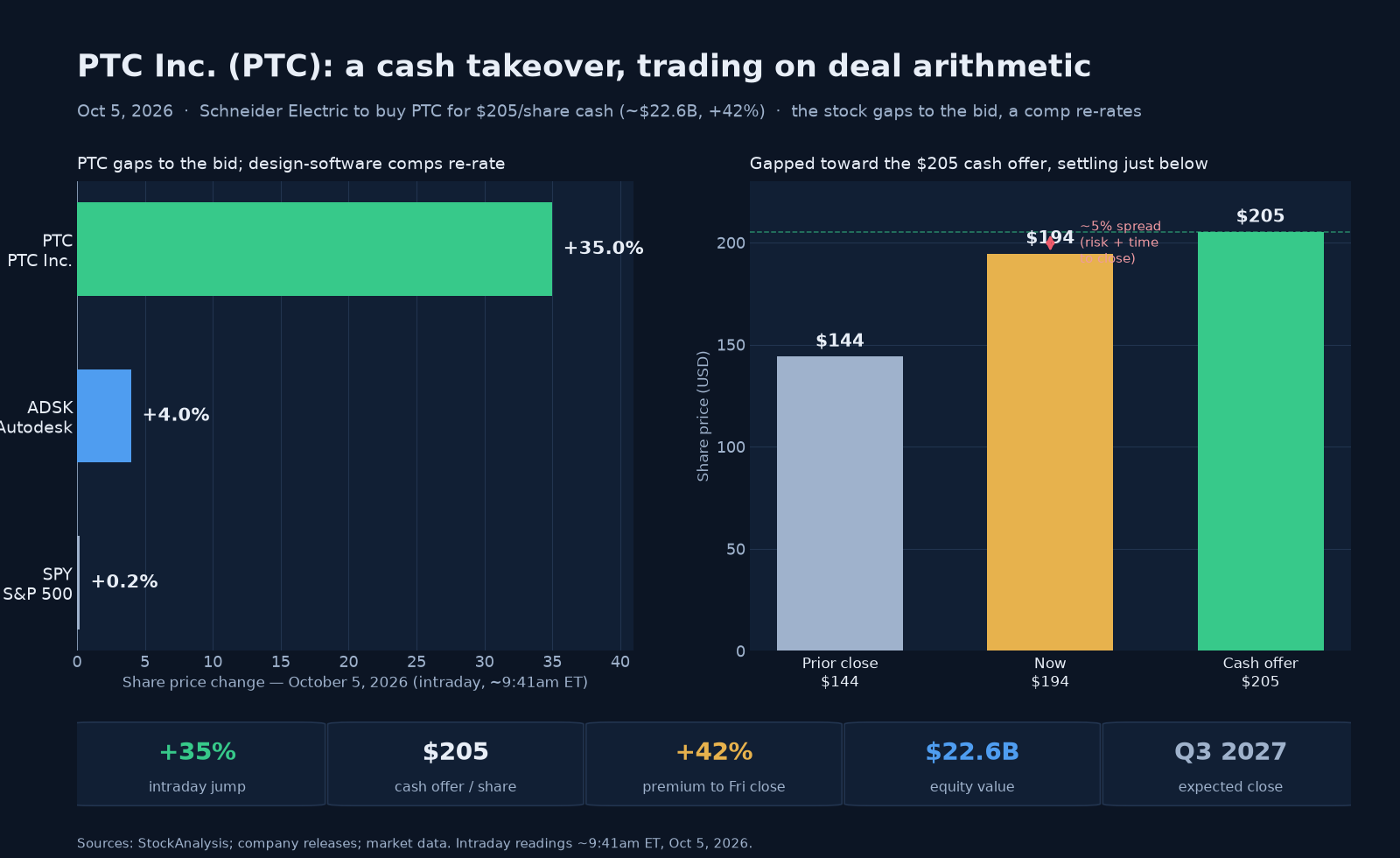
PTC Inc. jumped about 35% to roughly $194.49 on October 5 after Schneider Electric agreed to acquire the industrial-software maker in an all-cash deal at $205 a share — valuing PTC's equity near $22.6 billion, a 42.3% premium to Friday's close, in what would be Schneider's largest acquisition ever. With a firm cash bid in hand, the stock stopped trading on fundamentals and started trading on deal arithmetic: it gapped toward the offer but settled about 5% below it, a merger spread that prices the time and risk to a close expected by the third quarter of 2027, subject to a PTC shareholder vote and antitrust and CFIUS clearances. The logic is industrial software and AI — PTC's design and lifecycle tools (Creo, Windchill) carry an 84% gross margin and about $935 million of free cash flow, and the company had de-rated with the software group on AI fears, which is what made it available at a price Schneider would pay a premium over. The deal is also a read-through for the sector: design-software peers like Autodesk and Dassault Systèmes rose in sympathy as the price reframed what these assets are worth, while Loop Capital, Baird and Rosenblatt all moved PTC toward Hold/Neutral at the deal price — the textbook reaction to a fixed cash bid. The investment question now is simply whether the deal closes.
Why PTC stock jumped — a $22.6 billion cash takeover
On Monday, October 5, 2026, PTC Inc. (NASDAQ: PTC) jumped about 35%, trading near $194.49 in Monday-morning trading (an intraday reading, with the session still open), up from a $144.03 prior close [1]. The reason is as clean as market catalysts get: Schneider Electric agreed to acquire PTC in an all-cash deal at $205.00 a share, valuing the industrial-software maker's equity at roughly $22.6 billion — a 42.3% premium to Friday's close [2]. The deal — announced before Monday's open, with the merger agreement signed the prior day (Sunday, October 4) — was unanimously approved by both boards and would be Schneider Electric's largest acquisition ever, exceeding its roughly $11 billion purchase of Aveva [2].
When a company receives a firm, all-cash takeover bid, its stock stops trading on fundamentals and starts trading on deal arithmetic. That is exactly what happened here: PTC leapt toward the $205 offer but settled about 5% below it, near $194.49 [1]. That gap — the "merger spread" — is not skepticism about the price; it is the market pricing in the time and risk between signing and closing. Measured against the offer, the shares sit at about a 5% discount (the spread) to the $205 consideration — the return a buyer would earn if the deal completes [1]. The companies expect to close by the third quarter of 2027, though the merger agreement's regulatory long-stop date extends to January 4, 2028 — so the return is earned over roughly a year or more, subject to a PTC shareholder vote and regulatory clearances, and, helpfully for completion odds, the deal carries no financing condition [2].
The conditions that define the spread
The path to $205 runs through three gates [2]. First, PTC shareholders must approve the agreement — a low hurdle given the 42% premium and the board's unanimous recommendation. Second, antitrust review: the deal needs clearance under the U.S. Hart-Scott-Rodino Act and foreign competition laws, though Schneider (industrial automation and energy management) and PTC (design and lifecycle software) overlap little, which argues for a clean path. Third, and most distinctive here, CFIUS — the Committee on Foreign Investment in the United States — must review the purchase of a U.S. software company by a French acquirer. None of these is unusual for a deal this size, but together they explain why the stock sits a few dollars under the cash price rather than right at it.
Why Schneider wanted PTC
Strip away the deal mechanics and the logic is about industrial software and AI. PTC makes the tools engineers use to design and manage physical products — computer-aided design (Creo), product-lifecycle management (Windchill), and application- and service-lifecycle management (ALM and SLM) software — for industries from automotive to aerospace to medical devices; it had sharpened that focus earlier in 2026 by selling its ThingWorx IoT and Kepware connectivity business to a private-equity buyer [2]. Schneider's CEO framed the acquisition as creating "the industry's most complete Software & AI powerhouse," connecting data across the full lifecycle of products and assets [2]. It is a high-quality asset: PTC carries software-like economics — an 84% gross margin, a GAAP operating margin near 38%, and about $935 million of free cash flow on roughly $2.95 billion of revenue (reported trailing growth near 20%, a figure whose comparability is blurred by the divestiture) [3]. Notably, PTC had been a laggard into the bid — the stock had fallen roughly 17% from the start of 2026 amid worries about AI's effect on software multiples and some company-specific noise, including that divestiture — which is precisely what made it available at a price Schneider was willing to pay a large premium over [2].
Why it matters
The deal is also a read-through for the whole engineering-software group. For months the sector had de-rated on worries that generative AI would commoditize software; a strategic acquirer paying a 42% premium for one of its leaders is a concrete counter-argument, and the market treated it that way. a basket of design- and engineering-software names rose in sympathy — Autodesk, Dassault Systèmes and Nemetschek among them, up roughly a few percent apiece — not because anything changed at those companies but because the PTC price "reframes" what these assets are worth to a strategic buyer [5]. That is the signature of an M&A re-rating: the target gaps to the bid, and the closest comparables move in sympathy as investors mark their valuations to the deal, while the broad market (the S&P 500 was essentially flat) does nothing [5]. It is also one of several industrial-software purchases by Schneider in recent months, underscoring a deliberate push to buy its way into the industrial-AI stack rather than build it.
The move, in one cross-section
The same-session tape shows a deal-driven move, not a market one [5]:
| Name (ticker) | Oct 5, 2026 (intraday) | Read-through |
|---|---|---|
| PTC — PTC Inc. | ≈+35% | Jumped toward Schneider's $205 all-cash offer; now ~5% below it (the merger spread) [1][2] |
| ADSK — Autodesk | ≈+4% (early) | Design-software comp re-rating as the deal reframes sector valuations (Dassault, Nemetschek also up) [5] |
| SPY — SPDR S&P 500 ETF | ≈+0.2% | The broad market was essentially flat [5] |
PTC gapping to the bid while a close comparable (Autodesk) rose and the market stayed flat points to a company-specific M&A event — the Schneider acquisition — with a sympathy re-rating in engineering software, not a broad move [5].
What the Street thinks
Analyst behavior after a cash bid is distinctive, and it showed up immediately: on October 5, Loop Capital's Yun Kim downgraded PTC from Buy to Hold, raising the target to $205 (from $200) — not a bearish call but a mechanical one, moving the rating and target to the deal price because there is no fundamental upside beyond a fixed cash offer [6]. Loop was not alone: Baird and Rosenblatt also cut PTC to Neutral after the announcement — the textbook reaction to an acquisition, as targets converge on the bid and ratings drift to Hold or Neutral [6]. The pre-bid consensus is now largely moot, for context only — a Buy rating with an average target near $174, which sat below both the post-announcement price and the offer, with recent pre-deal marks like Berenberg's Hold at $170 and Citi's Neutral at $141 [6]. In other words, the Street valued PTC well under $205 on fundamentals; it took a strategic buyer to put that number on the table.
What to watch
- The shareholder vote. PTC holders of a majority of outstanding shares must approve; the 42% premium and unanimous board recommendation make approval the likely outcome [2].
- Antitrust and CFIUS. The HSR waiting period, any foreign merger reviews, and the CFIUS review of a French acquirer buying a U.S. software firm — the main sources of timeline and completion risk [2].
- The spread and the timeline. Whether the gap to $205 narrows as milestones clear, against an expected close by Q3 2027 (with a regulatory long-stop date extending to January 4, 2028) [2].
- A rival bid. Unlikely given the premium, but PTC can engage a qualifying superior proposal under the agreement — which would trigger a roughly $700 million termination fee — so a competing offer is the only realistic path to more than $205. Moves are tracked on the PTC stock page [1].
Illustrative deal-outcome sensitivity
Because PTC now trades on an announced cash deal, the scenarios below are anchored to deal outcomes, not a fundamental valuation — the $205 cash offer, the pre-bid price near $144, and the probability the transaction completes on its expected timeline [2]. They are a descriptive, author-weighted exercise — not a forecast, target, recommendation, or merger-arbitrage advice — with subjective weights that sum to 100%.
| Scenario | Illustrative price | Weight | Key drivers |
|---|---|---|---|
| Deal completes | ~$205 | 75% | Shareholders approve, antitrust and CFIUS clear, and the transaction closes at the $205 cash price by around Q3 2027 [2]. |
| Friction / delay | ~$190 | 10% | Regulatory review drags or conditions slip the timeline; the deal still completes, but time value and added uncertainty keep the stock below the offer for longer [2]. |
| Deal breaks | ~$150 | 15% | A regulatory block (antitrust/CFIUS) or a failed vote ends the deal, and the shares revert toward their pre-bid ~$144 level, with some residual takeover speculation [1]. |
Weighting those (0.75 × $205 + 0.10 × $190 + 0.15 × $150) gives an author-weighted reference value near $195 — an illustrative, probability-weighted scenario output mechanically derived from the weights above, and not a price target, fair value, expected return, or merger-arbitrage recommendation — essentially in line with Monday-morning's ~$194.49 level and just below the $205 offer [1][2], which is exactly what an efficiently priced merger spread looks like: the market is discounting a high-probability close for time and completion risk. This is a deal-arithmetic exercise and descriptive analysis of an announced transaction, not investment advice.
PTC data snapshot — October 5, 2026
| Figure | Value | As-of / source |
|---|---|---|
| Intraday quote | ~$194.49 (+~35%) — an intraday reading (the session was open) | Mon, Oct 5, 2026, ~9:41am ET — StockAnalysis [1] |
| Prior close / open | $144.03 prior close; opened $195.79 (gapped to the bid) | Oct 5, 2026 [1] |
| Volume vs average | ≈5.5M shares by ~9:41am vs a ≈1.80M 20-day average for a full session — already ~3× a full day's volume within minutes of the open | Oct 5 — StockAnalysis [1] |
| Deal price / spread | $205.00 all-cash offer; the stock sits ~5% below it — a ~5% discount (the merger spread), i.e. the return a buyer earns if the deal completes | Oct 5 [1] |
| Market cap | ≈$21.1B at the post-jump price (≈108.5M shares); before the bid equity was ≈$15.6B; the $205 offer values it at ≈$22.6B (≈$23.7B enterprise value); beta ≈1.00 | Oct 5 — StockAnalysis [3] |
| Valuation (pre-bid context) | At the ~$144 pre-bid price: trailing P/E ≈14×, forward P/E ≈17×, P/S ≈5.3× — but trailing earnings include a ~$465M ThingWorx/Kepware divestiture gain, so the ≈14× trailing P/E is artificially low; shown as context for the premium, not a basis for the post-bid price | Oct 5 — StockAnalysis [3] |
| Financials (TTM) | Revenue ≈$2.95B (reported +19.5%, but the period straddles the divestiture); net income ≈$1.22B (incl. a ~$465M divestiture gain); gross margin ≈84.5%; GAAP operating margin ≈38%; free cash flow ≈$935M; debt/equity ≈0.46 | TTM — StockAnalysis / SEC filings [3] |
| Catalyst | Schneider Electric agreed to acquire PTC for $205.00/share in cash (~$22.6B equity, a 42.3% premium); merger agreement signed Oct 4, announced Oct 5, unanimously approved by both boards; close expected by Q3 2027 (regulatory long-stop to Jan 4, 2028), subject to a PTC shareholder vote and clearances (HSR antitrust, CFIUS); no financing condition | Oct 4–5, 2026 — company releases / 8-K [2] |
| Same-day cross-section | ADSK ~+4% early (design-software comp re-rates; Dassault, Nemetschek also up a few percent), SPY +0.2% (market flat); Schneider Electric (Paris) is the acquirer, Dassault Systèmes the closest listed PLM peer | Oct 5 intraday [5] |
| Analyst view | Oct 5: Loop Capital (Yun Kim) downgraded Buy→Hold, target $200→$205 (= the deal price); Baird and Rosenblatt also cut to Neutral. Pre-bid consensus was a Buy, avg target ~$174 (below the offer) — now moot; prior marks included Berenberg Hold $170, Citi Neutral $141 | Oct 5, 2026 — StockAnalysis / analyst notes [6] |
PTC Inc. (PTC) stock FAQ
Why did PTC stock jump on October 5, 2026?
PTC jumped about 35% to roughly $194.49 after Schneider Electric agreed to acquire it in an all-cash deal at $205.00 a share, valuing PTC's equity at about $22.6 billion — a 42.3% premium to the prior close of $144.03. The merger agreement was signed on Sunday, October 4 and announced before Monday's open; unanimously approved by both companies' boards, it would be Schneider Electric's largest acquisition ever. Once a firm cash takeover is announced, the stock stops reflecting fundamentals and instead tracks the offer price, which is why PTC gapped up toward $205.
Why is PTC trading below the $205 offer price?
The gap — about 5% below the $205 offer — is the 'merger spread,' and it reflects the time and risk between signing and closing rather than doubt about the price. The companies expect the deal to close by the third quarter of 2027, subject to a PTC shareholder vote and regulatory clearances, so the shares trade at a discount to the cash price to compensate a buyer for waiting roughly nine to twelve months and for the possibility, however small, that the deal does not complete. As milestones clear, the spread typically narrows toward the offer; if the deal were to break, the stock would likely fall back toward its pre-bid level near $144.
What does Schneider Electric get from buying PTC?
PTC makes the software engineers use to design and manage physical products — computer-aided design (Creo), product-lifecycle management (Windchill), and application- and service-lifecycle management (ALM and SLM) — used across automotive, aerospace, and medical-device industries (it sold its ThingWorx IoT and Kepware connectivity business to a private-equity buyer earlier in 2026). Schneider Electric, an automation and energy-management company, framed the acquisition as creating 'the industry's most complete Software & AI powerhouse,' connecting data across the full lifecycle of products and assets. It is also a high-quality financial asset, with an 84% gross margin, a GAAP operating margin near 38%, and about $935 million of free cash flow on roughly $2.95 billion of revenue. The deal is Schneider's largest ever and part of a broader push to buy into the industrial-AI software stack.
What has to happen for the deal to close?
Three main conditions. First, PTC shareholders holding a majority of outstanding shares must approve the agreement at a special meeting — a low hurdle given the 42% premium and the board's unanimous recommendation. Second, the deal must clear antitrust review, including the U.S. Hart-Scott-Rodino waiting period and any foreign merger controls; the overlap between an automation-and-energy company and a design-software company is limited, which argues for a clean path. Third, because a French company is buying a U.S. software firm, the Committee on Foreign Investment in the United States (CFIUS) must review the transaction. The companies expect to close by the third quarter of 2027, with a regulatory long-stop date extending to January 4, 2028; helpfully for completion odds, the deal is not conditioned on Schneider's financing.
Why did Autodesk stock rise when PTC was acquired?
Autodesk rose a few percent — and peers like Dassault Systèmes and Nemetschek also ticked up — not because of any company-specific news but as a sympathy re-rating. For months, engineering- and design-software stocks had de-rated on fears that AI would pressure software valuations. A strategic acquirer paying a 42% premium for PTC is a concrete counter-argument, so investors marked up the closest comparables to reflect what these assets are apparently worth to a buyer. That pattern — the target gapping to the bid and comparables moving in sympathy while the broad market stays flat — is the signature of an M&A re-rating rather than a sector-wide fundamental change.
Is PTC stock a buy after the jump?
This article is descriptive analysis, not investment advice, and an announced cash deal changes the question entirely. The upside is capped at the $205 offer, so the remaining return from here is essentially the roughly 5% spread, earned only if the deal completes over the next nine to twelve months — an annualized merger-arbitrage yield in the mid-single digits that is attractive only to the extent one judges completion likely. Against that, the downside if the deal breaks is a fall back toward the pre-bid level near $144. In short, the decision is no longer about PTC's business quality or growth; it is a judgment about deal-completion probability, regulatory risk (including CFIUS), and timing.