Stock Analysis
Western Digital (WDC) Drops ~10% as Toshiba Plans to Double AI/Data-Center HDD Capacity
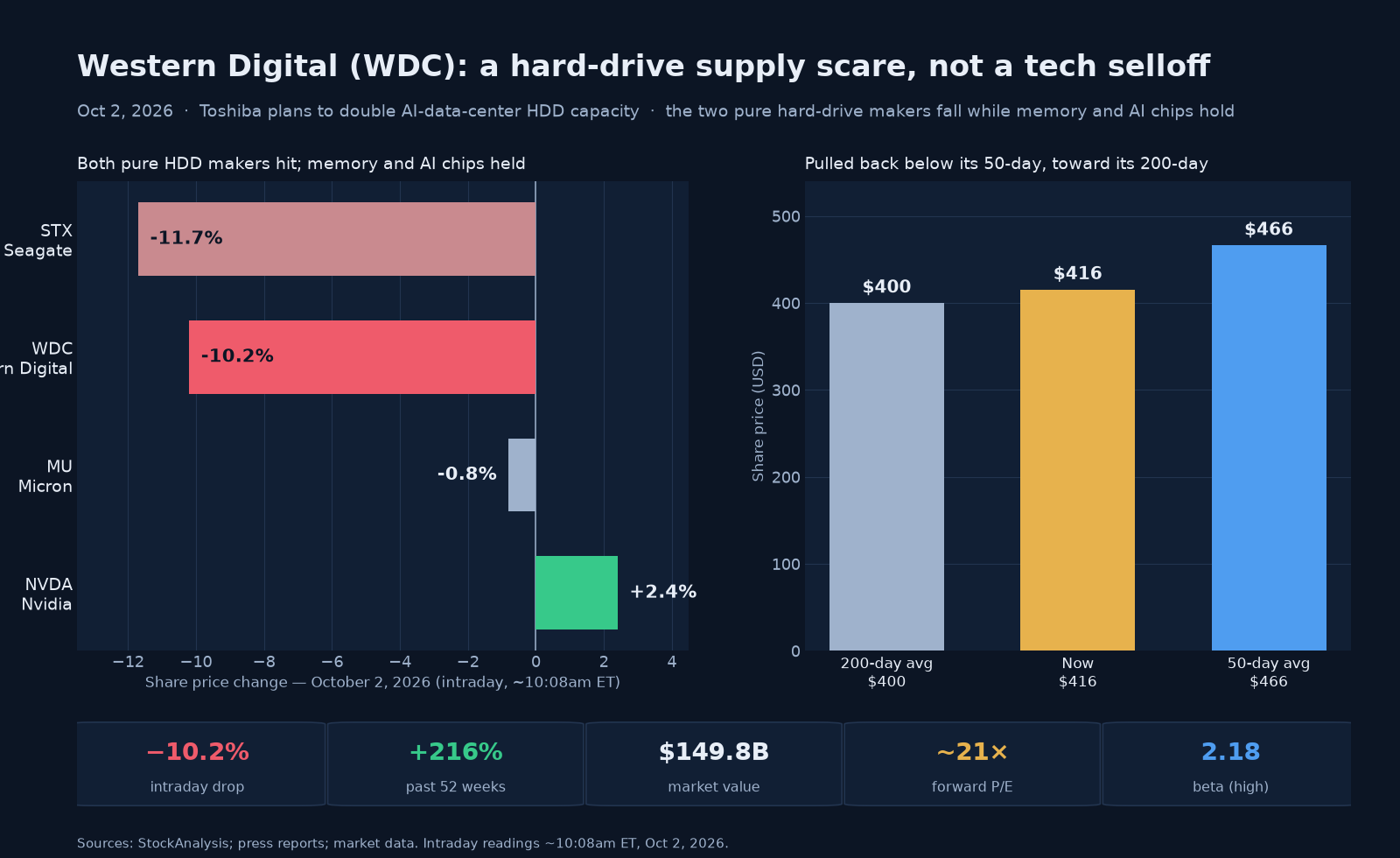
Western Digital fell about 10% to roughly $415.50 intraday on October 2 after a report, traced to Nikkei, that Toshiba plans to double its production capacity for the high-capacity hard drives used in AI data centers — a roughly ¥60 billion (about $380 million) investment centered on the Philippines, for its fiscal year ending March 2028. The move had nothing to do with Western Digital itself: the stock's run, up about 216% over the past year, was built on a concentrated, supply-disciplined HDD industry keeping drive prices and margins firm, and a credible new source of capacity from the smallest of the three makers directly challenges that. It was a hard-drive-specific supply scare amid a broadly firm tech tape, not a tech selloff — Seagate, the other pure HDD maker, fell about 12%, while Micron slipped under 1% and Nvidia rose. As a pure-play HDD company after spinning off its flash business as SanDisk, Western Digital has no segment to cushion a pricing threat, and at roughly 21 times forward earnings and 12 times sales its premium multiple embeds an assumption that constrained supply keeps pricing elevated. The analyst picture is bullish — a Buy consensus averaging near $665 — but it predates the Toshiba report, and the open question is how far those targets come down as the Street weighs what added supply means for pricing.
Why Western Digital stock dropped — a supply scare in a tight market
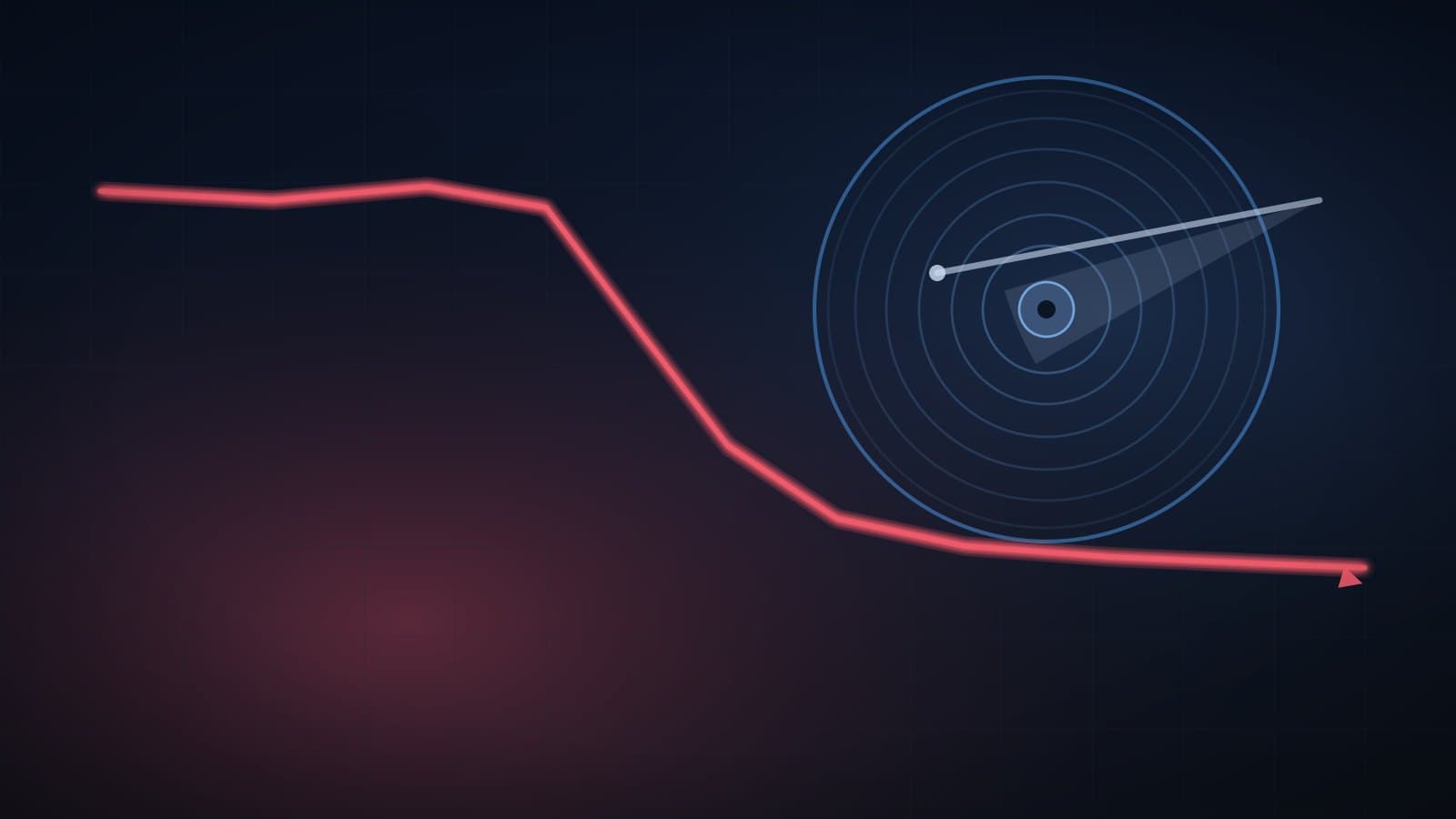
On Friday, October 2, 2026, Western Digital (NASDAQ: WDC) fell about 10%, trading near $415.50 intraday, down from a $462.56 prior close [1]. The catalyst was not about Western Digital at all: a report, traced to Nikkei, that Toshiba plans to double its production capacity for the high-capacity hard drives used in AI data centers — a roughly ¥60 billion (about $380 million) investment centered on its operations in the Philippines, for its fiscal year ending March 2028, and its first major hard-drive capacity expansion in about five years [2]. For a stock whose run has been built on tight drive supply, the prospect of a rival adding more capacity into the market was enough to erase about a tenth of its value in a morning.
The reaction makes sense once you see what has driven Western Digital this year. AI data centers need enormous amounts of cheap mass-capacity storage, and the nearline hard drives that provide it come from just three makers — Seagate, Western Digital, and the much smaller Toshiba. That concentration, plus disciplined capacity, gave the leaders real pricing power and fueled extraordinary margin expansion, and WDC shares had risen roughly 216% over the past year on the back of it [3]. Toshiba's plan challenges exactly that dynamic: more supply from the industry's smallest player tests the idea that drive prices and margins can keep climbing. That is why the two pure HDD names fell hard while the rest of the chip complex did not. It is worth being precise about the limits of the news, though — Toshiba doubling its own AI-drive capacity, from the smallest base of the three makers, is not the same as the industry doubling supply.
Why this hits Western Digital specifically
Western Digital is now a pure-play hard-disk-drive company, having completed the spin-off of its flash-memory business as SanDisk in early 2025, so a threat to HDD pricing is a threat to essentially its whole business — not one segment [3]. The same supply fear that cost WDC about 10% hit its larger rival even harder: Seagate fell about 12% [5]. Meanwhile the broader memory and AI-chip names barely moved or rose — Micron slipped under 1% and Nvidia was up — underscoring that this was a hard-drive-specific supply scare amid a broadly firm tech tape, not a tech-wide selloff [5]. It is worth noting the limits of the news, too: Toshiba is the smallest of the three makers, its added capacity is phased over the next couple of years, and AI-driven demand for nearline drives is still growing — so whether the extra supply actually erodes pricing, or is simply absorbed, is the open question the selloff is pricing in.
A stock priced for a tight market
Context matters because WDC is a high-beta cyclical (a beta above 2) that had already delivered an enormous move — up about 216% over the past year on the AI-storage boom [3]. The business has genuinely re-rated: revenue grew about 36% over the past year to roughly $12.9 billion, with a GAAP operating margin around 34–35% and free cash flow around $3.5 billion [3]. A note of caution on the headline multiple: the stock's trailing P/E near 17 is flattered by a one-time gain — a roughly $6.5 billion mark-to-market gain on its retained stake in SanDisk, which pushed reported net profit far above operating profit — so the cleaner lens is the forward view: about 21 times forward earnings and roughly 12 times sales at the post-drop price [3]. Those are still rich multiples for a hardware maker, and they embed an assumption that constrained supply keeps drive pricing and margins elevated. A credible new source of supply is precisely the kind of news that tests that assumption, which is why a premium-valued cyclical fell so fast on it.
Why it matters
The episode is really a hard-disk-drive industry signal, not just a Western Digital one. The entire thesis behind the HDD stocks' 2026 run was that a concentrated, supply-disciplined industry could keep raising prices into a demand boom. Toshiba's move is the first concrete challenge to that story, and the market treated it as a sector event: both pure HDD makers fell sharply — Seagate about 12%, Western Digital about 10% — while the memory and AI-chip names that share the "AI storage" theme did not [5]. That selectivity is the tell. It is also a reminder of how premium-valued cyclicals trade: the news was an announcement of future capacity, not an actual price cut or demand miss, yet it was enough to take 10% off a stock up more than 200% in a year — because what is priced in is not today's economics but the durability of tomorrow's pricing power.
The move, in one cross-section
The same-session tape shows a hard-drive-specific selloff, not a broad-market move [5]:
| Name (ticker) | Oct 2, 2026 (intraday) | Read-through |
|---|---|---|
| STX — Seagate | ≈−11.7% | The other pure HDD maker — hit hardest on the same supply fear [5] |
| WDC — Western Digital | ≈−10.2% | Pure-play HDD; Toshiba's doubling threatens its core pricing power [1][2] |
| MU — Micron | ≈−0.8% | Memory maker — barely moved; this was not a memory event [5] |
| NVDA — Nvidia | ≈+2.4% | AI chips higher — the broader AI complex was up [5] |
Both pure hard-drive makers falling sharply while memory was flat and AI chips rose points to a storage-supply-specific event — Toshiba's capacity plan — rather than a broad technology decline [5].
What the Street thinks
The published analyst picture is bullish — but it predates the Toshiba news, so it should be read as the backdrop the selloff is testing, not a reaction to it. The consensus rating is a Buy, with an average 12-month target near $665 — well above the current price — in a wide range from a low near $420 to a high near $1,050 [6]. A recent action was Citi's Asiya Merchant, who reiterated a Buy with a $740 target in September, having cut it from $800 to $740 back in August; also in early August, Bank of America's Wamsi Mohan kept a Buy while trimming to $720 (from $732) and Evercore ISI's Amit Daryanani stood at a Buy at $575, while Goldman Sachs's James Schneider sat at Hold, trimming his target to $615 (from $650) [6]. No analyst had changed a rating on the Toshiba report as of the move, so those elevated targets are a pre-drop snapshot — the open question is how far they come down as analysts weigh what added supply means for pricing.
What to watch
- Pricing, not headlines. Whether nearline drive prices and the makers' blended ASPs actually soften, or hold as demand absorbs the new capacity [2].
- Toshiba's follow-through. The scale and timing of the planned expansion — a phased fiscal-2027 plan off a small base is very different from an immediate flood of supply [2].
- The next earnings read. Western Digital's fiscal first-quarter results, expected in late October, and what management says about pricing and capacity discipline [1].
- Analyst resets. Whether the pre-drop targets (a ~$665 average) hold or come down as the Street models the supply news. Moves are tracked on the WDC stock page [1].
Illustrative valuation sensitivity
The scenarios below are anchored to Western Digital's forward earnings power (about 21× forward earnings at the post-drop price) and to the analyst target distribution (a low near $420, average ~$665, a high near $1,050) [6], turning on whether HDD pricing power survives a credible new source of supply. They are a descriptive, author-weighted exercise — not a forecast, target, recommendation, or intrinsic fair-value calculation — with subjective weights that sum to 100%.
| Scenario | Illustrative price | Weight | Key drivers |
|---|---|---|---|
| Upside | ~$560 | 35% | The selloff proves an overreaction: Toshiba's added supply is small and phased, AI-data-center demand keeps drives tight, pricing holds, and the stock re-rates back toward the low end of the analyst targets [6]. |
| Middle | ~$450 | 40% | The supply news tempers the pricing-power narrative and compresses the premium multiple modestly, but strong demand keeps earnings growing; the stock stabilizes somewhat above the current level [3]. |
| Downside | ~$340 | 25% | The market re-rates HDD pricing power lower as a structural supply response begins, the premium multiple (21× forward, ~12× sales) compresses toward historical norms, and estimates come down [3]. |
Weighting those (0.35 × $560 + 0.40 × $450 + 0.25 × $340) gives an illustrative, author-weighted reference value near $461 — a figure mechanically derived from the scenarios and weights above, not a price target or fair-value estimate — above Friday's ~$415.50 intraday level and well below the ~$665 pre-drop consensus target [1][6], reflecting a premium-valued cyclical whose next leg depends on whether the industry's pricing discipline holds against new supply. This is a Street-target-and-earnings-based scenario exercise and descriptive analysis of a news move, not investment advice.
WDC data snapshot — October 2, 2026
| Figure | Value | As-of / source |
|---|---|---|
| Intraday quote | ~$415.50 (−~10.2%) — an intraday reading (the session was open) | Fri, Oct 2, 2026, ~10:08am ET — StockAnalysis [1] |
| Prior close / open / range | $462.56 prior close; opened $423.20; early-session range $414.09–$427.71 (as of ~10:08am, still moving) | Oct 2, 2026 [1] |
| Volume vs average | ≈6.1M shares by ~10am vs a ≈6.76M 20-day average for a full session — already running near a full day's volume by mid-morning | Oct 2 — StockAnalysis [1] |
| 52-week trend | up ~216% over 52 weeks (a large AI-storage run; from roughly $131 a year earlier); below its ~$466 50-day and near its ~$400 200-day moving averages | As of Oct 2 [3] |
| Market cap | ≈$149.8B (≈360.5M shares); beta ≈2.18 (high) | Oct 2 — StockAnalysis [3] |
| Valuation | Recomputed at ~$415.50: trailing P/E ≈17× (flattered by a ~$6.5B one-time mark-to-market gain on the retained SanDisk stake); forward P/E ≈21×; price-to-sales ≈12× (vendor pages still showed ≈19×/≈23×/≈12.9× at the prior close) | Oct 2 — StockAnalysis [3] |
| Financials (TTM) | Revenue ≈$12.9B (+35.7%); gross margin ≈49%; GAAP operating margin ≈34–35%; free cash flow ≈$3.5B | TTM — StockAnalysis [3] |
| Catalyst | A report (traced to Nikkei) that Toshiba plans to double its production capacity for the high-capacity (nearline) hard drives used in AI data centers — a ~¥60B (~$380M) investment centered on the Philippines, for its fiscal year ending March 2028, its first major HDD capacity expansion in ~5 years — raising concern about the tight supply and pricing power behind the HDD makers' 2026 run. No WDC-specific news or rating change was identified | Oct 2, 2026 — press reports [2] |
| Same-day cross-section | STX −11.7% (the direct HDD peer, hit hardest), MU −0.8% (memory, barely moved), NVDA +2.4% (AI chips up) — MU/NVDA are broader-tech context, not HDD peers; an HDD-specific supply scare | Oct 2 intraday [5] |
| Analyst view | Consensus Buy, avg target ≈$665 (range ~$420 to ~$1,050) — all pre-dating the Toshiba news; recent actions: Citi Buy $740 (Sept reiteration; the $800→$740 cut was in Aug), BofA Buy $720 (from $732, Aug 6), Evercore Buy $575, Goldman Hold $615 (from $650, Aug 6) | As of Oct 2, 2026 — StockAnalysis / analyst notes [6] |
Western Digital (WDC) stock FAQ
Why did Western Digital (WDC) stock drop on October 2, 2026?
Western Digital fell about 10% to roughly $415.50 intraday after a report that Toshiba plans to double its production capacity for the high-capacity hard drives used in AI data centers — a roughly ¥60 billion (about $380 million) investment centered on the Philippines, for its fiscal year ending March 2028. The news was not about Western Digital itself. The stock's run this year was built on a concentrated, supply-disciplined HDD industry keeping drive prices firm, so the prospect of a credible new source of supply from the smallest of the three makers directly challenged that pricing-power story. A premium-valued cyclical fell hard on an announcement of future capacity, not an actual price cut.
What exactly did Toshiba announce?
According to the reports that moved the stock, which trace to Nikkei, Toshiba plans to roughly double its production capacity for the high-capacity nearline drives used in AI data centers, backed by an investment on the order of ¥60 billion (about $380 million) centered on its operations in the Philippines, over its fiscal year ending March 2028 — its first major hard-drive capacity expansion in about five years. This is specific to AI and data-center drives, not Toshiba's entire HDD line. Toshiba is the smallest of the three remaining HDD makers, behind Seagate and Western Digital, so the concern is less about Toshiba's absolute volume and more about what a more aggressive third competitor means for the industry's pricing discipline. The plan is phased over the next couple of years rather than an immediate addition of supply.
Why did this hit Western Digital and Seagate but not other chip stocks?
Because it is a hard-disk-drive supply story, and only Western Digital and Seagate are the pure-play HDD makers. Seagate, the larger of the two, actually fell more — about 12% — while Western Digital fell about 10%. By contrast, Micron, a memory maker, slipped less than 1%, and Nvidia was up more than 2%, so the broader memory and AI-chip complex was stable to higher. That selectivity is the signal: the market was repricing the specific risk that hard-drive pricing power could weaken, not selling technology broadly. Western Digital is especially exposed because, after spinning off its flash-memory business as SanDisk, it is now a pure-play HDD company with no other segment to cushion the blow.
Is Western Digital stock cheap after the drop?
Not obviously. The trailing P/E near 17 looks moderate, but it is flattered by a one-time gain — a roughly $6.5 billion mark-to-market gain on its retained stake in SanDisk, which pushed reported net profit far above operating profit — so the cleaner lens is the forward multiple, around 21 times forward earnings and roughly 12 times sales at the post-drop price. Those are rich multiples for a hardware maker, and they reflect an assumption that constrained supply keeps drive pricing and margins strong. The business itself is doing well — revenue up about 36% over the past year to roughly $12.9 billion, with around $3.5 billion of free cash flow — but a premium cyclical priced for tight supply is vulnerable precisely when a new source of supply appears, which is the debate the Toshiba news reopened.
What do analysts think of Western Digital now?
The published analyst picture is bullish, but it predates the Toshiba report and should be read as the backdrop the selloff is testing. The consensus rating is a Buy, with an average 12-month price target near $665 — well above the current price — in a wide range from about $420 to $1,050. A recent action was Citi's Asiya Merchant, who reiterated a Buy with a $740 target in September, having cut it from $800 to $740 back in August; also in early August, Bank of America's Wamsi Mohan kept a Buy while trimming to $720 (from $732) and Evercore ISI's Amit Daryanani stood at a Buy at $575, while Goldman Sachs's James Schneider stayed at Hold and trimmed his target to $615 (from $650). No analyst had changed a rating on the Toshiba news as of the move, so those elevated targets are a pre-drop snapshot that may come down as the Street models the supply risk.
What is the biggest risk for Western Digital now?
That the hard-drive industry's pricing discipline weakens. Western Digital is a pure-play HDD maker whose premium valuation — roughly 21 times forward earnings and 12 times sales — rests on the belief that a concentrated, supply-constrained industry can keep drive prices and margins firm into the AI-storage boom. A more aggressive third competitor is the first real challenge to that belief, and because the stock had run up more than 200% in a year, it has little room for disappointment. The offsetting factors are that Toshiba is the smallest maker, its expansion is phased over the next couple of years, and AI-data-center demand for nearline drives is still growing — so the extra capacity could be absorbed without a pricing collapse. Which of those forces wins is the open question.