Stock Analysis
Netflix (NFLX) Drops as Wells Fargo Turns Bear With a Street-Low $57 Target on Engagement Worries
Netflix fell about 4% to roughly $72 on September 18 after Wells Fargo's Steven Cahall downgraded the stock to Underweight from Equal Weight and cut his price target to a Street-low $57 from $80. (Prices are split-adjusted after Netflix's 10-for-1 split in November 2025.) The call is about engagement, not profitability: after reviewing more than 150 titles, Cahall estimates second-half engagement (hours viewed per subscriber per day) falls about 4% year-over-year — with Top-100 Originals viewing down about 21% — raising churn risk into 2027, and his $57 rests on a lower multiple (15 times 2027 earnings, down from 21). It is a rare bear — the lone Sell in the tracked coverage — against a bullish Street, whose average target near $95 sits about 30% above the price, and it landed on a stock already down about 40% over the year. The move was Netflix-specific — Disney and other media names fell far less — and the underlying business remains highly profitable, growing revenue ~16% at a ~30% operating margin with ~$11 billion of free cash flow. The debate is about how fast Netflix can still grow, and the annual viewership report Netflix will publish in early 2027 is the catalyst both sides are waiting on.

Why Netflix stock dropped — one bear against the bulls
On Friday, September 18, 2026, Netflix (NASDAQ: NFLX) fell about 4%, trading near $72 intraday, down from a $75.31 prior close [1]. (Prices are split-adjusted: Netflix completed a 10-for-1 stock split in November 2025, which is why the shares now trade near $72 rather than ~$720.) The catalyst was a single, pointed analyst downgrade: Wells Fargo's Steven Cahall cut Netflix to Underweight from Equal Weight and slashed his price target to $57 from $80 — a Street-low, and roughly 21% below where the stock was trading [2].
What makes the call notable is that it is a rare bearish voice — the lone Sell in Netflix's tracked coverage. The rest of the Street is broadly positive — the consensus rating is a Buy, the average target sits near $95, and the most recent notes before Cahall's were bullish (Evercore ISI at $110, Citi at $100, Bernstein at $95) [6]. So this was not the market reacting to fresh company news; it was the market weighing one well-argued bear thesis against a wall of bulls, and marking the stock down on it.
The bear case: engagement, the slate, and the multiple
Cahall's argument is about viewer engagement, not profitability. After reviewing more than 150 key titles across live events, series and films, he estimates Netflix's second-half engagement — hours viewed per subscriber per day — falls about 4% year-over-year, with viewing of its Top 100 Originals down about 21%, on a weaker slate of new shows into the back half of the year [2]. That, he argues, raises the risk of higher subscriber churn into 2027. Crucially, these are his estimates from a title-by-title review, not figures Netflix has reported — the negative catalyst he points to is the annual, full-year viewership report Netflix will publish in the first quarter of 2027, which he expects around January (Netflix is moving to an annual disclosure, separate from quarterly earnings) [2].
The target math follows from a lower multiple, not collapsing earnings. Cahall's $57 rests on about 15 times 2027 earnings, down from 21 times — a call that the market should pay less for Netflix's growth if engagement is cooling [2]. It lands on a stock that has already had a hard year: Netflix is down about 40% over the past 52 weeks and sits below both its 50-day (~$76) and 200-day (~$85) moving averages [1]. The downgrade did not start the slide; it added a fresh, specific bear thesis to a stock already in a downtrend, on heavy volume — about 33 million shares had traded by late morning against a ~27 million-share 20-day average for a full session [1].
The bull case the downgrade is arguing against
The reason the stock did not fall further is that Netflix's financials remain excellent. Revenue grew about 16% over the past year to roughly $48 billion, and the company earns a ~28% net margin and a ~30% operating margin, throwing off about $11 billion of free cash flow with a return on equity near 50% [3]. After the year-long de-rating, the shares trade near 20 times the fiscal-2026 earnings estimate (about 23 times trailing earnings) — a premium to the market, but far from the 40-times-plus multiples Netflix commanded at its peak [3]. The bull case is that engagement worries are overstated, that the ad-supported tier and live events are still ramping, and that a high-margin, cash-generative franchise growing mid-teens deserves its multiple. Cahall's downgrade is a direct wager against that — that the growth, and therefore the multiple, is set to cool.
Why it matters
The episode is a clean case of a single analyst moving a mega-cap — not on new company data, but on a differentiated read of the same data everyone has. That works only when the thesis is specific and the stock is already contested: Netflix down 41% on the year is a stock the market is unsure about, so a credible bear with a Street-low target and a concrete metric (a title-by-title engagement estimate) can tip it. It is also a reminder that at Netflix's stage the debate has shifted. The question is no longer whether Netflix can make money — it plainly does, at scale — but how fast it can still grow, and what multiple that growth deserves. Engagement is the leading indicator both sides are now fighting over, which is why a viewership report five months away is being priced today.
The move, in one cross-section
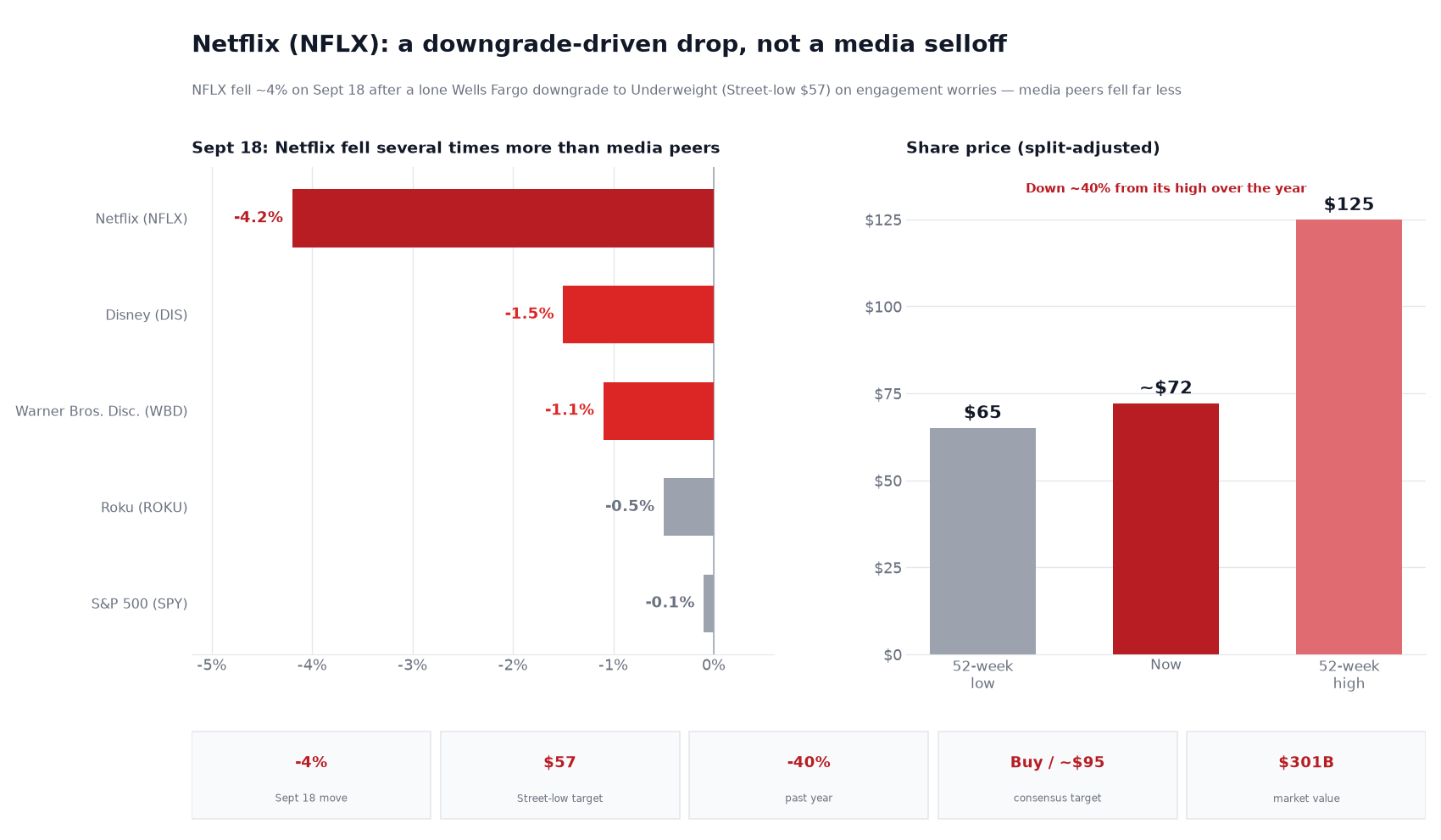
The same-day tape shows a Netflix-specific event, not a media selloff — Netflix substantially underperformed both the market and its media peers [5]:
| Name (ticker) | Sept 18, 2026 | Read-through |
|---|---|---|
| NFLX — Netflix | ≈−4.2% | Wells Fargo downgrade to Underweight, Street-low $57 target [1][2] |
| DIS — Disney | ≈−1.5% | Streaming peer — down modestly, no shared catalyst [5] |
| WBD — Warner Bros. Discovery | ≈−1.1% | Media peer — a small decline with the tape [5] |
| ROKU — Roku | ≈−0.5% | Streaming platform — roughly flat [5] |
| SPY — SPDR S&P 500 ETF | ≈−0.1% | The market was essentially flat [5] |
Netflix falling ~4% while Disney and the other media names slipped around 1% and the market was flat points to a company-specific event — a single downgrade — rather than a sector move [5].
What the Street thinks
Cahall is very much the outlier. The rating split runs roughly 25 Buys and six Holds against his lone Sell in the tracked coverage, and the average 12-month target sits near $95 — roughly 30% above the price — with his $57 now marking the low of a range topping out near $135 (the aggregated average is only beginning to absorb his cut) [6]. The recent actions on the other side of the trade are telling: Evercore ISI's Mark Mahaney raised his target to $110, Citi's Jason Bazinet sits at $100, Bernstein's Annick Mass at $95, and Wolfe Research's Peter Supino lifted his to $95 — all Buys, all above the price [6]. So the downgrade did not shift the consensus; it widened the gap between a bullish Street and a stock the market keeps marking down, with Cahall's $57 now anchoring the bearish end.
What to watch
- Engagement data. Netflix's annual, full-year viewership report — due in the first quarter of 2027, which Cahall expects around January — the specific catalyst he flagged [2].
- The Q3 print. Whether the October 20 earnings show subscriber, ad-tier and revenue momentum holding, or the deceleration the bear case assumes [1].
- Whether other analysts follow. If Cahall stays alone or the bearish view spreads, versus the bulls reiterating into the print [6].
- The content slate. How the back-half lineup and live events land, which is the crux of the engagement debate. Moves are tracked on the NFLX stock page [1].
Illustrative valuation sensitivity
The scenarios below are anchored to Netflix's forward earnings power (about 20× the fiscal-2026 earnings estimate) and to the analyst target distribution (a low of $57, average ~$95, a high of $135) [6], turning on whether engagement and growth cool as the bear case argues or hold as the bulls expect. They are a descriptive, author-weighted exercise — not a forecast, target, recommendation, or intrinsic fair-value calculation — with subjective weights that sum to 100%.
| Scenario | Illustrative price | Weight | Key drivers |
|---|---|---|---|
| Upside | ~$100 | 30% | Engagement worries prove overstated, the ad tier and live events keep growth in the mid-teens, and the multiple holds or re-rates toward the bullish targets [6]. |
| Middle | ~$82 | 40% | Growth stays solid but decelerates modestly, the stock stabilizes and recovers part of the year's decline toward the consensus, with the multiple roughly steady [3]. |
| Downside | ~$62 | 30% | Cahall's engagement-and-churn thesis plays out, growth slows, and the multiple compresses toward his ~15× 2027 target [2]. |
Weighting those (0.30 × $100 + 0.40 × $82 + 0.30 × $62) gives an author-weighted reference value near $81, above Friday's ~$72 level and below the ~$95 consensus target [1][6] — reflecting a highly profitable franchise whose next leg depends on whether engagement is cooling, as the bear argues, or holding, as the bulls expect. This is a Street-target-and-earnings-based scenario exercise and descriptive analysis of a news move, not investment advice.
NFLX data snapshot — September 18, 2026
| Figure | Value | As-of / source |
|---|---|---|
| Intraday quote | ~$72.17 (−~4.2%), split-adjusted — an intraday reading (the session was still open) | Fri, Sep 18, 2026, ~11:04am ET — StockAnalysis [1] |
| Prior close / open / range | $75.31 prior close; opened $71.27; day range $70.11–$72.18 (gapped down, then recovered) | Sep 18, 2026 [1] |
| Volume vs average | ≈33.0M shares by late morning vs a ≈26.7M 20-day average for a full session — heavy | Sep 18 — StockAnalysis [1] |
| 52-week range / trend | $65.08–$124.86 (split-adjusted); down ~40% over 52 weeks; below its ~$76 50-day and ~$85 200-day averages | As of Sep 18 [1] |
| Market cap | ≈$300.5B (≈4.16B shares after the Nov 2025 10-for-1 split); beta ≈1.53 | Sep 18 — StockAnalysis [3] |
| Valuation | At ~$72: trailing P/E ≈22.8×; ≈20× the ~$3.59 FY26 EPS estimate; ≈6.2× sales (a vendor snapshot at the $75.31 prior close reads ~23.7× / ~6.5×) | Sep 18 — StockAnalysis [3] |
| Financials (TTM) | Revenue ≈$48.4B (+16%); net income ≈$13.7B; EPS $3.17; gross margin ≈49%; operating margin ≈30%; free cash flow ≈$11.2B; ROE ≈50% | TTM — StockAnalysis [3] |
| Catalyst | Wells Fargo's Steven Cahall downgraded to Underweight (from Equal Weight), cut target to $57 from $80 (Street-low), citing softening engagement (estimated H2 viewership −4%, Top-100 Originals −20%+), a weak slate and churn risk; $57 = ~15× 2027 EPS (down from 21×) | Sep 18, 2026 — Wells Fargo / reports [2] |
| Same-day peers | DIS −1.5%, WBD −1.1%, ROKU −0.5% (media/streaming); SPY −0.1% (market) — Netflix's drop was idiosyncratic | Sep 18 [5] |
| Analyst view | Consensus Buy (~25 Buy / 6 Hold / 1 Sell in tracked coverage), avg target ≈$95 (~30% above the price), range $57 (Cahall) to $135; recent bulls: Evercore $110, Citi $100, Bernstein $95, Wolfe $95 — Cahall's $57 is the lone Sell | Aug–Sep 2026 — StockAnalysis / TipRanks / analyst notes [6] |
Netflix (NFLX) stock FAQ
Why did Netflix (NFLX) stock drop on September 18, 2026?
Netflix fell about 4% to roughly $72 after Wells Fargo analyst Steven Cahall downgraded the stock to Underweight from Equal Weight and cut his price target to a Street-low $57 from $80. His concern is softening viewer engagement and a weaker second-half slate of original series, which he argues raises subscriber-churn risk into 2027. It was not a reaction to new company data — it was a single, well-argued bear thesis against an otherwise bullish Street, and the market marked the stock down on it. (Prices are split-adjusted after Netflix's 10-for-1 stock split in November 2025.)
What is Wells Fargo's bear case on Netflix?
Analyst Steven Cahall's argument is about engagement rather than profitability. After reviewing more than 150 key titles across live events, series and films, he estimates Netflix's second-half engagement — hours viewed per subscriber per day — falls about 4% year-over-year, with viewing of its Top 100 Originals down about 21%, on a thinner slate of new shows. He believes that raises the risk of higher subscriber churn into 2027. His $57 target reflects a lower multiple — about 15 times 2027 earnings, down from 21 — essentially arguing the market should pay less for Netflix's growth if engagement is cooling. Importantly, the viewership figures are his own estimates, not data Netflix has reported; the report he is watching is the annual, full-year viewership disclosure Netflix will publish in the first quarter of 2027 (he expects it around January), as the company moves to an annual report separate from quarterly earnings.
Do other analysts agree with the Netflix downgrade?
No — Cahall is the outlier. The consensus rating on Netflix is still a Buy — roughly 25 Buys and six Holds against his lone Sell in the tracked coverage — with an average 12-month price target near $95, about 30% above the current price, in a range that now runs from his $57 low to a $135 high. The most recent notes on the other side are bullish: Evercore ISI's Mark Mahaney raised his target to $110, Citi's Jason Bazinet sits at $100, Bernstein's Annick Mass at $95, and Wolfe Research's Peter Supino lifted his to $95 — all Buy ratings above the price. So the downgrade did not move the consensus; it anchored the bearish end of a wide range and widened the gap between the Street's optimism and a stock the market keeps marking down.
Why is Netflix stock trading near $72 instead of over $700?
Because of a stock split. Netflix completed a 10-for-1 stock split that took effect in November 2025, so every share was divided into ten. That mechanically reduced the share price by about 90% — from roughly $720 to roughly $72 — while leaving the value of the company and each investor's stake unchanged. All the figures in this article, including the $57 target and the 52-week range of about $65 to $125, are on the post-split basis. A split changes the optics of the price, not the underlying economics.
Is Netflix stock a good value after the drop?
It depends on the growth question the downgrade raises. On the numbers, Netflix is a high-quality business: revenue grew about 16% over the past year to roughly $48 billion, at a ~30% operating margin and ~28% net margin, with about $11 billion of free cash flow and a return on equity near 50%. After a roughly 40% decline over the year, the shares trade near 20 times the current-year earnings estimate (about 23 times trailing earnings) — a premium to the market, but far below the 40-times-plus multiples of its peak. The bull case is that this is a reasonable price for a dominant, cash-generative grower. The bear case, Cahall's, is that if engagement and growth are cooling, even that multiple is too high. The valuation hinges on which is right.
What is the biggest risk for Netflix now?
That growth decelerates enough to compress the multiple further. Netflix still trades at a premium to the market, so if the engagement softness Wells Fargo flags shows up in subscriber growth, pricing power or the ad tier, the stock could keep de-rating even though the business stays profitable. The specific data point to watch is the annual, full-year viewership report Netflix will publish in the first quarter of 2027 (Cahall expects it around January). The offsetting strengths are a dominant global position, expanding margins, a maturing advertising business, and roughly $11 billion of annual free cash flow — which is why most of the Street still rates the stock a Buy well above the current price.