Stock Analysis
IonQ (IONQ) Falls ~9% on a $1.3B All-Stock Cybersecurity Acquisition
IonQ fell about 9% to roughly $36 on October 12 on a day it announced a definitive agreement to acquire Elisity, a zero-trust cybersecurity company, in an all-stock deal worth up to $1.3 billion. The counterintuitive part is the point: a stock dropping on its own acquisition. The all-stock structure is why — IonQ's share count is already up about 50% over the past year as it funds an acquisition-and-fundraising spree largely with stock, and Elisity is its third billion-dollar-scale deal in roughly 16 months, after the mostly-stock Oxford Ionics purchase and the cash-and-stock SkyWater acquisition. The strategic logic is forward-looking (pairing post-quantum cryptography with Elisity's zero-trust platform to sell 'quantum-era' security), but the market read the news as more dilution and more strategic sprawl from a pre-profit company valued near $14 billion on just $246 million of revenue — about 58 times sales, with an operating margin near negative 380%. A sign of company-specific pressure: IonQ fell about 9% while quantum peers Rigetti and D-Wave fell closer to 5.5% and the Nasdaq-100 slipped under 1% — more than the sector alone would explain. Wall Street stays overwhelmingly bullish on the long-term quantum roadmap — a Strong Buy consensus with an average target far above the price — which is exactly why a story stock like this swings so violently on news.
Why IonQ stock fell — a $1.3 billion acquisition the market didn't love
On Monday, October 12, 2026, IonQ (NYSE: IONQ) fell about 9%, trading near $36.24 intraday, on a day the company announced a definitive agreement to acquire Elisity, a zero-trust cybersecurity company, in an all-stock deal worth up to $1.3 billion [2]. The counterintuitive part is the one that matters: a stock falling on its own acquisition news. The move was a mix of two things — a broad sell-off in speculative quantum-computing names, and a company-specific verdict on the deal itself, which IonQ underperformed its quantum peers by several points to deliver [1][5]. In plain terms, the market read the deal as more dilution and more sprawl, not more value — at least on day one.
The all-stock structure is central to the reaction. IonQ will pay in shares, not cash, with the final count set at closing from a 20-day average price and collared between roughly $33 and $50 a share [2]. Because IonQ's share count has already risen about 50% over the past year as it funds an acquisition-and-fundraising spree largely with stock, another all-stock deal lands on shareholders who are already being diluted [3]. And this is not a one-off: Elisity is IonQ's third billion-dollar-scale acquisition in roughly 16 months, following the roughly $1.07 billion, mostly-stock purchase of Oxford Ionics (completed in 2025) and the roughly $1.8 billion cash-and-stock acquisition of chipmaker SkyWater Technology (completed in 2026) [2].
The deal — and the strategic pivot it represents
Elisity sells software that stops attackers and ransomware from moving laterally through corporate networks; it says it has more than 100 deployments, counts hospitals and healthcare companies among its customers, and reports no churn among deployed customers, though IonQ disclosed no revenue figure [2]. Its product addresses present-day enterprise security; the quantum angle is prospective. The strategic logic IonQ offered is forward-looking: pairing its post-quantum cryptography and quantum key distribution work with Elisity's zero-trust platform to sell "quantum-era" security — the idea being that powerful quantum computers will eventually break today's encryption, so protecting networks against that future is a potential growth market. Chief executive Niccolo de Masi framed it as positioning IonQ to "help customers protect critical infrastructure and enterprise networks throughout the transition to the quantum era" [2]. The headline figure includes up to $150 million of performance-based earnouts, so the amount paid at closing — expected in the fourth quarter, subject to regulators — will be below the $1.3 billion ceiling [2].
The reasons for skepticism
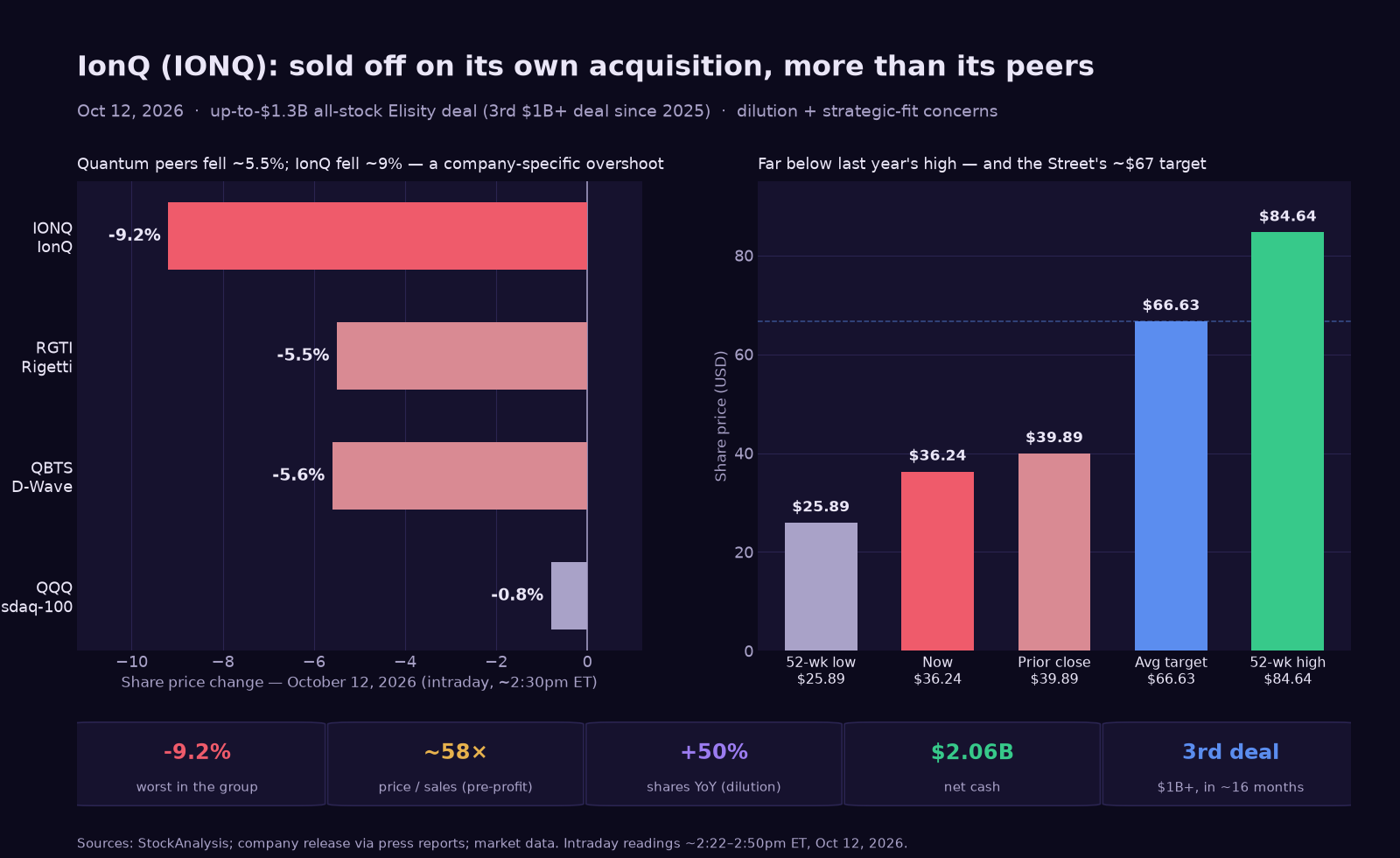
The sell-off is easier to understand once the valuation is in view. IonQ is a pre-profit quantum-computing company carrying a market value near $14 billion on roughly $246 million of trailing revenue — a price-to-sales ratio around 58 — with an operating margin of about negative 380% and no earnings [3]. Much of its reported revenue growth is itself acquisition-fueled. A company valued almost entirely on a long-dated story is especially sensitive to anything that adds shares or muddies the narrative, and an all-stock purchase of a cybersecurity firm does both. There is also a strategic-coherence question: IonQ builds quantum-computing hardware, and buying a network-security software vendor is a meaningful pivot whose synergies are conceptual rather than proven. As a rough illustration (before any contingent earnout shares, and sensitive to the closing price within the collar), the Elisity deal alone could issue new shares worth something like 6% to 8% of the enlarged company. Notably, IonQ holds about $2.06 billion of net cash, so it could have paid cash — choosing stock preserves that buffer for a business that burns heavily (and is already funding its other acquisitions, losses and research), but it puts the cost of the deal on existing shareholders [3]. A sign that the deal, not just the sector, weighed on the stock: IonQ fell about 9% while fellow quantum names Rigetti and D-Wave fell closer to 5.5% and the Nasdaq-100 dropped under 1% — suggesting company-specific pressure on top of a broad quantum sell-off [5].
Why it matters
IonQ has become a bellwether for the quantum-computing trade — a small-revenue company with a large valuation, using its richly priced stock as currency to buy its way toward scale and adjacency. Monday's reaction is a useful check on that model: the market will applaud ambition only up to the point where the dilution bill comes due, and a large all-stock deal layered onto an aggressive expansion appears to have reached it. The cross-section underscores that the move was partly sector and partly specific. Quantum peers fell together in a risk-off session for speculative, high-multiple technology, but IonQ fell roughly a third more than they did — pointing to company-specific pressure from the deal on top of the sector move, rather than that gap being a precise measure of it [5]. The episode is also a reminder of how two-sided these names are: the same stock that analysts peg far above its current price can drop 9% in an afternoon on a strategic announcement, because so much of the value rests on a future that has not yet arrived — and on a share count that keeps growing.
The move, in one cross-section
The same-session tape shows a sector sell-off with a company-specific overshoot [5]:
| Name (ticker) | Oct 12, 2026 (intraday) | Read-through |
|---|---|---|
| IONQ — IonQ | ≈−9.2% | The acquirer — down on dilution and strategic-fit concerns over the Elisity deal [1][2] |
| RGTI — Rigetti Computing | ≈−5.5% | Quantum peer — down on a sector risk-off, with no deal of its own [5] |
| QBTS — D-Wave Quantum | ≈−5.6% | Quantum peer — down with the group [5] |
| QQQ — Nasdaq-100 (ETF) | ≈−0.8% | Broad tech — modestly lower; the quantum names fell far more [5] |
Quantum peers down about 5.5% point to a sector move; IonQ down about 9% points to that plus company-specific pressure — the signature of a stock selling off on its own news [5].
What the Street thinks
Wall Street's posted view is strikingly bullish relative to the tape. The consensus rating is a Strong Buy, with an average 12-month target near $67 — well above the roughly $36 where the stock traded on Monday — within a very wide range from about $42 to $100 [6]. That dispersion is the story: analysts are underwriting IonQ's long-term quantum roadmap, not the economics of a cybersecurity acquisition, and the targets should be read as bets on the platform rather than endorsements of this deal — and the posted consensus may not yet reflect the Elisity transaction at all. It is worth holding that optimism against the fundamentals — no profits, heavy cash burn, a price-to-sales multiple near 58, and a share count rising about 50% a year — which is precisely the gap that makes a name like this swing violently on news. The bullish consensus and the 9% drop are not contradictory; they are the two halves of a story stock.
What to watch
- Dilution and the share count. How many shares the all-stock deal ultimately issues within its roughly $33–$50 collar, on top of a count already up about 50% over the past year [2].
- Deal close and regulatory review. Whether the Elisity acquisition closes in the fourth quarter as planned, and on what final terms [2].
- November 4 earnings. The next hard read on revenue, cash burn, and how the SkyWater, Oxford Ionics and Elisity acquisitions are being integrated [3].
- Quantum-sector sentiment. Whether the high-beta quantum group stabilizes or keeps de-rating, which will move IonQ regardless of the deal. Moves are tracked on the IONQ stock page [5].
Illustrative scenario sensitivity
Because IonQ is a pre-profit, narrative-driven stock, the scenarios below are anchored to the deal, dilution, and quantum-sector sentiment rather than to earnings or a single valuation — this is an unusually speculative, high-volatility name, and the dispersion is wide [6]. They are a descriptive, author-weighted exercise over roughly the coming six-to-twelve months as the deal closes and sentiment shifts — not a forecast, target, recommendation, or trading advice — with subjective weights that sum to 100%.
| Scenario | Illustrative price | Weight | Key drivers |
|---|---|---|---|
| Quantum narrative reaccelerates | ~$52 | 25% | Dilution fears fade, the "quantum-era security" story gains traction, and high-beta quantum momentum resumes, re-rating the stock back toward analyst targets [6]. |
| Range-bound and volatile | ~$37 | 35% | The deal closes and IonQ keeps executing, but added shares offset growth and the stock stays choppy near current levels [3]. |
| Dilution fatigue / sector de-rating | ~$27 | 40% | Serial stock-funded M&A and a broader quantum pullback weigh on a high-beta, pre-profit name, pulling it toward the low end of its 52-week range [1]. |
Weighting those (0.25 × $52 + 0.35 × $37 + 0.40 × $27) gives an author-weighted reference value near $37 — an illustrative, probability-weighted scenario output mechanically derived from the weights above, and not a price target, fair-value estimate, or prediction — essentially level with Monday's ~$36 intraday price [1][6]. The near-identity reflects a balanced but extraordinarily wide-dispersion setup: a stock where a credible long-term story and a real near-term dilution problem roughly offset, and where the outcome hinges far more on quantum-sector sentiment than on this one deal. This is a scenario exercise and descriptive analysis of a news-driven move, not investment advice.
IONQ data snapshot — October 12, 2026
| Figure | Value | As-of / source |
|---|---|---|
| Intraday quote | ~$36.24 (−~9.2%) — an intraday reading (the session was open) | Mon, Oct 12, 2026, ~2:22pm ET — StockAnalysis [1] |
| Prior close / open / range | $39.89 prior close; opened $38.79; day range $35.89–$38.81 | Oct 12, 2026 [1] |
| Trading | An active session on a news catalyst; beta ≈3.36 (very high) amplifies sector moves | Oct 12 — StockAnalysis [1] |
| 52-week trend | 52-week range $25.89–$84.64; down ~49% over 52 weeks, well off the high and below the 50-day average (~$41) | As of Oct 12 [3] |
| Market cap | ≈$14.40B (≈397.3M shares); enterprise value ≈$12.38B | Oct 12 — StockAnalysis [3] |
| Valuation | Pre-profit: no P/E (EPS ≈−$3.99); price-to-sales ≈58× (forward ≈21×); gross margin ≈31%, operating margin ≈−382% | Oct 12 — StockAnalysis [3] |
| Financials (TTM) | Revenue ≈$246M (+~371%, largely acquisition-fueled); net loss; net cash ≈$2.06B (cash ≈$2.12B, debt ≈$55M); shares up ~50% YoY | TTM — StockAnalysis [3] |
| Catalyst | IonQ announced a definitive agreement to acquire Elisity (zero-trust cybersecurity) in an all-stock deal worth up to $1.3B (incl. up to $150M earnout; share consideration collared ~$33–$50; closing Q4 2026). Rationale: "quantum-era" security. The stock fell ~9%, which market reporting tied to dilution and strategic-fit concerns — IonQ's third billion-dollar-scale acquisition in ~16 months (after Oxford Ionics, mostly stock, and SkyWater, cash-and-stock) | Oct 12, 2026 — company release via press reports [2] |
| Same-day cross-section | RGTI −5.5%, QBTS −5.6% (quantum peers); QQQ −0.8% (Nasdaq-100) — IonQ underperformed the group by ~3.6pp | Oct 12 intraday [5] |
| Analyst view | Consensus Strong Buy, avg target ~$66.63 (low $41.85, high $100) — well above the price; next earnings Nov 4, 2026 | Oct 12, 2026 — StockAnalysis / analyst notes [6] |
IonQ (IONQ) stock FAQ
Why did IonQ (IONQ) stock fall on October 12, 2026?
IonQ fell about 9% to roughly $36 on the same day it announced a definitive agreement to acquire Elisity, a zero-trust cybersecurity company, in an all-stock deal worth up to $1.3 billion. A stock falling on its own acquisition is counterintuitive, but the reaction reflects two things. First, the all-stock structure adds dilution: IonQ's share count is already up about 50% over the past year as it funds an acquisition-and-fundraising spree largely with stock, and this is its third billion-dollar-scale deal in roughly 16 months. Second, it raises a strategic-fit question — a quantum-computing hardware company buying a network-security software firm is a notable pivot. The quantum sector was also broadly lower that day, but IonQ fell roughly a third more than peers Rigetti and D-Wave, suggesting company-specific pressure on top of the sector selloff.
What is IonQ buying, and why?
IonQ agreed to acquire Elisity, which makes software that prevents attackers and ransomware from spreading laterally through corporate networks. Elisity says it has more than 100 deployments and counts hospitals and healthcare companies among its customers, though IonQ disclosed no revenue figure. The strategic rationale is forward-looking: IonQ wants to combine its post-quantum cryptography and quantum key distribution work with Elisity's zero-trust platform to sell 'quantum-era' cybersecurity. The premise is that powerful quantum computers will eventually be able to break today's encryption, so defending networks against that future is a potential growth market. CEO Niccolo de Masi framed the deal as positioning IonQ to protect critical infrastructure through the transition to the quantum era. The deal is worth up to $1.3 billion, including up to $150 million in performance-based earnouts, and is expected to close in the fourth quarter of 2026.
Why is dilution such a concern for IonQ shareholders?
Because IonQ pays for acquisitions with its own stock rather than cash, every deal issues new shares and dilutes existing holders. Its share count is already up about 50% over the past year (from stock-funded deals and capital raises), and Elisity is its third billion-dollar-scale acquisition in roughly 16 months — after the roughly $1.07 billion, mostly-stock purchase of Oxford Ionics (completed in 2025) and the roughly $1.8 billion cash-and-stock acquisition of chipmaker SkyWater Technology (completed in 2026). The Elisity deal is all-stock, with the final share count set at closing from a 20-day average price, collared between about $33 and $50 — a mechanical illustration suggests it would issue new shares worth roughly 6% to 8% of the enlarged company. Notably, IonQ holds about $2.06 billion of net cash and could have paid cash; choosing stock preserves that cash for a business that burns heavily, but it puts the cost of the deal on shareholders. For a pre-profit company valued largely on a long-term story, serial stock-funded M&A is a meaningful headwind.
Is IonQ profitable, and how is it valued?
No, IonQ is not profitable — it reported a net loss, has no price-to-earnings ratio, and runs an operating margin around negative 380%, meaning it spends far more than it earns. It is valued as a long-term story stock: a market capitalization near $14 billion against only about $246 million of trailing revenue, which is a price-to-sales ratio near 58 (its reported revenue growth is also heavily acquisition-fueled). The company does carry a strong balance sheet, with about $2.06 billion of net cash, and its revenue is growing quickly. But a valuation resting almost entirely on the future of quantum computing is highly sensitive to anything that adds shares or complicates the narrative — which is why the stock is unusually volatile, carries a very high beta, and is down about 49% over the past 52 weeks even after a strong prior run.
What do analysts think about IonQ stock?
Wall Street's posted view is strikingly bullish relative to the stock's recent action. The consensus rating is a Strong Buy, with an average 12-month price target near $67 — well above the roughly $36 where the stock traded on October 12 — within a very wide range from about $42 to $100. That dispersion is the key point: analysts are underwriting IonQ's long-term quantum-computing roadmap, not the economics of a cybersecurity acquisition, so the targets are better read as bets on the platform than as endorsements of this particular deal. The optimism should be weighed against the fundamentals — no profits, heavy cash burn, a price-to-sales multiple near 58, and a share count rising about 50% a year — which is exactly the gap that makes the stock swing sharply on news. A bullish consensus and a 9% single-day drop are the two halves of a story stock.
What should investors watch next for IonQ?
Four things. First, dilution: how many shares the all-stock Elisity deal ultimately issues within its roughly $33–$50 collar, on top of a share count already up about 50% over the past year. Second, the deal's progress — whether it closes in the fourth quarter of 2026 as planned and clears regulatory review. Third, IonQ's own earnings on November 4, 2026, the next hard read on revenue, cash burn, and how its recent acquisitions (Oxford Ionics, SkyWater and Elisity) are being integrated. Fourth, quantum-sector sentiment: IonQ is a high-beta name that moves with the broader quantum-computing trade regardless of its own news, so the group's direction matters as much as the deal. Because so much of the value rests on a long-dated story, the stock is likely to stay headline-sensitive and volatile.