Stock Analysis
Intuit (INTU) Stock Drops ~9% as a Revenue-Guidance Cut and the Mailchimp Sale Overshadow a Fiscal Q1 Beat
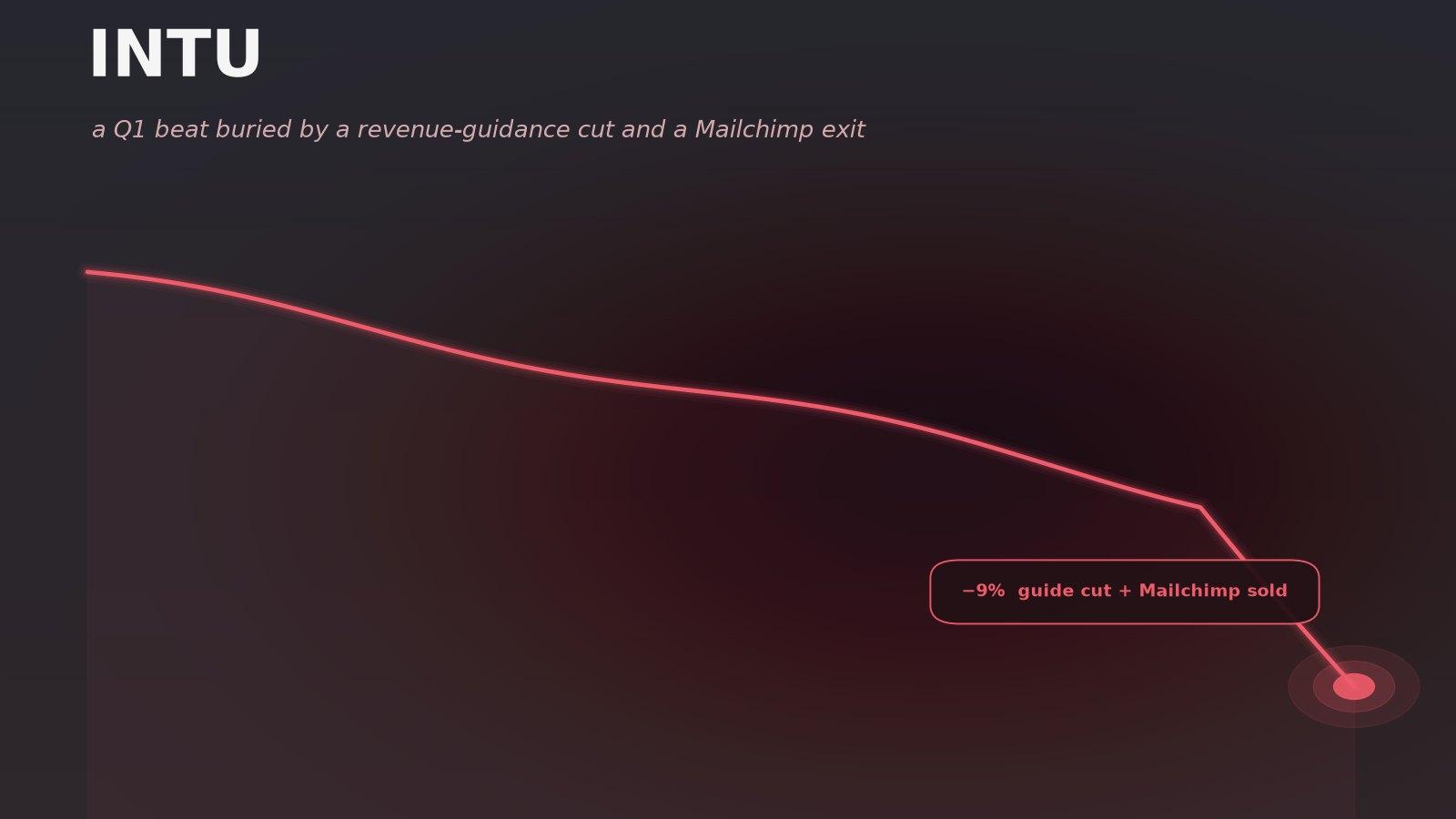
Intuit fell about 9%, to around $283, on November 20 after reporting fiscal Q1 results — a company-specific drop while the S&P 500 and Nasdaq-100 fell far less and tax/payroll peers (H&R Block, ADP) rose. The quarter itself beat: revenue rose 12% to $4.35 billion and GAAP EPS jumped 63% to $2.59, above the top of guidance, with QuickBooks up 15%. But Intuit cut its full-year revenue outlook to 8–9% growth — a reduction it pinned entirely on Credit Karma (whose growth guide fell from 11–13% to 3–7%), which it tied to higher interest rates and a faster-than-expected shift to AI-powered financial-product discovery — while reiterating its EPS guidance, so Intuit lowered its revenue outlook but kept its earnings outlook. It also agreed to sell Mailchimp to Bending Spoons for ~$3.68 billion, less than a third of the ~$12 billion it paid in 2021. With the stock already down ~58% from its high, the move is about the durability of consumer growth against AI, not this quarter's profits — even as the Street's average target sits ~40% above the price.
On Friday, November 20, 2026, Intuit Inc. (NASDAQ: INTU) fell about 9% in intraday trading, to around $283 (from a $310.02 prior close), after reporting fiscal first-quarter results the evening before [1]. The drop stood out because it came on a day the broad market was already weak — yet Intuit fell far more than the tape, while its closest peers rose: the S&P 500 was down about 2% and the Nasdaq-100 about 3.6%, but payroll giant ADP and tax-prep rival H&R Block were both higher, so Intuit's slide was plainly its own news [5]. And the news was not a bad quarter. It was a weaker revenue outlook and a costly strategic retreat: Intuit cut its full-year revenue guidance and announced it is selling Mailchimp for less than a third of what it paid — two things that speak directly to the fear that has already cut this stock roughly in half [2].
The quarterly results themselves were strong. Revenue rose 12% to $4.35 billion, ahead of expectations; GAAP earnings jumped 63% to $2.59 a share and adjusted EPS rose 56% to $2.91; and operating income climbed 63% — results management said came in above the top end of its own guidance [2]. The growth engine — Global Business Solutions, the segment that includes QuickBooks — was strong, with revenue up 15% to about $3.1 billion. In isolation this was a beat. The problem is that Intuit trades on its growth trajectory, and the forward-looking signals pointed the other way.
Why the stock fell — a revenue cut, not a profit cut, plus a humbling exit
The first catalyst was the guidance. Intuit lowered its full-year fiscal-2027 revenue outlook to about $23.08–$23.37 billion (8%–9% growth), from a prior range of $23.28–$23.51 billion (9%–10%) — a cut of roughly $150–$200 million that was entirely attributable to Credit Karma, whose expected full-year growth was slashed from 11%–13% to just 3%–7% [2]. Management attributed Credit Karma's slowdown to two things: higher-than-expected interest rates and a faster-than-anticipated shift toward AI-powered financial-product discovery — consumers increasingly shopping for loans and cards inside AI assistants rather than on Credit Karma [2]. That second reason is the one the market fixated on, because AI disintermediating Intuit's consumer funnel is the company's single biggest overhang. Crucially, though, this was a revenue cut, not an earnings cut: Intuit reiterated its full-year operating-income and EPS guidance (GAAP EPS of $20.12–$20.36, up 22%–24%) — in part because lower-than-expected stock-based-compensation expense and other cost savings are expected to offset the lost Credit Karma revenue, so the shortfall shows up in growth rather than profit this year [2]. The near-term outlook added to the pressure: Intuit guided fiscal second-quarter revenue to $4.93–$4.95 billion (6%–7% growth), a step down from the 12% it just posted and below Wall Street's expectations, with Consumer revenue expected to decline in the mid-single digits in the quarter [2].
The second catalyst was strategic. Intuit announced it will sell Mailchimp to Italy's Bending Spoons for an approximately $3.68 billion all-cash base price, with Intuit separately reinvesting about $368 million back into Bending Spoons equity — leaving roughly $3.31 billion in net cash [6]. Intuit paid roughly $12 billion for Mailchimp in 2021 — its largest acquisition ever — so it is exiting at less than a third of the purchase price (about three times the unit's projected revenue today), a rare and public admission that a marquee deal did not work; Mailchimp revenue actually fell 1% last quarter, to $313 million [2]. Management framed the sale as sharpening its focus on its core AI-driven financial platform, and plans to use the cash for buybacks. But the market read it as confirmation of a thesis it has been pricing for a year: a once-premium growth compounder retreating and refocusing rather than expanding [6].
The valuation question
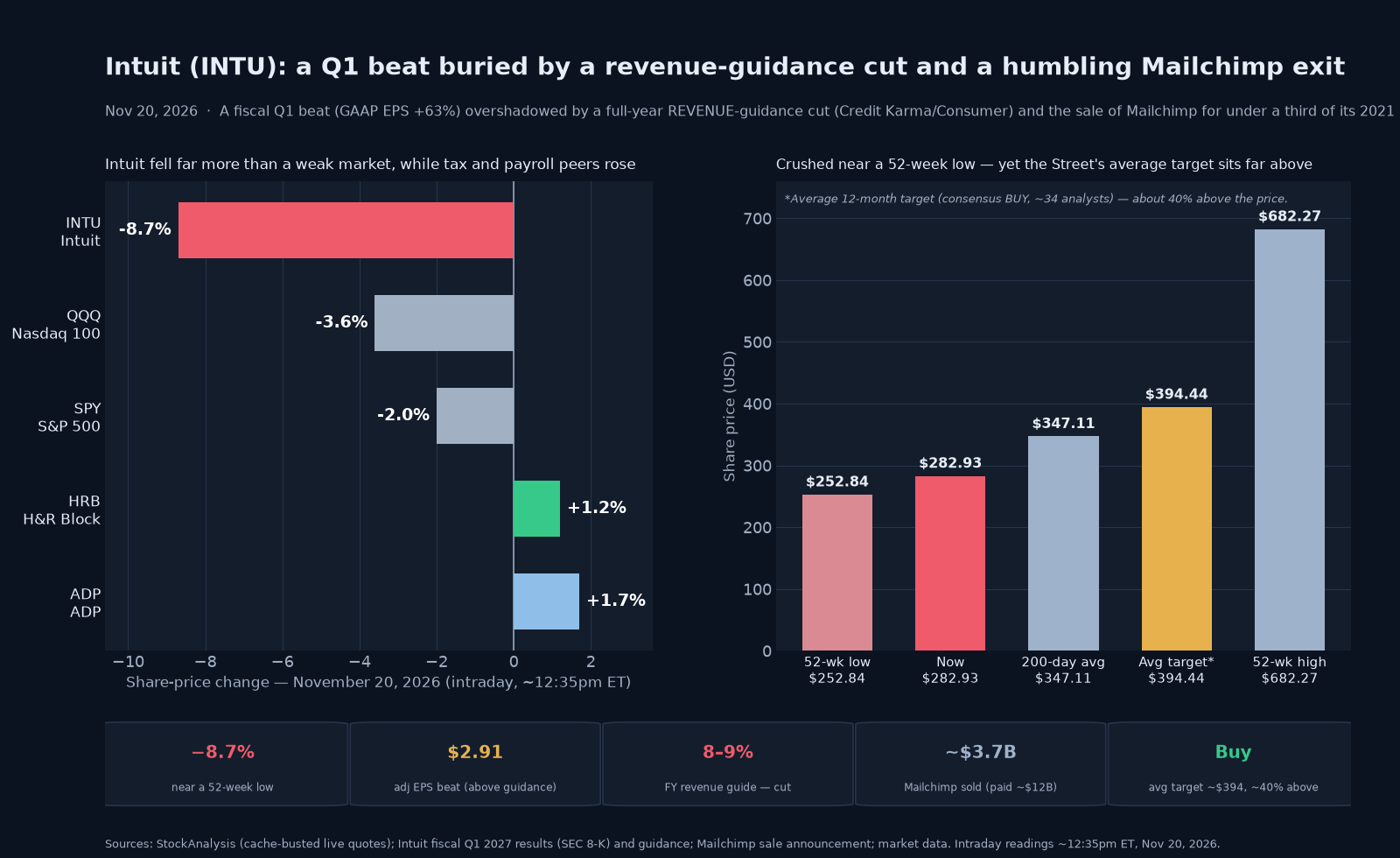
Here is the tension: on the numbers, Intuit now looks cheap for a business of its quality — the question is whether the quality is being impaired. After falling roughly 58% from its 52-week high of about $682 to near its 52-week low, the stock trades at about 16 times trailing earnings and just 12 times forward earnings, with a price-to-free-cash-flow multiple around 9 on roughly $9 billion of annual free cash flow [3]. This is a genuinely high-quality franchise: operating margins near 30%, a return on equity around 26%, a dividend just raised 15% (yielding about 2%), and $1.5 billion of stock repurchased in the quarter alone — buybacks up 73% year over year [2]. Tellingly, even after the sell-off the analysts' average 12-month price target of about $394 sits roughly 40% above the current price, with a Buy consensus [3]. In other words, the Street still sees a cash-rich compounder on sale; the market is pricing structural doubt. The valuation case rests entirely on whether the AI threat to TurboTax and Credit Karma is a manageable headwind or a secular impairment — a cheap multiple on durable earnings, or a value trap on earnings that are quietly eroding.
Analyst view
This is a high-quality compounder meeting a market that has stopped paying a premium for it, and the discipline is to separate the company's profitability (excellent) from its growth narrative (under a cloud). The bull case is concrete: QuickBooks is still compounding in the mid-teens, Q1 beat the top end of guidance, EPS and operating-income guidance were reaffirmed (though partly because lower-than-expected stock-compensation expense offsets the lost revenue), trailing operating margins are near 30%, free cash flow is roughly $9 billion, and management is returning cash aggressively — all for about 12 times forward earnings with a Street target some 40% higher. The bear case is about the direction of travel and the overhang: the revenue cut landed squarely on Credit Karma — which management tied to higher interest rates and an AI-driven shift in how consumers discover financial products, evidence that AI may already be weighing on at least part of the consumer franchise rather than being a purely forward-looking fear; selling Mailchimp at under a third of cost shows the company's expansion bets can misfire; and a de-rating from roughly $680 to $280 signals the market no longer treats Intuit's growth as reliable. The most balanced read is that Intuit delivered a profitable, cash-generative quarter and a cheap-looking stock, but that the sell-off is about the durability of consumer growth in an AI world, not about this quarter's profits — and that question will not be settled until the tax-filing season (fiscal Q2 and Q3) shows whether Credit Karma stabilizes and whether TurboTax holds up. The right lens is Credit Karma: if its growth holds, the bull case firms up; if the AI-driven erosion spreads or deepens, the de-rating may not be finished. This is descriptive analysis of a news-driven move, not investment advice.
Why it matters
Intuit is one of the clearest public-market tests of the question hanging over much of software: does generative AI expand incumbents or disintermediate them? Intuit has pitched itself as an AI winner — embedding assistants across TurboTax, QuickBooks and Credit Karma — yet the market keeps treating it as an AI loser, because free chatbots can increasingly answer the tax and personal-finance questions — and, as Intuit itself acknowledged, handle the product discovery — that drove people to its consumer products. Friday's revenue cut to Credit Karma, which management tied partly to exactly this AI shift, gives that narrative its first concrete data point, which is why a modest full-company trim triggered an outsized drop [2]. The Mailchimp sale matters for a second reason: it is a vivid case study in how expensive the 2021 era of software M&A was, and how much cheaper those assets are now — Intuit is selling Mailchimp for less than a third of what it paid just five years ago [6]. For Intuit specifically, the episode reframes the debate from "can this company grow?" — QuickBooks says yes — to "can its consumer franchise withstand AI?", a question the stock's halving says the market is far from answering in Intuit's favor.
The move, in one cross-section
The same-session tape shows Intuit falling hard on its own news while the broader market fell far less and its direct peers actually rose — the signature of a company-specific catalyst on a weak macro day [5]:
| Name (ticker) | Nov 20, 2026 (intraday) | Read-through |
|---|---|---|
| INTU — Intuit | ≈−8.7% | The earnings name — down on a revenue-guidance cut and the Mailchimp sale, near a 52-week low [1] |
| QQQ — Nasdaq-100 (ETF) | ≈−3.6% | Broad tech lower on a weak-market day — but less than half Intuit's drop [5] |
| SPY — S&P 500 (ETF) | ≈−2.0% | Market down on a seventh straight losing session — not the main driver of Intuit's move [5] |
| HRB — H&R Block | ≈+1.2% | Tax-prep peer higher — no read-through from Intuit's own guidance cut [5] |
| ADP — Automatic Data Processing | ≈+1.7% | Payroll/SMB-software peer higher — Intuit's drop was its own story [5] |
Intuit down ~9% while the S&P 500 and Nasdaq-100 fell far less and tax/payroll peers rose points to a single-company catalyst — its own guidance and the Mailchimp sale — rather than a sector or macro move. That H&R Block and ADP went the other way is the clearest evidence this was Intuit's story, not software's [5].
What to watch
- Credit Karma revenue. The single most important metric — whether the Credit Karma franchise Intuit just downgraded (and the broader Consumer segment it sits in) stabilizes, the proof the AI threat is manageable rather than secular [2].
- The tax season. The January-to-April filing season spans fiscal Q2 and Q3, and fiscal Q3 (February–April) is where TurboTax revenue is concentrated; Friday's Q1 TurboTax figure is seasonally tiny, so the real test is still ahead [2].
- QuickBooks (Global Business Solutions). Whether the mid-teens growth in the business engine holds, the offset that keeps total revenue growing even as consumer decelerates [2].
- Capital returns and the Mailchimp close. How aggressively Intuit deploys the ~$3.3 billion of Mailchimp cash into buybacks, and whether the deal closes on schedule in early 2027. Moves are tracked on the Intuit stock page.
Illustrative scenario sensitivity
Because the move reflects a profitable quarter meeting a structural growth question, the scenarios below are anchored to whether Intuit's consumer franchise stabilizes against AI — not to this quarter's profits [3]. They are a descriptive, author-weighted exercise over roughly the coming six-to-twelve months as the tax season and fiscal-2027 trends clarify — not a forecast, target, recommendation, or trading advice — with subjective weights that sum to 100%.
| Scenario | Illustrative price | Weight | Key drivers |
|---|---|---|---|
| Consumer stabilizes, re-rating | ~$370 | 30% | Credit Karma and TurboTax hold through tax season, QuickBooks keeps compounding, EPS guidance proves conservative, and the stock closes much of the gap to the Street's ~$394 target [3]. |
| Cheap, but the overhang lingers | ~$285 | 45% | Profits hold and buybacks support the stock, but the AI-disruption question stays open; the shares consolidate near current levels at a low multiple [1]. |
| AI erosion deepens | ~$215 | 25% | Credit Karma and TurboTax keep slipping, forcing further revenue cuts; the market concludes the consumer moat is structurally impaired and the de-rating extends [2]. |
Weighting those (0.30 × $370 + 0.45 × $285 + 0.25 × $215) gives an author-weighted reference value of about $293 — an illustrative, probability-weighted scenario output mechanically derived from the weights above, and not a price target, fair-value estimate, or prediction — modestly above Friday's ~$283 price [1]. That the weighted figure lands close to the current price reflects a simple reading: the market has repriced Intuit for genuine structural doubt, so from here the stock largely tracks whether the consumer franchise proves durable against AI. This is a scenario exercise and descriptive analysis of a news-driven move, not investment advice.
Intuit data snapshot — November 20, 2026
| Figure | Value | As-of / source |
|---|---|---|
| Intraday quote | ~$282.93 (≈−8.7%) — an intraday reading (market open); opened $284.06, day range $276.74–$300.44 (intraday low near −11%); sitting just above the 52-week low ($252.84) | Fri, Nov 20, 2026, ~12:35pm ET — StockAnalysis [1] |
| Prior close / 52-week trend | $310.02 prior close; 52-week range $252.84–$682.27 — down about 58% from the high (−56% over 52 weeks), and below both the 50-day ($317) and 200-day ($347) averages; beta ~0.92 | Nov 20, 2026 [1] |
| Market cap / valuation | ≈$75.8B (≈267M shares); enterprise value ≈$78.1B; P/E ≈16.1 trailing vs ≈12.1 forward; P/S ≈3.8 on ~$21.9B trailing revenue; price-to-FCF ≈9 on ~$9.0B free cash flow; dividend $5.52 (≈1.95% yield, ~31% payout, just raised 15%) | Nov 20 — StockAnalysis [3] |
| Q1 FY2027 results | Revenue $4.35B (+12%, beat ~$4.31B, "above the top end of guidance"); GAAP EPS $2.59 (+63% vs $1.59); non-GAAP EPS $2.91 (+56%; note: from Q1 FY2027 non-GAAP no longer excludes stock-based comp, prior year recast); GAAP operating income $868M (+63%); operating margin ~20% | Nov 19 — Intuit Q1 FY2027 results (SEC 8-K) [2] |
| By segment (Q1) | Global Business Solutions (QuickBooks) +15% to $3.1B — the growth engine; Consumer +7% to $958M (Credit Karma +9% to $708M; TurboTax +1% to $199M, seasonally small; ProTax +13%); Mailchimp −1% to $313M | Nov 19 — Intuit results [2] |
| Guidance | Full-year revenue CUT to $23.08–$23.37B (8–9% growth) from $23.28–$23.51B (9–10%) — a ~$150–$200M cut attributable entirely to Credit Karma, whose growth guide fell from 11–13% to 3–7% (management cited higher interest rates + an AI-driven shift in financial-product discovery); EPS and operating-income guidance REITERATED (GAAP EPS $20.12–$20.36, +22–24%; helped by lower stock-comp expense). Q2 revenue $4.93–$4.95B (+6–7%, below expectations). All guidance excludes the pending Mailchimp sale | Nov 19 — Intuit results [2] |
| Mailchimp divestiture | Agreed to sell Mailchimp to Bending Spoons for an ~$3.68B all-cash base price (Intuit reinvests ~$368M into Bending Spoons equity → ~$3.31B net cash) — less than a third of the ~$12B Intuit paid in 2021 (~3x the unit's projected revenue now); expected to close early 2027, cash earmarked for buybacks | Nov 19 — Intuit / Bending Spoons announcement [6] |
| Same-day cross-section | INTU −8.7% vs QQQ −3.6%, SPY −2.0%, HRB +1.2%, ADP +1.7% — a company-specific move (Intuit fell far more than a weak market while tax/payroll peers rose) | Nov 20 intraday [5] |
| Analyst view | Consensus "Buy" from ~34 analysts, average target ≈$394 — about 40% ABOVE the post-earnings price; short interest low (~3.4% of float), so a short-squeeze unwind is an unlikely explanation for the drop | Nov 20 — StockAnalysis [3] |
Intuit (INTU) Q1 earnings and Mailchimp FAQ
Why did Intuit (INTU) stock fall on November 20, 2026?
Intuit fell about 9% to around $283, near its 52-week low, even though its fiscal first-quarter results beat expectations. Two forward-looking items drove the drop. First, Intuit cut its full-year revenue guidance to about 8%–9% growth (from 9%–10%), a reduction attributable entirely to Credit Karma — whose growth outlook fell from 11%–13% to 3%–7% — which management tied to higher interest rates and a faster-than-expected shift toward AI-powered financial-product discovery, feeding the market's core worry that AI is disrupting Intuit's consumer franchise. Second, it announced it is selling Mailchimp to Bending Spoons for about $3.68 billion, less than a third of the roughly $12 billion it paid in 2021. Importantly, Intuit reiterated its earnings guidance, so this was a revenue and strategy story, not a profit miss. The move was company-specific: the S&P 500 and Nasdaq-100 fell far less that day, and peers H&R Block and ADP actually rose.
Did Intuit beat or miss earnings?
Intuit beat. First-quarter revenue rose 12% to $4.35 billion, ahead of expectations; GAAP earnings per share jumped 63% to $2.59; adjusted EPS rose 56% to $2.91; and operating income climbed 63% — results the company said came in above the top end of its own guidance. The growth engine, Global Business Solutions (the segment that includes QuickBooks), grew 15%. So the quarter itself was strong. The stock fell not on the results but on the outlook: Intuit cut its full-year revenue forecast (while keeping its profit guidance), and it announced the Mailchimp sale. One technical note: beginning this quarter, Intuit's non-GAAP figures no longer exclude stock-based compensation, and prior-year non-GAAP numbers were recast to match, so the adjusted-EPS comparison is on a like-for-like basis.
Why did Intuit stock drop if it only cut revenue guidance, not profit?
Because the revenue cut hit exactly the businesses the market is most worried about. Intuit's biggest overhang is the fear that generative AI — free chatbots that can answer tax and personal-finance questions — will erode its consumer franchise, especially Credit Karma and TurboTax. When Intuit cut its Credit Karma guidance — attributing it partly to a faster-than-expected shift toward AI-powered financial-product discovery, alongside higher interest rates — it gave that structural narrative a concrete data point, so a modest full-company trim produced an outsized reaction. The company reiterated its earnings and operating-income guidance (helped by lower stock-compensation expense offsetting the lost revenue), so current profitability is not the issue; the question investors are pricing is whether consumer growth is durable. With the stock already down about 58% from its high over the past year, the market is clearly treating the AI threat as a serious risk rather than a passing headwind.
Why is Intuit selling Mailchimp, and for how much?
Intuit agreed to sell Mailchimp, the email-marketing platform, to Italy's Bending Spoons for an approximately $3.68 billion all-cash base price, with Intuit separately reinvesting about $368 million into Bending Spoons equity — roughly $3.31 billion in net cash. That is striking because Intuit paid about $12 billion for Mailchimp in 2021, its largest acquisition ever, so it is exiting at less than a third of the purchase price (about three times the unit's projected revenue now). Mailchimp's revenue had stalled, falling 1% last quarter. Management framed the sale as sharpening Intuit's focus on its core AI-driven financial platform and plans to use the proceeds for share buybacks; the deal is expected to close in early 2027. Investors read it as a candid admission that a marquee expansion bet did not pay off, reinforcing the sense of a company retreating to its core rather than expanding.
Is Intuit stock cheap after the drop?
On the multiples, it is inexpensive for a business of this quality — the debate is whether the quality is being impaired. After falling roughly 58% from its 52-week high of about $682 to near its low, Intuit trades at about 16 times trailing earnings and just 12 times forward earnings, with a price-to-free-cash-flow ratio around 9 on roughly $9 billion of annual free cash flow. This is a high-margin franchise (trailing operating margins near 30%, return on equity around 26%) that just raised its dividend 15% and repurchased $1.5 billion of stock in the quarter. Even after the sell-off, the analysts' average price target of about $394 sits roughly 40% above the current price, with a Buy consensus — so the Street still sees a cash-rich compounder on sale. The catch is that the valuation depends on the AI threat to TurboTax and Credit Karma being manageable; if it is not, a cheap multiple on eroding earnings can be a value trap.
What should investors watch next for Intuit?
The single most important things are Credit Karma and Consumer-segment revenue — whether the businesses Intuit just downgraded stabilize, which would show the AI threat is a manageable headwind rather than a secular impairment. Beyond that, the real test for TurboTax is the tax-filing season, which spans fiscal Q2 and Q3 (February–April), since this quarter's TurboTax figure is seasonally tiny; watch whether QuickBooks (Global Business Solutions) keeps compounding in the mid-teens to offset consumer weakness; and watch how aggressively Intuit deploys the roughly $3.3 billion of Mailchimp cash into buybacks and whether that deal closes on schedule. Because the stock has re-rated on a structural growth question rather than a profit problem, the next move depends on the consumer franchise proving durable. This is descriptive analysis, not investment advice.