Stock Analysis
Target (TGT) Jumps Toward a 52-Week High on a Traffic-Led Q3 Beat and a Raised Sales Outlook
Target (TGT) jumped more than 5% on November 18, pushing toward its 52-week high after a traffic-led fiscal third-quarter beat — a gain that substantially outpaced flat big-box peers and the broad market. EPS of $2.65 (GAAP and adjusted alike) cleared the ~$2.07 expected, but about $0.50 came from a one-time $301 million tariff refund, leaving underlying EPS near $2.15 (still up ~21% year over year). What mattered more was the mix: comparable sales rose 5.6%, driven by a 5.0% gain in traffic — more shoppers, the proof point for a company whose slump was a traffic problem — though the category recovery stayed uneven, with apparel and home soft. Target also raised its full-year sales-growth outlook to around 6%. The catch is price: after more than doubling off an $83 low, the stock sits near its 52-week high and above the analysts' average target of ~$165.56, with only a Hold consensus, so much of the initial re-rating may already be reflected and the holiday quarter now has to confirm the recovery.
On Wednesday, November 18, 2026, Target Corporation (NYSE: TGT) jumped more than 5%, to around $168 — pushing to an intraday high of $169.88, just short of its $170.75 52-week high — after reporting fiscal third-quarter results before the open [1]. The gain was primarily earnings-driven: big-box peers Walmart and Costco were slightly lower and the broad market was flat, so Target substantially outperformed on its own results — even on a day when retail earnings were generally firm (the retail ETF rose and off-price chain TJX jumped on its own beat) [5]. And the news mattered, because Target has been one of retail's most-watched turnaround stories — a stock that fell all the way to about $83 earlier in the cycle and has now more than doubled back toward its highs [1]. This quarter gave the bulls what they wanted: a big earnings beat, faster comparable sales driven by more shoppers in the stores, and a raised full-year sales outlook [2].
The headline was eye-catching but needs one important caveat. Target reported EPS of $2.65, far above the roughly $2.07 analysts expected — but about $0.50 of that came from a one-time item: a $301 million pretax tariff refund, worth roughly $228 million after tax [2]. That $2.65 is identical on a GAAP and an adjusted basis, so there is no separate "clean" adjusted figure hiding a larger beat; strip out the refund and the underlying number was closer to $2.15 a share, still up about 21% year over year (reported EPS actually rose 42%, but against an unusually weak year-ago quarter) — a strong result, just not quite the ~28% beat-versus-consensus the headline figure implies [6]. Beyond that refund, the rest of the quarter was encouraging: revenue rose about 7% to roughly $27 billion, ahead of expectations, and the operating metrics were genuinely good. Even the margin gain leaned partly on the refund — the quarter's reported operating margin of about 6.2% included roughly 1.1 percentage points from the tariff benefit, leaving it nearer 5.1% underneath, though that is still up from about 4.4% a year earlier [2].
What actually drove the move — traffic is back, and Target raised its outlook
The single most important number was comparable sales, up 5.6%, well ahead of the ~3.8% analysts modeled — and, crucially, the growth was traffic-led: comparable transactions (shoppers) rose about 5.0% while the average basket barely grew (up about 0.6%), so the gain came from more people walking in and clicking, not bigger baskets — helped, to be fair, by an easy comparison against a year-ago quarter when comps fell 2.7% [2]. Even allowing for that, positive traffic is the proof point that matters for Target, because its multi-year slump was fundamentally a traffic problem — shoppers drifting to Walmart and Amazon. Store comps rose 4.6% and digital comps jumped 9.8%. The category picture, though, stayed uneven: beauty grew more than 9%, food and beverage nearly 7%, and the toys-and-entertainment "Fun 101" category almost 27%, but apparel and accessories still fell about 3.8% and home and décor rose only about 2.5% [2]. Just as important for profitability, Target's high-margin non-merchandise revenue — advertising, credit-card profit-sharing, memberships and its third-party marketplace — grew about 19%, led by Roundel advertising (up roughly 23% to about $296 million); it is a mix shift that helps margins even when the core retail business runs low-margin [2].
The second driver was the raised guidance. Target lifted its full-year net-sales growth outlook to around 6%, about a percentage point above its prior range, and raised its full-year EPS guidance to $10.65–$11.40 (from $9.90–$10.90), and said November sales were in line with — and accelerating from — October's trends, a reassuring signal heading into the all-important holiday season [2]. A beat on the operating numbers, a traffic-led comp, and an upgraded outlook into the holidays is exactly the combination that re-rates a beaten-down consumer stock — and it did [2].
The valuation question
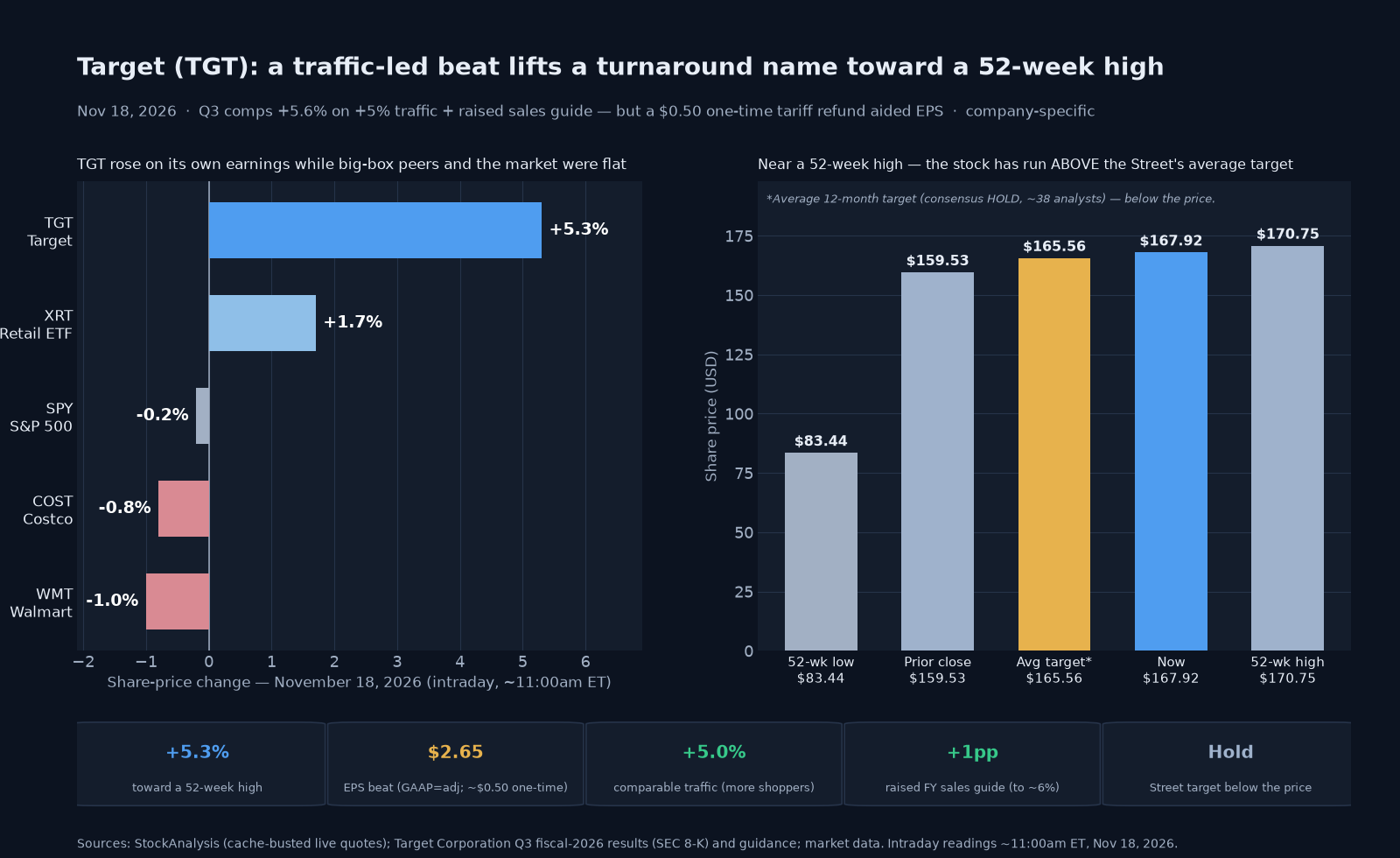
Here is the tension in the story: Target's operating turn is real, but the stock has already priced in a lot of it. After more than doubling off its lows, the shares trade near a 52-week high, and — tellingly — the analysts' average 12-month price target of about $165.56 sits slightly below the current price, with a consensus rating of only Hold [3]. In other words, the market has re-rated the stock faster than the sell-side, which has been slow to lift its targets — though several may well do so after this beat. On multiples, Target looks cheap at first glance — about 15.7 times trailing earnings and roughly 0.7 times sales — but that trailing figure is flattered by one-time items: tariff refunds have added about $2.14 a share to earnings recognized so far this year, which partly explains why the forward P/E is actually higher, around 17.75 — the clean, recurring earnings power sits below the one-time-aided trailing number, and forward estimates also bake in expectations for next year's operating performance [3]. The dividend is a genuine anchor — Target is a Dividend King yielding about 2.8% with a comfortable ~48% payout — but the valuation case now rests on whether the traffic recovery is durable, not on the stock being obviously cheap [3].
Analyst view
This is a turnaround proving itself, met by a stock that has already moved — and the discipline is to separate the two. The bull case is concrete and encouraging: comparable traffic is positive again, the comparable-sales beat was traffic-led (even if category performance was uneven), high-margin advertising and other non-merchandise revenue is compounding, management raised the outlook into the holidays, and Target is a cash-generative Dividend King throwing off a near-3% yield. The bear case is about price and quality of earnings: the headline EPS leaned on a one-time tariff refund, the stock sits near a 52-week high above the average analyst target with only a Hold consensus, the forward multiple is higher than the trailing one, and a single strong quarter does not prove that shoppers won't drift away again once comparisons get harder. The most balanced read is that Target delivered a genuinely good, traffic-led quarter that validates the turnaround and justifies the pop, but that the easy money — the re-rating from "left for dead" at $83 back toward $170 — has largely been made, and the stock now needs the holiday quarter and fiscal 2027 to confirm the trend. The right lens is traffic: if comparable transactions keep rising, the stock can grow into and past the Street's cautious targets; if traffic stalls, a stock at its highs has little cushion. This is descriptive analysis of a news-driven move, not investment advice.
Why it matters
Target is a bellwether for the discretionary American consumer, and for a long time its weakness told a worrying story — shoppers trading down to Walmart and the warehouse clubs and pulling back on the discretionary goods (home, apparel, toys) that are Target's bread and butter. A traffic-led comp of 5.6%, with beauty, food and toys all strong, is therefore a genuinely positive read-through: it suggests the middle-income consumer is both showing up and buying more than just essentials, at least into the holidays. The quarter also showcases the broader retail playbook that is working across the industry — Target's fast-growing advertising and other non-merchandise revenue mirrors what Walmart and Amazon have built, a high-margin layer that makes a low-margin retailer more profitable and more defensible. The same session saw off-price retailer TJX also jump on a beat-and-raise, reinforcing that well-run retailers are capturing holiday demand even as the macro backdrop stays uncertain [5]. For Target specifically, the episode shifts the debate from "is the business broken?" to "how durable is the recovery, and how much is already priced?" — a far better question to be asking, but one that sets a higher bar for the holiday quarter to come.
The move, in one cross-section
The same-session tape shows Target rising on its own earnings while its big-box peers and the broad market sat still — the signature of a company-specific catalyst [5]:
| Name (ticker) | Nov 18, 2026 (intraday) | Read-through |
|---|---|---|
| TGT — Target | ≈+5.3% | The earnings name — up on a traffic-led Q3 beat and a raised sales outlook [1] |
| XRT — S&P Retail (ETF) | ≈+1.7% | Retail ETF up modestly, lifted by Target's and TJX's earnings [5] |
| WMT — Walmart | ≈−1.0% | Big-box peer slightly lower — no read-through to Target's beat [5] |
| COST — Costco | ≈−0.8% | Warehouse-club peer unmoved to lower [5] |
| SPY — S&P 500 (ETF) | ≈−0.2% | Broad market flat — TGT went the other way on its results [5] |
Target up more than 5% while Walmart and Costco were flat-to-lower and the S&P 500 was flat points to a single-company catalyst — its own earnings and raised guidance — rather than a sector or macro move (fellow retailer TJX, which also reported a beat-and-raise, jumped about 10% on its own news) [5].
What the Street thinks
Analysts are cautious even after the beat — which is itself part of the story. With a Hold consensus from about 38 analysts and an average 12-month target near $165.56 — just below the post-earnings price — the sell-side has been slower to upgrade Target than the market has been to buy it [3]. Expect some targets to move higher as analysts digest a traffic-led comp and a raised outlook, but the gap between an enthusiastic tape and a cautious consensus is a useful measure of how much skepticism still surrounds this turnaround, and it leaves the burden of proof with the holiday quarter [3].
What to watch
- Comparable traffic. The single most important metric — whether comparable transactions keep rising through the holidays and into fiscal 2027, the proof the recovery is durable rather than a one-quarter bounce [2].
- The holiday quarter. Whether the raised ~6% sales-growth guidance holds up through Target's most important selling season [2].
- Margins and the ad business. Whether high-margin advertising and other non-merchandise revenue keeps compounding, supporting profitability as the core retail business stays low-margin [2].
- Earnings quality. How much of future EPS is operational versus one-time items like the tariff refund — the cleaner the beat, the more convincing the turnaround. Moves are tracked on the Target stock page.
Illustrative scenario sensitivity
Because the move reflects a strong quarter meeting a stock that has already re-rated off its lows, the scenarios below are anchored to the durability of the traffic recovery — not to this quarter alone [3]. They are a descriptive, author-weighted exercise over roughly the coming six-to-twelve months as the holiday season and fiscal-2027 trends clarify — not a forecast, target, recommendation, or trading advice — with subjective weights that sum to 100%.
| Scenario | Illustrative price | Weight | Key drivers |
|---|---|---|---|
| Traffic recovery compounds | ~$190 | 30% | Comparable traffic keeps rising through the holidays, margins improve on the ad-revenue mix, and the stock breaks out past its 52-week high as analysts upgrade [3]. |
| Good, but priced in | ~$168 | 45% | The outlook broadly holds but the easy re-rating is done; the stock consolidates near its highs and the cautious consensus as the market waits for holiday proof [1]. |
| Traffic stalls on tougher comps | ~$140 | 25% | Momentum fades as comparisons harden or the consumer pulls back, the one-time-flattered earnings normalize lower, and a stock at its highs gives back ground [2]. |
Weighting those (0.30 × $190 + 0.45 × $168 + 0.25 × $140) gives an author-weighted reference value of about $167.60 — an illustrative, probability-weighted scenario output mechanically derived from the weights above, and not a price target, fair-value estimate, or prediction — essentially in line with Wednesday's ~$168 price [1]. That the weighted figure lands so close to the current price reflects a simple reading: the market has already repriced Target for a working turnaround, so from here the stock largely tracks whether the traffic recovery proves durable through the holidays. This is a scenario exercise and descriptive analysis of a news-driven move, not investment advice.
Target data snapshot — November 18, 2026
| Figure | Value | As-of / source |
|---|---|---|
| Intraday quote | ~$167.92 (≈+5.3%) — an intraday reading (market open); opened $160.99, day range $159.95–$169.88; the $169.88 intraday high came just below the $170.75 52-week high | Wed, Nov 18, 2026, ~11:19am ET — StockAnalysis [1] |
| Prior close / 52-week trend | $159.53 prior close; 52-week range $83.44–$170.75 — the stock has more than doubled off its low; beta ~0.93 (slightly below-market historical sensitivity) | Nov 18, 2026 [1] |
| Market cap / valuation | ≈$76.5B (≈454M shares); enterprise value ≈$90.8B; P/E ≈15.7 trailing vs ≈17.75 forward (forward higher because trailing EPS is flattered by one-time items); P/S ≈0.7 on ~$110B trailing revenue; dividend $4.64 (≈2.8% yield, ~48% payout) — a Dividend King | Nov 18 — StockAnalysis [3] |
| Q3 FY2026 results | EPS $2.65 (identical GAAP and adjusted) vs ~$2.07 consensus (beat) — but ~$0.50 from a $301M pretax tariff refund ($228M after-tax), so underlying EPS ~$2.15 (up ~21% YoY vs prior-yr adj $1.78; reported EPS +42% off a weak base). Operating margin ~6.2% incl. ~1.1pp refund (ex-refund ~5.1% vs ~4.4% a year ago). Revenue ~$27B (+~7%, beat ~$26.5B). Comparable sales +5.6% (vs ~3.8% est; prior-yr comp −2.7%); comparable traffic +5.0%, basket only +0.6% (store comps +4.6%, digital +9.8%) | Nov 18 — Target Q3 FY2026 results (SEC 8-K) [2] |
| Category & mix | Uneven recovery: beauty +~9%, food/beverage +~7%, toys ("Fun 101") +~27%, but apparel & accessories −~3.8% and home/décor +~2.5%. High-margin non-merchandise (advertising, credit-card profit-sharing, memberships, marketplace) +19.3%, led by Roundel ad revenue ~$241M→$296M — a margin-supportive mix shift | Nov 18 — Target results [2] |
| Guidance (raised) | Full-year net-sales growth lifted to around 6% (+1pp vs prior range); full-year EPS guide raised to $10.65–$11.40 (from $9.90–$10.90, incl. ~$2.14/sh refund benefit to date); November sales in line with and accelerating from October trends, into the holiday season | Nov 18 — Target results [2] |
| Same-day cross-section | TGT +5.3% vs WMT −1.0%, COST −0.8%, SPY −0.2%, XRT +1.7% — a company-specific move (fellow retailer TJX also +~10% on its own beat-and-raise) | Nov 18 intraday [5] |
| Analyst view | Consensus "Hold" from ~38 analysts, average target ≈$165.56 — slightly BELOW the post-earnings price (the stock has run above the Street); targets likely to be revised up for the beat | Nov 18 — StockAnalysis [3] |
Target (TGT) Q3 earnings FAQ
Why did Target (TGT) stock jump on November 18, 2026?
Target rose more than 5%, to around $168 — pushing to an intraday high of $169.88, just short of its 52-week high — after reporting fiscal third-quarter results before the open that beat expectations and came with raised guidance. The standout was comparable sales, up 5.6% versus the ~3.8% analysts expected, and the growth was traffic-led: comparable transactions (shoppers) rose about 5.0%, meaning more people are coming to Target rather than just spending more per trip. That matters because Target's multi-year slump was fundamentally a traffic problem. EPS of $2.65 beat the ~$2.07 consensus (though about $0.50 of that was a one-time tariff refund), revenue rose ~7% to about $27 billion, and the company raised its full-year sales-growth outlook to around 6%. The move was company-specific — Walmart, Costco and the broad market were roughly flat.
Did Target really beat earnings, or is the $2.65 misleading?
Both are true, which is why the quarter needs care. Target's EPS of $2.65 — the same figure on a GAAP and an adjusted basis — did beat the roughly $2.07 consensus by a wide margin, but about $0.50 of it came from a one-time item: a $301 million pretax tariff refund (about $228 million after tax). Stripping that out, the underlying figure was closer to $2.15 a share, which is still up about 21% year over year — a genuinely strong result, just not the ~28% blowout the headline implies. The revenue and sales numbers, by contrast, carried no such one-time distortion: revenue rose about 7% to roughly $27 billion (ahead of expectations), comparable sales rose 5.6%, and comparable traffic rose 5.0%. Even the reported operating margin of about 6.2% leaned partly on the refund (roughly 1.1 points of it), so the quarter was good on its merits, but the one-time tariff refund made the headline numbers look even better than the underlying business did.
Why is Target's traffic growth so important?
Because traffic is the heart of Target's turnaround story. For several years, Target's sales struggled not because existing shoppers spent less, but because fewer people were coming — customers drifted to Walmart, the warehouse clubs and Amazon, especially for everyday essentials. When a retailer's comparable sales grow on bigger baskets but fewer visits, it is a fragile kind of growth. When they grow because more people are walking in and clicking — as they did this quarter, with comparable transactions up about 5.0% — it signals the brand is winning customers back. Target's store comps rose 4.6% and digital comps 9.8%, with strength across beauty, food and toys, so the traffic gains were broad. Sustained traffic growth is the single clearest proof that the recovery is real rather than a one-quarter bounce.
Is Target stock cheap after the jump?
It is less cheap than the trailing multiple suggests, and the market has already re-rated it. At around $168, Target trades near 15.7 times trailing earnings and roughly 0.7 times sales — superficially inexpensive for a retailer. But that trailing figure is flattered by one-time items: tariff refunds have added about $2.14 a share to earnings recognized so far this year, which is why the forward P/E is actually higher, around 17.75 — the clean, recurring earnings power sits below the one-time-aided trailing number. More tellingly, the stock has more than doubled off an $83 low to sit near its 52-week high, and the analysts' average 12-month target of about $165.56 is slightly below the current price, with only a Hold consensus — so the shares are trading above where the Street thinks they belong. The dividend is a real anchor (Target is a Dividend King yielding about 2.8% with a ~48% payout), but the valuation now depends on the traffic recovery being durable, not on the stock being obviously cheap.
Why do analysts only rate Target a Hold if it just beat?
It reflects how much skepticism still surrounds the turnaround after two difficult years. With a consensus Hold from about 38 analysts and an average 12-month target of roughly $165.56 — slightly below the post-earnings price — the Street has effectively been slower to upgrade Target than the market has been to buy it. That unusual setup, a stock trading above its average target, tells you the sell-side wants more proof before chasing it: one strong, partly one-time-flattered quarter near a 52-week high is not yet enough to convince analysts the recovery is durable. Expect some targets to rise as analysts incorporate the traffic-led comp and the raised outlook, but the cautious consensus is a useful counterweight to an enthusiastic tape — the burden of proof now sits with the holiday quarter and fiscal 2027.
What should investors watch next for Target?
The single most important thing is comparable traffic — whether the number of shoppers keeps rising through the holidays and into fiscal 2027, which is the proof the recovery is durable rather than a one-quarter bounce. Beyond that, watch whether the raised ~6% sales-growth guidance holds through Target's most important selling season; whether high-margin advertising and other non-merchandise revenue keeps compounding to support profitability; and the quality of earnings — how much of future EPS is operational versus one-time items like this quarter's tariff refund. Because the stock has already run above the Street's average target to near a 52-week high, the next leg depends on holiday execution actually confirming the trend rather than on the turnaround narrative alone. This is descriptive analysis, not investment advice.