Stock Analysis
Disney (DIS) Nears a 52-Week High on a Q4 Beat, a 33% Dividend Hike, and a $3 Billion Savings Target
The Walt Disney Company rose about 2.5% to roughly $122 — within about 1% of a 52-week high — on November 17 after reporting fiscal fourth-quarter results, outperforming flat media peers and the broader market. Revenue rose 16% to $25.9 billion (though an extra 53rd week flatters that to roughly 8% underlying) and adjusted EPS of $1.77 beat expectations, with the standout being streaming: operating income more than doubled to $824 million (about +65% excluding the extra week), confirming the direct-to-consumer business is becoming meaningfully profitable. Management paired the beat with a shareholder-friendly message — a 33% dividend increase (to $2.00 a year) and a target of about $3 billion in annual cost savings by fiscal 2029 — while reaffirming double-digit adjusted-EPS growth in fiscal 2027 and, notably, raising content spending ~9% to roughly $26 billion, so this is still a growth-and-invest story. The turnaround, initiated under Bob Iger and now led by CEO Josh D'Amaro, is clearly working — but the catch is price: the stock has risen ~14% in a year to near its 52-week high, with only ~5% upside to the average analyst target, so much of it is already in the shares.
On Tuesday, November 17, 2026, The Walt Disney Company (NYSE: DIS) rose about 2.5% to roughly $122, within about 1% of a 52-week high, after reporting fiscal fourth-quarter results before the open [1]. It outperformed its media peers and the broad market, which were roughly flat, so the gain looked company-specific [5]. And the news was the kind investors have been waiting years for from Disney's turnaround — initiated under Bob Iger and now led by chief executive Josh D'Amaro, who took over in March 2026 — a beat on earnings, sharply higher streaming profits, solid theme parks, a 33% dividend increase, and a new $3 billion annual cost-savings target, all at once [2].
The headline numbers were strong — with one important caveat. Revenue rose 16% to $25.9 billion, ahead of the roughly $25.2 billion analysts expected, and adjusted earnings of $1.77 a share (up from $1.11 a year earlier) topped the ~$1.67 consensus [2]. The caveat is an extra 53rd week in both the quarter and the fiscal year: Disney estimates it added roughly $1.6 billion to quarterly revenue (so the ~16% growth is closer to 8% on a comparable basis) and about $0.17 to full-year adjusted EPS, flattering the headline growth rates [2]. A second nuance is GAAP: diluted EPS of $1.51 rose sharply from $0.73 for the quarter, but for the full fiscal year GAAP diluted EPS fell about 18% to $5.63 even as adjusted EPS climbed to $7.02 — a decline Disney attributes mainly to a tough comparison against unusually favorable fiscal-2025 tax benefits (including a Hulu income-tax reclassification), plus some fiscal-2026 restructuring and transaction-related charges, rather than to operating weakness [2].
What actually drove the move — streaming scales its profit, and cash comes back to shareholders
Two things powered the gain. First, the business is firing on its two most important cylinders. Streaming — long the money-loser that overshadowed the turnaround story — delivered: Disney+ and Hulu's combined direct-to-consumer subscription revenue rose 19% to about $6.05 billion, and streaming operating income more than doubled, to $824 million, from $402 million a year earlier [2]. That headline reflects the extra 53rd week — Disney estimates roughly $160 million of the gain came from it, so on a comparable basis streaming operating income rose closer to 65% (to about $664 million) — but either way it is the proof point bulls wanted: the direct-to-consumer business is becoming meaningfully profitable [2]. (One wrinkle for investors: Disney said it will stop reporting streaming operating income as a separate line from the first quarter of fiscal 2027, folding it into a broader Entertainment segment, which will make this metric harder to track going forward [2].) Meanwhile the Experiences segment — the theme parks and cruise business that is Disney's profit engine — grew revenue 15% to about $10.1 billion (about 7 points of that from the extra week), with strong results at Walt Disney World and Disneyland Paris offsetting softer international-visitor trends and weakness at Hong Kong and Shanghai [2]. Studio and content results rounded out a broad-based quarter.
Second, management paired the results with a clear message about capital returns. Disney raised its dividend about 33% — its board declared a total of $2.00 per share (up from $1.50), payable in two $1.00 installments in January and July 2027 — a signal of confidence in cash flow [2]. It also set a target to generate about $3 billion of annual run-rate cost savings by fiscal 2029, including further layoffs [6]. Crucially, management said most of those savings are meant to fund future investment rather than drop straight to profit — and the company is raising content spending about 9% to roughly $26 billion in fiscal 2027 — so this is efficiency to support growth, not a pivot to harvesting margins [2]. Disney also reaffirmed its outlook for double-digit adjusted-EPS growth in fiscal 2027 (excluding the 53rd week), with total segment operating income guided up about 8% and plans for roughly $11 billion of free cash flow and about $9 billion of share buybacks [2]. Together, the earnings beat, the dividend increase and a confident capital plan helped drive the stock higher.
The valuation question
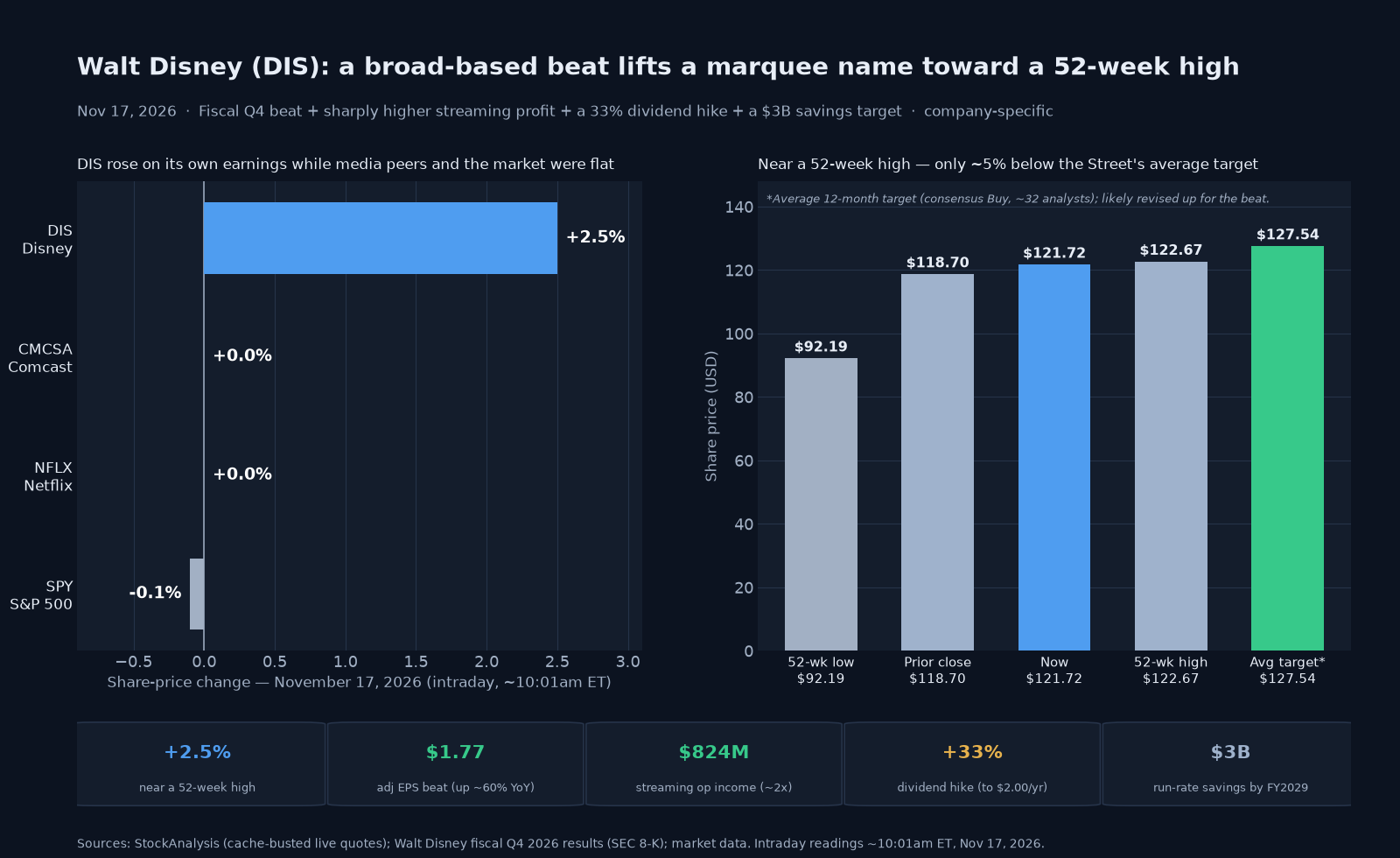
Disney is no longer the deeply discounted turnaround stock it was a couple of years ago — much of the recovery is now in the price. At about $122 the shares trade near 22 times trailing earnings, but a more reasonable 16 times forward earnings, reflecting the double-digit EPS growth the company is guiding to [3]. On sales it is modest at about 2 times revenue, fair for a business mixing high-margin parks and licensing with a streaming segment only now turning profitable [3]. The catch is that the stock has already climbed about 14% over the past year to sit near its 52-week high, and the analysts' average 12-month target of about $127.54 is only roughly 5% above the current price — so much of the "turnaround is working" re-rating appears to have already happened [3]. From here, the stock likely needs the fiscal-2027 guide — double-digit EPS growth, a resilient parks business, continued streaming progress — to actually deliver, rather than simply to stop disappointing. The dividend, yielding only about 1.6% on the new $2.00 payout, is a confidence signal more than an income story; the real engine remains earnings growth, which is itself boosted by buybacks (total segment operating income is guided up only about 8%).
Analyst view
This is a turnaround maturing into an execution story, and the discipline is to separate the quality of the quarter from how much of it is already priced. The bull case is strong and well-supported: streaming is now clearly profitable and scaling (operating income rose sharply), the parks are broadly resilient, management is returning cash and targeting cost savings, and the fiscal-2027 outlook points to double-digit adjusted-EPS growth — a company doing the right things with momentum. The bear case is about price and a few flattered figures: the stock sits near a 52-week high with only mid-single-digit upside to the consensus target, full-year GAAP EPS fell, an extra 53rd week padded the growth rates, total segment operating income is guided up only about 8% (with EPS growth leaning on buybacks), and a ~1.6% yield offers little cushion if execution wobbles. The balanced interpretation is that Disney delivered a genuinely good quarter and a shareholder-friendly message, which justifies the move, but that the valuation now assumes continued delivery rather than offering a bargain. The right lens is fiscal 2027: if streaming margins keep widening and parks hold up, the stock can grow into and past its target; if either stalls, a stock at its highs has less room for error. This is descriptive analysis of a news-driven move, not investment advice.
Why it matters
Disney is a bellwether for two of the biggest questions in media and consumer spending: whether traditional entertainment giants can make streaming genuinely profitable rather than just big, and whether the theme-park and experiences economy stays resilient as households watch their budgets. This quarter answered both encouragingly — a sharp rise in streaming operating income (to $824 million) is a milestone for the whole legacy-media complex, and growth at the Experiences unit suggests the premium-experience consumer is largely holding up. The capital-return signal matters too: a 33% dividend increase, about $9 billion of planned buybacks and a $3 billion cost-savings target point to a management confident in its cash flow. But it is not a pivot to harvesting margins — Disney is raising content spending about 9% to roughly $26 billion in fiscal 2027, and says most of the targeted savings will fund that investment, so the story is still growth-and-invest, now with sharper capital discipline alongside it. For the stock specifically, the episode marks a transition from "is the turnaround real?" to "how much growth is left, and at what price?" — a healthier debate to be having, but one that sets a higher bar for each coming quarter. For now, a broad-based beat and a confident capital plan pushed a marquee name to within about 1% of its 52-week high.
The move, in one cross-section
The same-session tape shows Disney outperforming its media peers and the broad market, which were roughly flat — consistent with a company-specific catalyst [5]:
| Name (ticker) | Nov 17, 2026 (intraday) | Read-through |
|---|---|---|
| DIS — Walt Disney | ≈+2.5% | The earnings name — up on a Q4 beat, sharply higher streaming profit, a 33% dividend hike and a $3B savings target [1] |
| NFLX — Netflix | ≈flat | Streaming leader barely moved — no read-through to Disney's company-specific beat [5] |
| CMCSA — Comcast | ≈flat | Media/parks peer roughly unchanged [5] |
| SPY — S&P 500 (ETF) | ≈flat | Broad market little changed — DIS stood out on its results [5] |
Disney up ~2.5% while its closest media peers and the S&P 500 were roughly flat points to a single-company catalyst — its own earnings and capital plan — rather than a sector or macro move [5].
What the Street thinks
Analysts are constructive but no longer chasing. The consensus rating is a Buy from about 32 analysts, with an average 12-month price target near $127.54 — only about 5% above where the stock trades after the pop [3]. That narrow gap, paired with a Buy rating, is the tell: the Street believes in the direction (profitable streaming, resilient parks, capital returns) but, with the stock trading near its 52-week high, is not pricing in dramatic further upside over the next year. Analysts could raise targets as they incorporate the beat and the reaffirmed fiscal-2027 outlook, but the starting point is a stock that has already been rewarded for the turnaround working. The gap between price and target is less a promise than a measure of how much good news is now embedded [3].
What to watch
- Streaming profitability — and disclosure. Whether the direct-to-consumer business keeps improving; note that from the first quarter of fiscal 2027 Disney will fold streaming operating income into a broader Entertainment segment, so this key metric will be harder to track directly [2].
- Parks and Experiences. Whether attendance and per-guest spending hold up, especially at the international parks (Hong Kong and Shanghai showed softer trends), since Experiences is the profit engine most exposed to a consumer slowdown [2].
- Cost savings versus reinvestment. Execution on the ~$3 billion annual run-rate savings target by fiscal 2029 — and whether it funds growth (content spend is rising ~9% to ~$26 billion) without cutting into content quality [6].
- The fiscal-2027 outlook, tested quarterly. Any confirmation or slippage on double-digit adjusted-EPS growth and ~8% segment operating-income growth. Moves are tracked on the Disney stock page.
Illustrative scenario sensitivity
Because the move reflects a strong quarter meeting a stock that has already re-rated, the scenarios below are anchored to fiscal-2027 execution — streaming margins, parks resilience and the cost plan — rather than to this quarter alone [3]. They are a descriptive, author-weighted exercise over roughly the coming six-to-twelve months as those trends clarify — not a forecast, target, recommendation, or trading advice — with subjective weights that sum to 100%.
| Scenario | Illustrative price | Weight | Key drivers |
|---|---|---|---|
| Execution compounds | ~$140 | 30% | Streaming margins keep widening, parks stay strong, the cost plan lands, and the stock grows past the Street's target on double-digit EPS growth [3]. |
| Good, but priced in | ~$123 | 45% | The guide broadly holds but the turnaround is already reflected; the stock consolidates near its highs and the consensus target as investors wait for proof [1]. |
| Consumer or content stumble | ~$105 | 25% | A parks/consumer slowdown or a streaming-margin stall undercuts the EPS trajectory, and a stock at its highs gives back ground [2]. |
Weighting those (0.30 × $140 + 0.45 × $123 + 0.25 × $105) gives an author-weighted reference value of about $123.60 — an illustrative, probability-weighted scenario output mechanically derived from the weights above, and not a price target, fair-value estimate, or prediction — essentially in line with Tuesday's ~$122 price [1]. That the weighted figure lands so close to the current price reflects a simple reading: the market has already repriced Disney for a working turnaround, so from here the stock largely tracks whether fiscal-2027 execution delivers. This is a scenario exercise and descriptive analysis of a news-driven move, not investment advice.
Walt Disney data snapshot — November 17, 2026
| Figure | Value | As-of / source |
|---|---|---|
| Intraday quote | ~$121.72 (≈+2.5%) — an intraday reading (market open); opened $118.26, day range $118.26–$121.72; within ~1% of the 52-week high | Tue, Nov 17, 2026, ~10:01am ET — StockAnalysis [1] |
| Prior close / 52-week trend | $118.70 prior close; 52-week range $92.19–$122.67; up ~14% over the past year; well above its 50-day ($109.77) and 200-day ($103.86) averages; beta ~1.43 | Nov 17, 2026 [1] |
| Market cap / valuation | ≈$210B (≈1.73B shares); enterprise value ≈$248B; P/E ≈21.6 trailing vs ≈16.1 forward; P/S ≈2.0 on ~$102.3B trailing revenue | Nov 17 — StockAnalysis [3] |
| Q4 FY2026 results | Revenue +16% to $25.9B (beat ~$25.2B; ~8% ex the extra 53rd week); adjusted EPS $1.77 (up from $1.11, beat ~$1.67); GAAP diluted EPS $1.51 (up from $0.73). Streaming (DTC, Disney+/Hulu) revenue +19% to ~$6.05B, operating income ~$824M (up from ~$402M; ~+65%/~$664M ex the extra week); Experiences revenue ~$10.1B (+15%, ~7pp from the extra week) | Nov 17 — Disney Q4 FY2026 results (SEC 8-K) [2] |
| Full-year FY2026 | Revenue +8% to $102.3B; adjusted EPS $7.02; GAAP diluted EPS $5.63 (down ~18% — mainly a tough comparison vs favorable FY2025 tax benefits, incl. a Hulu income-tax reclassification, plus some FY2026 charges); both Q4 and FY included an extra 53rd week (~$0.17 to FY adjusted EPS) | Nov 17 — Disney results [2] |
| Capital return & plan | Dividend raised ~33% — $2.00/share for the year (two $1.00 installments, Jan & Jul 2027), up from $1.50; forward yield ~1.6%. A ~$3B annual run-rate cost-savings target by FY2029 (incl. layoffs) — but MOST meant to fund reinvestment, not margin; content spend is rising ~9% to ~$26B | Nov 17 — Disney results / coverage [2] [6] |
| FY2027 guidance (reaffirmed) | Double-digit adjusted-EPS growth (ex the 53rd week), total segment operating income +~8%, ~$11B free cash flow, ~$9B buybacks, ~$26B content spend (+~9%); from Q1 FY2027 streaming operating income will no longer be reported separately (folded into Entertainment) | Nov 17 — Disney results [2] |
| Same-day cross-section | DIS +2.5% vs NFLX ≈flat, CMCSA ≈flat, SPY ≈flat — a company-specific earnings move, not a sector or macro one (Warner Bros. Discovery is excluded — it was acquired by Skydance and no longer trades) | Nov 17 intraday [5] |
| Analyst view | Consensus "Buy" from ~32 analysts, average target ≈$127.54 — only ~5% above the post-earnings price (the stock has run to its 52-week high); targets likely to be revised for the beat | Nov 17 — StockAnalysis [3] |
Disney (DIS) Q4 earnings FAQ
Why did Disney (DIS) stock rise on November 17, 2026?
Disney rose about 2.5% to roughly $122 — within about 1% of a 52-week high — after reporting fiscal fourth-quarter results before the open that beat Wall Street's expectations and came with a shareholder-friendly message. Revenue rose 16% to $25.9 billion and adjusted EPS of $1.77 topped the roughly $1.67 consensus, but the standout was streaming: direct-to-consumer operating income more than doubled to $824 million (helped by an extra 53rd week; about +65% without it), confirming the business is becoming meaningfully profitable. Management also raised the dividend about 33% (to $2.00 a year), set a ~$3 billion annual cost-savings target for fiscal 2029, and reaffirmed double-digit adjusted-EPS growth in fiscal 2027. The move was company-specific — media peers and the broad market were roughly flat on the day.
Did Disney actually beat earnings, and how strong was the quarter?
Yes. Adjusted earnings of $1.77 a share beat the roughly $1.67 analysts expected and rose sharply from $1.11 a year earlier, and revenue of $25.9 billion (up 16%) topped the ~$25.2 billion consensus. The quality was broad-based: streaming operating income doubled to $824 million, the theme-park Experiences segment grew 15% to about $10.1 billion, and studio results contributed. Two nuances to keep in mind: both the quarter and the year included an extra 53rd week that added roughly $1.6 billion to quarterly revenue (so the ~16% growth is closer to 8% underlying) and about $0.17 to full-year adjusted EPS, flattering the headline growth rates; and on a GAAP basis, full-year diluted EPS actually fell about 18% to $5.63 (versus adjusted EPS of $7.02), which Disney attributes mainly to a tough comparison against unusually favorable fiscal-2025 tax benefits (including a Hulu income-tax reclassification) plus some fiscal-2026 restructuring and transaction-related charges — not to operating weakness.
Is Disney's streaming business finally profitable?
It is the single most important takeaway from this quarter, and the answer is increasingly yes. Disney+ and Hulu's combined direct-to-consumer subscription revenue rose 19% to about $6.05 billion, and streaming operating income more than doubled to $824 million from about $402 million a year earlier. One caveat: the extra 53rd week in the quarter contributed an estimated ~$160 million, so on a comparable basis streaming operating income rose closer to 65% (to about $664 million) — still a strong, meaningful improvement. For years streaming losses overshadowed Disney's turnaround; a segment now generating hundreds of millions in quarterly operating profit is the proof point investors wanted. Two things to watch: durability (whether margins keep widening as Disney keeps investing in content), and disclosure — from the first quarter of fiscal 2027, Disney will stop reporting streaming operating income as a separate line, folding it into a broader Entertainment segment, so the metric will be harder to track directly.
What did Disney announce about its dividend and costs?
Two shareholder-friendly moves accompanied the earnings. First, Disney raised its dividend about 33% — its board declared a total of $2.00 per share (up from $1.50), payable in two $1.00 installments in January and July 2027 — a signal of management's confidence in cash flow. Even after the raise, the yield is only about 1.6%, so the dividend is more a confidence signal than an income story; the real driver remains earnings growth (itself boosted by roughly $9 billion of planned buybacks). Second, Disney set a target of about $3 billion in annual run-rate cost savings by fiscal 2029, including further layoffs. Importantly, management said most of those savings are meant to fund future investment rather than flow straight to profit — and the company is actually raising content spending about 9% to roughly $26 billion in fiscal 2027 — so this is efficiency to support growth, not a pivot to harvesting margins.
Is Disney stock still a good value after the rise?
It depends on how much you trust the fiscal-2027 guide, because a lot of the turnaround is now in the price. At about $122, Disney trades near 22 times trailing earnings but a more reasonable 16 times forward earnings, reflecting the double-digit EPS growth it is guiding to, and about 2 times sales — not cheap, not expensive, for a business mixing high-margin parks with newly profitable streaming. The catch is that the stock has already climbed about 14% over the past year to sit near its 52-week high, and the analysts' average target of about $127.54 is only roughly 5% above the current price. So much of the 're-rate on a working turnaround' move appears to have already happened. From here, the stock needs fiscal-2027 execution — widening streaming margins, resilient parks, the cost plan landing — to deliver, rather than simply to stop disappointing.
What should investors watch next for Disney?
The most important thing is streaming profitability — whether the direct-to-consumer business keeps improving — though from the first quarter of fiscal 2027 Disney will fold streaming operating income into a broader Entertainment segment, so investors will have to infer it from less granular disclosure. Beyond that, watch the Experiences (theme parks and cruises) segment, since it is Disney's profit engine and the most exposed to a consumer slowdown (international parks like Hong Kong and Shanghai showed softer trends); execution on the ~$3 billion annual run-rate cost-savings target for fiscal 2029, and whether it funds growth without hurting content as Disney raises content spending to about $26 billion; and each quarter's progress against the double-digit adjusted-EPS growth outlook for fiscal 2027. Because the stock has already re-rated to near its 52-week high with only mid-single-digit upside to the consensus target, the next leg depends on that execution actually showing up in the numbers. This is descriptive analysis, not investment advice.