Stock Analysis
Tyson Foods (TSN) Jumps ~7% on a Better-Than-Feared Q4 and an Outlook for Sharply Narrower Beef Losses
Tyson Foods jumped about 7% to roughly $62.80 on November 16 after reporting fiscal fourth-quarter results — and it did so on a risk-off day, with the S&P 500 down nearly 2% as the AI, chip and crypto trades sold off. For a defensive consumer-staples name to rise ~7% while the market fell is a clear company-specific signal, reinforced by a rotation into cheap, low-beta stocks. Tyson's adjusted EPS of $0.61 was roughly in line with or slightly above commonly cited consensus estimates, but it was down ~47% year over year, and on a GAAP basis the company posted a $0.22-per-share loss; revenue of $14.6 billion beat but underlying sales fell ~4%, and adjusted operating income dropped 41%. What drove the jump was the outlook — specifically for beef: management guided its Beef segment from a $654 million fiscal-2026 loss toward roughly breakeven in 2027 (a $300 million loss to a $100 million profit), a sharp narrowing of the biggest drag on earnings caused by a historic cattle shortage, even though total-company adjusted operating-income guidance ($1.7–$2.15 billion) is roughly flat versus this year's $1.977 billion. The stock looks cheap on sales (~0.4x) and reasonable on forward earnings (~16x), but after the pop it sits right at the analysts' average target with a Hold rating — so the move reads as a weak-but-better-than-feared quarter plus a credible beef-loss turn, re-rating a beaten-down defensive in one session.
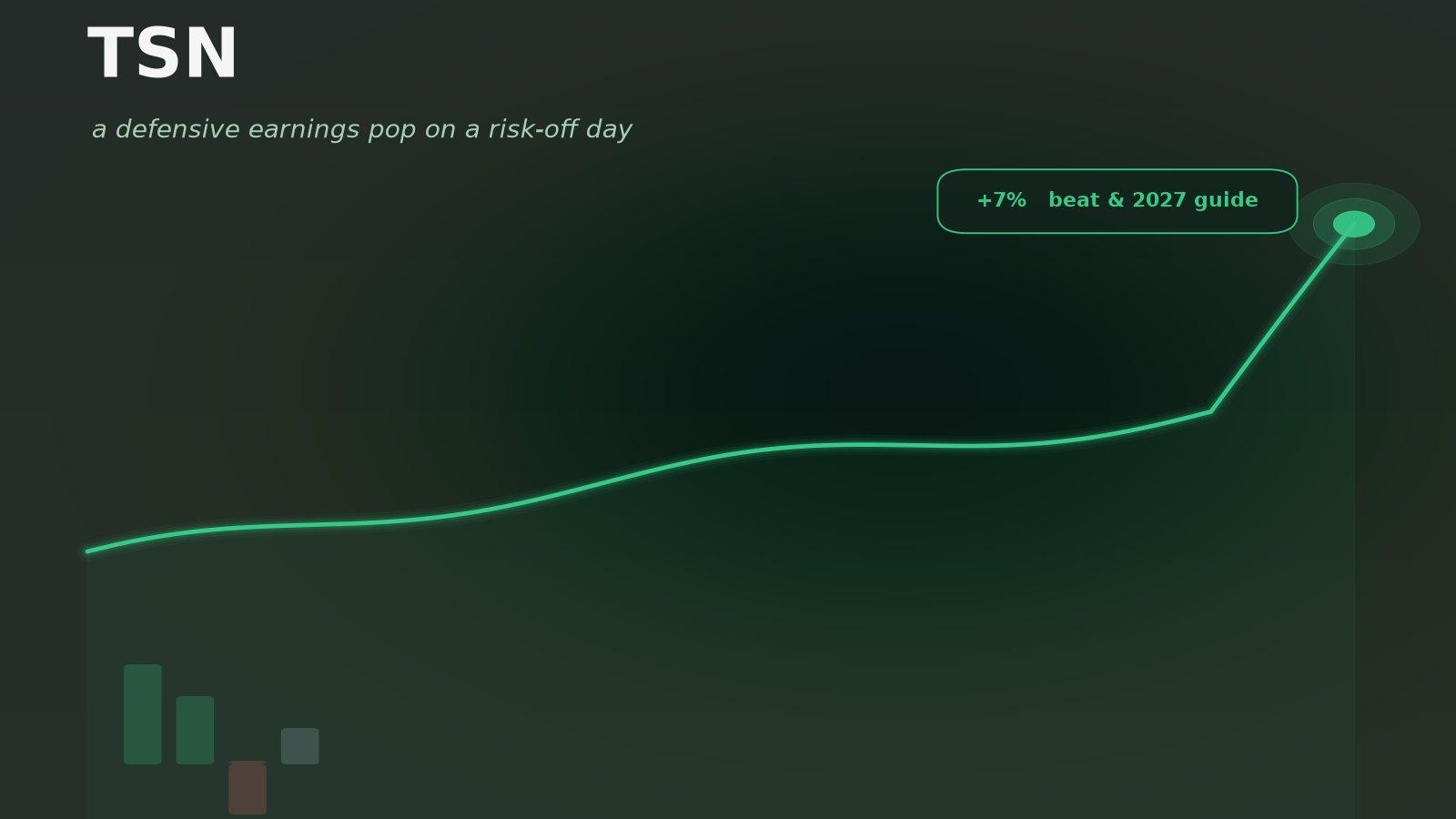
On Monday, November 16, 2026, Tyson Foods (NYSE: TSN) jumped about 7% to roughly $62.80 — having traded as much as ~11% higher intraday, to $65.34 — after reporting fiscal fourth-quarter results before the open [1]. What made the move stand out was the backdrop: it came on a risk-off day, with the S&P 500 down nearly 2% as the AI, semiconductor and crypto trades sold off hard [5]. For a defensive consumer-staples name to rise ~7% while the broad market fell is evidence of a company-specific catalyst — potentially reinforced by investors seeking defensive exposure on a day they were selling risk. Tyson — the largest U.S. meat company, behind brands from its namesake chicken to Jimmy Dean and Hillshire Farm — edged past the most-cited adjusted-earnings estimate and, more importantly, pointed to a 2027 in which its painful beef losses narrow sharply [2].
But the quarter has to be read carefully, because the headline "beat" is modest and sits on top of an objectively weak print. Tyson's adjusted EPS of $0.61 came in at or a touch above the most-cited consensus (around $0.60, though published estimates ranged widely enough that some outlets scored the quarter a miss) — and it was down roughly 47% year over year, while on a GAAP basis the company actually posted a loss of $0.22 a share [2]. Revenue of about $14.6 billion rose 5.2% and beat the ~$14.2 billion consensus, but that growth was flattered by an extra week in the fiscal year and legal accrual items; stripping those out, underlying sales were down about 4% [2]. Adjusted operating income fell 41% to $361 million, a thin 2.6% margin, and actually came in below some analysts' models [2]. So the honest summary is: Tyson cleared a lowered bar on adjusted EPS and revenue, while profit shrank sharply — and the stock rose anyway, because of what management signaled about beef next year.
What actually drove the move — a beef-loss turn, not a profit jump
Two things powered the gain. First, the guidance — but not in the way the headline number suggests. Tyson guided fiscal 2027 total-company adjusted operating income to $1.7–$2.15 billion. That is not a companywide recovery: fiscal 2026 adjusted operating income was already $1.977 billion (itself down 14% on the year), so the midpoint of the new range actually sits slightly below this year's result — and fiscal 2026 carried an extra 53rd week, which further muddies a like-for-like comparison [2]. What excited the market was the composition. Tyson guided its all-important Beef segment from a $654 million adjusted operating loss in fiscal 2026 to a range of roughly a $300 million loss to a $100 million profit in 2027 — a dramatic narrowing of the single biggest drag on its earnings — even as it expects Chicken to step down from an unusually strong $1.86 billion toward about $1.3–$1.6 billion [2]. In other words, the market rewarded a de-risking of the worst part of the story, not a jump in total profit. Tyson also guided to roughly $0.8–$1.3 billion of free cash flow, with sales down 3.5%–5.5% (largely on lower beef volumes and the lost 53rd week) [2]. Second, the quarter itself was better than feared: Chicken and Prepared Foods — the higher-margin, more stable businesses — generated adjusted operating income of about $389 million and $321 million respectively in the quarter (and $1.86 billion and $1.33 billion for the full year), largely offsetting Beef's losses [2].
Because Beef is the whole problem, it is worth being specific. Tyson's Beef segment posted an adjusted operating loss of about $171 million in the quarter — far worse than the ~$52 million loss a year earlier — and a $654 million loss for the full fiscal year, versus about $275 million in 2025 [2]. The cause is the U.S. cattle cycle: the national herd is near multi-decade lows, so live-cattle prices are extremely high while the beef Tyson sells has not kept pace — pushing its processing margins into negative territory. The losses largely reflect industrywide cattle-supply pressures rather than company-specific factors alone, and that is why the market is willing to look through them: cattle cycles turn, and management's 2027 guidance suggests the financial impact could ease, though the timing of a cyclical recovery remains uncertain. The risk is timing — if herd rebuilding takes longer, beef stays a drag deep into 2027 and that guided improvement slips. The quarter, in other words, advanced the beef-recovery thesis without proving it.
The valuation question
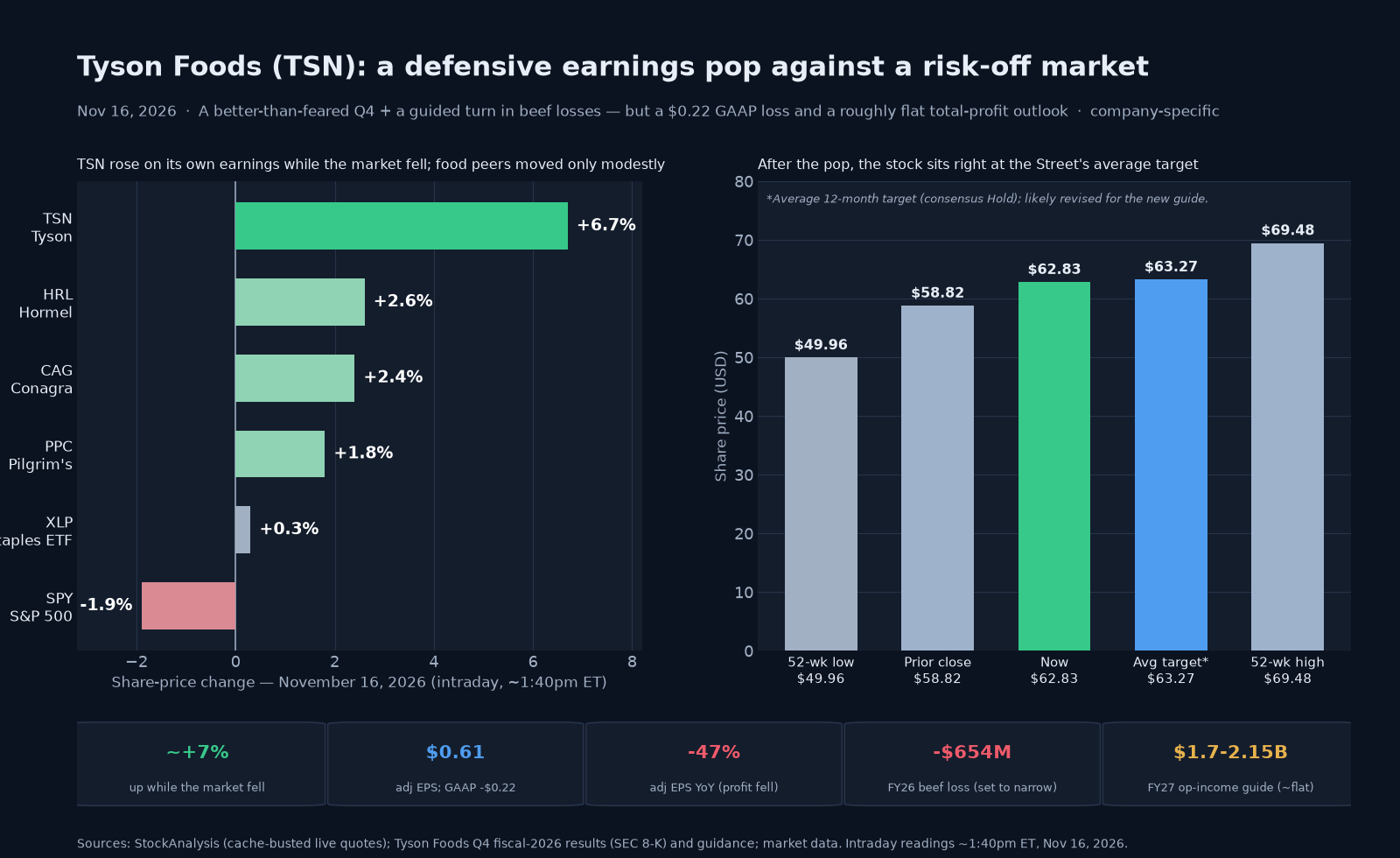
Tyson is a classic low-margin, cyclical processor, and its valuation has to be read through that lens. The stock is not expensive on sales — it trades at about 0.4 times revenue on roughly $56 billion of annual sales — but its earnings multiple is distorted by the cycle: a trailing P/E near 49 looks rich only because fiscal-2026 GAAP earnings were so depressed, while the forward P/E of about 16 reflects the Street's expectation that reported earnings normalize back toward the adjusted level in 2027 [3]. That gap between a high trailing and a reasonable forward multiple is the normalization bet in one number. The balance-sheet nuance to watch is the dividend: Tyson yields about 3.25% and has a long record of raises, but the payout ratio is above 100% of depressed GAAP earnings [3] — sustainable if profits recover as guided, more strained if they do not. After the pop, the stock also sits essentially at the analysts' average 12-month target of about $63.27 (the consensus rating is Hold), so the easy re-rating from "beaten down" to "fairly valued" has largely happened in one session [3]. From here the stock needs the guided beef turn to actually show up.
Analyst view
This is a "look through the trough" story, and the discipline is to separate what improved (the outlook) from what is still weak (the current quarter). The bull case is that Tyson is a defensive, dividend-paying staple whose two best businesses — Chicken and Prepared Foods — are performing well, whose worst business (Beef) is near a cyclical bottom that history says will turn, and whose management just guided that beef's losses should narrow sharply in 2027; on a day when investors were fleeing richly valued AI names, a cheap, low-beta protein company with an earnings catalyst may have appealed to those seeking defensive exposure. The bear case is equally grounded: the "beat" was on adjusted EPS that still fell 47%, GAAP was a loss, adjusted operating income fell 41% and missed some analysts' estimates, the beef cycle has repeatedly disappointed timing expectations, and after a 7% pop the stock has already reached the consensus target with a Hold rating and a stretched payout ratio. The most honest read is that the quarter was weak but better-than-feared, paired with a credible plan for beef losses to shrink (even though total-company profit guidance is roughly flat) — which is enough to re-rate a beaten-down defensive name in one session, but not enough to call the cycle turned. The right lens is the guidance versus the actuals: if beef losses narrow through 2027 as promised, today's move looks early; if they don't, the stock has gotten ahead of the fundamentals. This is descriptive analysis of a news-driven move, not investment advice.
Why it matters
Tyson is a bellwether for the American protein complex and for packaged food, so its results read across to grocery prices, to cattle and chicken producers, and to peers like Pilgrim's Pride, Hormel and Conagra [5]. The quarter crystallized the single biggest theme in the meat business right now: a historic cattle shortage that has turned beef — normally Tyson's largest segment by revenue — into a money-loser, even as chicken economics are healthy. That divergence is why Tyson's guidance hinges so heavily on one question: when does beef stop bleeding? The session also showed something broader about the tape. On a day the AI trade was being sold aggressively, a low-valuation, dividend-paying food stock jumping 7% on an earnings reaction is a small but real sign that some investors were leaning toward defensive, value-oriented names — the kind of move that tends to appear when investors start worrying that the market's most crowded trades have run too far. For Tyson specifically, the resolution will come from the next few quarters of beef margins and whether the 2027 guide proves conservative or optimistic. For now, a weak-but-better-than-feared quarter and a beef-recovery promise bought the stock a strong day against a weak market.
The move, in one cross-section
The same-session tape shows Tyson rising sharply on its own earnings while the broad market fell and food peers moved only modestly — the signature of a company-specific catalyst, potentially amplified by some demand for defensive names [5]:
| Name (ticker) | Nov 16, 2026 (intraday) | Read-through |
|---|---|---|
| TSN — Tyson Foods | ≈+6.7% | The earnings name — up on a better-than-feared Q4 and an outlook for sharply narrower beef losses, despite a GAAP loss [1] |
| HRL — Hormel Foods | ≈+2.6% | Packaged-protein peer — up modestly on the defensive bid and read-through [5] |
| CAG — Conagra Brands | ≈+2.4% | Packaged food — caught the same rotation into staples [5] |
| PPC — Pilgrim's Pride | ≈+1.8% | Chicken pure-play — up on the healthy-chicken read-through [5] |
| XLP — Consumer Staples (ETF) | ≈+0.3% | Staples roughly flat — a green island in a red market [5] |
| SPY — S&P 500 (ETF) | ≈−1.9% | Broad market down hard on an AI/semi/crypto selloff — TSN went the other way [5] |
Tyson up ~7% while the S&P 500 fell ~2% — and well ahead of its own sector peers — is the signature of a company-specific catalyst (its earnings), potentially reinforced by some risk-off interest in cheaper, defensive names [5].
What the Street thinks
Analysts are cautious on Tyson even after the beat. The consensus rating is a Hold from about 13 analysts, with an average 12-month price target of roughly $63.27 — only about 1% above where the stock trades after Monday's jump [3]. In other words, the pop has carried the stock right up to the Street's fair-value estimate, which is why the near-term reaction among analysts is less "upgrade" and more "wait and see whether the 2027 guide holds." The low target gap, paired with a Hold rating, captures the ambivalence cleanly: the business is stabilizing and the beef-recovery guide is credible, but beef-cycle timing risk and a stretched payout keep the Street from chasing it higher right away. The targets will move as analysts update for the guidance, so the consensus is a snapshot rather than a settled view [3].
What to watch
- Beef margins. The single most important number for Tyson — whether the Beef segment's losses narrow through fiscal 2027 as the cattle cycle turns, the swing factor in the whole guide [2].
- Chicken and Prepared Foods. Whether the two profit engines hold their margins and keep offsetting beef [2].
- The 2027 guide, tested quarterly. Any confirmation or slippage on the $1.7–$2.15 billion adjusted operating income target [2].
- The dividend and cash flow. Whether free cash flow (guided $0.8–$1.3 billion) comfortably covers the payout as profits recover. Moves are tracked on the Tyson stock page.
Illustrative scenario sensitivity
Because the move reflects a guided beef-loss turn meeting a weak current quarter rather than a step-change in present earnings, the scenarios below are anchored to beef-cycle timing and 2027 execution — not to this quarter's result [3]. They are a descriptive, author-weighted exercise over roughly the coming six-to-twelve months as the cycle clarifies — not a forecast, target, recommendation, or trading advice — with subjective weights that sum to 100%.
| Scenario | Illustrative price | Weight | Key drivers |
|---|---|---|---|
| Beef troughs, guide proves conservative | ~$72 | 30% | Cattle cycle turns, beef losses narrow faster than guided, chicken stays strong, and the stock re-rates toward its 52-week high on 2027 earnings power [3]. |
| Beef turn on track, but priced in | ~$62 | 45% | The beef-improvement guide broadly holds but the easy re-rating is done; the stock consolidates near current levels and the consensus target as analysts wait for proof [1]. |
| Beef stays bad, guide slips | ~$52 | 25% | Herd rebuilding drags, beef losses persist into 2027, and the stock gives back the pop toward the lower half of its range [2]. |
Weighting those (0.30 × $72 + 0.45 × $62 + 0.25 × $52) gives an author-weighted reference value of about $62.50 — an illustrative, probability-weighted scenario output mechanically derived from the weights above, and not a price target, fair-value estimate, or prediction — essentially in line with Monday's ~$62.80 price [1]. That the weighted figure lands so close to the current price reflects a simple reading: the market has already repriced Tyson from "beaten down" to "fairly valued on a beef recovery" in one session, so from here the stock largely tracks whether the beef cycle actually turns. This is a scenario exercise and descriptive analysis of a news-driven move, not investment advice.
Tyson Foods data snapshot — November 16, 2026
| Figure | Value | As-of / source |
|---|---|---|
| Intraday quote | ~$62.83 (≈+6.8%) — an intraday reading (market open); opened $60.90 and traded as high as $65.34 (~+11%) before trading near $62.83 at the stated observation time; day range $60.46–$65.34 | Mon, Nov 16, 2026, ~1:40pm ET — StockAnalysis [1] |
| Prior close / range | $58.82 prior close; 52-week range $49.96–$69.48 (~10% below the high, ~26% above the low); beta ~0.37 (a low-volatility defensive) | Nov 16, 2026 [1] |
| Market cap | ≈$22.0B (≈350.9M shares); enterprise value ≈$29.0B | Nov 16 — StockAnalysis [3] |
| Valuation | P/S ≈0.41 on ~$56.4B trailing sales; trailing P/E ≈49 (depressed GAAP) vs forward P/E ≈16.2 (the recovery bet); dividend $2.04 (≈3.25% yield), payout ratio above 100% of GAAP earnings | Nov 16 — StockAnalysis [3] |
| Q4 FY2026 results | Adjusted EPS $0.61 (beat; −47% YoY) vs GAAP EPS −$0.22 (a loss); revenue $14.585B (+5.2% YoY, beat ~$14.2B est, but ~−4% ex extra week + legal items); adjusted operating income $361M (−41%, 2.6% margin) | Nov 16 — Tyson Q4 FY2026 results (SEC 8-K) [2] |
| Segments | Beef the drag: Q4 adjusted operating loss ≈−$171M (vs ≈−$52M a year ago; FY2026 loss ≈−$654M) on the cattle-cycle squeeze; Chicken (Q4 ≈$389M, FY ≈$1.86B) and Prepared Foods (Q4 ≈$321M, FY ≈$1.33B) the offsets | Nov 16 — Tyson results [2] |
| FY2027 guidance (the catalyst) | Total adjusted operating income $1.7–$2.15B — roughly flat vs FY26's $1.977B, NOT a companywide recovery; the improvement is concentrated in Beef (guided from a −$654M loss toward −$300M to +$100M), offset by lower Chicken ($1.3–$1.6B); sales −3.5% to −5.5%; free cash flow $0.8–$1.3B | Nov 16 — Tyson results [2] |
| Same-day cross-section | TSN +6.7% vs SPY −1.9%, XLP +0.3%, HRL +2.6%, CAG +2.4%, PPC +1.8% — TSN rose on its own earnings while the market sold off | Nov 16 intraday [5] |
| Analyst view | Consensus "Hold" from ~13 analysts, average target ~$63.27 — only ~1% above the post-jump price (the stock has caught up to the Street); targets subject to revision for the new guide | Nov 16 — StockAnalysis [3] |
Tyson Foods (TSN) Q4 earnings FAQ
Why did Tyson Foods (TSN) stock jump on November 16, 2026?
Tyson rose about 7% — to roughly $62.80, having traded as much as ~11% higher intraday — after reporting fiscal fourth-quarter results before the open. The move was notable because it came on a risk-off day, with the S&P 500 down nearly 2% as the AI, chip and crypto trades sold off; a defensive consumer-staples name rising while the market fell is a clear company-specific signal, reinforced by a rotation into cheap, low-beta stocks. Two things drove it: Tyson's adjusted EPS of $0.61 edged past the most-cited estimate, and — more importantly — management guided its loss-making Beef segment to improve sharply in 2027 (from a $654 million fiscal-2026 loss toward roughly breakeven). The market looked past an objectively weak GAAP quarter and focused on that beef turn, even though total-company adjusted operating-income guidance ($1.7–$2.15 billion) is roughly flat versus this year's $1.977 billion.
Did Tyson Foods actually beat earnings, or is that misleading?
It is genuinely ambiguous, which is why the quarter needs care. Tyson's adjusted (non-GAAP) EPS of $0.61 edged past the most commonly cited consensus (around $0.60), and revenue of about $14.6 billion beat as well — but published estimates ranged widely enough that some outlets scored the EPS a miss, so the 'beat' is narrow and depends on which estimate you use. And the quality was weak: adjusted EPS was still down roughly 47% year over year, on a GAAP basis the company posted a loss of $0.22 a share, adjusted operating income fell 41% to $361 million (a thin 2.6% margin) and missed some analysts' models, and the revenue growth was flattered by an extra week in the fiscal year and legal accrual items (underlying sales were down about 4%). So Tyson cleared a lowered bar while profit shrank sharply. The stock rose on the forward guidance, not the strength of the quarter itself.
Why are Tyson's beef losses so large?
Beef is Tyson's biggest segment by revenue, and it is the main reason profits collapsed. In the quarter, Beef posted an adjusted operating loss of about $171 million, far worse than the roughly $52 million loss a year earlier. The cause is the U.S. cattle cycle: the national herd is near multi-decade lows after years of drought and high costs, so live-cattle prices are extremely high while the price of the beef Tyson sells has not kept pace — compressing its spreads to negative. This is an industry-wide condition, not a Tyson-specific execution failure, and it is why the market is willing to look through it: cattle cycles eventually turn as ranchers rebuild herds. The risk is timing — if that rebuild takes longer than expected, beef stays a drag deep into 2027.
What is Tyson's guidance for fiscal 2027?
Tyson guided fiscal 2027 total-company adjusted operating income to a range of $1.7–$2.15 billion. Importantly, that is roughly flat-to-down versus the $1.977 billion it earned in fiscal 2026 (the midpoint sits slightly below), so it is not a companywide profit recovery. What the market responded to is the composition: the Beef segment is guided from a $654 million loss in fiscal 2026 to a range of a $300 million loss to a $100 million profit in 2027 — a sharp improvement — while Chicken is guided down from an unusually strong $1.86 billion toward $1.3–$1.6 billion. Tyson also guided to free cash flow of roughly $0.8–$1.3 billion and total sales down about 3.5%–5.5% (partly on lower beef volumes and the loss of fiscal 2026's extra 53rd week). So the outlook that drove the jump is specifically a narrowing of beef losses, not higher total profit — and it hinges on a cattle-cycle turn whose timing is uncertain.
Is Tyson Foods stock cheap after the jump?
It depends which multiple you use, which is the heart of the recovery debate. On sales, Tyson looks cheap — about 0.4 times roughly $56 billion of annual revenue, normal for a low-margin processor. On earnings, the picture is split: the trailing P/E near 49 looks expensive only because fiscal-2026 GAAP earnings were so depressed, while the forward P/E of about 16 reflects the Street's expectation that reported earnings normalize back toward the adjusted level in 2027. That gap is essentially the normalization bet expressed as a number. After the 7% pop, though, the stock sits right at the analysts' average 12-month target of about $63.27, with a consensus Hold rating, so the easy move from 'beaten down' to 'fairly valued' has largely happened. The dividend yields about 3.25%, but the payout ratio is above 100% of depressed GAAP earnings — sustainable if profits recover as guided, more strained if they don't.
What should investors watch next for Tyson Foods?
The single most important thing is beef margins: whether the Beef segment's losses narrow through fiscal 2027 as the cattle cycle turns, which is the swing factor in the entire guide. Beyond that, watch whether Chicken and Prepared Foods — Tyson's two profit engines — hold their margins and keep offsetting beef; whether each quarter confirms or undercuts the $1.7–$2.15 billion operating-income target; and whether free cash flow (guided $0.8–$1.3 billion) comfortably covers the dividend as profits recover. Because the stock has already re-rated to the Street's fair-value estimate in one session, the next leg depends on the guided beef recovery actually showing up in the numbers rather than on the guidance alone.