Stock Analysis
Nvidia (NVDA) Slides as Jensen Huang Abruptly Resigns as CEO, Days Before Earnings
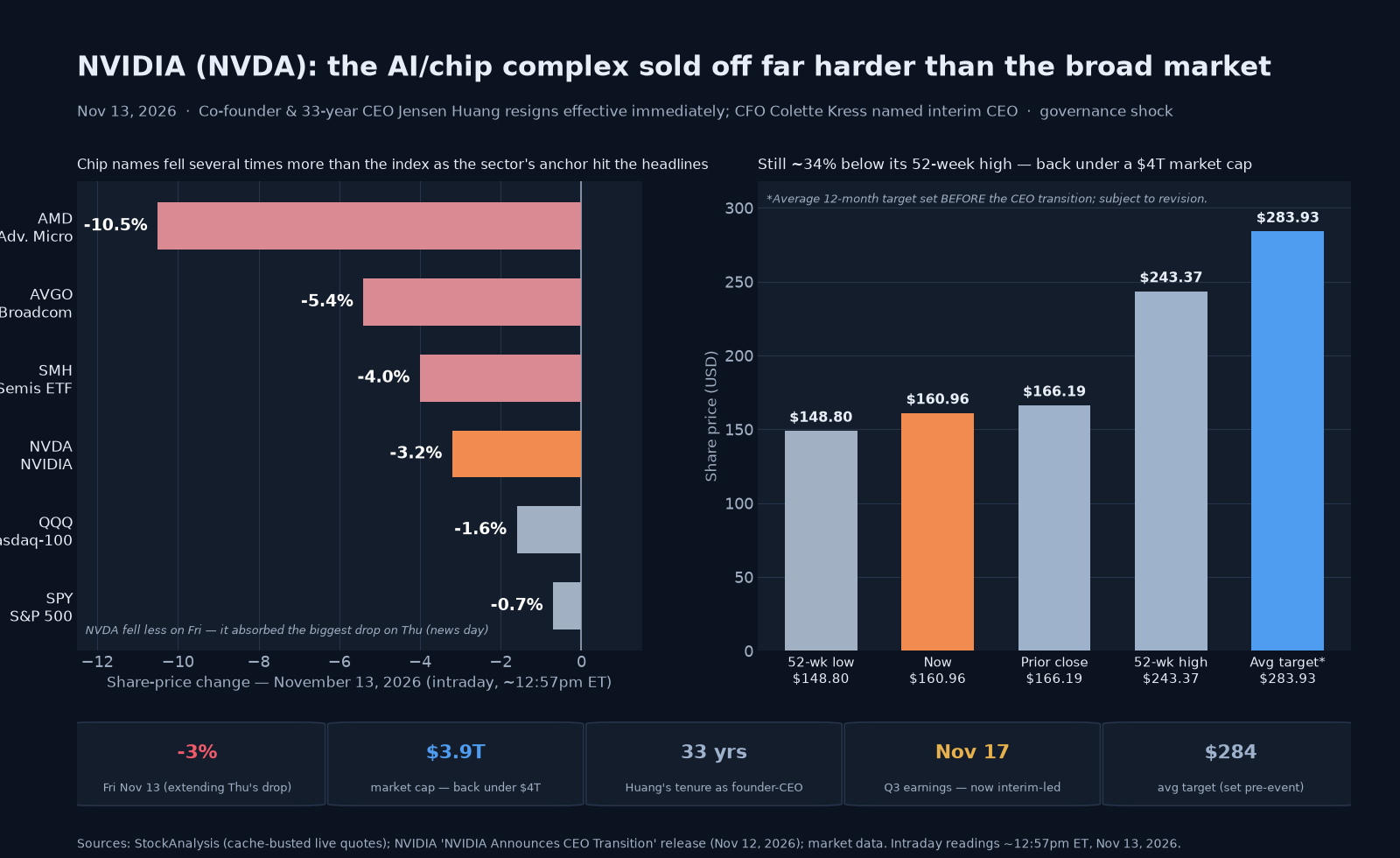
NVIDIA fell about 3% to roughly $161 on November 13, slipping back below a $4 trillion market value, as the market digested a sudden and unexpected leadership change: co-founder Jensen Huang has resigned as President, CEO and board member, effective immediately. The Board named longtime CFO Colette Kress interim CEO and appointed Harvey C. Jones as its first-ever Chair, while launching a search for a permanent chief. NVIDIA's transition release gave no reason; days earlier, Mr. Huang had acknowledged an affair and the board had launched an independent investigation into a reported foreign-intelligence targeting (ongoing and unproven), and lawmakers have since sought his testimony. Because NVIDIA anchors the entire AI trade, the turmoil added to an already fragile tape — AMD fell ~10.5%, Broadcom ~5.4% and the semis ETF ~4%, versus less than 1% for the S&P 500. The timing is delicate: NVIDIA reports fiscal Q3 (FY2027) results on November 17, so one of tech's most closely watched prints will be delivered by an interim CEO days into an unexpected leadership transition. The franchise looks intact — ~$303B trailing revenue, ~20x earnings — so the sell-off reads as a repricing of leadership and governance risk rather than any newly reported operating weakness.
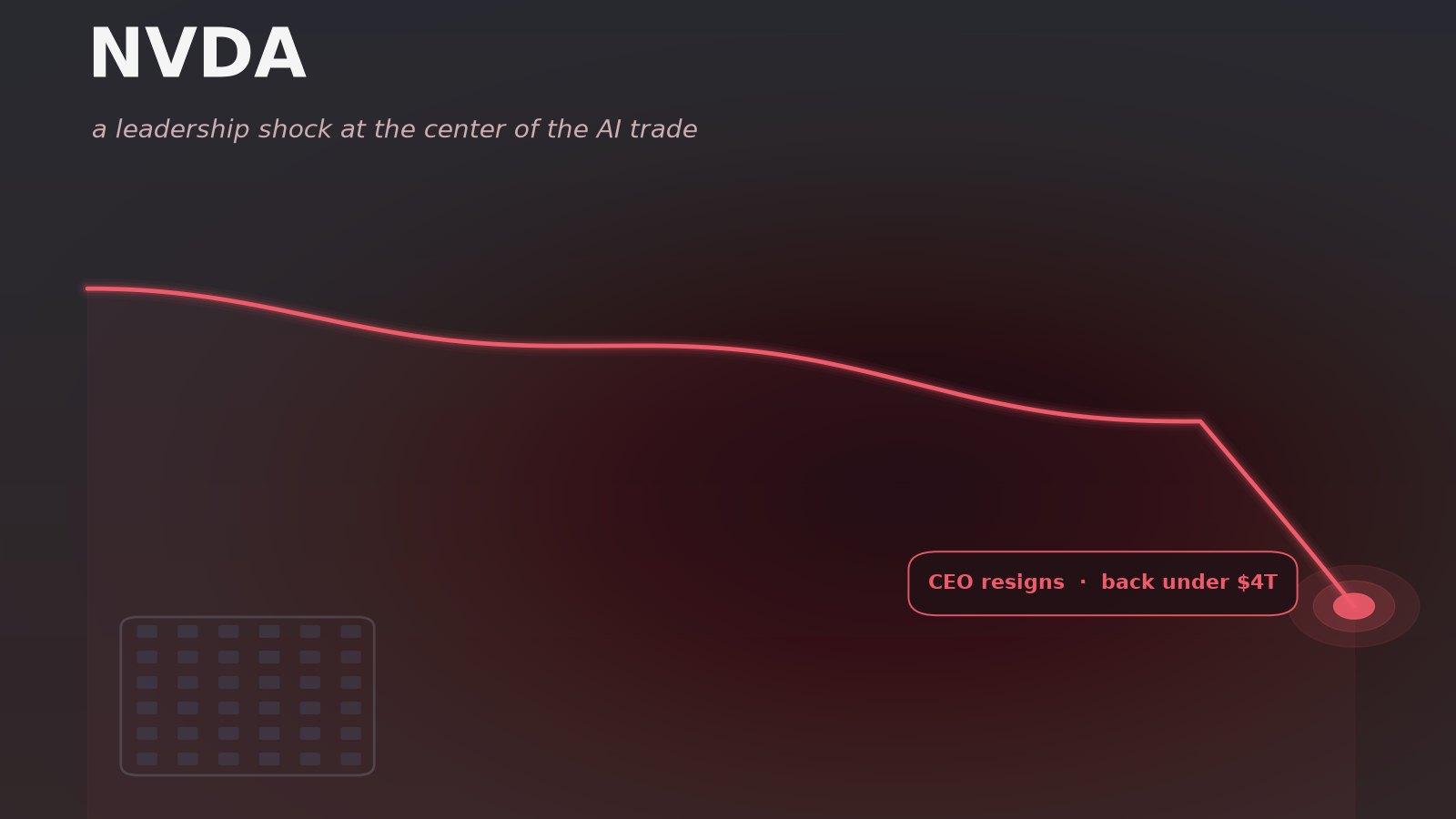
On Friday, November 13, 2026, NVIDIA (NASDAQ: NVDA) fell about 3% to roughly $161 intraday, slipping the company's market value back below $4 trillion to about $3.9 trillion, as the market kept digesting a sudden and unexpected leadership change: co-founder Jensen Huang has resigned as chief executive [1]. The drop extended a sharp move the day before — on Thursday, after NVIDIA announced the transition, the stock opened roughly 13% lower and fell as much as ~14% below Wednesday's close, touching an intraday low of $148.80 (its lowest in more than a year), before recovering to finish down about 4.3% [6]. NVIDIA is the anchor of the entire AI trade, so its leadership turmoil added to an already fragile tape for AI and semiconductor stocks: on Friday, AMD fell about 10.5%, Broadcom about 5.4% and the semiconductor ETF about 4%, while the S&P 500 was down less than 1% [5].
What happened — an abrupt CEO transition at the center of the AI boom
In a release titled "NVIDIA Announces CEO Transition," dated November 12, 2026, the company said Jensen Huang had resigned as President, Chief Executive Officer and a member of the Board, effective immediately [2] — NVIDIA's SEC filing indicates the Board accepted the resignation on November 11, and the company announced it publicly the next day. Huang co-founded NVIDIA in 1993 and had run it for 33 years, turning a graphics-chip maker into the indispensable supplier of AI computing — so his sudden departure is not a routine succession. The Board named longtime finance chief Colette Kress, NVIDIA's Executive Vice President and CFO, as interim CEO while she continues as CFO, and appointed Harvey C. Jones — a technology executive and investor best known for leading Synopsys — as the company's first-ever Chair of the Board, a governance structure NVIDIA had not previously had [2]. The Board said it is initiating a search for a permanent CEO and will consider internal and external candidates, and it stressed continuity: Jones said the Board has "full confidence in Colette and the leadership team" and expects operations, customer commitments and the product roadmap to continue without interruption [2].
Notably, the November 12 transition release itself gave no reason for the departure [2]. The resignation did, however, follow separate developments that had drawn public scrutiny. Days earlier, on November 8, Mr. Huang had publicly acknowledged an extramarital affair in a statement issued through the company, and NVIDIA's board said it was launching an independent investigation — overseen by a committee of independent directors with outside counsel — in light of reporting that Mr. Huang had been the target of a foreign-intelligence effort [6]. At that point the company framed the situation as Mr. Huang continuing to lead NVIDIA; the resignation followed a few days later. It is important to keep the threads distinct: the affair was acknowledged by Mr. Huang, while the national-security dimension is the subject of an ongoing investigation and remains unproven, and the company has not publicly stated that either was the reason he resigned [6]. Separately, lawmakers have sought his account: reporting indicates House Republicans requested a closed-door briefing (raising the possibility of a subpoena) and the chair of the Senate Banking Committee requested testimony, adding a political and regulatory dimension to an already unusual situation [6]. For investors, the point is narrower than the headlines: a founder-CEO widely seen as irreplaceable has left suddenly, the company has not tied the exit to any single cause, and the uncertainty arrives at a delicate moment.
Why the stock fell — succession risk, days before the most-watched print in tech
The market's reaction reflects three overlapping worries. First is the "founder premium." Huang was not just the CEO; he was the face of NVIDIA's strategy, its customer relationships and its credibility on a product cadence that now spans a new AI chip generation roughly every year. Markets price some of that leadership into the stock, and an abrupt exit forces investors to re-underwrite it. Second is timing: NVIDIA reports fiscal third-quarter (Q3 FY2027) results on Tuesday, November 17, as previously scheduled [2] — so one of the market's most closely watched earnings reports will now be delivered by an interim CEO, days into an unexpected leadership transition, with every forward comment scrutinized for signs of disruption. Third is the headline overhang: an abrupt departure against the backdrop of an acknowledged affair, an open company investigation into a reported foreign-intelligence matter, and congressional interest together create exactly the kind of open-ended risk that markets discount first and analyze later. Against that, the Board's continuity message and the choice of a long-tenured insider as interim CEO are meant to reassure that the operating machine — the roadmap, the hyperscaler commitments, the supply chain — keeps running [2].
The valuation question
For all the drama, NVIDIA is not an expensive-looking stock on its own numbers — which is what makes the sell-off look like a story about risk rather than valuation. The company has grown into its price: trailing revenue is about $303 billion, up ~83% year over year, with roughly $193 billion of net income and about $7.91 of EPS, so even near $161 the stock trades around 20 times trailing earnings and ~13 times forward earnings [3]. That is a market multiple for a company still growing like a start-up. The debate the resignation reopens is not "is NVIDIA cheap or dear?" but "how much of this franchise depended on one person, and what is the right risk premium now?" A high-beta stock (beta ~2.25) that had already fallen about a third from its 52-week high of $243 was primed to move violently on exactly this kind of shock [3]. The company's most recent results — AI demand, the annual product cadence — are a matter of record and are not changed by a Friday headline; what moved is the discount rate investors apply to an uncertain future, with the leadership question now sitting on top of it.
Analyst view
This is a leadership and governance event, not a fundamentals event, and the two require different lenses. The CEO transition does not change NVIDIA's most recently reported revenue or its product roadmap today, and the Board went out of its way to say it expects operations and customer commitments to continue without interruption; the choice of a trusted, long-serving CFO as interim chief is meant as a signal of continuity rather than crisis [2]. The bull reading is that NVIDIA's advantages — its software ecosystem, its install base, its supply agreements — are institutional, not personal, and that a clean, well-run transition leaves the franchise intact; some commentators argued the stock could even benefit once the uncertainty clears [6]. The bear reading is that an abrupt, unexplained exit of an irreplaceable founder, amid a separate, ongoing investigation and congressional interest, is a genuine increase in risk — to strategy continuity, to the government and customer relationships Huang personally cultivated, and to sentiment across an AI trade that keys off this one stock; before the news, some analysts had warned his departure could cost a meaningful slice of market value [6]. Taken together, the range of possible outcomes has widened: the most recently reported results are strong, but the operational consequences of the transition are not yet clear, and the range of what could happen to the multiple — and to the November 17 print's reception — is wider than it was a week ago. The consensus rating remains bullish and the average target sits far above the price, but those figures were largely set before the transition, and several analysts have already trimmed their targets or downgraded the stock since the news, so the consensus is still moving [3]. This is descriptive analysis of a news-driven move, not investment advice.
Why it matters
NVIDIA is not just a large stock; it is the keystone of the AI trade, a top weight in the S&P 500 and the Nasdaq-100, and the reference price for the entire semiconductor complex. That is why NVIDIA's turmoil, layered onto an already jittery AI tape, coincided with AMD, Broadcom, the neocloud names and the broad semis ETF falling far more than the market as a whole on the same day [5] — when the bellwether wobbles, much of what is indexed to the AI narrative wobbles with it. The episode is also a reminder that mega-cap technology now carries key-person and governance risk that index investors rarely price until it surfaces: NVIDIA had no separate board chair until this week, and the market is now re-learning how much leadership premium was embedded in a $4 trillion valuation. The resolution will come from two things in quick succession — how credibly interim CEO Colette Kress and the Board steward the November 17 earnings call and the permanent-CEO search, and whether the reported allegations and congressional interest stay a headline or become a business issue. For now, the franchise looks intact and the move appears consistent with investors reassessing leadership and governance risk rather than responding to any newly reported operating weakness — but the hardest questions about NVIDIA's next chapter are suddenly open.
The move, in one cross-section
The same-session tape shows the AI/chip complex selling off far harder than the broad market — consistent with a shock centered on the sector's bellwether and amplified by an already fragile AI tape, rather than a broad macro day [5]:
| Name (ticker) | Nov 13, 2026 (intraday) | Read-through |
|---|---|---|
| NVDA — NVIDIA | ≈−3.2% | The epicenter — extending Thursday's drop on Jensen Huang's abrupt resignation; back below $4T market cap [1] |
| AMD — Advanced Micro Devices | ≈−10.5% | The hardest-hit AI peer — a high-beta name giving back a recent rally as the AI trade re-rated [5] |
| AVGO — Broadcom | ≈−5.4% | AI-infrastructure bellwether — down with the complex [5] |
| SMH — Semiconductor ETF | ≈−4.0% | The chip sector fell broadly behind NVIDIA [5] |
| QQQ — Nasdaq-100 (ETF) | ≈−1.6% | Tech-heavy index down, but far less than the chips [5] |
| SPY — S&P 500 (ETF) | ≈−0.7% | Broad market only modestly lower — this was an AI-complex event [5] |
NVIDIA itself was down less on Friday than several of its peers — because it had already absorbed the biggest shock on Thursday — but the pattern is unmistakable: the names most tied to the AI buildout fell several times more than the index, which is what you would expect when the sector's anchor is the one in the headlines [5].
What to watch
- The November 17 earnings call. The first major test: how interim CEO Colette Kress frames demand, the product roadmap and any disruption, and whether guidance holds [2].
- The permanent-CEO search. Internal versus external, and how quickly — a credible appointment could reduce much of the succession uncertainty the stock is pricing [2].
- Customer and government relationships. Whether the hyperscaler commitments and the delicate export-control situation Huang personally managed proceed smoothly under new leadership.
- The investigation and headline track. Whether NVIDIA's independent investigation and the congressional requests stay a reputational matter or develop into a business one [6]. Moves are tracked on the NVIDIA stock page.
Illustrative scenario sensitivity
Because this is a governance and sentiment shock rather than an earnings move, the scenarios below are unusually wide and are anchored to the resolution of uncertainty — the November 17 print, the speed and credibility of the CEO search, and whether the headline risk fades — not to a change in near-term fundamentals [6]. They are a descriptive, author-weighted exercise over roughly the coming one-to-three months as those questions clarify — not a forecast, target, recommendation, or trading advice — with subjective weights that sum to 100%.
| Scenario | Illustrative price | Weight | Key drivers |
|---|---|---|---|
| Clean transition, uncertainty clears | ~$185 | 35% | A reassuring Nov 17 call, a credible CEO-search path and fading headlines let the stock re-rate back toward its pre-event level as fundamentals reassert [3]. |
| Overhang lingers | ~$160 | 40% | The business holds but leadership, governance and headline uncertainty keep a risk discount on the multiple, leaving the stock range-bound near current levels [1]. |
| Disruption or escalation | ~$132 | 25% | A messy search, a cautious print, or the investigation/congressional interest becoming a business issue deepen the de-rating toward the lower end of its recent range [6]. |
Weighting those (0.35 × $185 + 0.40 × $160 + 0.25 × $132) gives an author-weighted reference value near $162 — an illustrative, probability-weighted scenario output mechanically derived from the weights above, and not a price target, fair-value estimate, or prediction — essentially in line with Friday's ~$161 intraday price [1]. That the weighted figure lands close to the current price reflects a simple reading: the stock has already fallen substantially on the news, and from here much of the outcome turns on how the leadership question resolves rather than on this quarter's demand — the weighted figure is a mechanical output of the assumptions above, not independent evidence about fair value. This is a scenario exercise and descriptive analysis of a news-driven move, not investment advice.
NVIDIA data snapshot — November 13, 2026
| Figure | Value | As-of / source |
|---|---|---|
| Intraday quote | ~$160.96 (≈−3.2%) — an intraday reading (market open); opened higher at $169.91 before fading; day range $158.39–$170.00 | Fri, Nov 13, 2026, ~12:57pm ET — StockAnalysis [1] |
| Prior close / two-day arc | $166.19 prior close; on Thursday the stock opened ~13% lower and fell as much as ~14% below the prior close — to a $148.80 intraday low, its lowest in over a year — before recovering to close down 4.34%, then fell further on Friday | Nov 12–13, 2026 [6] |
| Market cap | ≈$3.89 trillion — back below $4 trillion (on ~24.15B shares) | Nov 13 — StockAnalysis [3] |
| 52-week trend | 52-week range $148.80–$243.37; trades ~34% below the 52-week high; beta ~2.25 (a high-volatility mega-cap) | As of Nov 13 [1] |
| Valuation | Trailing revenue ~$303B (+~83% YoY), net income ~$193B, EPS ~$7.91; P/E ~20.4 trailing, ~13.3 forward — a market multiple for a hyper-growth franchise | Nov 13 — StockAnalysis [3] |
| Catalyst | Jensen Huang resigned as President, CEO and board member, effective immediately; CFO Colette Kress named interim CEO (keeps CFO); Harvey C. Jones named first-ever Board Chair; a permanent-CEO search is underway. The Nov 12 release gave no reason; separately, on Nov 8 Mr. Huang acknowledged an affair and NVIDIA's board launched an independent investigation into a reported foreign-intelligence targeting (ongoing, unproven), and lawmakers have sought his testimony | Nov 12, 2026 — NVIDIA CEO-transition release [2]; coverage [6] |
| Next earnings | Q3 fiscal 2027 results on Tuesday, November 17, 2026 (as previously scheduled) — the first major test under interim leadership | NVIDIA release [2] |
| Same-day cross-section | AMD −10.5%, AVGO −5.4%, SMH −4.0% vs QQQ −1.6%, SPY −0.7% — the AI/chip complex sold off behind its bellwether while the broad market held up | Nov 13 intraday [5] |
| Analyst view | Consensus "Buy" from ~61 analysts, average 12-month target ~$283.93 — an aggregated snapshot largely set before the transition; several analysts have already cut targets or downgraded the stock since the news, so the consensus is still moving | Nov 13 — StockAnalysis [3] / coverage [6] |
Nvidia (NVDA) CEO-resignation FAQ
Why did Nvidia (NVDA) stock fall on November 13, 2026?
NVIDIA fell about 3% on Friday, November 13 — to roughly $161, slipping its market value back below $4 trillion — as the market kept digesting the abrupt resignation of co-founder and chief executive Jensen Huang, announced the day before. The move extended a sharp drop on Thursday, when the stock opened about 13% lower and fell as much as ~14% below the prior close — to an intraday low of $148.80, its lowest in more than a year — before recovering to close down about 4.3%. Because NVIDIA is the anchor of the AI trade, the shock also dragged down the rest of the chip complex — AMD, Broadcom and the semiconductor ETF all fell much more than the broad market. Importantly, the sell-off is about leadership and governance risk, not a change in the business: NVIDIA's revenue, backlog and product roadmap are unchanged by the headline.
What exactly did Nvidia announce about Jensen Huang?
In a release titled 'NVIDIA Announces CEO Transition,' dated November 12, 2026, the company said Jensen Huang had resigned as President, Chief Executive Officer and a member of the Board, effective immediately. Huang co-founded NVIDIA in 1993 and had led it for 33 years. The Board named longtime finance chief Colette Kress — the Executive Vice President and CFO — as interim CEO while she continues as CFO, appointed Harvey C. Jones (formerly of Synopsys) as the company's first-ever Chair of the Board, and said it is launching a search for a permanent CEO, considering internal and external candidates. The Board emphasized continuity, saying it has full confidence in the leadership team and expects operations, customer commitments and the product roadmap to continue without interruption.
Why did Jensen Huang resign?
NVIDIA's November 12 transition release gave no reason. The context, however, is on the record. On November 8, Mr. Huang publicly acknowledged an extramarital affair, and NVIDIA's board said it was launching an independent investigation — overseen by independent directors with outside counsel — in light of reporting that he had been the target of a foreign-intelligence effort. It is important to keep the threads distinct: the affair was acknowledged by Mr. Huang, while the national-security dimension is the subject of that ongoing investigation and remains unproven, and the company has not publicly stated that either was the reason he resigned. Separately, lawmakers have sought his account — House Republicans requested a closed-door briefing (raising the possibility of a subpoena) and the chair of the Senate Banking Committee requested testimony. For investors, the confirmed facts are what matter: an abrupt, effective-immediately resignation of a founder-CEO, an interim leader in place, and a search underway.
Who is running Nvidia now?
Colette Kress, NVIDIA's long-serving Executive Vice President and Chief Financial Officer, is serving as interim CEO while continuing in the CFO role until a permanent successor is named. Harvey C. Jones — a technology executive and investor known for leading Synopsys — has been appointed the company's first-ever Chair of the Board, a governance structure NVIDIA did not previously have (Huang had been both president and CEO without a separate board chair). The Board said it is initiating a search for a permanent chief executive and will weigh both internal and external candidates, though it gave no timeline. The choice of a trusted, long-tenured insider as interim CEO is widely read as a continuity signal.
Does the resignation change Nvidia's business or earnings?
Not directly, and not immediately. The CEO transition is a leadership and governance event; it does not alter NVIDIA's current revenue, backlog or product roadmap, and the Board explicitly said it expects operations and customer commitments to continue without interruption. The company still trades on strong fundamentals — trailing revenue of about $303 billion, up roughly 83% year over year, around $193 billion of net income, and a price-to-earnings ratio near 20 trailing and about 13 forward. What the resignation changes is the risk premium investors apply: the uncertainty around succession, the open company investigation and congressional interest, and the fact that NVIDIA reports fiscal Q3 results on November 17 under interim leadership. That is why the stock re-rated even though the business case is unchanged.
When does Nvidia next report earnings, and why does the timing matter?
NVIDIA will report its fiscal third-quarter 2027 results on Tuesday, November 17, 2026, as previously scheduled — just days after the leadership change. The timing matters because this is one of the most closely watched earnings reports in the market, and it will now be delivered by interim CEO Colette Kress days into an unexpected leadership transition. Investors will scrutinize the demand commentary, the product-roadmap cadence and any sign of disruption even more than usual, and a reassuring call could do a great deal to settle the uncertainty the stock is currently pricing — while a cautious one could deepen it. The permanent-CEO search and the course of the company's investigation are the other two things that will drive the stock from here.