Stock Analysis
Palo Alto Networks (PANW) to Buy AI Startup Applied Compute for $4.5 Billion in Its Latest Platform Bet
Palo Alto Networks agreed to buy AI startup Applied Compute for $4.5 billion in all stock — well above the valuation it raised at only two weeks earlier — announced alongside a record Q1; the combined news sent the stock up 6.4% (nearly 9% intraday). It is the latest move in a platformization strategy that contrasts with the CrowdStrike–Zscaler megamerger.
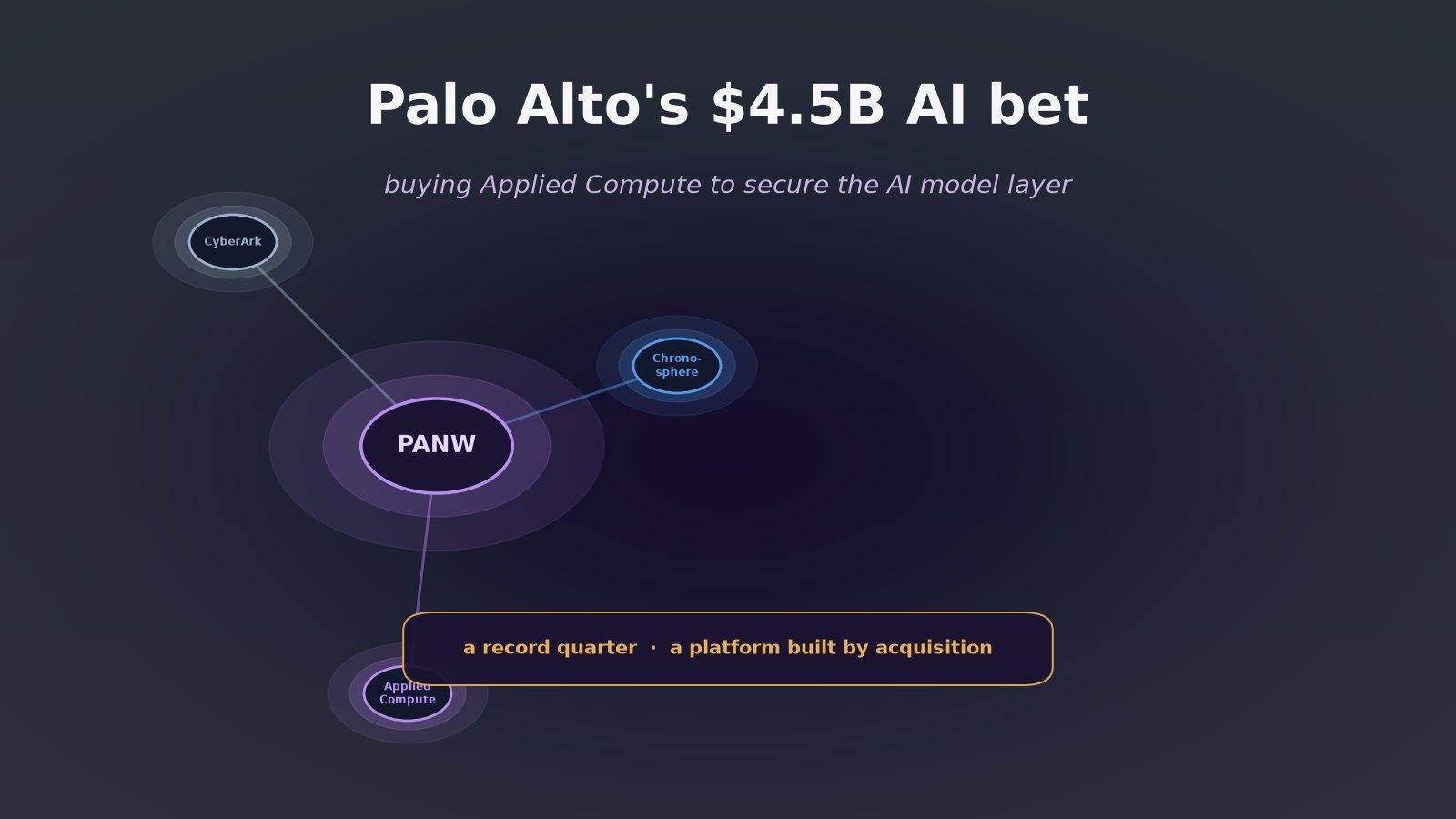
On November 18, Palo Alto Networks (PANW) agreed to buy Applied Compute, an artificial-intelligence startup founded in 2025, for $4.5 billion in an all-stock deal [2]. The timing was notable: the acquisition was announced alongside a record fiscal first quarter — revenue up 39% and the company's forward guidance "materially" raised — and the combined news sent PANW shares up 6.4% the next day, with an intraday gain of nearly 9% [3]. More than another bolt-on, the deal marks Palo Alto's push into securing the AI model layer itself, and it is the latest move in a strategy that looks very different from the $43.9 billion megamerger its rivals CrowdStrike and Zscaler are pursuing [6].
A rich price for a young AI startup
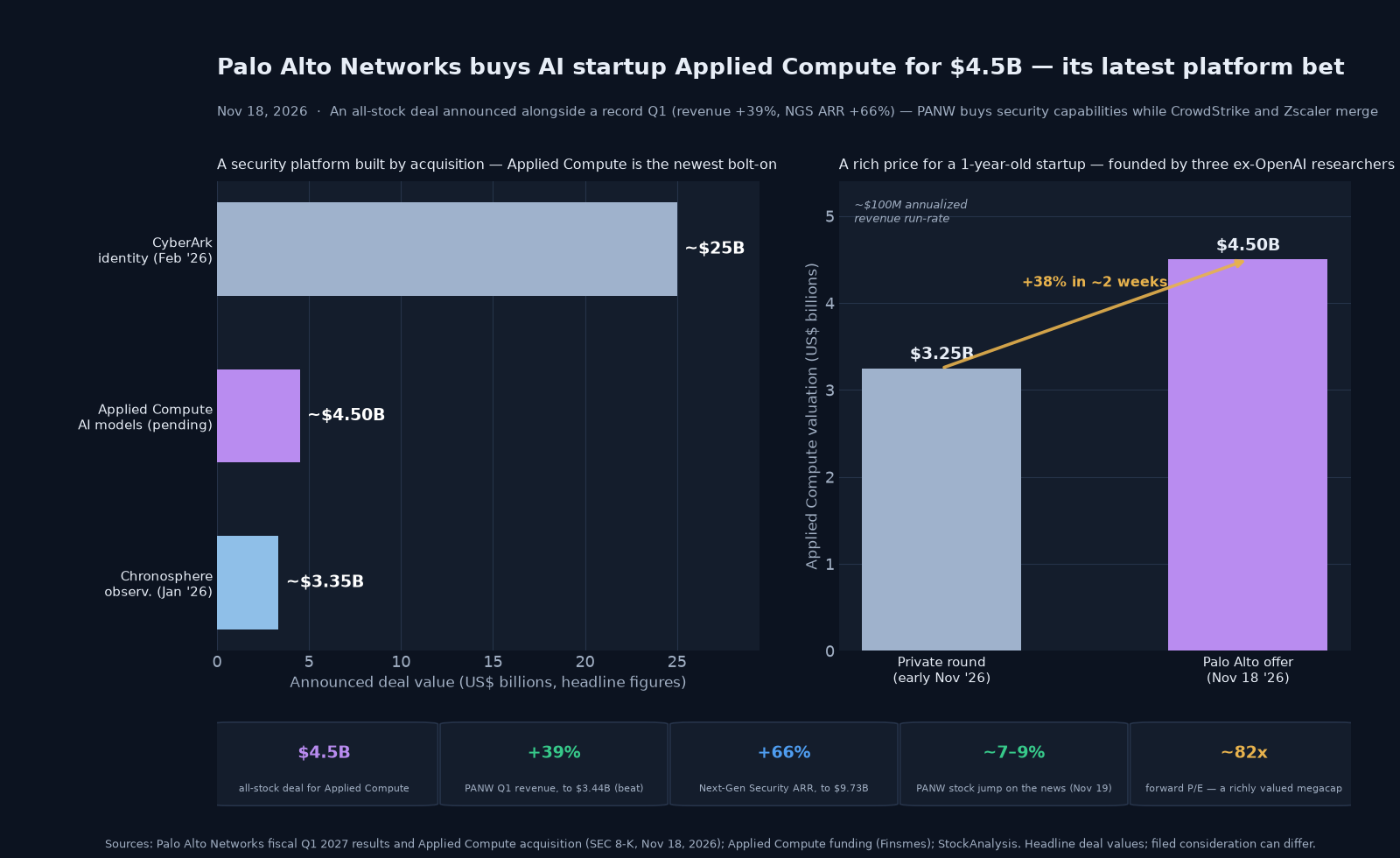
Applied Compute was founded in 2025 by three former OpenAI researchers, and it sells a platform for adapting (post-training) open-weight AI models and running them in production — the kind of work enterprises increasingly want to do on their own data rather than send everything to a closed model. It is small and new: roughly $100 million in annualized revenue run-rate, which puts the $4.5 billion price at about 45 times that run-rate. What makes the markup striking is its speed. Only about two weeks before the deal, Applied Compute had raised $350 million at a $3.25 billion valuation in a round that included Nvidia; Palo Alto's offer is roughly 38% higher, though a negotiated acquisition price and a private funding round are structured differently and not strictly comparable [2]. That is less a bargain than a statement about how fiercely large companies are competing for AI talent and capability — co-founder and CEO Yash Patil is expected to become Palo Alto's co-chief AI officer once the deal closes, and CEO Nikesh Arora told investors he expects to build Palo Alto's own frontier AI research team to roughly 100 people.
The strategic logic is straightforward even if the valuation is not. "Every enterprise is going to run a mix of open and closed models, and every one of those models needs to be secured," Arora said [2]. Palo Alto expects the business to add about $1 billion of Next-Gen Security annual recurring revenue by fiscal 2029 — a projection, not a guarantee [2]. The deal is all-stock and is expected to close in Palo Alto's fiscal third quarter of 2027, subject to regulatory clearance.
The deal landed alongside a record quarter
In the same release, Palo Alto reported fiscal first-quarter revenue of $3.44 billion, up 39% and ahead of expectations, with non-GAAP earnings of $1.05 a share beating the roughly $0.97 the Street modeled [1]. That growth is not all organic — it includes revenue from recently acquired businesses such as CyberArk and Chronosphere. A key metric for management — Next-Gen Security ARR, the recurring revenue from its newer platforms — jumped 66% to $9.73 billion, and remaining performance obligations rose 35% to $21 billion [1]. On the back of that, the company lifted its full-year revenue outlook to $14.52–$14.57 billion (which excludes the pending Applied Compute deal) and raised its profit and ARR targets too. The market reacted positively, though with earnings and the acquisition announced together, their individual effects are hard to separate.
Applied Compute is the latest addition to a deliberate "platformization" strategy under Arora: get customers to consolidate their security tools onto one Palo Alto platform, then keep widening what that platform covers. Platformized customers now account for about two-thirds of Next-Gen Security ARR [1]. To build the platform, Palo Alto has gone shopping aggressively — most dramatically its CyberArk acquisition (identity security, its largest-ever deal, announced at about $25 billion and closed in February) and its Chronosphere purchase (observability, announced at about $3.35 billion and closed in January); later filings recorded purchase consideration of roughly $21 billion and $3 billion, respectively [5]. Applied Compute extends that reach up the stack, from securing networks, clouds and identities to securing the AI model layer itself.
Two approaches to the same consolidation
The cybersecurity industry is consolidating around a single idea — that customers want fewer vendors and unified platforms — but the biggest players are getting there differently. CrowdStrike and Zscaler are pursuing one transformational combination, a $43.9 billion all-stock merger [6]. Palo Alto is assembling its platform through a steady stream of acquisitions — not all of them small, as the roughly $25 billion CyberArk deal shows, down to specialized AI purchases like the $4.5 billion Applied Compute deal. Both bets are on the same endgame; the question for investors is which approach integrates more cleanly and which one the market will pay more for.
Analyst view
None of this comes cheap — for Palo Alto's shareholders or for the stock. PANW is a roughly $292 billion company whose shares are up about 93% year to date and trade near 82 times forward earnings and more than 20 times trailing sales [1]. Its trailing GAAP price-to-earnings ratio exceeds 600 — a figure that reflects GAAP profit heavily reduced by stock-based compensation (over $600 million in the quarter) and the integration costs of all those acquisitions. Those are real costs to shareholders, not accounting noise, especially for a company paying for deals in its own stock; free cash flow and non-GAAP earnings (adjusted EPS guidance of $4.26–$4.30 this year) offer additional perspective but do not erase them. Wall Street remains constructive, with a consensus "Buy" rating and an average price target around $412, implying upside from the recent ~$356 level [1].
Palo Alto is a fast-growing cybersecurity platform pursuing an acquisition-led expansion, and paying premium prices — for its deals and in its own multiple — to stay ahead of a consolidating market. The strategy carries real risks worth naming. All-stock deals dilute existing shareholders' ownership; for Applied Compute the share-count increase looks modest, on the order of 1.6% at the deal's disclosed reference price, though whether it dilutes earnings per share depends on the returns the deal ultimately generates — and it adds up across a stream of deals. Management also expects the acquisition to trim operating margins by up to one percentage point in fiscal 2027 and about two points in fiscal 2028 before recovering, and the broader AI build-out to require capital spending. And its projected $1 billion contribution to Next-Gen Security ARR by fiscal 2029 is a multi-year forecast — ARR, not profit or cash flow — resting on a small, young business, while a stock at 80-plus times forward earnings leaves little room for a stumble in integration or growth.
A fresh risk surfaced just before this was published: on November 25, Bloomberg reported that a former Palo Alto regional vice president had sued the company, alleging he was dismissed after objecting to accounting practices he says inflated revenue — specifically, pushing resellers to submit purchase orders before customers had formally approved deals. Palo Alto called the claims "completely meritless," and the allegations are unproven, but the report sent the shares lower in November 25 after-hours trading [1]. For a company trading at a premium valuation, allegations concerning revenue recognition are an added risk for investors to monitor. For investors, PANW remains a bet that platformization keeps compounding — and that buying into the AI model layer now, at a rich price, generates enough return to justify the cost.
This article is descriptive market analysis for general information. It explains the terms and context of Palo Alto Networks' acquisition of Applied Compute; it is not investment advice or a recommendation to buy or sell any security. Figures are approximate and as of the dates cited, and will change.
Palo Alto's Applied Compute deal: common questions
What did Palo Alto Networks buy, and for how much?
On November 18, 2026, Palo Alto Networks (PANW) agreed to acquire Applied Compute, an AI startup founded in 2025, for $4.5 billion in an all-stock deal. Applied Compute builds a platform for adapting (post-training) open-weight AI models and running them in production. The deal is expected to close in Palo Alto's fiscal third quarter of 2027, subject to regulatory clearance, after which Applied Compute's co-founder and CEO Yash Patil is expected to become Palo Alto's co-chief AI officer.
Why is Palo Alto paying $4.5 billion for such a small company?
Applied Compute is tiny — about $100 million in annualized revenue run-rate — and the price looks rich: only about two weeks earlier it had raised money at a $3.25 billion valuation, so $4.5 billion is roughly 38% higher. The premium reflects a fierce race among big companies for AI talent and capability (Applied Compute was founded by three former OpenAI researchers) rather than current financials. Palo Alto expects the business to add about $1 billion of Next-Gen Security ARR by fiscal 2029 — a multi-year projection, not a guarantee.
Why did PANW stock rise on the news?
The acquisition was announced alongside a strong fiscal first quarter: revenue rose 39% to $3.44 billion (a beat), non-GAAP EPS of $1.05 beat estimates, and Next-Gen Security ARR jumped 66% to $9.73 billion. Palo Alto also materially raised its full-year guidance. That combination of a record quarter, higher guidance and an ambitious AI deal sent the stock up 6.4% the next day (November 19), with an intraday gain of nearly 9%. Because earnings and the deal were announced together, their individual effects are hard to separate.
What is Palo Alto's 'platformization' strategy?
Platformization is Palo Alto's push to get customers to consolidate their many security tools onto a single Palo Alto platform, then to keep widening what that platform covers. Platformized customers now make up about two-thirds of its Next-Gen Security ARR. To build out the platform, Palo Alto has acquired aggressively — most notably its roughly $25 billion purchase of CyberArk (identity security) and the $3.35 billion Chronosphere deal (observability). Applied Compute extends the platform to securing AI models themselves.
How does this compare to the CrowdStrike–Zscaler merger?
Both reflect the same industry trend — customers consolidating onto unified security platforms — but the approaches differ. CrowdStrike and Zscaler are combining in a single $43.9 billion all-stock merger, while Palo Alto is assembling its platform through a stream of separate acquisitions of varying sizes. Both are bets on the same endgame; the open question is which approach integrates more smoothly and which the market ultimately rewards more.
Is PANW stock expensive?
Yes, by most measures. PANW is about a $292 billion company trading near 82 times forward earnings and more than 20 times sales, up roughly 93% year to date. Its trailing GAAP P/E above 600 reflects GAAP profit being heavily reduced by stock-based compensation (over $600 million in the quarter) and acquisition-integration costs — real costs to shareholders, though free cash flow and non-GAAP earnings offer additional perspective. Analysts remain constructive, with a 'Buy' consensus and an average target around $412, but the high multiple leaves little margin for a stumble.