Stock Analysis
HP Inc (HPQ) Jumps ~10% on a Q4 Beat as Commercial PC Revenue Climbs Despite Falling Shipments
HP Inc rose about 10% on November 25 after a fiscal Q4 double beat — adjusted EPS of $0.83 and $16 billion in revenue — as commercial and AI PC demand lifted sales even though unit shipments fell 29%. It stood out on a day the rest of tech sold off, but a one-time tariff refund boosted earnings and an accounting change flatters the 2027 guidance.
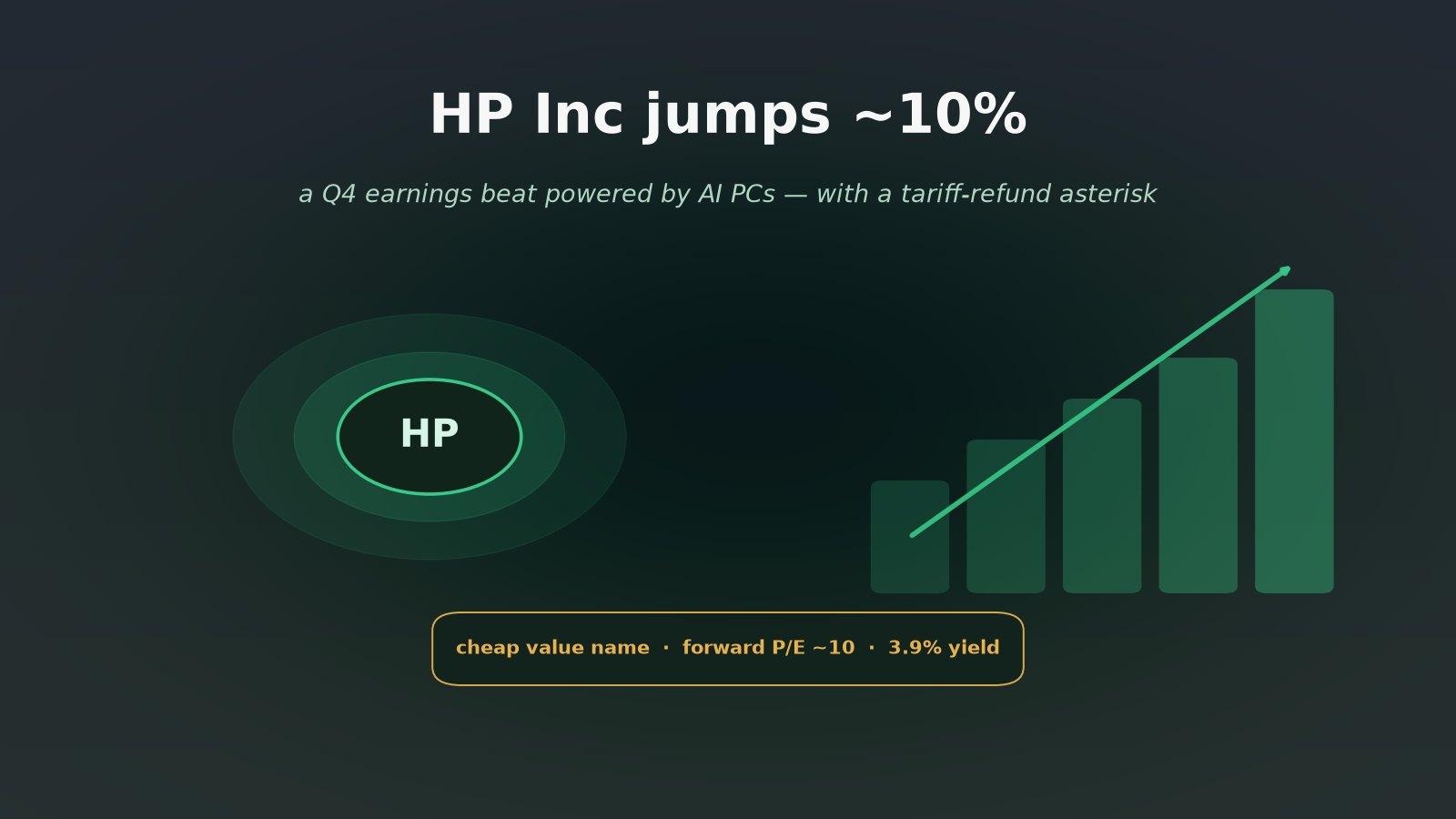
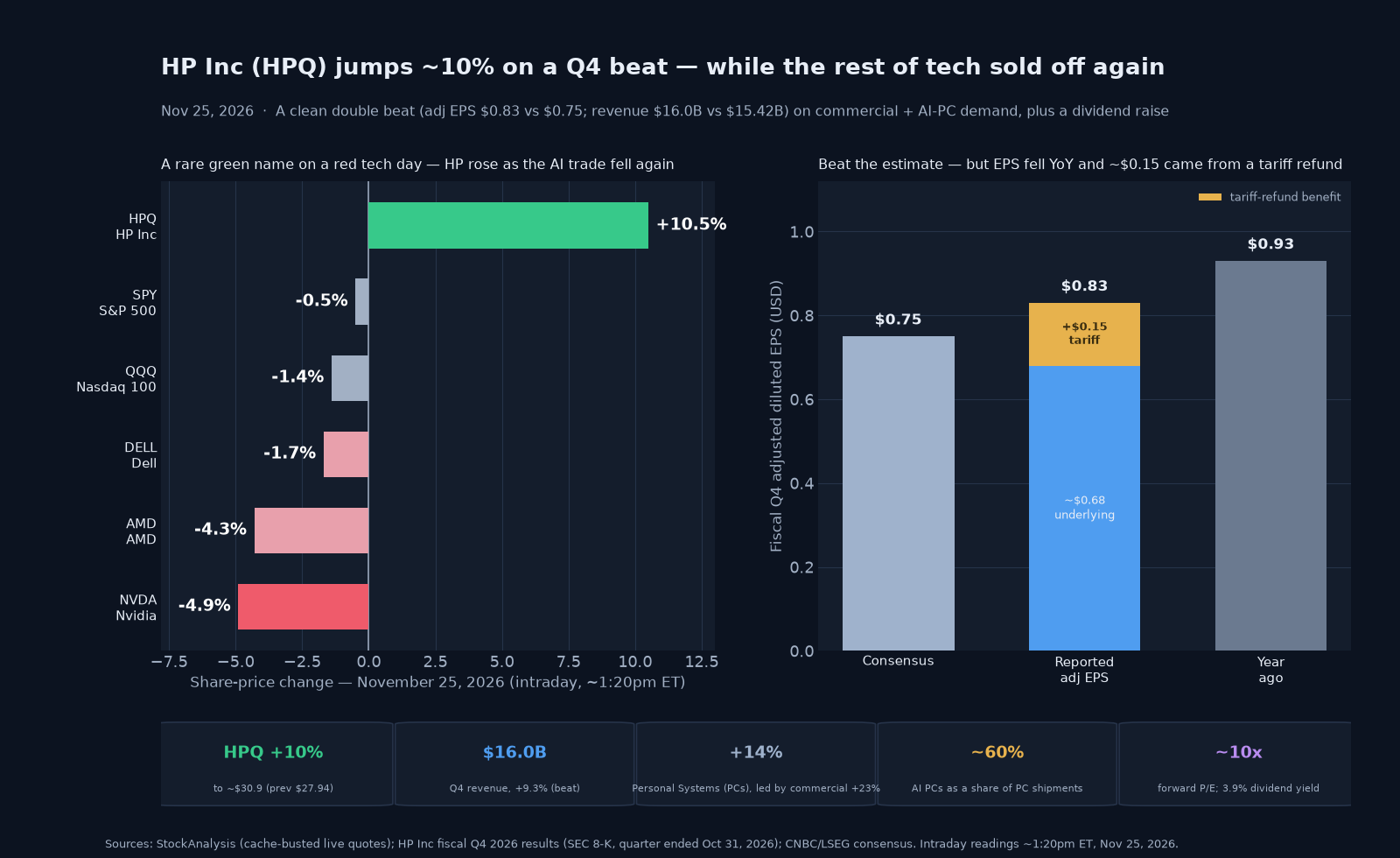
HP Inc (HPQ) jumped about 10% to roughly $30.90 in intraday trading on Wednesday, November 25, 2026 (around 1:20 p.m. ET), up from Tuesday's close of $27.94 [1]. The move came after HP reported fiscal fourth-quarter results — for the quarter ended October 31 — following Tuesday's close, and it stood out for a simple reason: HP rose on a day the rest of technology fell again, as the AI trade sold off for a second straight session (Nvidia −4.9%, AMD −4.3%) [3]. A cheap, unloved hardware name beating expectations was a rare patch of green on a red screen — though, as the numbers below show, its earnings beat leaned partly on a one-time tariff refund.
A double beat — with caveats
The headline numbers were better than Wall Street expected. Adjusted earnings per share came in at $0.83 versus the $0.75 analysts expected, and revenue of $16.0 billion topped the $15.42 billion consensus, up 9.3% year over year [3]. HP also raised its dividend to $0.31 per share from $0.30 and returned roughly $0.5 billion to shareholders through buybacks in the quarter [2]. For a stock trading at barely 10 times forward earnings with a near-4% yield, a double beat and a dividend hike were enough to spark a sharp rally — amplified by the contrast with the sinking AI-chip names around it.
The growth engine was Personal Systems, HP's PC division, where revenue rose 14% to $11.8 billion [2]. The strength was concentrated in commercial PCs, up 23%, as businesses continued a long-delayed upgrade cycle — the end of Windows 10 support and the arrival of "AI PCs" have given corporate buyers a reason to refresh aging fleets. HP said AI PCs reached nearly 60% of its PC shipments, up from around 30% a year earlier [2]. Printing, HP's profit engine, was quieter: revenue slipped 1% to $4.3 billion, though it still carried a healthy 19.7% operating margin.
Read the quality, not just the beat
Look closer and the quarter is less pristine than the headline. Three things temper it. First, a one-time tariff refund added about $0.15 to EPS; strip it out and underlying earnings were closer to $0.68 — and even the reported $0.83 was down roughly 11% from $0.93 a year ago [2]. The beat leaned on a non-recurring gain, not surging profit, and HP says its fiscal-2027 outlook assumes no repeat of those refunds. Second, Personal Systems' revenue growth reflected price and mix, not volume: total unit shipments fell about 29% (commercial down 28%, consumer down 31%), so revenue rose on higher prices and a richer commercial mix even as HP sold far fewer machines [2]. And that revenue growth is not translating into stronger profitability: Personal Systems' operating margin was just 3.0%, squeezed by surging memory and storage costs — by HP's account, memory has jumped from roughly 15% to 40% of a PC's component cost in a year as AI demand strains supply [6]. Free cash flow fell sharply from a year earlier.
Third, and most easily missed: HP's fiscal-2027 guidance is not an apples-to-apples comparison. Management guided to non-GAAP EPS of $3.15–$3.45, a midpoint of about $3.30 that is already slightly below FY2026's $3.33. And the comparison is tougher still, because beginning in the new fiscal year HP will start excluding stock-based compensation from its non-GAAP figures — adding back a cost worth about $0.38 per share in FY2026 [2]. Put FY2026 on that same, more generous basis and adjusted EPS would have been about $3.71 — so against a like-for-like baseline the FY2027 guide implies an earnings decline of roughly 11%. Revenue, in short, delivered the cleaner beat; adjusted earnings leaned on the non-recurring refund, and the outlook points to a lower comparable number.
A value stock, re-rated on a mixed quarter
None of this makes the quarter bad — it makes it a mixed one, helped by a one-time gain and a favorable market rotation. That matters for how to read the 10% pop. HP is a classic value name: trailing twelve-month revenue around $60.5 billion, net income of about $2.4 billion (down slightly year over year), a trailing P/E near 12 and a forward P/E under 10 — though that forward multiple leans on the same, more generous new earnings basis — with a dividend yield near 4% and steady buybacks shrinking the share count [1]. It is run for now by interim CEO Bruce Broussard, the former Humana chief who stepped in after Enrique Lores left to run PayPal earlier this year; HP has already named Emma Walmsley, the former GSK chief executive, as its next CEO, effective January 4, 2027 [5].
Analyst view
The most telling detail is where the stock now sits relative to Wall Street. HP had already closed Tuesday at $27.94, slightly above the average analyst price target of about $27.55 (a consensus "Hold" across 18 analysts) [1] — so Wednesday's 10% jump widened that premium to roughly 12%, leaving the shares well above the consensus target. That puts the rally in perspective: a cheap, slow-growing hardware company delivered a solid-but-flattered quarter, raised its dividend, and got rewarded on a day when investors appeared to rotate out of growth-oriented tech and hunt for something that worked. The AI-PC refresh cycle is real and gives Personal Systems a genuine tailwind into 2027, but net income is still drifting lower, memory costs are squeezing margins, the printing business is shrinking, and the guidance implies lower earnings on a comparable basis. Wednesday's move looks more like a reassessment of HP's long-standing value-and-yield appeal than a shift in its growth trajectory — a re-rating of the old story, not the start of a new one.
This article is descriptive market analysis for general information. It explains why HP shares moved and the context behind the quarter; it is not investment advice or a recommendation to buy or sell any security. Figures are intraday and approximate as of roughly 1:20 p.m. ET on November 25, 2026, and will change.
HP's Q4 earnings and the ~10% jump: common questions
Why did HP (HPQ) stock jump on November 25, 2026?
HP rose about 10% to roughly $30.90 after reporting a fiscal fourth-quarter double beat: adjusted EPS of $0.83 (versus $0.75 expected) and revenue of $16.0 billion (versus $15.42 billion expected, up 9.3%), led by strong commercial PC demand and AI PCs reaching nearly 60% of shipments. HP also raised its dividend. The move stood out because it came on a day the rest of tech — especially AI-chip names like Nvidia and AMD — sold off again, so a cheap name beating expectations was a rare bright spot.
Was HP's earnings beat as strong as it looks?
It was a genuine beat, but the quality is mixed. About $0.15 of the $0.83 adjusted EPS came from a one-time tariff refund, and even the reported figure was down roughly 11% from $0.93 a year earlier — so profit is still falling, not surging. The Personal Systems revenue growth (+14%) came from higher prices and a richer commercial mix rather than volume: total unit shipments fell about 29%. And surging memory and storage costs held the PC division's operating margin to just 3.0%. The beat was real, but it was flattered by a non-recurring tariff gain.
Is HP's fiscal 2027 guidance really growth?
Not on a like-for-like basis. HP guided to non-GAAP EPS of $3.15–$3.45 for FY2027 — a midpoint of about $3.30 that is already slightly below FY2026's $3.33. And the comparison is tougher than it looks: starting in FY2027 HP will begin excluding stock-based compensation from its non-GAAP numbers (adding back a cost worth about $0.38 per share in FY2026). Put FY2026 on that same basis — about $3.71 — and the FY2027 guide implies an earnings decline of roughly 11%. The outlook also assumes no repeat of this year's tariff refunds.
What is driving HP's PC growth — are AI PCs real demand?
The demand is real but concentrated. Commercial PCs rose 23% as businesses refresh aging fleets ahead of the end of Windows 10 support, and HP said AI PCs reached nearly 60% of shipments, up from around 30% a year earlier. That is a genuine tailwind for Personal Systems into 2027. But it is a mix-and-price story — total unit shipments fell as HP favored higher-value machines — and the consumer side is still weak.
Is HP a cheap stock after the jump?
HP trades at a trailing P/E near 12 and a forward P/E under 10, with a dividend yield around 3.9% — classic value territory. But cheapness reflects its profile: revenue around $60.5 billion with net income drifting slightly lower, a shrinking printing business, and low-single-digit growth. Tellingly, even after the 10% pop the stock trades above the average analyst price target of about $27.55, with a consensus 'Hold' rating — analysts are not chasing it.
Who runs HP now?
HP is led for now by interim CEO Bruce Broussard, the former Humana chief executive, who stepped in after Enrique Lores left HP to become CEO of PayPal in early 2026. On November 4, 2026, HP named Emma Walmsley, the former GSK chief executive, as its next permanent CEO, effective January 4, 2027. The fiscal Q4 results were presented by Broussard and CFO Karen Parkhill.