Stock Analysis
Advanced Micro Devices (AMD) Falls ~9% Amid a Chip Selloff and a 336.9M-Share Resale Filing
Advanced Micro Devices dropped about 9% on November 24 amid a broad semiconductor selloff that reversed Monday's rally. A fresh SEC filing to register 336.9 million shares — mostly AMD's OpenAI and Meta warrants — added a company-specific overhang, a reminder of potential future dilution rather than immediate share issuance.
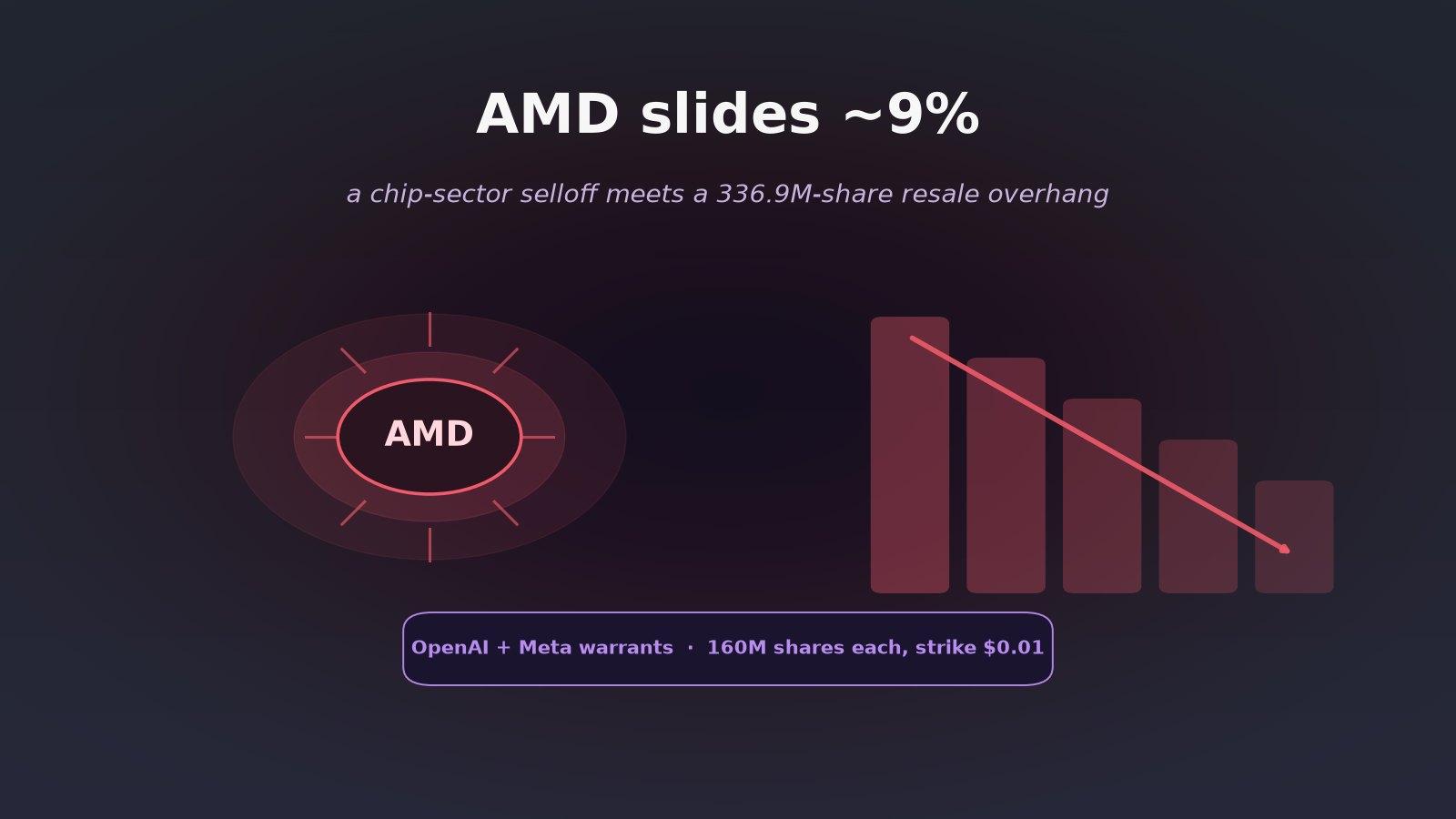
Advanced Micro Devices (AMD) fell about 8.9% to roughly $413 in intraday trading on Tuesday, November 24, 2026 (around 2:05 p.m. ET), down from Monday's close of $453.46 [1]. The drop was steep, but AMD was far from alone: the entire semiconductor complex sold off hard, giving back the sharp rally it had staged on Monday after Nvidia reinstated Jensen Huang as chief executive [6]. Layered on top was a company-specific wrinkle — a new filing to register roughly 336.9 million AMD shares for resale, tied mostly to the warrants AMD granted to OpenAI and Meta [2].
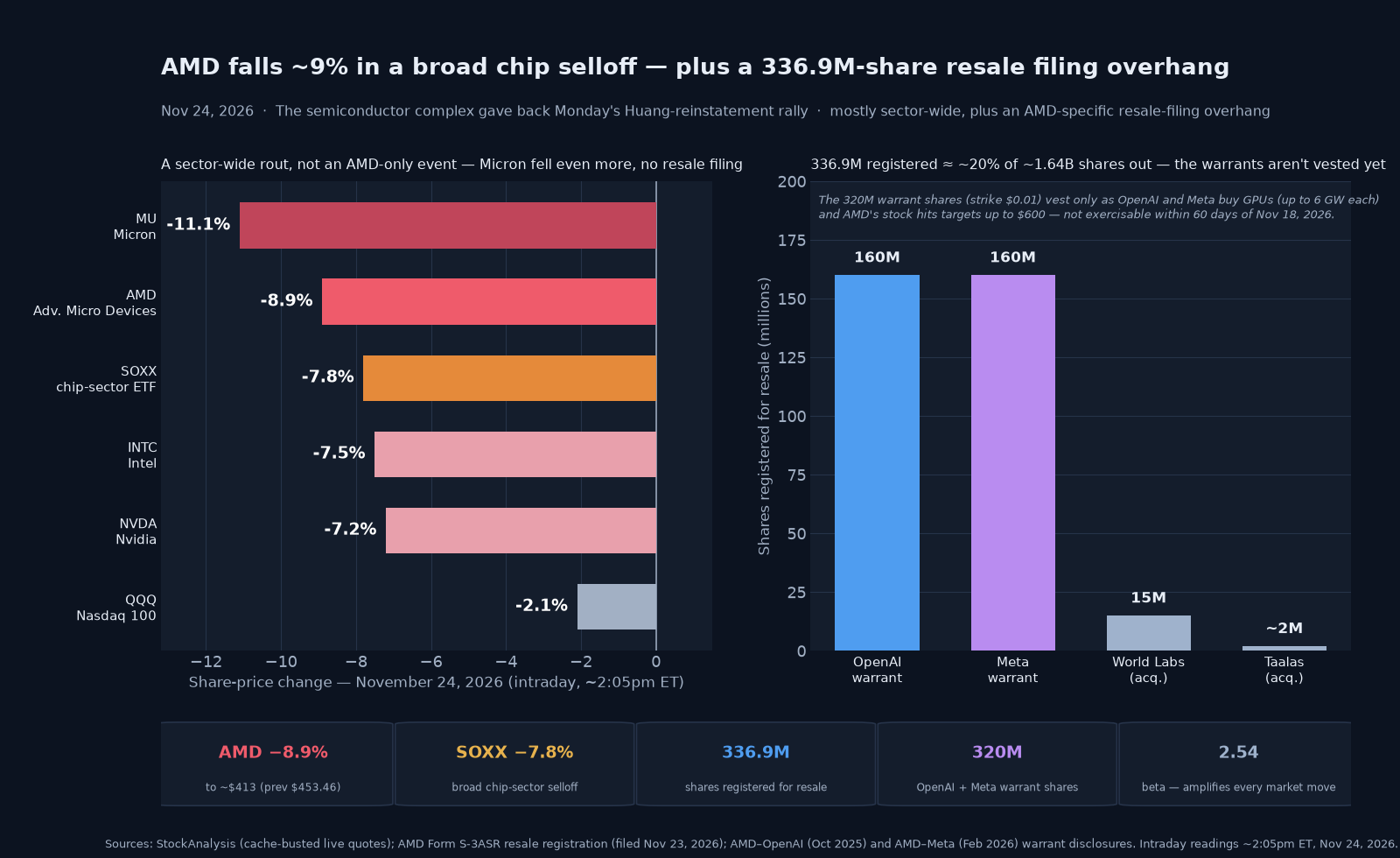
A broad semiconductor selloff, with an AMD-specific overhang
The most important context is that this was a sector-wide move, not an AMD-specific collapse. Micron fell about 11.1%, Intel about 7.5% and Nvidia about 7.2%; the broad iShares Semiconductor ETF (SOXX) dropped roughly 7.8%, while the Nasdaq-100 was down only about 2.1% [1]. That spread — chips down far more than the index — is the signature of investors pulling risk out of the AI trade specifically, not a broad market panic. Micron fell even more than AMD despite no comparable resale filing, which is consistent with the selling being driven by the group rather than by any single company's news. What the day's price action cannot do is cleanly separate how much of AMD's slightly larger drop was the sector and how much was its own filing.
The selloff largely reversed Monday's surge. Semiconductor stocks had jumped on Monday after Nvidia's board reinstated Jensen Huang as CEO, a headline that briefly re-energized the whole AI-hardware complex [6]. Tuesday gave much of that back as traders weighed stretched valuations and looked ahead to inflation data before the Federal Reserve's December meeting. AMD, with a beta of about 2.54, has historically been far more volatile than the broad market [1] — so on a hard risk-off day for chips, an outsized drop is unsurprising.
What the 336.9 million-share filing actually is
After Monday's close, AMD filed an automatic shelf registration (Form S-3ASR) covering up to 336,934,324 shares for potential resale by existing holders [2]. Two points matter for reading it correctly. First, this is not a capital raise: AMD is not the seller and will not receive any proceeds from sales made by those shareholders. Second, and more important, it is not 337 million newly issued shares hitting the market. The bulk of the registration is the two customer warrants — 160 million shares each underlying the OpenAI and Meta agreements — with the remainder (about 17 million shares) tied to AMD's World Labs and Taalas acquisitions, some of which are already-issued shares rather than new supply.
The warrant shares, by contrast, do not exist yet. AMD issued OpenAI a warrant for up to 160 million shares in October 2025 [3] and Meta a parallel warrant in February 2026 [5], each struck at just $0.01. But the warrants vest only in tranches as each customer buys AMD GPUs — scaling toward 6 gigawatts of deployment apiece — and as AMD's stock clears a rising ladder of price targets, reaching $600 for the final tranche, subject to further commercial and technical conditions [2]. According to the prospectus, neither customer's warrant shares were expected to become exercisable within 60 days of November 18, 2026. The filing also fulfills registration rights AMD had already agreed to; it does not accelerate the shares' creation, and it is not a sign either customer intends to sell. So far the warrants have barely affected the share count: AMD's diluted weighted-average shares rose only about 1.5% over the past two years, and that reflects buybacks and employee stock as much as anything, leaving the 320 million warrant pool a separate, still-largely-unrealized source of potential dilution [2].
Why the resale registration matters to investors
If the filing creates no immediate dilution, why might it matter to investors? Because it put a concrete, large number — the warrants alone equal roughly 19.5% of AMD's ~1.64 billion shares outstanding (about 16% of an enlarged share base if fully exercised) — back in front of investors on the exact morning the chip rally was unwinding. The warrants are the price AMD agreed to pay to lock in two anchor customers: shares equal to roughly 10% of its existing stock for each of OpenAI and Meta (about 8% of an enlarged company apiece), earned only if they buy enormous volumes of AMD silicon and the stock climbs about 45% from today's level toward $600 for the final tranche. For bulls, that is a cheap price for demand that could be worth tens of billions in revenue. For skeptics, it is a visible overhang — a future supply of stock that grows precisely as the thesis works — and a reminder that these mega-deals carry real accounting costs: AMD has already booked a roughly $1.2 billion warrant liability, and the warrants are set to reduce reported revenue as qualifying customer sales are recognized [2]. On a nervous day, that reminder may help explain why AMD underperformed the broad semiconductor ETF.
AMD had also been under pressure since a November 19 report from Hunterbrook — whose affiliated fund disclosed a short position — that raised questions about the company's China-related business and export-control compliance. AMD disputed the allegations, saying they misrepresent its business and that it complies with applicable U.S. export-control laws, and the stock fell sharply the next day. That controversy was a lingering concern entering Tuesday's session rather than a fresh catalyst for Tuesday's selloff.
Analyst view
Zoom out and the picture is a high-beta leader coming off the boil, not a broken story. AMD trades around $413, roughly 37% below its 52-week high of $658.52 set in early October, yet it is still up sharply over the past year [1]. Trailing twelve-month revenue is about $45.4 billion (up ~42%) with net income near $7.6 billion, and the stock changes hands at a punchy ~89x trailing earnings but a more digestible ~27x forward earnings on the data provider's forecast — the gap reflects the rapid earnings growth analysts expect [1]. Wall Street remains broadly constructive: the average analyst price target sits near $656 with a consensus close to "Strong Buy" across roughly 54 analysts, implying meaningful upside if execution holds [1].
The honest read is that Tuesday bundled three things that are easy to conflate: a broad, macro-driven chip selloff, a company-specific overhang reminder (the resale filing), and lingering sentiment from a contested short report — and the day's trading cannot tell you their exact weights. None of them signaled weakening demand; the OpenAI and Meta deals represent expected future demand, not distress. But the warrant structure means that as the stock rises and milestones are met, more potential dilution is earned. That is the central tension investors are now repricing: whether anchor-customer revenue worth tens of billions outweighs the accounting costs and the shares — about 19.5% of AMD's existing count, or roughly 16% of an enlarged company — those customers could eventually come to own through the warrants. For a stock this volatile, expect the debate to be loud in both directions.
This article is descriptive market analysis for general information. It explains why AMD shares moved and the structure of the disclosures behind the move; it is not investment advice or a recommendation to buy or sell any security. Figures are intraday and approximate as of roughly 2:05 p.m. ET on November 24, 2026, and will change.
AMD's November 24 drop: common questions
Why did AMD stock fall on November 24, 2026?
AMD fell about 8.9% to roughly $413 mainly as part of a broad semiconductor selloff that reversed Monday's rally. Chip peers fell hard too — Micron about 11.1%, Intel about 7.5% and Nvidia about 7.2%, with the SOXX ETF down about 7.8% — so the move was mostly sector-wide. A new filing to register 336.9 million AMD shares for resale added company-specific pressure on top.
Does the 336.9 million-share filing mean AMD is diluting shareholders now?
No — not immediately. The Form S-3ASR registers shares for potential resale by existing holders, and AMD receives no proceeds. Most of it (320 million shares) is the OpenAI and Meta warrants, which do not exist yet. They vest only as those customers buy AMD GPUs toward 6 gigawatts each and as AMD's stock hits price targets up to $600, and the prospectus said they were not expected to be exercisable within 60 days of November 18, 2026. The remaining ~17 million shares are acquisition-related, some already issued. It is a future overhang, not current dilution.
What are the OpenAI and Meta warrants?
As part of multi-year GPU supply deals, AMD issued OpenAI (October 2025) and Meta (February 2026) warrants to buy up to 160 million AMD shares each at a $0.01 strike. The shares vest in tranches tied to gigawatts of AMD GPUs deployed and to rising AMD stock-price targets. Fully earned, the two warrants would equal roughly 19.5% of AMD's shares outstanding.
How much is the potential dilution if the warrants fully vest?
The 320 million warrant shares equal about 19.5% of AMD's roughly 1.64 billion shares outstanding, or about 16% of an enlarged share base if both warrants are fully exercised. But that is a maximum that only accrues if OpenAI and Meta deploy up to 6 gigawatts of AMD GPUs each and AMD's stock climbs toward $600 — so the potential dilution grows only as the business succeeds.
What was the Hunterbrook short report about?
Hunterbrook — whose affiliated fund disclosed a short position in AMD — published a report on November 19 raising questions about the company's China-related business and export-control compliance, which contributed to a sharp drop on November 20. AMD disputed the allegations, saying they misrepresent its business and that it complies with applicable U.S. export-control laws. It is an allegation AMD disputes, and it is background to the November 24 selloff rather than its trigger.
Is AMD still growing, or is this a demand problem?
The November 24 drop was about valuation, sentiment and a share overhang, not weak demand. AMD's trailing revenue is about $45.4 billion (up roughly 42%) with net income near $7.6 billion, and the OpenAI and Meta deals represent large future demand. The stock trades around 27x forward earnings, and the average analyst target is near $656 with a consensus close to 'Strong Buy.'