Stock Analysis
Diamondback (FANG) Buys Out Its Double Eagle Partner in a ~$5 Billion Midland Basin Deal
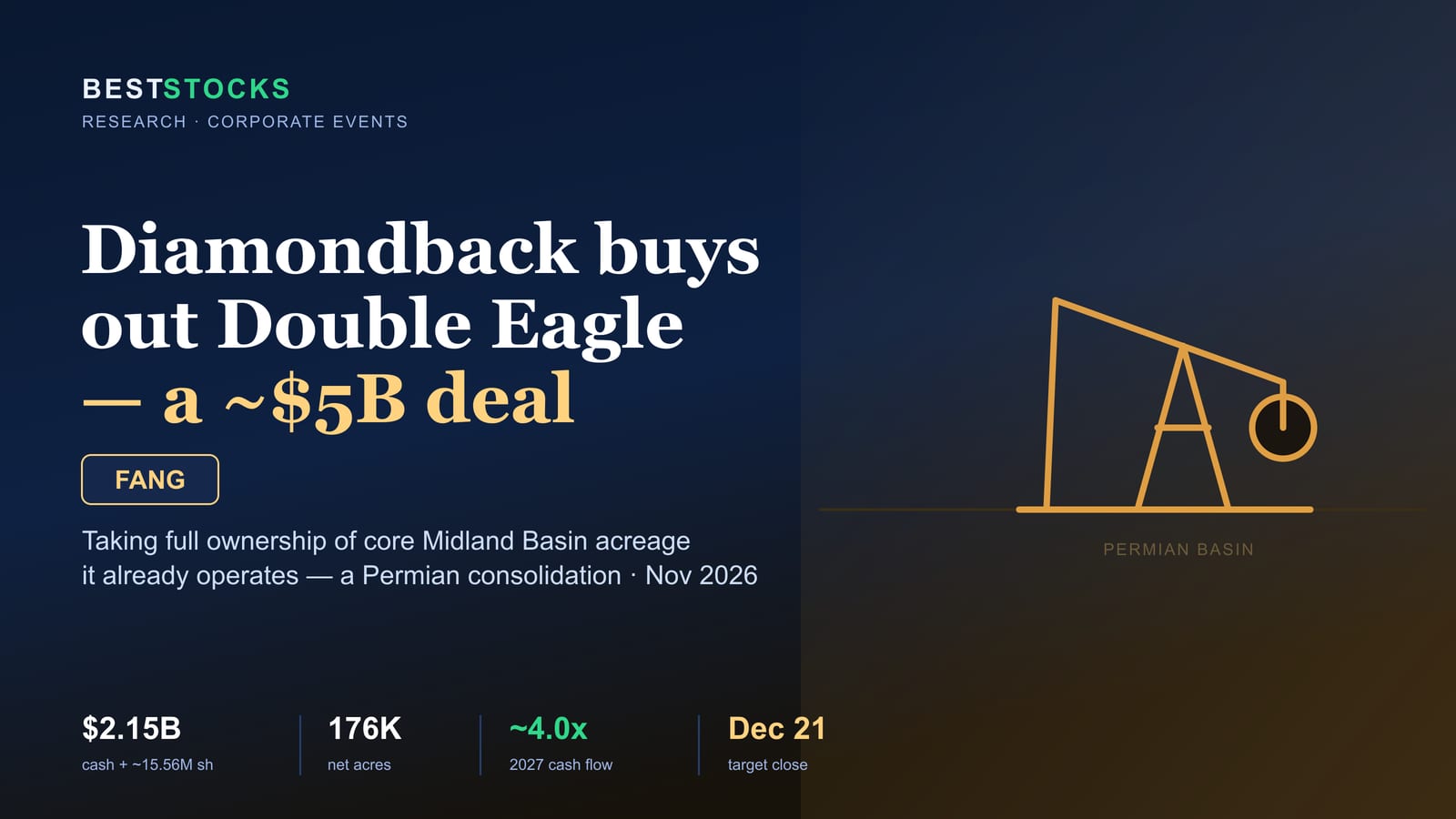
Diamondback Energy agreed to buy out its partner Double Eagle's remaining ~40% stake in their core Midland Basin partnership for $2.15 billion in cash plus about 15.56 million shares — roughly $4.9 billion in total. Rather than a move into new territory, it is a consolidation play: Diamondback takes full ownership of acreage it already operates and had planned to drill, lifting its interest in top-tier inventory at about 4 times next year's cash flow, with no new rigs required. The deal, signed November 13 and announced November 16, is expected to close December 21.
Summary
On November 16, 2026, Diamondback Energy (NASDAQ: FANG) announced a deal it had signed three days earlier: it will buy out its partner Double Eagle's remaining ~40% stake in their core Midland Basin partnership for $2.15 billion in cash plus about 15.56 million Diamondback shares — a total of roughly $4.9 billion at the current share price [1]. The clarifying point most headlines miss is that this is not a splashy move into new territory. It is a consolidation deal: Diamondback is mopping up the minority interest in acreage it already co-develops and had planned to drill, so it lifts its economic stake in known, top-tier inventory without adding a single rig [2]. The company expects the transaction — valued at about 4.0 times estimated 2027 cash flow (EBITDA) and adding roughly 176,000 net acres — to be immediately accretive, and plans to close it on December 21, 2026 [1].
What changed
Diamondback and Double Eagle formed a Midland Basin partnership in 2022, with Diamondback the majority owner and operator and Double Eagle holding a roughly 40% interest. This deal collapses that structure: Diamondback acquires Double Eagle's subsidiaries (Double Eagle IV and V Midco) to own the partnership outright [1]. According to its investor presentation, the acquisition raises Diamondback's working interest across the partnership's units (from about 36% to 60%), adds roughly 147 net drilling locations, and concentrates ownership in inventory where it is already the operator — about 70% of the acquired top-quartile locations sit in units Diamondback runs today [2]. The financial shape matters too: with roughly $2.15 billion of the consideration in cash and about $2.75 billion in stock, the deal is only partly dilutive, and the ~4.0x forward cash-flow multiple is low for prime Permian acreage — the kind of price that is easier to justify precisely because Diamondback already knows these wells intimately [1]. Projected 2027 production from the added interest is about 35 thousand barrels of oil per day (roughly 92,000 barrels of oil equivalent per day including gas and liquids) [1].
Why it matters
The deal is another data point in the defining trend of U.S. shale: consolidation. A decade of fragmented drilling has given way to a land grab by the biggest, lowest-cost operators, who are buying scale and inventory because the best acreage is finite and getting one's drilling costs down is the surest path to durable free cash flow. Diamondback has been the most aggressive consolidator in the Midland Basin — the ~$26 billion Endeavor Energy acquisition in 2024 vaulted it into the top tier, and it has kept buying since [4]. Peers are doing the same across the Permian, from Occidental and EOG Resources to Devon Energy, as the industry concentrates into a handful of scaled, efficient producers. For Diamondback specifically, buying out a partner to own prime acreage outright is the logical next step after the big transformational deals: it is lower-risk, immediately productive, and tightens control over a core position — the consolidation endgame rather than its opening act [2].
It also says something about how Diamondback intends to compete. Alongside this acquisition, the company recently agreed — with KKR — to buy a majority stake in Deep Blue, a Midland Basin produced-water infrastructure platform, deepening its control over the unglamorous but essential plumbing of shale development [4]. Taken together, the moves sketch a strategy of owning not just the rock but the surrounding infrastructure and the full working interest in its best wells — squeezing more margin out of a finite resource base. That is a rational response to a maturing basin, though it concentrates the company's fortunes ever more tightly on the Permian and on the oil price.
What to watch
- The deal close. Targeted for December 21, 2026, subject to customary conditions and regulatory clearance [1].
- The oil price. The single biggest driver of Diamondback's earnings and of the value of the acquired acreage — no deal changes that [3].
- 2027 capital and production guidance. How the added interest folds into Diamondback's plan, reported on its earnings calls; it lifted 2026 oil output to about 524 thousand barrels per day [3].
- The Deep Blue water deal. Diamondback and KKR's purchase of Five Point's majority stake, expected to close in the fourth quarter [4].
- Capital returns. Whether the accretion supports the dividend (~2.6% yield) and buybacks, tracked through the company's filings [3].
What did Diamondback Energy buy from Double Eagle?
Diamondback agreed to acquire the subsidiaries that hold Double Eagle's remaining roughly 40% interest in a core Midland Basin partnership the two companies formed in 2022, giving Diamondback full ownership of acreage it already operates. The price is $2.15 billion in cash plus about 15.56 million Diamondback shares — roughly $4.9 billion in total at the current share price — and the deal adds about 176,000 net acres and an estimated 35 thousand barrels of oil per day of 2027 production (about 92,000 barrels of oil equivalent per day including gas and liquids) [1]. The agreement was signed on November 13 and announced on November 16, 2026, and is expected to close on December 21, 2026. It is a pending acquisition, not yet completed.
Why is Diamondback buying out Double Eagle?
- To own what it already runs. Diamondback operates the 2022 partnership's acreage; buying the remaining 40% gives it full economic exposure to wells already in its drilling plan [2].
- Capital efficiency. About 70% of the acquired top-tier inventory is in units Diamondback already operates, so it adds production and locations without adding rigs [2].
- An attractive price. About 4.0 times estimated 2027 cash flow is low for prime Midland Basin acreage, and management expects immediate accretion to cash flow, free cash flow and net asset value per share [1].
- Consolidation strategy. It continues Diamondback's run of Permian dealmaking (Endeavor, an earlier Double Eagle deal, and the Deep Blue water platform) aimed at scale and low costs [4].
Diamondback's recent Permian acquisitions
| Target | Value | Status / date | What it added |
|---|---|---|---|
| Endeavor Energy | ~$26B (incl. debt) | Completed Sep 10, 2024 | Transformational Midland Basin scale [4] |
| Double Eagle (prior) | ~$4.08B | Announced Feb 18, 2025; completed Apr 1, 2025 | Core Midland Basin acreage & inventory [4] |
| Deep Blue (with KKR) | Majority stake | Agreed Nov 10, 2026; closing Q4 2026 | Produced-water infrastructure platform [4] |
| Double Eagle 40% stake | ~$4.9B ($2.15B cash + ~15.56M shares) | Signed Nov 13, announced Nov 16, 2026; closing Dec 21 | Full ownership of a partnership it operates; ~176,000 net acres [1] |
What could move FANG next?
- Oil prices — the dominant driver of earnings and acreage value [3].
- The Double Eagle close (Dec 21) and the Deep Blue water-deal close (Q4) [1][4].
- 2027 capital-spending and production guidance and the company's reinvestment discipline [3].
- Capital returns — the dividend and share buybacks funded by free cash flow [3].
- Further M&A — whether the serial consolidator keeps buying, and at what prices [4].
What is Diamondback's fair value after the deal?
Diamondback is a low-cost Permian producer, so its value is driven first and foremost by the oil price and by its free-cash-flow generation, not by any single acquisition. The scenarios below anchor to the analyst consensus (a Buy rating with a ~$238 target) [5], Diamondback's forward valuation (about 7.8× forward earnings, a ~2.6% dividend), and crude-price sensitivity, against the ~$177.92 intraday price on November 20. Probabilities are illustrative author estimates and sum to 100%; this is descriptive analysis, not a forecast, target, or recommendation.
| Scenario | Illustrative price | Probability | Key drivers |
|---|---|---|---|
| Oil firm, accretion delivers | ~$235 | 35% | Crude holds or rises, the deal adds free cash flow as expected, and FANG re-rates toward the ~$238 consensus target [3]. |
| Range-bound oil | ~$190 | 45% | Steady crude and disciplined capital returns support modest upside from a cheap starting multiple [3]. |
| Oil weakens | ~$145 | 20% | A crude downturn pressures cash flow and the group's multiple, outweighing deal accretion [3]. |
Weighting those (0.35 × $235 + 0.45 × $190 + 0.20 × $145) gives a probability-weighted fair value near $197 — about 11% above the ~$178 price [3]. The deal modestly improves the picture — more low-cost inventory at a cheap multiple — but it does not change the core truth of owning an oil producer: the single biggest swing factor is the crude price, not the transaction. The stock screens cheap on forward earnings with a healthy dividend, which is the bull case; the bear case is simply lower oil. This is a scenario exercise and descriptive analysis, not investment advice.
Diamondback (FANG) / Double Eagle deal FAQ
What did Diamondback Energy acquire from Double Eagle?
Diamondback agreed to buy the subsidiaries holding Double Eagle's remaining roughly 40% interest in a core Midland Basin partnership the two formed in 2022, giving Diamondback full ownership of acreage it already operates. The consideration is $2.15 billion in cash plus about 15.56 million Diamondback shares — roughly $4.9 billion in total at the current share price — and the deal adds about 176,000 net acres and an estimated 35 thousand barrels of oil per day of 2027 production (about 92,000 barrels of oil equivalent per day including gas and liquids). It was signed on November 13 and announced on November 16, 2026, valued at about 4.0 times estimated 2027 cash flow, and is expected to close on December 21, 2026. Because the share portion floats with Diamondback's stock, the headline total value will vary with the share price until closing.
Is the Diamondback–Double Eagle deal completed?
Not yet. The definitive purchase agreement was signed on November 13 and disclosed on November 16, 2026, but as of November 20 it is a pending acquisition that the companies expect to close on December 21, 2026, subject to customary closing conditions and regulatory clearance. So the terms are set and both sides have committed, but the transaction has not closed and the acreage has not yet changed hands. Investors should treat the production, acreage and accretion figures as the company's projections for the combined position rather than realized results, and watch for the expected December close as the next concrete milestone.
Why is this deal considered low-risk for Diamondback?
Because Diamondback is buying more of something it already knows and operates, rather than entering unfamiliar territory. The acreage sits in a Midland Basin partnership Diamondback formed with Double Eagle in 2022, in which Diamondback was already the majority owner and operator; buying the remaining ~40% simply gives it full economic ownership. Its investor presentation indicates the deal raises Diamondback's working interest across the partnership's units (from about 36% to 60%), adds roughly 147 net drilling locations, and that about 70% of the acquired top-quartile inventory is in units Diamondback already runs — so it adds production and inventory without needing to add rigs or integrate a new operating team. That low integration risk, combined with a modest ~4.0x forward cash-flow multiple and management's expectation of immediate per-share accretion, is why the market viewed it as a sensible, capital-efficient transaction. The main risks are financial (part of the price is stock, so some dilution) and macro (oil prices), not operational.
How does this fit Diamondback's acquisition history?
It is the latest in an aggressive run of Permian consolidation. Diamondback's transformational deal was the roughly $26 billion acquisition of Endeavor Energy (including debt), completed in September 2024, which made it one of the largest pure-play Midland Basin producers. It followed with a separate Double Eagle acquisition of about $4.08 billion, announced in February 2025 and completed that April, and in November 2026 it agreed — alongside KKR — to buy a majority stake in Deep Blue, a Midland Basin produced-water infrastructure platform. This new ~$4.9 billion buyout of Double Eagle's partnership stake continues that strategy of building scale, owning its core acreage outright, and controlling the surrounding infrastructure. The pattern is clear: Diamondback is consolidating the Midland Basin to drive down costs and maximize free cash flow, though it also concentrates the company's fortunes ever more tightly on the Permian and on the oil price.
What are the risks for Diamondback (FANG) stock?
The dominant risk is the oil price. As a low-cost but oil-weighted Permian producer, Diamondback's earnings, free cash flow and the value of its acreage all rise and fall with crude, and no acquisition can hedge that away; a sustained downturn would pressure both its cash flow and the valuation multiple the market assigns the group. Beyond commodities, the company is a serial acquirer — Endeavor, two Double Eagle deals and a water-infrastructure platform within about two years — so cumulative leverage and execution risk build up even when each individual deal is smart, and part of this deal's price is stock, which dilutes existing holders. On the other side, the stock screens cheap, at roughly 7.8 times forward earnings with a dividend yield near 2.6% and a Buy consensus with a target around $238, so if oil holds the risk-reward looks favorable. In short, the bull case is cheap valuation plus low-cost scale; the bear case is simply lower oil.
Does Diamondback pay a dividend?
Yes. Diamondback pays a base dividend — recently $4.72 per share annually, a yield of about 2.6% at the current price — and has historically supplemented it with variable returns and share buybacks funded by free cash flow, consistent with the capital-return model common among large shale producers. The company has emphasized capital discipline, targeting a reinvestment rate around 30%–32% of cash flow and returning much of the rest to shareholders. The Double Eagle deal is relevant to the dividend because management expects it to be immediately accretive to free cash flow per share, which supports the capacity for returns, though the ultimate level of dividends and buybacks will depend on oil prices and the company's balance-sheet priorities after funding the cash portion of the acquisition. As always with an oil producer, the sustainability of capital returns is tied to the commodity cycle.