Stock Analysis
Sanofi Agrees to Buy Insmed (INSM) for $41 Billion — the Rumor Becomes a $175 Cash Deal
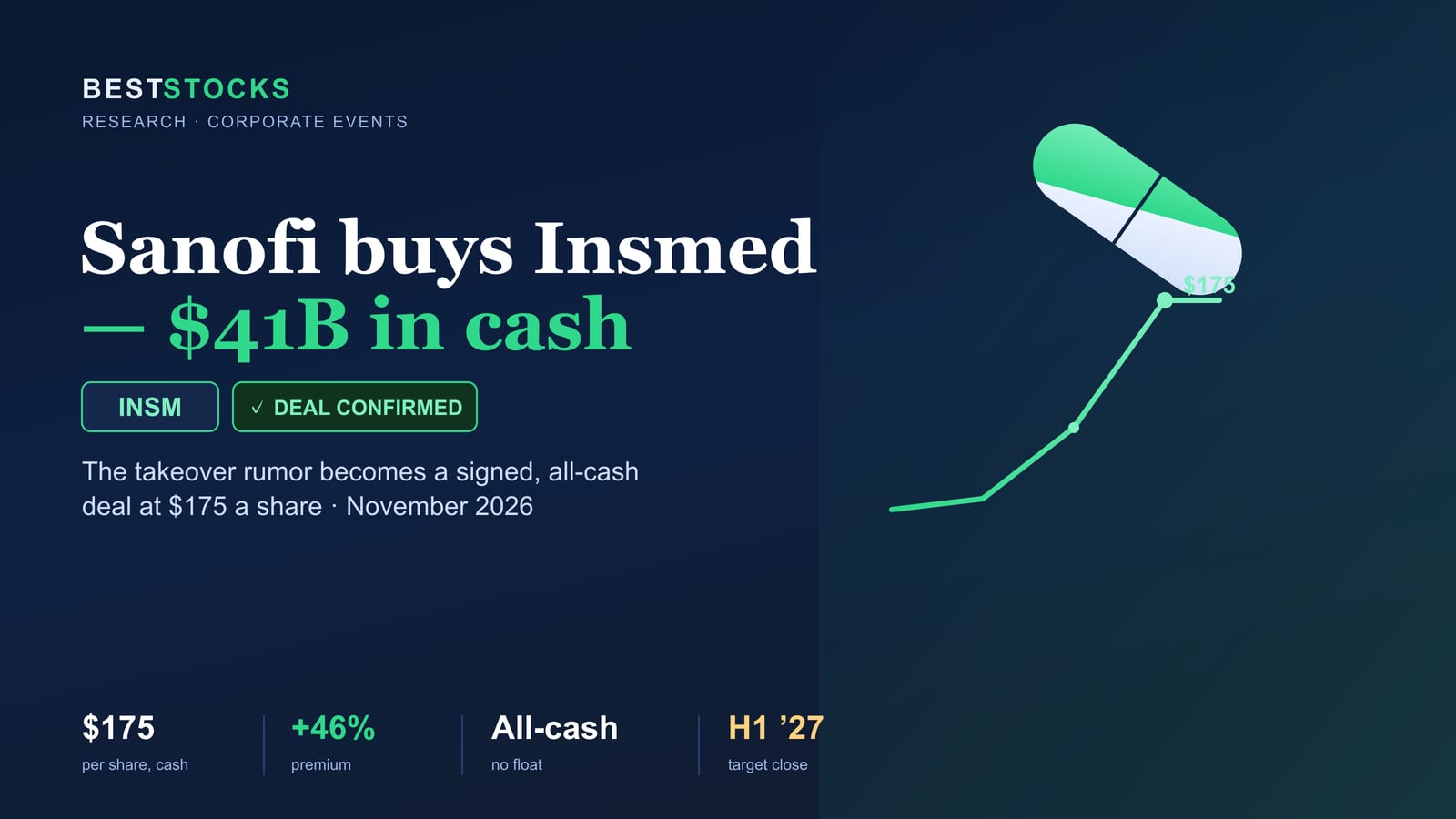
The rumor became a deal: Sanofi agreed to acquire Insmed for $175.00 a share in cash, a total of about $41 billion — the largest pharma acquisition in nearly three years and Sanofi's biggest in roughly two decades. Confirming the Bloomberg report Insmed jumped on last week, the all-cash offer locks in a ~46% premium to the unaffected pre-deal price, so unlike a stock-for-stock takeover the value no longer floats. Insmed jumped about 14% to ~$170, a tight arbitrage spread to the $175 offer, with the deal expected to close in the first half of 2027.
Summary
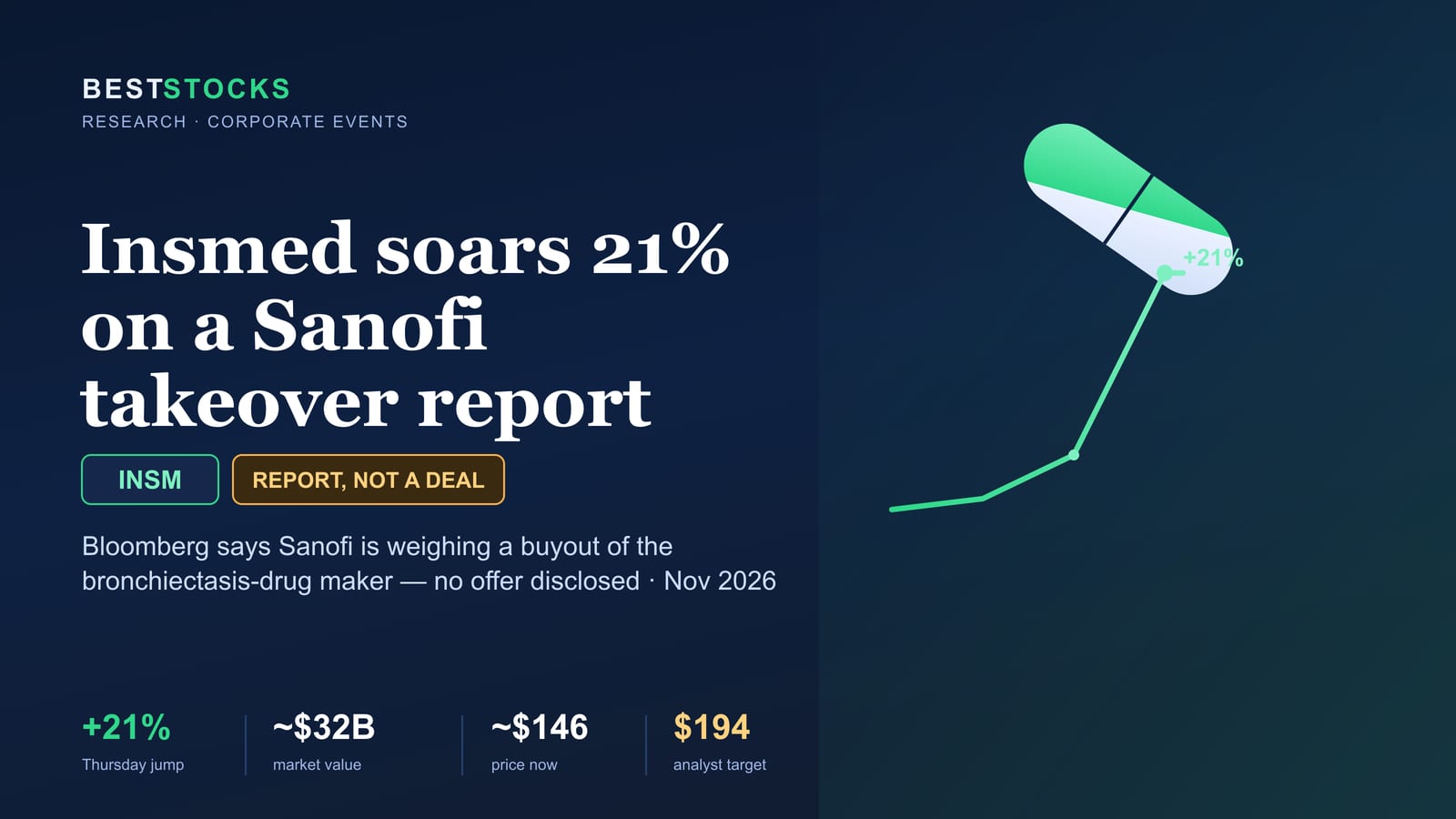
The takeover report became a takeover. On November 24, 2026, Sanofi agreed to acquire Insmed (NASDAQ: INSM) for $175.00 a share in cash — a total equity value of about $41.0 billion (€37.6 billion), the largest pharmaceutical acquisition in nearly three years and Sanofi's biggest deal in roughly two decades [1]. The definitive agreement, signed the prior evening, confirms the Bloomberg report we covered last week, when Insmed jumped ~21% on news that Sanofi was merely weighing a bid (see our November 20 analysis of the rumor) [5]. The crucial detail now is that the deal is all cash: unlike a stock-for-stock takeover whose value floats with the acquirer, Insmed holders are being offered a fixed $175, a clean ~46% premium to Insmed's unaffected November 18 close of $119.80 (and about 17% above its November 23 close of $149.09) [1]. Insmed shares jumped about 14% to ~$170, now trading just under the offer — a tight merger-arbitrage spread that reflects little more than the time to close [2].
What changed
A week ago this was speculation with no price; now it is a signed, fixed-price deal. The structure is notably clean. It is all cash at $175 a share, with no financing condition — Sanofi is funding it from cash on hand and committed debt, backed by a $35 billion bridge facility arranged with JPMorgan — so the risk to Insmed holders is about whether the deal closes, not what it will be worth [1]. Closing is expected in the first half of 2027, subject to a vote of Insmed shareholders (requiring more than two-thirds of all outstanding shares — a higher bar than a simple majority) and to U.S. and foreign antitrust and foreign-investment clearances; the agreement carries a $1.125 billion termination fee payable by Insmed under specified circumstances, such as accepting a superior proposal [1]. Tellingly for an acquisition this size, Sanofi's own shares rose — its Paris-listed stock gained about 9%, potentially its best day since 2008 — as investors endorsed the strategic fit; Sanofi reaffirmed its 2026 guidance, its progressive dividend and its intention to keep a strong credit rating, and expects the deal to add to earnings by the end of 2028 [3].
Why it matters
This is the clearest example yet of big pharma spending heavily to buy its way out of looming patent cliffs. Sanofi, like its peers, faces the eventual erosion of its biggest earner and has chosen to pay a full price for a company with approved, fast-growing drugs rather than gamble on its own pipeline — the biggest biopharma acquisition since Pfizer bought Seagen in 2023, and Sanofi's largest in about twenty years [1]. It validates a thesis that has been building all year: commercial-stage, de-risked assets in respiratory and rare disease command premium valuations, because they offer near-term revenue and durable franchises that are hard to replicate. Expect the read-through to ripple across other mid-cap biotechs with approved products and clean growth stories, which the market will increasingly price with a takeover option embedded.
It is also a case study in how different a cash deal feels from a stock one. Because Insmed holders are getting a fixed $175 rather than shares in the buyer, their outcome no longer depends on the acquirer's stock price — the premium is locked, the arbitrage is tight, and the risk is almost entirely about completion. That is the opposite of a stock-for-stock takeover, where the headline premium floats and can erode if the acquirer's shares fall. For investors, the practical takeaways are to watch the shareholder vote (a demanding two-thirds-of-all-shares threshold), the antitrust and foreign-investment reviews across multiple jurisdictions, and the timeline to a first-half-2027 close — the few things that could still move the stock from here [1].
What to watch
- The shareholder vote. Approval needs more than two-thirds of all outstanding Insmed shares, a higher hurdle than a simple majority [1].
- Regulatory clearances. U.S. antitrust plus specified foreign antitrust and foreign-investment approvals — the main completion risk, with a close targeted for the first half of 2027 [1].
- A rival bid. Unlikely at a ~46% premium, and discouraged by the $1.125 billion termination fee, but not impossible for a prized asset [1].
- The arbitrage spread. The gap between the ~$170 price and the $175 offer reflects the market's read on completion odds and timing [2].
- Insmed's business through close. Continued BRINSUPRI and ARIKAYCE momentum, reported on earnings calls until the deal completes [3].
Is Sanofi buying Insmed?
Yes — Sanofi agreed to acquire Insmed, though the deal has not yet closed. On November 24, 2026, the companies announced a definitive merger agreement (signed November 23) under which Sanofi will acquire all outstanding shares of Insmed for $175.00 per share in cash, a total equity value of about $41.0 billion [1]. It is a committed, agreed transaction rather than the rumor it was a week earlier, but it remains pending: completion is expected in the first half of 2027 and requires approval by Insmed shareholders (more than two-thirds of all outstanding shares) and U.S. and foreign regulatory clearances. Until it closes, Insmed continues to operate independently, and the shares trade at a modest discount to the $175 offer to reflect the time and risk until completion.
Why did Insmed (INSM) stock jump to about $170?
- A fixed cash offer. Sanofi agreed to pay $175 a share in cash, so Insmed repriced toward that figure, closing most of the gap [1].
- A ~46% premium. The $175 price is about 46% above Insmed's unaffected November 18 close (and ~17% above its November 23 close) [1].
- Certainty, not a float. Because it is all cash with no financing condition, the premium is locked rather than moving with an acquirer's stock [1].
- A tight arb. At ~$170, the ~$5 remaining gap to $175 is just the discount for the time to a first-half-2027 close [2].
Sanofi–Insmed deal terms at a glance
| Term | Detail |
|---|---|
| Price / structure | $175.00 per share, all cash; signed Nov 23, announced Nov 24, 2026 [1] |
| Value | ~$41.0 billion equity (€37.6B) — pharma's biggest deal in ~3 years; Sanofi's largest in ~20 years [1] |
| Premium | ~46% to the unaffected Nov 18 close ($119.80); ~17% to the Nov 23 close ($149.09) [1] |
| Financing | Cash + committed debt; $35B JPMorgan bridge; no financing condition [1] |
| Approvals | Insmed vote (>two-thirds of all shares); U.S. + foreign antitrust & investment clearances [1] |
| Termination fee | $1.125 billion (Insmed → Sanofi, e.g. a superior proposal) [1] |
| Expected close | First half of 2027; EPS-accretive by end of 2028 [1] |
What could change the Insmed deal?
- Regulatory review across U.S. and foreign jurisdictions — the main completion risk [1].
- The shareholder vote (two-thirds of all shares) [1].
- A competing bid (unlikely at a ~46% premium; a $1.125B break fee applies) [1].
- Timeline slippage beyond the targeted first-half-2027 close [1].
- Any material change at Insmed before closing [3].
What is Insmed (INSM) worth now?
With a fixed $175 cash offer agreed, Insmed is now a merger-arbitrage position: its value equals $175 if the deal closes, discounted for the time and risk until it does, or its standalone value if it does not. The scenarios below anchor to the $175 offer, the ~$120 unaffected pre-deal price, and the first-half-2027 close, against the ~$170 intraday price on November 24. Probabilities are illustrative author estimates and sum to 100%; this is descriptive analysis, not a forecast, target, or recommendation.
| Scenario | Illustrative price | Probability | Key drivers |
|---|---|---|---|
| Deal closes on schedule | $175 | 80% | Shareholders and regulators approve; the stock converges to the cash price by the first-half-2027 close [1]. |
| Delay or minor friction | ~$168 | 12% | A longer review or vote timing widens the arb spread temporarily, but the deal still completes [1]. |
| Deal fails | ~$140 | 8% | A regulatory block or failed vote sends Insmed back toward its standalone value, cushioned by its strong fundamentals [2]. |
Weighting those (0.80 × $175 + 0.12 × $168 + 0.08 × $140) gives a probability-weighted fair value near $172 — just above the ~$170 price [2]. That tight result is the honest signal of an all-cash deal at an attractive premium: the market assigns a high probability to completion, so upside is effectively capped at $175 and the remaining return is the small arbitrage spread, while the main risk is a regulatory or shareholder-vote surprise. Unlike a rumor or a stock deal, there is little left to debate about price — only about whether and when it closes. This is a scenario exercise and descriptive analysis, not investment advice.
Sanofi–Insmed deal FAQ
What are the terms of Sanofi's acquisition of Insmed?
Sanofi agreed to acquire all outstanding shares of Insmed for $175.00 per share in cash — a total equity value of about $41.0 billion (€37.6 billion). The all-cash offer represents a premium of about 46% to Insmed's unaffected closing price of $119.80 on November 18 (before reports of a possible deal surfaced), and roughly 17% above its November 23 close of $149.09. The definitive merger agreement was signed November 23 and announced November 24, 2026. There is no financing condition: Sanofi is funding the purchase from cash on hand and committed debt, supported by a $35 billion bridge facility arranged with JPMorgan. The deal is expected to close in the first half of 2027, subject to approval by Insmed shareholders and to U.S. and foreign regulatory clearances, and it carries a $1.125 billion termination fee payable by Insmed under specified circumstances.
Is the Sanofi–Insmed deal completed?
No. It is a signed, definitive agreement, but it has not closed. The companies announced the deal on November 24, 2026 (the agreement was signed November 23), and they expect it to complete in the first half of 2027. Before then it requires approval from Insmed shareholders — specifically more than two-thirds of all outstanding shares, a higher bar than a simple majority — and clearances from U.S. antitrust regulators as well as specified foreign antitrust and foreign-investment authorities. So while both boards have agreed and Sanofi has committed financing, the transaction is pending, which is why Insmed trades at a small discount to the $175 offer price. Investors should describe it as a deal Sanofi has agreed to, not one it has completed, and watch the shareholder vote and regulatory reviews as the key remaining steps.
Why is Insmed trading below the $175 offer price?
Because of standard merger-arbitrage dynamics. Once a company agrees to be bought for a fixed cash price, its shares typically trade just below that price until the deal closes, with the gap reflecting two things: the time value of waiting (here, until the first half of 2027) and the risk that the deal does not complete. At about $170, Insmed sits roughly $5, or under 3%, below the $175 offer — a tight spread that signals the market views completion as highly likely. If the probability of closing were lower, or the timeline longer, the discount would be wider. Because this is an all-cash deal with no financing condition, the price is locked at $175, so there is little debate about valuation — the spread is almost entirely about whether and when regulators and shareholders approve. The small remaining return from here is essentially that arbitrage spread, not further upside.
Why is Sanofi buying Insmed, and why did Sanofi's stock rise?
Sanofi is buying Insmed to add a scaled, de-risked respiratory and rare-disease franchise built around two approved, first-in-disease drugs: BRINSUPRI (brensocatib), the first therapy for non-cystic-fibrosis bronchiectasis, which is already running above a $1 billion annual revenue pace, and ARIKAYCE for refractory MAC lung disease, alongside the late-stage TPIP program. Strategically, this diversifies Sanofi's growth away from its heavy dependence on the immunology blockbuster Dupixent as that drug's patent protection erodes in the early 2030s, though it would be an overstatement to say one deal fully solves that patent cliff. Unusually for an acquirer in a large deal, Sanofi's shares rose — its Paris-listed stock gained about 9%, potentially its best day since 2008 — because investors judged the strategic fit strong and the terms manageable: Sanofi reaffirmed its 2026 guidance, its progressive dividend and its intention to maintain a strong credit rating, and expects the deal to add to earnings by the end of 2028.
How does this compare with the earlier takeover rumor?
This is the confirmation of the rumor that sent Insmed soaring a week earlier. On November 19, 2026, Bloomberg reported that Sanofi was weighing an acquisition of Insmed, and the stock jumped about 21% on that preliminary, unconfirmed report — with no price, terms, or certainty attached. At that stage, any takeover value was hypothetical; analysts floated a 30%–50% premium, implying a range of roughly $35–$43 billion, but Insmed could have remained independent. The November 24 announcement removes that uncertainty: the deal is now signed at a fixed $175 per share in cash, about $41 billion, within the range the rumor had implied. The key difference for investors is certainty. A week ago Insmed traded on the probability of a deal; now it trades on the probability of a specific, agreed deal closing. That is why the stock, which had pulled back toward $149 after the initial rumor spike, leapt again to about $170 on the confirmed terms.
What are the risks to the Sanofi–Insmed deal?
The principal risk is completion rather than price, since the $175 cash figure is fixed. First, regulatory: the deal needs U.S. antitrust clearance plus specified foreign antitrust and foreign-investment approvals, and a transaction of this size can draw detailed review, though Insmed's specialized respiratory and rare-disease focus limits direct competitive overlap with Sanofi. Second, the shareholder vote: approval requires more than two-thirds of all outstanding Insmed shares, a demanding threshold. Third, timeline: a close is targeted for the first half of 2027, leaving a window during which conditions could change, with contractual termination dates extending into 2027 and early 2028. A competing bid is unlikely given the ~46% premium and the $1.125 billion termination fee, and there is no financing condition, which removes one common risk. For shareholders, the practical point is that upside is capped at the $175 offer, so the risk-reward is a small arbitrage return against the low-probability but real chance that the deal is blocked or delayed.