Stock Analysis
Insmed (INSM) Jumps ~21% on a Report Sanofi Is Weighing a Takeover
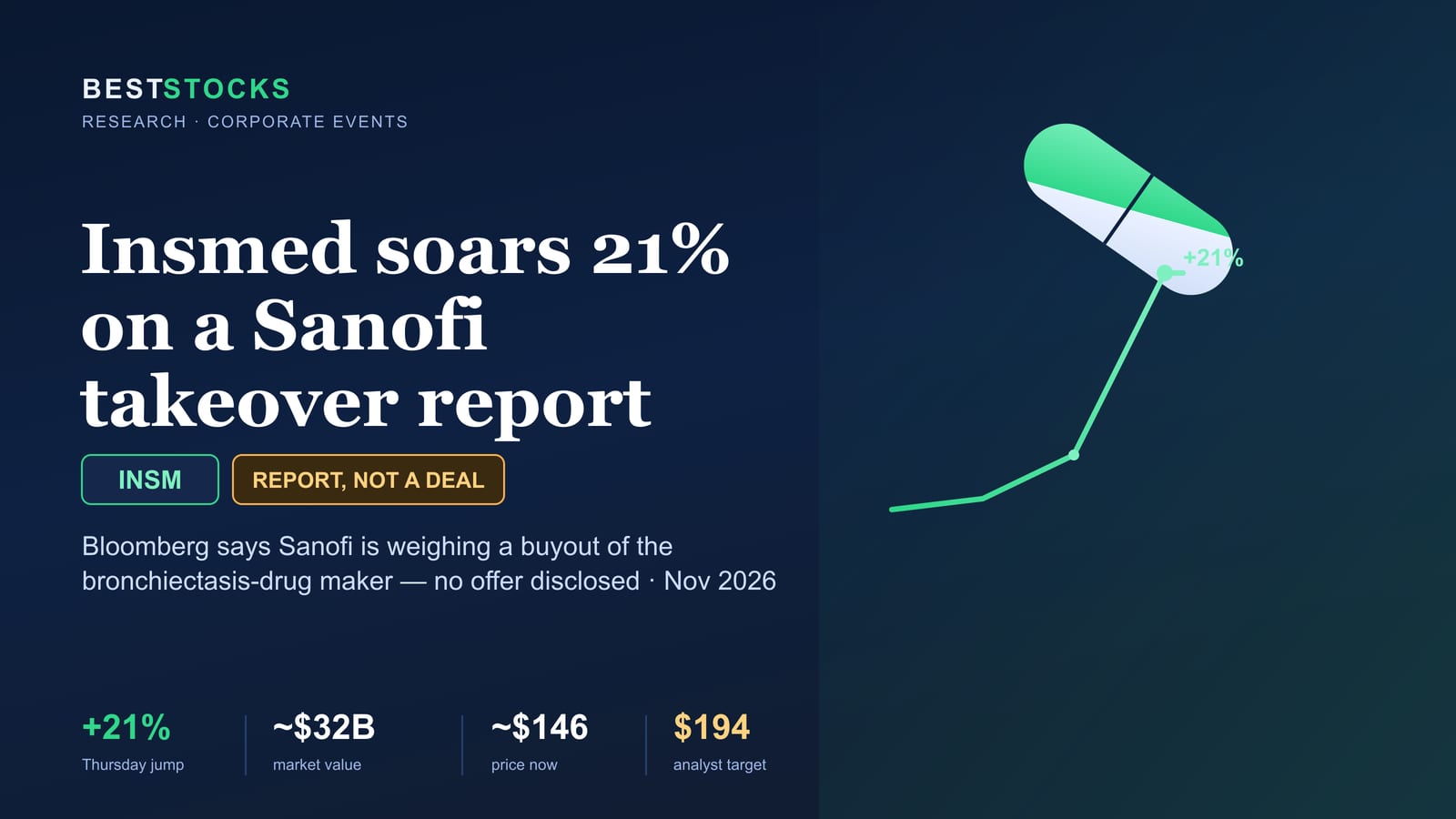
Insmed surged about 21% on November 19 after Bloomberg reported that Sanofi is weighing an acquisition of the company and working with advisers — a preliminary report, not a deal: no offer, price, or confirmation has been disclosed. The appeal is clear: Insmed's first-in-class bronchiectasis drug BRINSUPRI is ramping toward $1.35–1.4 billion of 2026 guidance, alongside ARIKAYCE and a late-stage pipeline, exactly the kind of de-risked respiratory franchise big pharma is hunting. But Insmed is no distressed seller — its standalone analyst target already tops the current price — so the 21% pop prices in a premium bid that has not been proposed.
Summary
On Thursday, November 19, 2026, shares of Insmed (NASDAQ: INSM) surged about 21% — closing up 20.58% at $144.46, after a brief volatility halt — on a Bloomberg report that Sanofi is weighing an acquisition of the company and working with advisers [1]. The stock added another roughly 1.5% on Friday, to about $146.61, lifting Insmed's market value to around $32 billion from roughly $26 billion before the report [2]. The crucial qualifier, though, is what this is not: it is not a deal. Bloomberg's report, citing people familiar, describes a preliminary exploration — no formal offer, no price, no definitive agreement, and no confirmation from either company; Reuters corroborated only that the report exists, not that a transaction was agreed [1]. And unlike a classic takeover of a stumbling target, Insmed is a prized, fast-growing asset — its standalone analyst price target (~$194) already sits above the current price [2]. So the move reflects the market pricing the possibility of a premium bid for a coveted company, not a done deal.
What changed
The trigger was a single, well-sourced report. Bloomberg said on November 19 that Sanofi — the French pharma giant behind the blockbuster immunology drug Dupixent — is evaluating a purchase of Insmed and has engaged advisers [1]. Insmed shares were halted for volatility, reopened sharply higher, and finished the day up more than 20% from a November 18 close near $119.80; Sanofi's U.S.-listed shares (SNY) slipped about 2.25%, the typical reaction for a would-be acquirer contemplating a large, mostly-cash outlay [1]. What the market has not received is anything concrete. There is no disclosed price, structure, or timeline, and Sanofi's own chief financial officer, François-Xavier Roger, had earlier flagged an appetite for larger deals while cautioning against expecting major near-term moves [5]. In other words, the stock is trading on takeover interest, not a takeover.
How much could Insmed fetch? Only hypothetically. Applying a standard 30%–50% takeover premium to the pre-rumor $119.80 price implies roughly $156–$180 a share, or about $34–$39 billion of equity value; RBC's Leonid Timashev has floated a wider $170–$210 range (about $37–$46 billion), reflecting Insmed's pipeline optionality [4]. These are illustrative figures, not an offer or an established consensus — a point worth stressing, because the stock at ~$146 has already priced in a meaningful chunk of a premium that has not actually been proposed [2][4].
Why it matters
The report is a signal about the state of biopharma dealmaking as much as about Insmed. Large drugmakers are facing looming patent cliffs and are hunting for commercial-stage, de-risked assets to refill their pipelines — and they are increasingly willing to pay up for the scarce ones. Insmed fits the template almost perfectly: a profitable-trajectory (cash-flow positive expected in 2027), fast-growing respiratory and rare-disease company with a first-in-class launch, a second marketed drug, and late-stage pipeline shots. That is why the broader group — Eli Lilly, Merck and Amgen among them — has been active in biotech M&A, and why a Sanofi–Insmed tie-up, if it happened, would validate respiratory and rare-disease platforms as assets worth owning rather than partnering with [4][5].
For Insmed specifically, the episode underscores how much value the market had already ascribed to the business even before the rumor: the stock had roughly tripled off its 52-week low near $90 on the strength of the BRINSUPRI launch, and analysts rated it a Strong Buy with targets well above the pre-rumor price [2]. That cuts both ways. It makes Insmed a logical, high-quality target — but it also means a would-be acquirer must pay a premium on top of an already-rich valuation, and that Insmed's board (which, in a notable coincidence, added former Sanofi CEO Paul Hudson as an independent director in October) can credibly argue the company is worth more alone [5]. The honest read is that the strategic fit is real, but a 21% pop on an unconfirmed report prices in a deal that does not yet exist.
What to watch
- Confirmation, terms — or denial. Any official statement from Sanofi or Insmed, an announced price, or a report that talks have ended; the single biggest swing factor [1].
- A competing bidder. A prized respiratory asset could attract other suitors, which would raise the price — or Sanofi could walk away [4].
- The BRINSUPRI ramp. Whether quarterly sales keep tracking toward the $1.35–$1.4 billion 2026 guidance, reported on Insmed's earnings calls [3].
- The ARIKAYCE FDA decision. A target action date of January 28, 2027 on a potential frontline MAC lung-disease expansion — a standalone catalyst independent of any deal [3].
- Sanofi's signals and the financing question. Any indication of how serious Sanofi is, and whether it is prepared to take on the leverage a deal this size implies [5].
Is Sanofi buying Insmed?
Not as of November 20, 2026 — there is no announced deal. Bloomberg reported on November 19 that Sanofi is weighing or exploring a potential acquisition of Insmed and is working with advisers, citing people familiar with the matter, and Reuters corroborated that the report exists [1]. But no formal offer, price, or definitive agreement has been disclosed, and neither company has confirmed a transaction. The reporting describes a preliminary exploration that could lead to a deal, a different outcome, or nothing at all. In short, this is takeover interest, not a takeover — and it should not be described as a pending acquisition or as confirmed negotiations.
Why did Insmed (INSM) stock jump?
- A takeover report. Bloomberg said Sanofi is exploring an acquisition of Insmed, sending the shares up about 21% (a 20.58% close) after a volatility halt on November 19 [1].
- A coveted, de-risked franchise. Insmed's first-in-class bronchiectasis drug BRINSUPRI is ramping fast, alongside ARIKAYCE and a late-stage pipeline — exactly what big pharma is hunting [3].
- Takeover-premium math. A 30–50% premium to the pre-rumor price implies roughly $156–$180 a share (RBC floated $170–$210), so traders priced in part of a potential bid [4].
- Already-strong standalone sentiment. The stock had tripled off its 52-week low on the BRINSUPRI launch, with analyst targets above the pre-rumor price [2].
Insmed–Sanofi takeover report at a glance
| Item | Detail |
|---|---|
| The report | Bloomberg (Nov 19, 2026): Sanofi is weighing an acquisition of Insmed, working with advisers — preliminary; no offer, price or confirmation [1] |
| The move | INSM +20.58% to $144.46 Thu (briefly halted), ~$146.61 Fri; from a ~$119.80 pre-rumor close. SNY ADR −2.25% [1][2] |
| Market value | ~$32B (from ~$26B pre-rumor), on ~219M shares [2] |
| Hypothetical takeover value | ~$34–39B at a 30–50% premium (~$156–180/sh); RBC's Timashev $170–210/sh (~$37–46B) — illustrative, not an offer [4] |
| Lead drug | BRINSUPRI (brensocatib) — first-in-class DPP1 inhibitor, FDA-approved Aug 12, 2025 for non-CF bronchiectasis; 2026 revenue guidance $1.35–1.4B (Q3 actual $400.1M) [3] |
| Second drug + pipeline | ARIKAYCE (refractory MAC lung disease), 2026 guidance $460–470M, FDA decision Jan 28, 2027; TPIP in Phase 3 [3] |
| Standalone view | Strong Buy consensus, ~$194 target (above the price); rev ttm $1.52B (+240%); ~$1.1B cash; cash-flow positive expected 2027 [2][3] |
What could move INSM next?
- Deal confirmation, terms, or denial — the dominant catalyst, on no fixed timeline [1].
- A rival bidder for a scarce respiratory asset [4].
- BRINSUPRI quarterly sales vs. the $1.35–1.4B 2026 guidance [3].
- ARIKAYCE FDA decision (Jan 28, 2027) on a frontline MAC expansion [3].
- Sanofi's posture and financing capacity for a deal of this size [5].
What is Insmed's fair value amid the Sanofi report?
Because this is a reaction to an unconfirmed takeover report, the scenarios below are anchored to the deal outcome and to Insmed's standalone trajectory rather than to a single multiple, over roughly the coming weeks-to-months as the situation resolves. They tie to cited inputs — the ~$194 standalone analyst target, the 30–50% hypothetical premium, and RBC's $170–210 range — against the ~$146 intraday price on November 20. Probabilities are illustrative author estimates and sum to 100%; this is descriptive analysis, not a forecast, target, recommendation, or any prediction that a transaction will occur.
| Scenario | Illustrative price | Probability | Key drivers |
|---|---|---|---|
| A bid emerges at a premium | ~$178 | 35% | Sanofi (or another suitor) agrees terms at a premium to the pre-rumor price; the stock moves toward the offer, less deal risk [4]. |
| No near-term deal; standalone re-rates | ~$160 | 45% | The rumor cools without an offer, but strong BRINSUPRI momentum and the ~$194 target carry the stock higher over time [2]. |
| Rumor fades, near-term pullback | ~$128 | 20% | No bid and a risk-off tape; the stock gives back much of the takeover pop toward its pre-rumor level [1]. |
Weighting those (0.35 × $178 + 0.45 × $160 + 0.20 × $128) gives a probability-weighted fair value near $160 — about 9% above the ~$146 price [2]. The unusual feature of this situation is that both the deal path and the no-deal path point higher, because Insmed's standalone target already exceeds today's price; the clearest downside is simply a near-term fade if the rumor passes without an offer. That makes the risk-reward asymmetric to the upside on a longer horizon, but path-dependent and headline-driven in the near term. This is a scenario exercise and descriptive analysis of a news-driven move, not investment advice.
Insmed (INSM) / Sanofi takeover FAQ
Is Sanofi acquiring Insmed?
Not as of November 20, 2026 — no acquisition has been announced or confirmed. On November 19, Bloomberg reported that Sanofi is weighing or exploring a potential acquisition of Insmed and is working with advisers, citing people familiar with the matter, and Reuters corroborated that the report exists. However, there is no publicly disclosed offer price, no definitive agreement, and no confirmation from either Sanofi or Insmed. The reporting describes a preliminary exploration that could lead to a deal, to different terms, or to nothing at all. It would be inaccurate to describe the situation as a pending acquisition or as confirmed negotiations; it is takeover interest, not an agreed transaction.
Why did Insmed (INSM) stock jump about 21%?
The stock rose because of the Bloomberg report that Sanofi is exploring a takeover. Insmed's shares were briefly halted for volatility on November 19 and reopened sharply higher, closing up 20.58% at $144.46 from a prior close near $119.80, and added more on November 20 to about $146.61. Two things made the report so combustible. First, Insmed is a highly coveted asset: its first-in-class drug BRINSUPRI (brensocatib) is the first and only FDA-approved therapy for non-cystic-fibrosis bronchiectasis and is ramping quickly, and the company has a second marketed drug (ARIKAYCE) plus a late-stage pipeline. Second, takeover math is powerful: a standard 30%–50% premium to the pre-rumor price implies roughly $156–$180 a share, so traders quickly repriced the stock toward a potential bid. The move is the market pricing in the probability and likely premium of a deal, not a confirmed transaction.
How much could Sanofi pay for Insmed?
No price has been proposed, so any figure is hypothetical. Applying a standard 30%–50% takeover premium to Insmed's pre-rumor price of about $119.80 implies roughly $156–$180 per share, or about $34–$39 billion of equity value. RBC analyst Leonid Timashev has floated a wider range of about $170–$210 per share — roughly $37–$46 billion — reflecting the optionality in Insmed's pipeline. These are illustrative estimates, not an offer or an established consensus. It is worth emphasizing that Insmed's standalone analyst price target is already around $194, above the current price, which means a buyer would need to pay a premium on top of an already-rich valuation. In practice, the eventual price (if any deal happens) would depend on negotiations, competing interest, and how much value the two sides assign to Insmed's growth and pipeline.
What does Insmed make, and why would Sanofi want it?
Insmed is a biopharmaceutical company focused on serious and rare respiratory diseases. Its lead product, BRINSUPRI (brensocatib), is a first-in-class oral DPP1 inhibitor approved by the FDA in August 2025 as the first and only therapy for non-cystic-fibrosis bronchiectasis (ages 12 and up); the company guides to 2026 revenue of about $1.35–$1.4 billion for it. Insmed also markets ARIKAYCE for refractory MAC (Mycobacterium avium complex) lung disease, and is developing TPIP, a late-stage (Phase 3) inhaled treatment, among other pipeline programs. For Sanofi, whose growth depends heavily on the immunology blockbuster Dupixent, acquiring a scaled, de-risked respiratory franchise would be strategically coherent — adding a fast-growing first-in-class launch and pipeline optionality in a therapeutic area it knows well. That strategic fit is why analysts such as BMO called a deal sensible, even though nothing has been agreed.
What are the risks to the Insmed takeover story?
Several, which is why the move should be treated as speculative. First and most basic, there may be no deal: the report is unconfirmed, there is no offer or terms, and Sanofi's own CFO has publicly cautioned against expecting major near-term acquisitions. Second, Insmed is not a distressed seller — its standalone analyst target (about $194) already exceeds the current price, so management has little incentive to accept a modest premium and may prefer to remain independent. Third, the stock already trades well above its pre-rumor level, so a premium is partly priced in; if the rumor fades without an offer, the shares would likely give back much of the jump. Fourth, financing and execution: an acquisition of this size would require Sanofi to increase its leverage considerably, and such deals can draw antitrust and shareholder scrutiny. In short, the upside case depends on a confirmed bid at a premium, while the base case leans on Insmed's own fundamentals; the current price embeds a bet on an uncertain outcome.
Why is the former Sanofi CEO on Insmed's board?
In October 2026, Paul Hudson — who had been Sanofi's chief executive — joined Insmed's board of directors as an independent director. It is a notable coincidence given the subsequent takeover report, and it means Insmed's board includes someone with deep knowledge of Sanofi's strategy and of large pharma dealmaking. However, it is important not to over-read it: a board appointment does not establish that acquisition negotiations are taking place, and the companies have not linked the two. It is the kind of detail that adds color to the story and could matter to how any approach is evaluated, but on its own it is not evidence of a deal. As with the rest of this situation, it should be treated as context, not confirmation.