Stock Analysis
Private Equity Circles Global Payments (GPN): GTCR Weighs a ~$50 Billion Take-Private
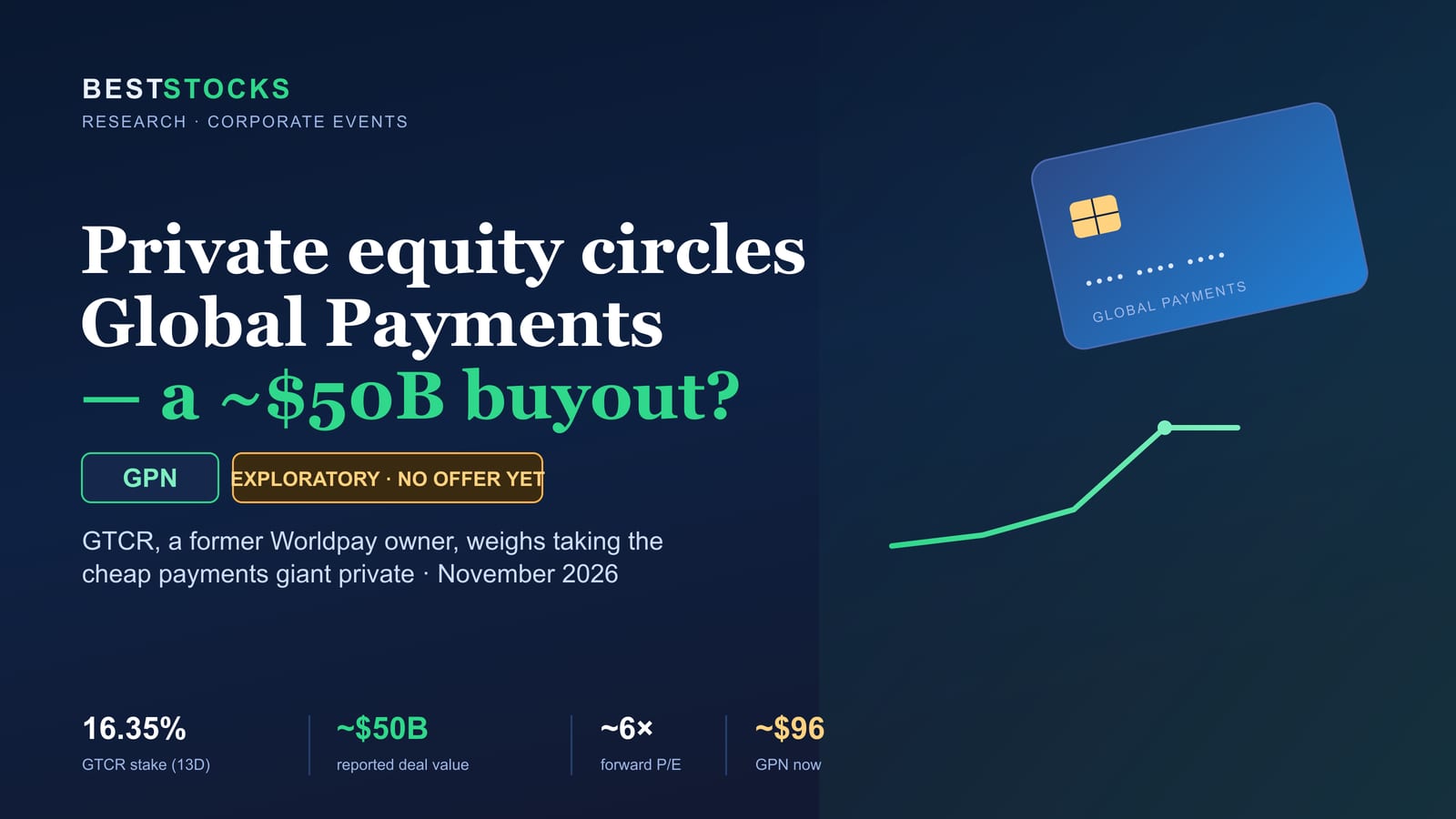
Private-equity firm GTCR disclosed a 16.35% stake in Global Payments and is weighing a take-private worth roughly $50 billion including debt, sending the payments processor's shares up as much as ~14% to around $96. But it is exploratory, not a deal — there is no formal offer, and a rival consortium walked away from a similar idea just two weeks earlier. What gives GTCR's interest credibility is that it once controlled Worldpay, the asset at Global Payments' core, and received its GPN shares when it sold Worldpay to the company. With the stock cheap at about six times forward earnings, the market is pricing the odds of a buyout.
Summary
Private equity is circling one of the biggest names in payments. On November 20, 2026, the buyout firm GTCR filed a Schedule 13D disclosing a 16.35% stake in Global Payments (NYSE: GPN) and said it is evaluating strategic transactions, potentially including acquiring the whole company; Bloomberg reported GTCR is lining up other private-equity firms to finance a possible take-private worth roughly $50 billion including debt [1]. The essential caveat is that this is exploratory, not a deal: there is no formal offer, no agreed price, and the saga is distinctly on-again, off-again — a rival consortium walked away just two weeks ago [3]. What makes GTCR's interest credible, though, is that it is no stranger to Global Payments. GTCR used to own a controlling stake in Worldpay — the asset at the heart of Global Payments today — and received its GPN shares as part of selling Worldpay to the company earlier this year [4]. The shares jumped as much as ~14% intraday on the report and trade near $96, as the market prices in the possibility of a buyout of a company that looks statistically cheap [2].
What changed
The signal was a change in filing, not a new purchase. GTCR has held about 16.35% of Global Payments (roughly 43.3 million shares) since January 2026, when it received the stock as partial consideration for selling Worldpay to the company; what changed on November 20 is that it converted its passive 13G filing into an active Schedule 13D — the form an investor uses when it may seek to influence or acquire control [1]. On top of that, Bloomberg reported GTCR is working to assemble the capital for a take-private valued around $50 billion (a figure that includes Global Payments' debt and an assumed premium; the company's enterprise value is about $43.6 billion today) [1][2]. And on November 24, Reuters reported that Blackstone, Warburg Pincus and Apollo Global Management are in talks to help finance the bid through equity or preferred-equity investments — a sign the money is being sought, though no financing has been finalized and assembling it remains challenging [3].
This is the second act. In late October, the Financial Times reported that Clayton, Dubilier & Rice and GTCR were interested in Global Payments, but on November 12 Reuters reported the consortium had abandoned that pursuit, sending the stock down about 12% [3]. (The roughly $40 billion figure cited then was Global Payments' approximate enterprise value, not a bid, so the later $50 billion number should not be read as a raised offer.) GTCR's renewed, solo-led approach a week later revived the shares. The stock's path tells the story — a slide into the low $80s when the first attempt collapsed, then a sharp bounce on the fresh interest.
Why it matters
The episode is a window into two forces reshaping finance. The first is the private-equity hunt for cheap public companies: with many quality businesses trading at depressed multiples, buyout firms are increasingly willing to attempt very large take-privates, and a cash-rich payments processor at six times earnings is a textbook target. The second is the pressure on legacy payment processors themselves. Once-steady giants like Global Payments and FIS have seen their growth and valuations compress as nimbler fintechs and the card networks Mastercard and Visa capture more of the economics — which is precisely why their shares are cheap enough to tempt private buyers who think they can fix them away from quarterly scrutiny [5].
It is also a reminder of how tangled these companies' recent histories are. The Worldpay asset at the center of this has changed hands repeatedly: GTCR bought control of it in 2024, then in a complex 2025–2026 reshuffle Global Payments acquired Worldpay while selling its own Issuer Solutions business to FIS — leaving GTCR as a large Global Payments shareholder and, now, a would-be acquirer of the whole thing [4]. For investors, the practical takeaway is to treat this as an event-driven situation with real two-way risk: the upside is a premium take-private, but the path there runs through financing that is not yet in place, a regulatory review, and a buyer that has every incentive to walk if the numbers do not work — as a prior group just did.
What to watch
- A formal proposal — or another walk-away. Whether GTCR makes an actual offer with a price, or abandons the effort as CD&R did; the single biggest swing factor [1].
- The financing consortium. Whether Blackstone, Warburg Pincus and Apollo commit the equity needed to fund a ~$50 billion deal [3].
- GTCR's standstill and board stance. How GTCR's contractual restrictions and Global Payments' board shape any approach, tracked through SEC filings [1].
- Regulatory signals. Any indication of antitrust or payment-industry scrutiny of a large payments buyout [3].
- The underlying business. Whether Global Payments keeps delivering the adjusted cash flow and Worldpay synergies that make it attractive, reported on its earnings calls [5].
Is Global Payments being taken private?
Not yet — there is no agreed deal. As of November 25, 2026, private-equity firm GTCR has disclosed a 16.35% stake in Global Payments and said it is evaluating strategic transactions that could include acquiring the company, and Bloomberg has reported it is seeking partners to finance a potential take-private worth roughly $50 billion including debt [1]. But no formal offer or price has been made, no definitive agreement exists, and the situation is explicitly exploratory. It is also fragile: an earlier consortium that included GTCR and Clayton, Dubilier & Rice abandoned a similar effort on November 12 [3]. So the correct description is that a buyer is exploring a possible take-private, not that Global Payments is being taken private; whether it happens depends on a formal offer, financing, approvals and the board's response.
Why did Global Payments (GPN) stock jump?
- Renewed takeover interest. GTCR's November 20 Schedule 13D and the Bloomberg report of a ~$50 billion take-private plan sent the shares up as much as ~14% intraday (closing up ~10%) [1][2].
- A credible buyer. GTCR previously controlled Worldpay, Global Payments' core asset, and already owns ~16% of the company [4].
- A cheap target. Global Payments trades around six times forward earnings with strong adjusted cash flow — attractive to private equity [5].
- Financing coming together. Reports that Blackstone, Warburg Pincus and Apollo may help fund the bid added conviction [3].
The Global Payments take-private saga — timeline
| Date | Development |
|---|---|
| Oct 30, 2026 | Financial Times reports CD&R and GTCR are interested in Global Payments (EV then ~$40B) [3] |
| Nov 12, 2026 | Reuters: the consortium abandons the pursuit; GPN falls ~12% [3] |
| Nov 20, 2026 | GTCR files a Schedule 13D (16.35% stake); Bloomberg reports a ~$50B take-private plan; GPN jumps ~14% intraday [1] |
| Nov 24, 2026 | Reuters: Blackstone, Warburg Pincus, Apollo in talks to help finance the bid [3] |
| Nov 25, 2026 | GPN trades ~$96; still exploratory — no formal offer [2] |
What could move GPN next?
- A formal offer and price — or GTCR walking away again [1].
- Financing commitments from the reported private-equity consortium [3].
- The board's response and any standstill-related constraints on GTCR [1].
- Regulatory signals on a large payments buyout [3].
- Business results — adjusted cash flow and Worldpay synergies [5].
What is Global Payments (GPN) worth?
With a possible take-private in the air but no offer on the table, Global Payments trades on the probability of a deal rather than on fundamentals alone. The scenarios below anchor to a plausible take-private premium, the stock's cheap standalone valuation (about six times forward earnings), and the ~$83–$84 level it fell to when the first attempt collapsed, against the ~$96 intraday price on November 25. Probabilities are illustrative author estimates and sum to 100%; this is descriptive analysis, not a forecast, target, or recommendation, and not a prediction that any deal will occur.
| Scenario | Illustrative price | Probability | Key drivers |
|---|---|---|---|
| A take-private at a premium | ~$115 | 35% | GTCR's consortium secures financing and agrees a deal at a premium to the pre-interest price [1]. |
| Talks drag on, no deal yet | ~$96 | 35% | The exploration continues without a firm offer; the stock holds on takeover hope plus cheap fundamentals [2]. |
| Interest collapses again | ~$84 | 30% | Financing or price gaps end the effort, as happened November 12; the stock returns toward its standalone level [3]. |
Weighting those (0.35 × $115 + 0.35 × $96 + 0.30 × $84) gives a probability-weighted value near $99 — modestly above the ~$96 price [2]. The near-match is the honest signal: the market has priced in a meaningful but far-from-certain chance of a buyout, so the risk-reward is roughly balanced and distinctly binary. The upside is a premium offer; the downside is a second collapse like the one two weeks ago. For now this is an event-driven situation whose value hinges on whether exploration becomes an offer, not on quarterly numbers. This is a scenario exercise and descriptive analysis, not investment advice.
Global Payments (GPN) take-private FAQ
Is a private-equity firm buying Global Payments?
Not under any agreed deal. As of November 25, 2026, the private-equity firm GTCR has disclosed a 16.35% stake in Global Payments through a Schedule 13D and said it is evaluating strategic transactions that could include acquiring the company, and Bloomberg has reported it is working to finance a potential take-private valued at roughly $50 billion including debt. However, no formal offer or price has been made and no definitive agreement exists — the situation is explicitly exploratory. It is also fragile: an earlier group that included GTCR and Clayton, Dubilier & Rice abandoned a similar pursuit on November 12, 2026, which sent the stock down about 12%. So the accurate description is that a buyer is exploring a possible take-private, not that Global Payments is being acquired. Whether it happens depends on a formal offer, securing financing, regulatory approvals and the board's response.
Why is GTCR interested in Global Payments, and how is it connected to Worldpay?
GTCR's interest is credible because it already knows and partly owns the business. Worldpay, the payment-processing asset now at the core of Global Payments, was controlled by GTCR, which acquired a 55% stake in it in early 2024. In a complex transaction announced in April 2025 and completed in January 2026, Global Payments acquired Worldpay while simultaneously selling its own Issuer Solutions business to FIS. As part of selling Worldpay to Global Payments, GTCR received Global Payments stock — the roughly 16.35% stake it holds today. So GTCR understands Worldpay intimately and is already Global Payments' large shareholder, which is why its exploration of taking the whole company private is taken seriously. That history provides a plausible strategic rationale for its interest, though it should be read as analysis rather than a confirmed statement of GTCR's motives.
Why did Global Payments (GPN) stock jump?
The shares rose because of renewed takeover interest. On November 20, 2026, GTCR converted its passive stake disclosure into an active Schedule 13D — the filing used when an investor may seek to influence or acquire control — and Bloomberg reported that GTCR was assembling partners to finance a take-private worth about $50 billion including debt. The stock jumped as much as roughly 14% intraday (closing up about 10%) and has since risen toward $96. Several factors amplified the move: GTCR is a credible buyer given its Worldpay history and existing ~16% stake; Global Payments is statistically cheap, at around six times forward earnings with strong adjusted cash flow; and on November 24 Reuters reported that Blackstone, Warburg Pincus and Apollo were in talks to help finance the bid, adding conviction that the money might come together. The move reflects the market pricing in the probability of a buyout, not a confirmed transaction.
Is Global Payments a cheap stock?
On conventional measures, yes — which is a big part of why it has attracted private-equity interest. Global Payments trades at roughly six times forward earnings, a low multiple for a large, established payments company, after a difficult stretch in which its growth and valuation compressed amid competition from fintechs and the card networks. It does carry a reported GAAP net loss, but that largely reflects one-time items from reshaping its portfolio (including the sale of its Issuer Solutions business as discontinued operations) rather than the health of the ongoing business, which generated about $870 million of adjusted free cash flow in the third quarter. A note of caution on cash flow: on a conventional basis, free cash flow for the first nine months was actually negative (around negative $516 million) because of transaction-related payments tied to the Worldpay deal, so the appeal is better described through adjusted cash flow and the company's underlying earnings power. For a buyer able to look past the noise, that combination — a low multiple plus substantial adjusted cash generation — is exactly what makes it a take-private candidate.
What are the risks to a Global Payments buyout?
The risks are considerable, which is why the stock trades below plausible deal levels. First and most basic, there may be no deal: the situation is exploratory, with no offer or price, and a rival consortium abandoned a similar effort just two weeks earlier. Second, financing is the crux — a take-private of roughly $50 billion for a company already carrying about 3.4 times net leverage would be one of the largest buyouts in years, which is why GTCR is reportedly recruiting Blackstone, Warburg Pincus and Apollo to help fund it; assembling that much equity and debt is difficult, and nothing is committed. Third, regulatory review: a payments deal of this scale would draw antitrust and payment-industry scrutiny, though those are potential hurdles rather than confirmed objections. Fourth, GTCR's existing stake comes with standstill restrictions that constrain how it can pursue the company. In short, the upside is a premium take-private, but the path there runs through financing, approvals and a buyer with every incentive to walk if the economics do not work — as one group already did on November 12.
What would a take-private price look like?
No price has been proposed, so any figure is hypothetical. The widely cited ~$50 billion is a Bloomberg-reported transaction value that includes Global Payments' debt and an assumed premium, not an offer; the company's enterprise value is about $43.6 billion today, and its equity market value is roughly $25 billion. A take-private would typically come at a premium to the undisturbed share price — Global Payments traded in the low-to-mid $80s before the renewed interest — so a deal, if it happened, would likely be struck above that level, though the exact premium would depend on negotiations, the financing available and the board's stance. It is worth stressing that the stock, near $96, already embeds a meaningful chance of a buyout; if the exploration ends without an offer, as the prior attempt did, the shares would likely give back much of their recent gain toward their standalone value. Until there is a formal proposal with terms, the price should be treated as a bet on the probability of a deal rather than a known number.