Stock Analysis
Black Hills and NorthWestern Complete Their Merger to Form Bright Horizon Energy (NYSE: HZN)
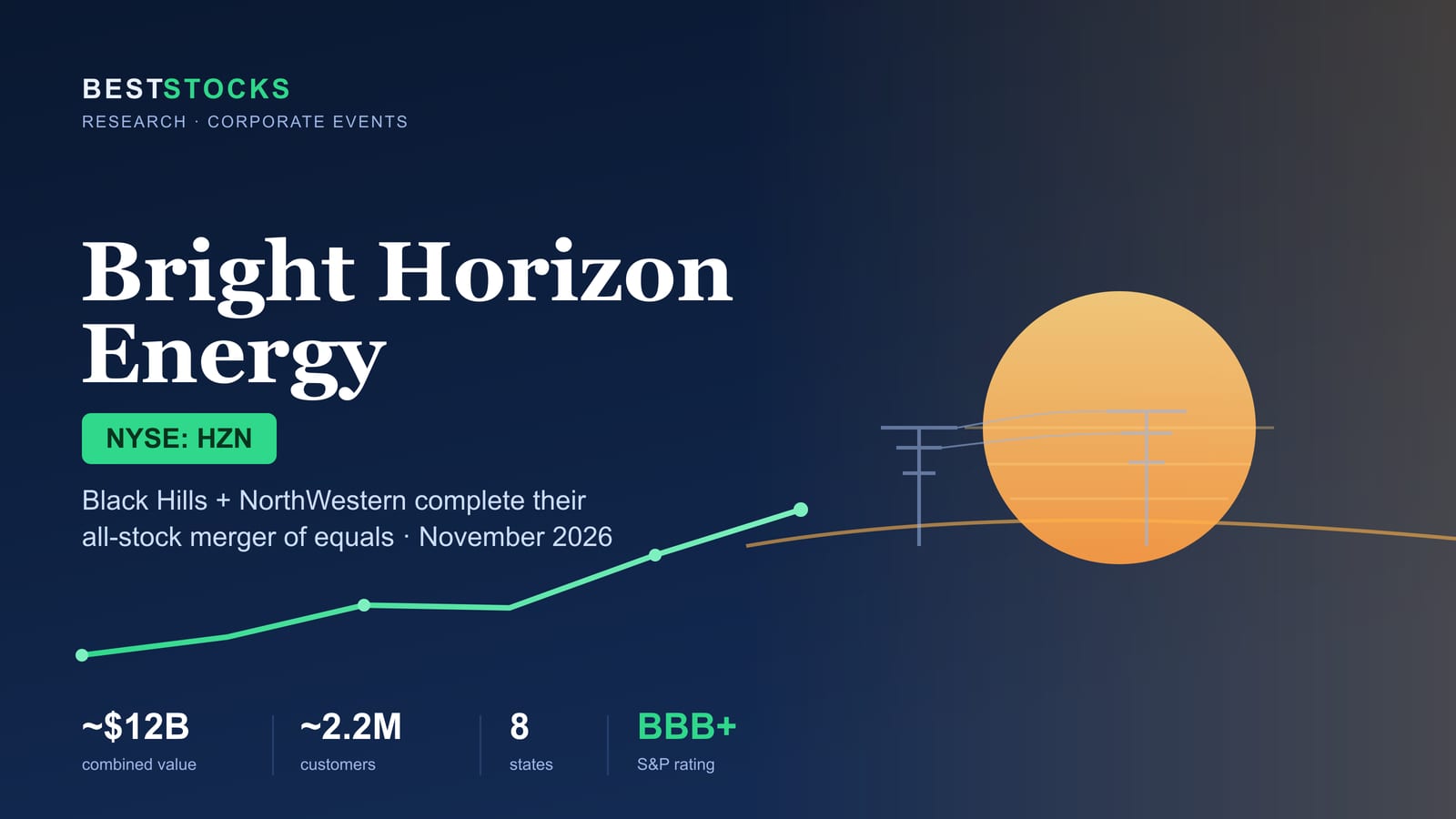
Black Hills and NorthWestern Energy completed an all-stock merger of equals on November 13, 2026, forming Bright Horizon Energy (NYSE: HZN) — a roughly $12 billion regulated utility serving about 2.2 million electric and gas customers across eight states, with a growing pipeline of data-center electricity demand.
Summary
On November 13, 2026, Black Hills Corp. and NorthWestern Energy Group completed an all-stock "merger of equals," creating one of the larger regulated utilities in the American West: Bright Horizon Energy Corporation, which began trading on the New York Stock Exchange under the ticker HZN on November 16 [1][2]. The combined company serves roughly 2.2 million electric and natural gas customers across eight states — Montana, South Dakota, Nebraska, Wyoming, Colorado, Iowa, Kansas and Arkansas — and S&P Global Ratings affirmed it at BBB+ on completion [1][3]. The single fact most coverage blurs is what kind of deal this is: it is not a cash takeover. Black Hills is simply the surviving legal entity, renamed; NorthWestern becomes a wholly owned subsidiary, and NorthWestern holders received 0.98 of a Bright Horizon share for each NorthWestern share [2]. Both shareholder bases now own the same company — a low-beta, dividend-focused utility whose real attraction is a growing pipeline of data-center electricity demand.
What changed
Mechanically, the merger folds two similarly sized utilities into one. Before the close, Black Hills was worth about $6.6 billion (around $86.70 a share) and NorthWestern about $5.2 billion (around $84.91) [4][6]. At the 0.98 exchange ratio, NorthWestern's roughly 61 million shares convert into about 60 million new Bright Horizon shares, lifting the combined share count to roughly 136 million and the combined market value to about $12 billion at HZN's ~$87 price [2][4]. NorthWestern's Nasdaq listing disappears — it was removed from the S&P MidCap 400 (Chime Financial took its index slot effective November 18), while the combined company retains the index membership as HZN on the NYSE [7]. The last regulatory hurdle had been the Montana Public Service Commission; shareholders of both companies, the Nebraska and South Dakota commissions, FERC and Hart-Scott-Rodino antitrust review had already signed off [2].
A practical wrinkle for anyone pulling up the new ticker: the data vendors are mid-transition. As of the first trading day, quote pages under HZN still display Black Hills' standalone figures — a market cap near $6.7 billion, about 76.5 million shares, trailing revenue of roughly $2.3 billion and trailing EPS near $4.14 [4]. Those are not the merged company's numbers. The combined Bright Horizon has roughly 136 million shares, a market value near $12 billion, and trailing revenue well above $3.5 billion once NorthWestern is consolidated. Until the feeds catch up, it is easy to badly understate the size of what was just created.
Why it matters
The deal is a clean example of the theme reshaping the whole utility sector in 2026: electricity demand is growing again for the first time in a generation, and data centers are the reason. After two decades of flat load, regulated utilities are suddenly fielding gigawatt-scale requests from hyperscalers, and the ones with the balance sheet to build generation and transmission fast are the winners. Black Hills turned that into a signed contract — up to 590 megawatts of grid-connected service plus management of about 2.1 gigawatts of third-party resources for Google in Cheyenne, backed by $1.8 billion of planned generation investment from 2027 to 2029 [5]. NorthWestern, for its part, filed a Montana "large new load" tariff designed to let big customers like data centers connect without shifting costs onto households [6]. Scale makes both efforts easier to finance. That is why consolidation is accelerating across the group — from NextEra Energy and Duke Energy at the large-cap end down through Xcel Energy and now Bright Horizon in the mid-cap tier — as management teams conclude that size is the cheapest way to fund an AI-era build-out.
For income investors specifically, the merger preserves one of the market's most durable dividend stories. Black Hills had raised its dividend for 56 consecutive years, one of the longest streaks of any public company and enough to make it a "Dividend King"; HZN inherits that record and the roughly $2.81 annual payout (a ~3.2% yield) [4][5]. A larger, more diversified, still investment-grade utility is, if anything, better positioned to keep that streak alive. The trade-off is that the same heavy capital cycle that creates the growth also requires ongoing equity and debt issuance, which is the main thing that could slow dividend growth or pressure the stock if interest rates stay high — utilities are sensitive to rates because they compete with bonds for income buyers and borrow heavily to invest.
What to watch
- First combined guidance and synergy targets. Standalone, Black Hills guided to 2026 adjusted EPS of $4.25–$4.45 and NorthWestern to $3.68–$3.83; the first Bright Horizon outlook — and any cost-synergy number — will reset how the Street models HZN. Watch the next earnings release [5][6].
- The Google/Cheyenne ramp. Energy service is slated to begin in late 2027 and reach peak load by 2030; milestones (or slippage) on that $1.8 billion generation build are the biggest swing factor for growth [5].
- Integration across eight regulators. Rate cases, merger commitments and the Colstrip coal question in Montana will play out through state filings over the next several years [6].
- Dividend continuity. HZN went ex-dividend on November 17; the real test is whether the board extends the 56-year increase streak at the next declaration [4].
- Credit and equity needs. S&P's BBB+ with its outlook, and the size and timing of equity issuance to fund the capital plan, will shape per-share growth and the stock's rate sensitivity [3].
What is Bright Horizon Energy (HZN), and what happened to Black Hills and NorthWestern?
Bright Horizon Energy Corporation (NYSE: HZN) is the new name of the company created by the all-stock merger of Black Hills Corp. and NorthWestern Energy, completed November 13, 2026. Black Hills is the surviving legal entity and was simply renamed; its BKH ticker became HZN on the NYSE. NorthWestern is now a wholly owned subsidiary, its Nasdaq listing (NWE) retired, with former NorthWestern shareholders receiving 0.98 of a Bright Horizon share for each share they held. The result is a single regulated electric and gas utility serving about 2.2 million customers across eight states [1][2].
Why did Black Hills and NorthWestern merge?
- Scale to fund a heavy capital cycle. Both are mid-cap regulated utilities facing a large, data-center-driven investment program; a bigger combined rate base and equity base make that cheaper to finance [5][6].
- Data-center load growth. Black Hills' contracted Google project in Wyoming and NorthWestern's Montana large-load tariff both target hyperscaler demand — the sector's first real load growth in decades [5][6].
- A stronger investment-grade profile. S&P affirmed the combined company at BBB+, supporting lower borrowing costs for the build-out [3].
- Geographic fit. Eight contiguous states (Montana, the Dakotas, Nebraska, Wyoming, Colorado, Iowa, Kansas, Arkansas) with complementary electric and gas operations [1].
Black Hills vs. NorthWestern vs. Bright Horizon — the merger at a glance
| Measure | Black Hills (pre-close) | NorthWestern (pre-close) | Bright Horizon (combined, HZN) |
|---|---|---|---|
| Market value | ~$6.6B (~$86.70/sh) | ~$5.2B (~$84.91/sh) | ~$12B at ~$87 on ~136M shares [4] |
| Customers | ~1.3M (gas & electric) | ~850K (MT, SD, NE) | ~2.2M across 8 states [1] |
| 2026 adj. EPS guide (standalone) | $4.25–$4.45 | $3.68–$3.83 | First combined guidance pending [5][6] |
| Dividend | $0.703/qtr · 56-yr increase streak | $0.67/qtr | ~$2.81/yr (~3.2% yield), streak carried by HZN [4] |
| Credit rating | Investment grade | Investment grade | BBB+ (S&P, affirmed on close) [3] |
| Listing | NYSE: BKH (renamed) | Nasdaq: NWE (retired) | NYSE: HZN; stays in S&P MidCap 400 [2][7] |
Baseline note: the pre-close prices are each company's last independent close; the combined market value is computed on HZN's intraday ~$87 price and the ~136 million post-merger share count, not taken from a data feed (most of which still showed Black Hills-standalone figures on the first trading day) [4].
What could move HZN next?
- First Bright Horizon guidance / synergy targets — the next earnings release, resetting the model for the combined company [5].
- Google/Cheyenne construction milestones — late-2027 service start toward 2030 peak load on the $1.8B generation plan [5].
- State rate cases and the Montana Colstrip question — the pace and outcome of regulatory proceedings across eight jurisdictions [6].
- Interest-rate path — utility multiples are rate-sensitive; a higher-for-longer environment pressures the group, lower rates help [4].
- Dividend declaration — whether HZN extends the 56-year increase streak [4].
What is Bright Horizon Energy's fair value after the merger?
HZN is a low-beta regulated utility, so its value is driven by rate-base growth, allowed returns and the dividend rather than by a single catalyst. With no combined guidance yet, the scenarios below anchor to the Street's existing ~$91 target, the ~3.2% dividend yield, both predecessors' 4%–6% long-term rate-base/EPS growth guidance, and the data-center optionality — against the ~$87 intraday price on November 16. Probabilities are illustrative author estimates and sum to 100%; this is descriptive analysis, not a forecast, target, or recommendation.
| Scenario | Illustrative price | Probability | Key drivers |
|---|---|---|---|
| Bull — data-center build delivers | ~$101 | 25% | Google/Cheyenne ramps on schedule, synergies land, and HZN re-rates toward premium regulated-utility peers on visible load growth [5]. |
| Base — steady regulated compounding | ~$91 | 50% | 4%–6% rate-base and EPS growth, dividend streak intact, roughly in line with the Street's ~$90.64 target [4]. |
| Bear — integration & funding drag | ~$76 | 25% | Rate-case setbacks, Colstrip/Montana friction, heavier equity dilution, or higher-for-longer rates compress the multiple [3][6]. |
Weighting those (0.25 × $101 + 0.50 × $91 + 0.25 × $76) gives a probability-weighted fair value near $90 — about 3% above the ~$87 intraday price, and close to the Street's ~$91 target [4]. The read is that HZN looks fairly valued to modestly cheap for an income-oriented holder: the dividend and steady rate-base growth support the base case, while the contracted data-center pipeline is the main source of upside asymmetry. This is a scenario exercise and descriptive analysis, not investment advice.
Bright Horizon Energy (HZN) merger FAQ
What is Bright Horizon Energy (NYSE: HZN)?
Bright Horizon Energy Corporation is the company created by the all-stock merger of Black Hills Corp. and NorthWestern Energy Group, completed on November 13, 2026. Black Hills was the surviving legal entity and was renamed Bright Horizon Energy; its NYSE ticker changed from BKH to HZN, and the stock began trading under the new symbol on November 16, 2026. NorthWestern Energy became a wholly owned subsidiary. The combined company is a regulated electric and natural gas utility serving approximately 2.2 million customers across eight states — Montana, South Dakota, Nebraska, Wyoming, Colorado, Iowa, Kansas and Arkansas — with a market value near $12 billion and an S&P credit rating of BBB+.
What happened to Black Hills (BKH) and NorthWestern (NWE) shares?
Black Hills shares were not bought out; the company was simply renamed, so BKH holders now own the same shares under the new ticker HZN on the NYSE, with their share count unchanged. NorthWestern shareholders received 0.98 of a Bright Horizon (HZN) share for each NorthWestern share they held — an all-stock conversion, not a cash payment — and NorthWestern's Nasdaq listing (NWE) was retired. NorthWestern was also removed from the S&P MidCap 400 index (replaced by Chime Financial effective November 18, 2026), while the combined company keeps the index membership as HZN. In short, both former shareholder bases now own one combined utility.
Why did Black Hills and NorthWestern merge?
The core logic is scale. Both were sub-$7 billion regulated utilities facing an unusually heavy capital-investment cycle driven by data-center electricity demand, which is expensive to finance with a small equity base. Combined, they have a larger rate base to spread costs over, a stronger investment-grade credit profile (S&P affirmed BBB+), and more capacity to fund new generation and transmission without excessive dilution. The deal also unites complementary operations across eight contiguous states and pools two data-center growth efforts — Black Hills' contracted project to power a planned Google data center in Cheyenne, Wyoming, and NorthWestern's Montana large-load tariff aimed at big new customers. Size, in a sector suddenly seeing its first real load growth in decades, is the cheapest way to fund the build-out.
Does Bright Horizon Energy pay a dividend?
Yes. The combined company carries over Black Hills' dividend, an annual rate of about $2.81 per share (roughly $0.703 per quarter), which works out to a yield near 3.2% at the stock's ~$87 price. The notable point is the record behind it: Black Hills had increased its dividend for 56 consecutive years, one of the longest streaks of any U.S. public company and enough to classify it as a 'Dividend King.' Bright Horizon inherits that streak, and HZN went ex-dividend on November 17, 2026. Whether the board extends the 56-year increase record at its next declaration is a key thing for income investors to watch, though the heavy capital-spending cycle is the main factor that could slow future dividend growth.
Why is the data-center angle important for HZN?
Because it is the growth engine that makes a regulated utility interesting again. After roughly two decades of flat U.S. electricity demand, hyperscalers building AI data centers are now requesting gigawatt-scale power, and utilities that can build generation and transmission to serve them earn a regulated return on that investment. Black Hills turned the theme into a signed contract: definitive agreements, effective September 30, 2026 and running through 2048, to serve a planned Google data center in Cheyenne, Wyoming — up to 590 megawatts of grid-connected service plus management of about 2.1 gigawatts of third-party resources — supported by $1.8 billion of planned generation investment from 2027 to 2029 and projected to contribute roughly $150 million of net income by 2030. NorthWestern added a Montana large-load tariff for 5-megawatt-plus customers including data centers. That contracted, large-load demand is rarer than the sector-wide talk about it, and it is the main source of upside for HZN.
What are the risks to the Bright Horizon Energy merger story?
Several, which is why this is a steady-compounder rather than a fast re-rating. First, integration risk: aligning operations, systems and rate cases across eight state regulators is slow and politically sensitive, and merger commitments can constrain how quickly synergies are realized. Second, NorthWestern brings exposure to the Colstrip coal plant and recently took a regulatory disallowance charge, both of which can create earnings volatility and regulatory friction in Montana. Third, funding: the large capital program will require ongoing equity and debt issuance, and equity issuance dilutes per-share growth while heavy borrowing raises sensitivity to interest rates — utilities tend to underperform when rates stay high. Fourth, execution on the Google/Cheyenne build: delays or cost overruns on the $1.8 billion generation plan would push out the growth. None of these threaten the company's investment-grade stability, but together they cap how much upside to expect in the near term.