Stock Analysis
Summit Therapeutics (SMMT) Plunges ~16% to a 52-Week Low After the FDA Rejects Ivonescimab's First US Filing
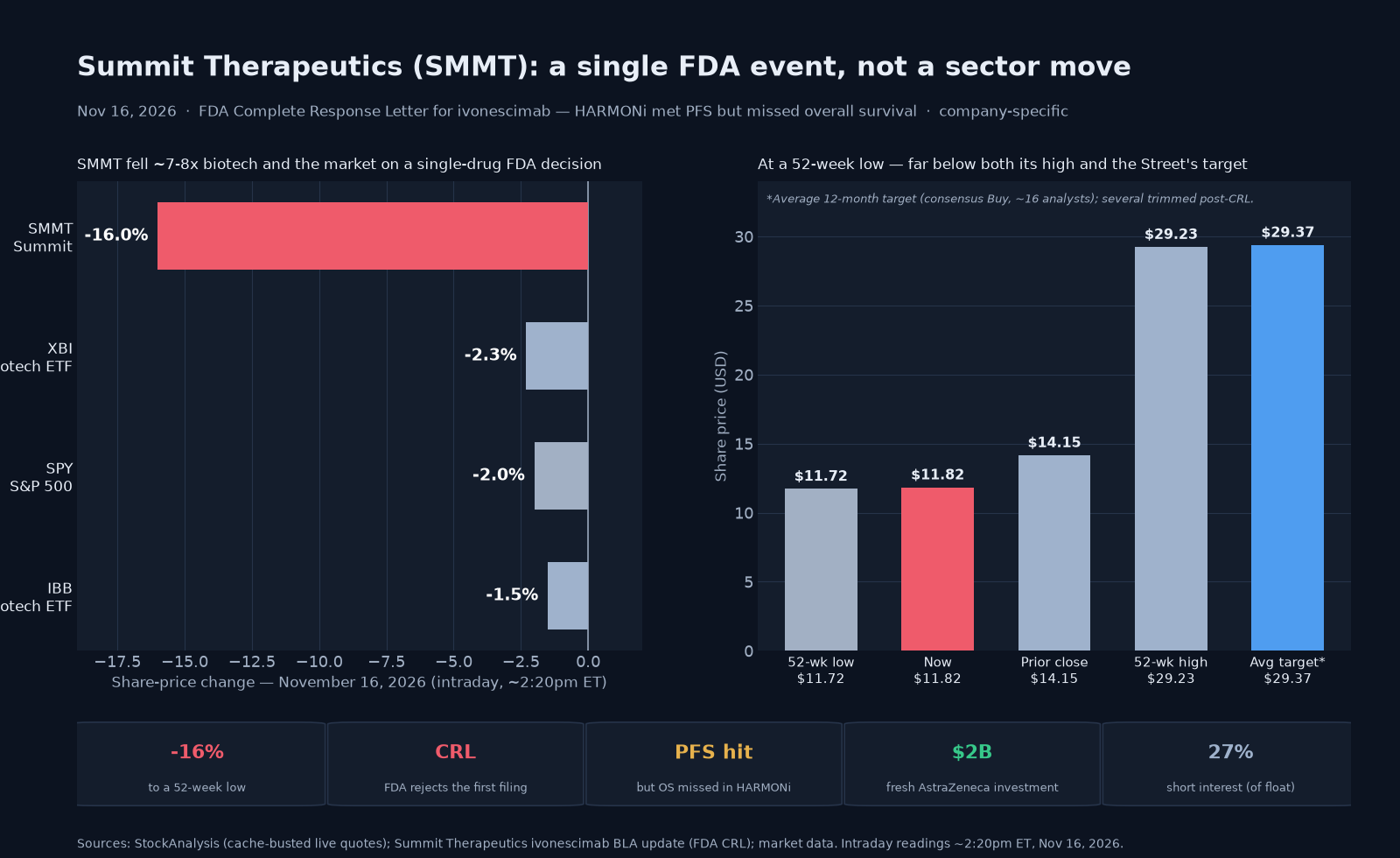
Summit Therapeutics plunged about 16% to roughly $11.82 — a fresh 52-week low — on November 16 after disclosing that the FDA had issued a Complete Response Letter (a rejection, for now) for its lead drug, ivonescimab. The move was emphatically company-specific: on a day the broad market and biotech indexes each fell about 2%, Summit dropped eight times as hard. The CRL covers ivonescimab plus chemotherapy after EGFR-targeted treatment in non-small cell lung cancer, from the Phase 3 HARMONi trial — which clearly met its progression-free survival goal (6.8 vs 4.4 months) but whose primary overall-survival analysis narrowly missed significance (16.8 vs 14.0 months, HR 0.79, p=0.057), and the FDA judged the benefit-risk insufficient. Crucially, this is not a verdict that the drug fails to extend life: in a separate first-line trial (China's HARMONi-2) ivonescimab beat Keytruda on overall survival (30.8 vs 22.6 months, HR 0.73, p=0.009). Several things keep the CRL from being thesis-ending: it covers one smaller indication; the far larger global first-line opportunity (HARMONi-3, HARMONi-7) is still ahead; and just six weeks earlier AstraZeneca completed a $2 billion strategic investment in Summit. Even after the drop, Summit is a ~$9.4 billion company with roughly $2.6 billion of liquidity (including the AstraZeneca cash) and ~27%-of-float short interest — a well-funded, AstraZeneca-backed, polarizing bet whose value rests almost entirely on first-line survival data still to come.
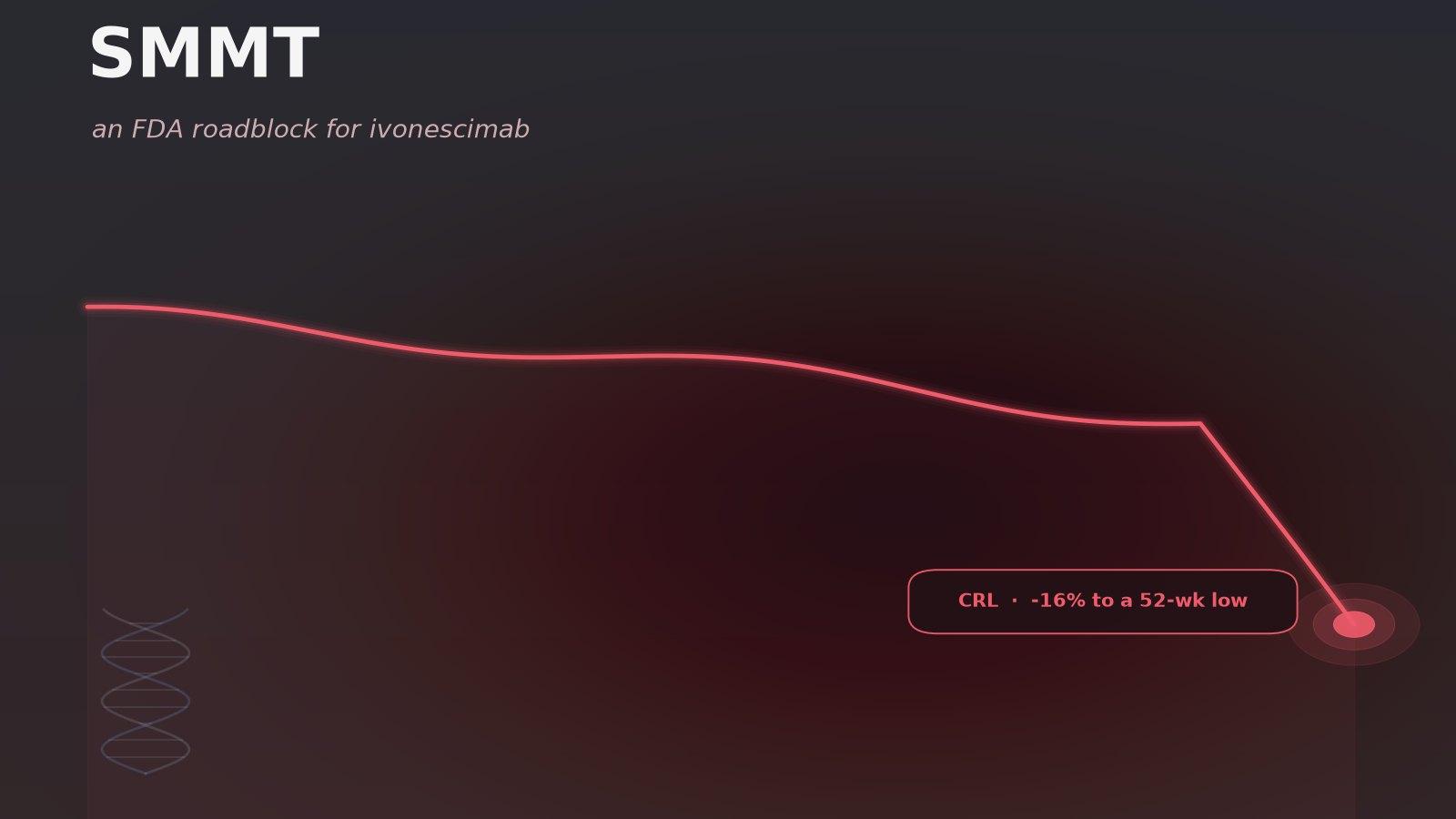
On Monday, November 16, 2026, Summit Therapeutics (NASDAQ: SMMT) plunged about 16% to roughly $11.82, a fresh 52-week low, after the company disclosed that the U.S. Food and Drug Administration had issued a Complete Response Letter (CRL) — a formal rejection, for now — for its lead drug, ivonescimab [1]. The move was emphatically its own news: on a day the broad market and biotech indexes each fell about 2%, Summit dropped seven to eight times as hard, reflecting a sharp, company-specific reaction to the regulatory setback [5]. Ivonescimab is one of the most closely watched drugs in all of oncology — a PD-1/VEGF "bispecific" antibody, licensed from China's Akeso, that beat Merck's Keytruda on both progression-free and overall survival in a Chinese head-to-head trial (HARMONi-2) and that drew a $2 billion strategic investment from AstraZeneca just six weeks ago — so a rejection on its first U.S. filing is a real blow, even if a contained one, to a stock priced for the drug to become a blockbuster [2].
What happened — a rejection built on the gap between two endpoints
The CRL covers a specific use: ivonescimab combined with platinum-containing chemotherapy following EGFR-targeted treatment in advanced non-small cell lung cancer (NSCLC) — the indication Summit sought to approve on its global Phase 3 HARMONi trial [2]. The reason is the crux of the whole story. HARMONi clearly met its progression-free survival (PFS) endpoint — median PFS of about 6.8 months versus 4.4 months for chemotherapy alone (hazard ratio 0.52; p<0.0001) — but its prespecified primary overall-survival (OS) analysis did not reach statistical significance: median survival was about 16.8 versus 14.0 months (HR 0.79; p=0.057), a near-miss [2]. A later exploratory analysis suggested a survival benefit (HR 0.76; nominal p=0.0151), but the FDA concluded the evidence did not establish a favorable benefit-risk profile for approval — a judgment that also weighs ivonescimab-plus-chemo's higher toxicity (grade-3-or-worse treatment-related adverse events of roughly 50% versus 42% for chemo alone) against the PFS gain [2]. In plain terms: the drug demonstrably slowed the disease, but in this setting the data did not prove, to the agency's bar, that patients lived meaningfully longer with an acceptable safety profile. (The FDA's letter itself is not public; these details come from Summit's disclosure and trial presentations, so the agency's precise requirements are not independently confirmed [6].)
Several things keep this from being a thesis-ending event, and they matter for how the stock trades from here. First, the CRL applies to one indication, not the whole drug: this was a post-EGFR-TKI beachhead, not ivonescimab's main event. Second, ivonescimab has already shown a statistically significant survival win elsewhere: in Akeso's China-only HARMONi-2 trial — first-line, head-to-head against Keytruda — median overall survival was about 30.8 versus 22.6 months (HR 0.73; p=0.009), so the drug is not without survival evidence; the open question is whether that result repeats in Summit's global studies [6]. Third — and this is why a $9 billion company can take a 16% hit without collapsing — the far larger opportunity is still ahead and is now well funded: Summit is running first-line NSCLC trials (HARMONi-3, pairing ivonescimab with chemotherapy against Keytruda-plus-chemo, with squamous PFS data expected around the end of 2026; and HARMONi-7, ivonescimab monotherapy versus Keytruda in high-PD-L1 patients), both with PFS and overall survival as dual primary endpoints, and just six weeks ago AstraZeneca completed a $2 billion strategic equity investment in Summit alongside a clinical collaboration [2]. Those first-line readouts, not this rejected filing, are what the valuation is really built on. The CRL delays the near-term U.S. opportunity and reduces its perceived probability of success; it does not settle whether ivonescimab becomes a major immunotherapy backbone.
Why the stock fell — a hyped drug meets a hard regulatory standard
Summit's valuation has always rested on expectation rather than revenue — the company sells no products yet — so sentiment and probability-of-success assumptions move the stock violently. Ivonescimab's reputation was built on beating Keytruda in China — on progression-free survival and, later, on overall survival in the first-line HARMONi-2 trial — and bulls extrapolated that into a drug that could reset lung-cancer treatment globally. The CRL is a pointed reminder that a PFS benefit is not automatically enough when the overall-survival signal is borderline and the regimen adds toxicity: the FDA's determination was specific to ivonescimab's benefit-risk in this post-TKI population, not a blanket statement that progression-free survival can no longer support approvals [2]. Still, it reframes the near-term U.S. debate from "how big can this be?" to "will the survival benefit hold up in the global trials?", and a market that had priced in a lot of the former repriced sharply toward that uncertainty. The stock is now ~60% below its 52-week high and sits essentially at its 52-week low [1]. The counterpoint, which keeps this a battleground rather than a rout, is that the balance sheet is strong and the biggest catalysts are unaffected — which is why the sell-off, while severe, did not erase the company's multibillion-dollar value.
The valuation question
Summit cannot be valued on earnings — it has no product revenue, lost about $833 million over the trailing year, and ran roughly $525 million in trailing negative free cash flow [3]. Even after the plunge, it carries a market capitalization of about $9.4 billion on roughly 800 million common shares — an enormous figure for a pre-commercial biotech, and a direct measure of how much ivonescimab success is still embedded in the price [3]. The reassuring part of the balance sheet is liquidity, and it is far stronger than the quarter-end figures suggest: Summit reported about $630 million of cash at September 30, then received $2 billion from AstraZeneca's equity investment that closed October 5, for combined liquidity on the order of $2.6 billion against only ~$20 million of debt — providing substantial funding capacity for its first-line program, subject to future spending [2]. The AstraZeneca stake came as convertible preferred shares (rights equivalent to roughly 12% of Summit's common), so it adds both cash and some future dilution. The more unsettling feature is the setup around the stock: short interest is about 27% of the tradable float (a much smaller slice of total shares outstanding, since insiders hold the majority), among the highest for a company this size, which tells you ivonescimab has been one of the market's most polarizing bets for years [3]. That two-sided positioning is why the shares can gap double digits on a single headline in either direction. The whole investment case, in one line: a well-capitalized, AstraZeneca-backed company whose multibillion-dollar value hangs almost entirely on upcoming first-line survival data, with a vocal short base betting the hype has outrun the evidence.
Analyst view
This is a classic high-conviction, binary biotech, and the discipline is to separate a setback on one indication from the fate of the franchise. The bull case is that ivonescimab's mechanism and efficacy record remain intact — it beat Keytruda on both PFS and overall survival in first-line HARMONi-2, AstraZeneca signaled institutional confidence with a $2 billion investment, the rejected filing was a smaller post-TKI indication, and the trials that actually justify the valuation (first-line NSCLC) are still coming; on that reading, a 16% drop on a non-core CRL is an overreaction. The bear case is that the warning signs the skeptics have pressed for years are now concrete: in this HARMONi setting ivonescimab reliably delayed progression but the primary survival analysis missed (if only narrowly), the regimen adds toxicity, the pivotal survival win so far is a China-only trial whose global applicability is unproven, and a $9 billion valuation with no revenue leaves enormous room to fall if the global first-line trials disappoint on survival. On balance, the news is a real, specific negative on timing and probability — the U.S. path for this indication is blocked and the OS bar is now front and center — but it is not dispositive about the larger opportunity, which is why the Street's average target still sits far above the price even as several firms trimmed their numbers [3]. The right lens is the global first-line data: a clear survival benefit from HARMONi-3 and HARMONi-7 could make today's sell-off appear overdone, while a result that echoes HARMONi's borderline OS would give the bearish thesis substantial support. This is descriptive analysis of a news-driven move, not investment advice, and binary clinical-stage biotech carries outsized risk in both directions.
Why it matters
Ivonescimab is a bellwether for one of the biggest bets in cancer drug development — whether a new class of PD-1/VEGF bispecifics can displace or augment the checkpoint inhibitors (like Keytruda) that have dominated immuno-oncology for a decade. Summit's stumble is therefore read across to the whole category and to its Chinese originator, Akeso, and it sharpens a debate that extends well beyond one stock: how much overall-survival evidence a new oncology drug needs when its progression-free benefit is clear but its survival signal is borderline and it adds toxicity. The FDA did not declare that PFS can no longer support approvals — it approves on PFS in many settings — but its benefit-risk judgment here is a caution for any developer leaning on a PFS endpoint with soft survival data. For Summit specifically, the episode resets expectations without resolving them: the global first-line HARMONi trials remain the real verdict, and they are what will determine whether ivonescimab is a landmark drug or a cautionary tale about extrapolating from early or single-geography endpoints. For now, a feared-but-not-fatal regulatory setback knocked a hyped stock to a 52-week low while leaving its central question wide open.
The move, in one cross-section
The same-session tape shows Summit crashing on its own news while biotech and the broad market fell only modestly — the signature of a single-stock, binary regulatory event rather than a sector move [5]:
| Name (ticker) | Nov 16, 2026 (intraday) | Read-through |
|---|---|---|
| SMMT — Summit Therapeutics | ≈−16% | The event — an FDA Complete Response Letter for ivonescimab sent it to a 52-week low [1] |
| XBI — S&P Biotech (ETF) | ≈−2.3% | Biotech broadly lower with risk assets — a fraction of SMMT's move [5] |
| SPY — S&P 500 (ETF) | ≈−2.0% | Broad market down on an AI/semi/crypto selloff [5] |
| IBB — Nasdaq Biotech (ETF) | ≈−1.5% | Large-cap biotech modestly lower — no sector read-through to Summit's drop [5] |
Summit down ~16% while biotech ETFs and the S&P 500 fell ~2% is the signature of a company-specific, binary catalyst — an FDA decision on a single drug — not a sector or macro move [5].
What the Street thinks
Analysts remain broadly constructive on the franchise even as they mark down this indication. The consensus rating is a Buy from about 16 analysts, with an average 12-month price target near $29 — more than double the post-drop price, and roughly back at the stock's own 52-week high [3]. The telling detail is the reaction to the CRL: several firms trimmed their targets (for example, cuts into the high-teens-to-low-$40s range depending on the house) while largely keeping their ratings, and at least one reiterated a Buy with a target around $30 [6]. That combination — a bullish consensus, a target far above the price, but fresh downward revisions — captures the ambivalence precisely: the Street still believes in ivonescimab's first-line potential but has lowered its odds and pushed out its timeline for the U.S. opportunity. The very wide gap between price and target is less a promise than a measure of how binary the first-line readouts have become [3].
What to watch
- The first-line trials. HARMONi-3 (squamous PFS data expected around the end of 2026) and HARMONi-7 — above all, whether these global trials show a clear overall-survival benefit, the bar HARMONi missed and the question the China-only HARMONi-2 win must now answer at global scale [2].
- The resubmission path. What the FDA actually requires for this indication, and whether Summit pursues a resubmission or waits for stronger first-line data [2].
- The AstraZeneca collaboration. How the clinical partnership that accompanied AstraZeneca's $2 billion investment develops, since it validates — and could broaden — the ivonescimab program [2].
- The short base. With short interest around 27% of the float, positioning can amplify moves in both directions around every data point. Moves are tracked on the Summit stock page.
Illustrative scenario sensitivity
Because the regulatory setback concerns one indication, while the drug's broader prospects remain uncertain, the scenarios below are anchored to the first-line survival data and the regulatory path — not to this quarter or this filing alone [3]. They are a descriptive, author-weighted exercise over roughly the coming twelve-to-twenty-four months as those trials report — not a forecast, target, recommendation, or trading advice — with subjective weights that sum to 100%. Clinical-stage biotech outcomes are genuinely binary, so the dispersion here is deliberately very wide.
| Scenario | Illustrative price | Weight | Key drivers |
|---|---|---|---|
| Global first-line data delivers survival | ~$26 | 30% | HARMONi-3 and HARMONi-7 show a clear overall-survival benefit, confirming the China HARMONi-2 result at global scale, validating ivonescimab as a backbone and re-rating the stock toward its prior highs and the Street's target [3]. |
| Overhang persists, data mixed/pending | ~$12 | 40% | The U.S. setback lingers, global first-line readouts are awaited or ambiguous, and the stock stays range-bound near its lows as the market waits for proof [1]. |
| Global trials echo the OS shortfall | ~$6 | 30% | The global first-line trials fail to confirm a clear survival benefit, undercutting the core thesis and compressing the valuation toward a level backstopped mainly by its ~$2.6 billion of cash [3]. |
Weighting those (0.30 × $26 + 0.40 × $12 + 0.30 × $6) gives an author-weighted reference value near $14.40 — an illustrative, probability-weighted scenario output mechanically derived from the weights above, and not a price target, fair-value estimate, or prediction [1]. It sits above Monday's ~$11.82 price mainly because the enormous upside case is weighted meaningfully, which is the nature of a binary biotech: the outcomes are widely dispersed, and the probability-weighted figure need not correspond to any likely trading price. The honest signal is the width of the range, not the point estimate — the outcome is dominated by first-line survival data that has not yet reported. This is a scenario exercise and descriptive analysis of a news-driven move, not investment advice.
Summit Therapeutics data snapshot — November 16, 2026
| Figure | Value | As-of / source |
|---|---|---|
| Intraday quote | ~$11.82 (≈−16.5%) — an intraday reading (market open); opened $12.71, day range $11.69–$13.28; a fresh 52-week low | Mon, Nov 16, 2026, ~2:20pm ET — StockAnalysis [1] |
| Prior close / 52-week trend | $14.15 prior close; 52-week range $11.72–$29.23 (~60% below the high); beta ~−1.52 | Nov 16, 2026 [1] |
| Market cap / balance sheet | ≈$9.4B (≈800M common shares; float ~154M); ≈$630M cash at Sept 30 plus $2.0B from AstraZeneca (closed Oct 5) ≈ $2.6B liquidity vs ~$20M debt, for an enterprise value near ≈$6.8B | Nov 16 — StockAnalysis / Summit [2] [3] |
| Financials | No product revenue; trailing net loss ≈$833M; EPS ttm ≈−$1.07; free cash flow ≈−$527M across operations (heavy clinical spend) — valued entirely on ivonescimab's future | Nov 16 — StockAnalysis [3] |
| Catalyst | FDA Complete Response Letter for ivonescimab + platinum chemo after an EGFR TKI in advanced NSCLC (Phase 3 HARMONi): PFS met (6.8 vs 4.4 mo, HR 0.52, p<0.0001) but the prespecified primary OS missed (16.8 vs 14.0 mo, HR 0.79, p=0.057; a post-hoc update HR 0.76, nominal p=0.0151); the FDA found the benefit-risk insufficient (ivonescimab+chemo also carried higher toxicity) | Nov 15–16, 2026 — Summit ivonescimab BLA update [2] |
| Still ahead (the real verdict) | Global first-line NSCLC trials: HARMONi-3 (+chemo vs Keytruda+chemo; squamous PFS ~end-2026) and HARMONi-7 (mono vs Keytruda, high-PD-L1), both with dual PFS/OS primary endpoints — and the drug already has a first-line OS win vs Keytruda in Akeso's China-only HARMONi-2 (30.8 vs 22.6 mo, HR 0.73, p=0.009) | Ongoing — company pipeline [2] [6] |
| Same-day cross-section | SMMT ≈−16% vs XBI −2.3%, SPY −2.0%, IBB −1.5% — a company-specific FDA event, not a biotech or macro move | Nov 16 intraday [5] |
| Positioning & analysts | Short interest ≈27% of the float (a battleground; much smaller as a share of the ~800M total shares); consensus "Buy" from ~16 analysts, average target ≈$29 (>2x the price), with several firms trimming targets post-CRL | Nov 16 — StockAnalysis [3] / coverage [6] |
Summit Therapeutics (SMMT) ivonescimab CRL FAQ
Why did Summit Therapeutics (SMMT) stock fall on November 16, 2026?
Summit plunged about 16% to roughly $11.82 — a fresh 52-week low — after it disclosed that the FDA had issued a Complete Response Letter (CRL), a formal rejection for now, for its lead drug ivonescimab. The move was clearly company-specific: on a day the S&P 500 and biotech ETFs each fell about 2%, Summit dropped roughly eight times as hard, which is the signature of a single-stock, binary regulatory event rather than a sector move. The rejection concerns ivonescimab's first U.S. filing, and it reset a stock that had been priced for the drug to become a blockbuster — even though the rejection applies to only one, smaller indication.
What is a Complete Response Letter, and what exactly did the FDA reject?
A Complete Response Letter (CRL) is the FDA's way of telling a company it will not approve an application in its current form, and that more work is needed; it is a setback, not necessarily a permanent 'no.' Here, the CRL covers a specific use: ivonescimab combined with platinum-based chemotherapy in previously treated (second-line), EGFR-mutated advanced non-small cell lung cancer, which Summit sought to approve on its Phase 3 HARMONi trial. The agency did not approve that filing because, while HARMONi clearly met its progression-free survival goal, the trial's prespecified primary overall-survival analysis narrowly missed statistical significance (HR 0.79, p=0.057) — and the FDA judged the overall benefit-risk insufficient, weighing the progression benefit against the regimen's added toxicity. Summit said the drug's safety profile was consistent with prior studies.
What is the difference between progression-free survival and overall survival?
They are two different ways of measuring whether a cancer drug works, and the gap between them is the heart of this story. Progression-free survival (PFS) measures how long patients go before their cancer worsens or they die — it shows the drug is controlling the disease. Overall survival (OS) measures how long patients actually live. OS is the harder, more definitive bar, because a drug can delay progression without ultimately helping people live longer. In the HARMONi trial, ivonescimab improved PFS (6.8 vs 4.4 months, HR 0.52) but its prespecified primary OS analysis narrowly missed statistical significance (16.8 vs 14.0 months, HR 0.79, p=0.057), and the FDA decided the benefit-risk was not enough for approval. Importantly, that does not mean ivonescimab has no survival data: in a different, first-line trial (Akeso's China-only HARMONi-2) it showed a statistically significant OS benefit over Keytruda (30.8 vs 22.6 months, HR 0.73, p=0.009). So the survival question is not settled against the drug — it is specific to this HARMONi setting and to whether the China result repeats in Summit's global first-line studies.
Is ivonescimab finished as a drug?
No — and that distinction is important for understanding why a roughly $9 billion company did not collapse on the news. The CRL applies to one indication (second-line, EGFR-mutated NSCLC), not to ivonescimab as a whole. The far larger opportunity — and what Summit's valuation is really built on — is first-line (newly diagnosed) lung cancer, which the company is testing in bigger Phase 3 trials such as HARMONi-3 and HARMONi-7. Those readouts, not this rejected filing, are the real verdict on the drug. Two further points cut against a 'finished' read: ivonescimab already won on overall survival versus Keytruda in the first-line HARMONi-2 trial in China, and AstraZeneca completed a $2 billion strategic investment in Summit just six weeks before the CRL — a notable vote of confidence in the program. So the CRL delays and lowers the odds on the near-term U.S. path for this indication, but it does not resolve whether ivonescimab becomes a major immunotherapy backbone. The key test is whether the global first-line trials show a clear overall-survival benefit.
Is Summit Therapeutics stock cheap after the drop?
It depends entirely on your view of ivonescimab, because there is nothing else to value. Summit has no product revenue, lost about $833 million over the past year, and ran roughly $525 million of negative free cash flow across its operations. Even after falling to a 52-week low, it carries a market capitalization of about $9.4 billion — which is a direct measure of how much future ivonescimab success is still priced in, not a sign of cheapness. The balance sheet is a genuine positive, and stronger than it looks at first glance: about $630 million of cash at quarter-end plus $2 billion received from AstraZeneca's October equity investment — roughly $2.6 billion of liquidity against only ~$20 million of debt — means the company is well funded to run its trials for years. But short interest is around 27% of the tradable float, so this is a polarizing battleground stock that can move sharply in either direction. In short, it is not 'cheap' or 'expensive' in the usual sense — it is a well-capitalized, AstraZeneca-backed binary bet on first-line survival data.
What should investors watch next for Summit Therapeutics?
The single most important thing is the first-line lung-cancer data — the HARMONi-3 and HARMONi-7 trials and other front-line readouts — and specifically whether they show a clear overall-survival benefit, the bar that HARMONi missed. Beyond that, watch what the FDA actually requires for the rejected indication and whether Summit pursues a resubmission or waits for stronger data; the cash runway, which is comfortable after AstraZeneca's $2 billion October investment lifted liquidity to roughly $2.6 billion; the AstraZeneca clinical collaboration that came with it; and the roughly 27%-of-float short interest, which can amplify moves around every data point. Because the stock trades far below the Street's average target, the gap is less a promise than a measure of how binary those upcoming survival readouts have become. This is descriptive analysis, not investment advice, and clinical-stage biotech carries outsized risk.