Stock Analysis
Summit Therapeutics (SMMT) Jumps ~6% on a New Ivonescimab Kidney-Cancer Trial
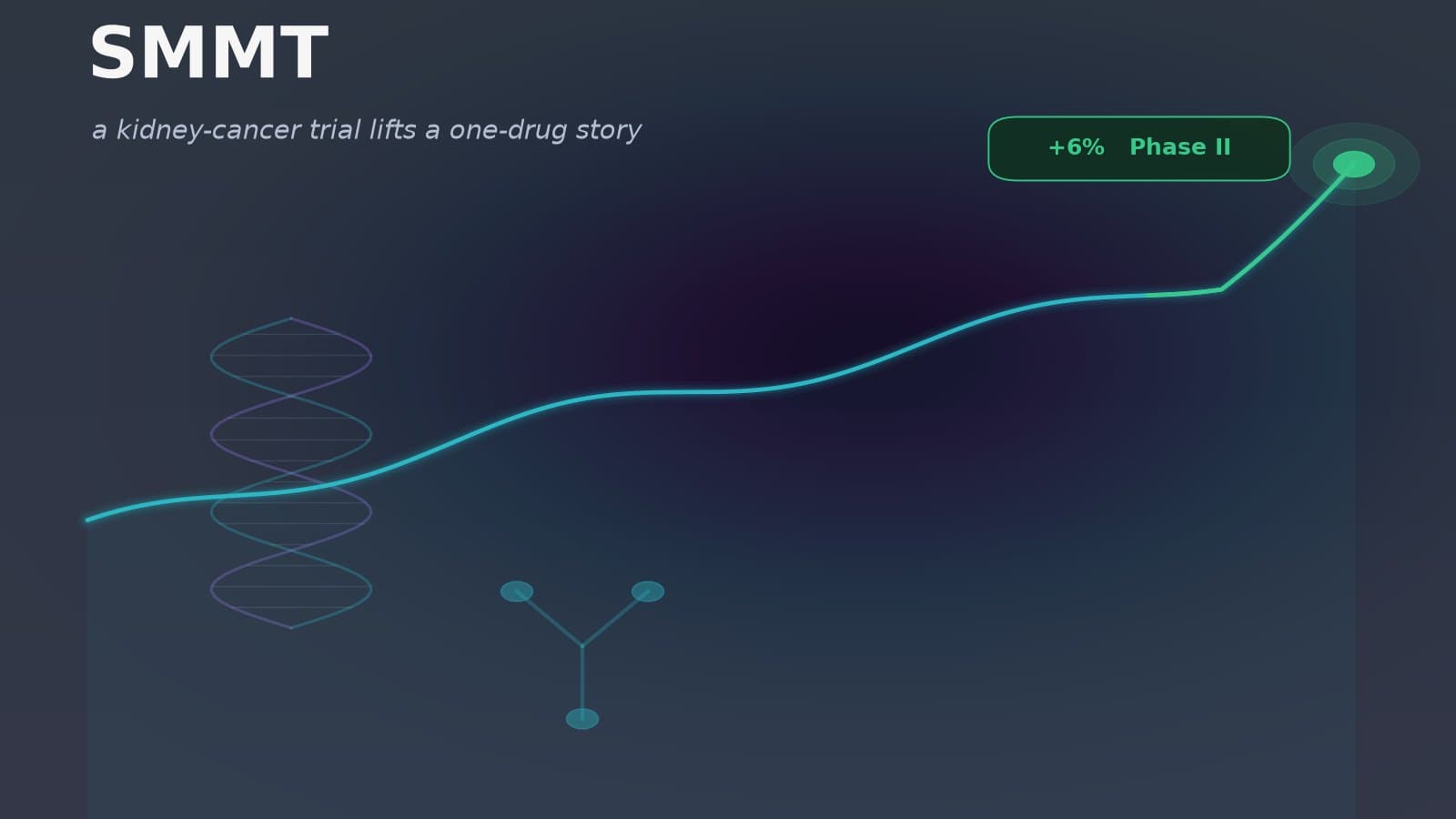
Summit Therapeutics rose about 6% to roughly $15.57 on October 19 after announcing it had opened a global Phase II trial of ivonescimab — its closely watched lead drug — in previously untreated advanced clear cell kidney cancer, with partner Akeso. The key nuance: this is the opening of a mid-stage study, not a data readout, so it is an incremental catalyst that expands the story rather than one that proves it. Summit is effectively a one-drug company: ivonescimab is a PD-1/VEGF bispecific antibody, licensed from China's Akeso, that outperformed Merck's Keytruda in a Chinese lung-cancer trial — nearly doubling progression-free survival and, in updated data, delivering a significant overall-survival benefit (30.8 vs 22.6 months) — though the global trial behind its U.S. filing has yet to formally confirm that survival benefit in Western patients. With no product revenue and a market value above $12 billion, essentially all of Summit's worth is the market's bet on that drug, so a new indication is a fresh call option on the thesis. Two bigger items frame it: AstraZeneca agreed in late September to invest about $2 billion in Summit equity (a ~12% stake), transforming the balance sheet and removing the financing overhang, and the FDA has a November 14, 2026 decision date on ivonescimab in EGFR-mutated lung cancer — a near-term, binary catalyst that matters far more than a trial start. Monday's move was partly company-specific and partly a tailwind: biotech broadly rallied, with the sector ETF up about 2.5%, but Summit outperformed. The risks are a binary valuation on one molecule, an unconfirmed Western survival benefit, and a stock down roughly 47% from its high. Analysts carry a Buy consensus and an average target near $30, inside a wide range from about $12 to the mid-$40s.
Why Summit Therapeutics stock jumped — ivonescimab moves into kidney cancer
On Monday, October 19, 2026, Summit Therapeutics (NASDAQ: SMMT) rose about 6%, closing near $15.57 after trading as high as $15.77 [1]. The catalyst was a pipeline announcement: Summit said it had opened a global Phase II study of ivonescimab, its closely watched lead drug, in previously untreated advanced clear cell kidney cancer (renal cell carcinoma) [2]. The move was partly the company's own news and partly a tailwind — biotech broadly rallied on the day — but Summit outperformed the group, which points to the trial news doing real work [5].
The study (identified as SMT112-216) is a randomized, open-label trial expected to enroll roughly 100 patients across the United States and China, run with Summit's partner Akeso; it tests several ivonescimab-based regimens — including combinations with cadonilimab and with ipilimumab, and ivonescimab alone — against a standard nivolumab-plus-ipilimumab comparator, with objective response rate as a primary measure [2]. Summit said it had opened trial sites on Monday; precisely, that is site activation, not proof that patients are already being dosed. The strategic point is expansion: ivonescimab has been developed primarily in lung cancer, and taking it into kidney cancer broadens the opportunity for a drug whose value rests on being usable across many tumor types. But it is worth being precise about what this is — the opening of a mid-stage trial, not a data readout — which makes it an incremental catalyst that expands the story rather than a result that proves it.
What ivonescimab is, and why the stock is so sensitive to it
Summit is effectively a one-drug story, and that drug is ivonescimab — a next-generation PD-1/VEGF bispecific antibody that Summit licensed from China's Akeso for most major markets outside Greater China [2]. It drew intense attention after a Chinese Phase III lung-cancer trial (HARMONi-2) showed it outperforming Merck's Keytruda — nearly doubling progression-free survival and, in updated data, delivering a statistically significant overall-survival benefit (median 30.8 versus 22.6 months) [2]. The more debated data come from the global HARMONi trial that underpins Summit's U.S. filing: there, ivonescimab-plus-chemotherapy improved progression-free survival, but the overall-survival benefit — while trending favorably on longer follow-up — has not been formally confirmed in the Western subgroup [2]. That split is the heart of the investment debate. With no product revenue and a market value above $12 billion, essentially all of Summit's worth is the market's estimate of ivonescimab's eventual success [3], so every pipeline datapoint moves the stock — and a new indication is a fresh call option on the thesis.
Two bigger items frame Monday's move. First, Summit is no longer a cash-constrained biotech: in late September 2026, AstraZeneca agreed to invest $2 billion in newly issued Summit equity (a roughly 12% stake) to accelerate ivonescimab, alongside a clinical collaboration pairing it with AstraZeneca's antibody-drug conjugates [3]. That strengthens the balance sheet and is a notable vote of confidence from a major pharma — though it is financial and strategic backing, not clinical or regulatory validation, and the equity itself added meaningfully to the share count. Second, and more consequential than any trial opening, Summit faces a near-term U.S. regulatory decision, with an FDA target date of November 14, 2026, on ivonescimab in previously treated EGFR-mutated lung cancer [2]. That binary event — a first potential U.S. approval — is the catalyst that actually matters most in the weeks ahead; Monday's kidney-cancer news widened the story, but the FDA verdict will move it.
The reasons for caution
The enthusiasm is understandable, but the risks are the ones that define a clinical-stage biotech. First, this was a trial opening, not data — it adds a shot on goal, not a result, and kidney-cancer immunotherapy is a crowded, competitive field. Second, the near-term swing factor is not this trial but the FDA decision targeted for November 14: a first U.S. approval for ivonescimab would be a major milestone, and a setback — or a label narrower than hoped — would sting, though even a disappointing outcome would not erase the value of the broader ivonescimab franchise, which already has a Chinese approval and multiple programs [2]. Third, the Western survival question is unresolved: ivonescimab's China data are strong on both progression-free and overall survival, but the global trial's overall-survival benefit has not been formally confirmed in Western patients, which is the crux of the bear case [2]. Fourth, the stock is beaten down and technically weak — down about 26% over the past year and roughly 47% below its 52-week high near $29 — so Monday's pop is a bounce within a downtrend, not a breakout [1]. Finally, while the AstraZeneca investment removed the financing overhang, it added roughly 12% to the share count, and the whole case remains binary — a $12 billion-plus valuation on essentially one molecule, where any key readout can reprice the stock sharply. Part of Monday's gain, too, was simply a strong day for biotechs generally [5].
Why it matters
The episode is a clean example of how a single-asset biotech trades: on optionality. Summit did not report results on Monday; it opened a trial, and the stock still rose about 6%, because for a company whose value is a bet on one drug, a new indication is a new way for that bet to pay off. The cross-section underscores the nuance — biotech was broadly higher, with the sector ETF up about 2.5%, so part of the move was a rising tide; but Summit's roughly 6% gain outpaced the group, which is the fingerprint of company-specific news on top of a supportive tape [5]. It is also a reminder of the asymmetry baked into these names: a beaten-down stock, down roughly half from its high, can add hundreds of millions in value on a trial start — and give it back just as fast on a data miss. For ivonescimab, the signal in Monday's tape is incremental: the franchise is widening, but the verdicts that will actually settle the valuation are the efficacy and survival readouts still to come.
The move, in one cross-section
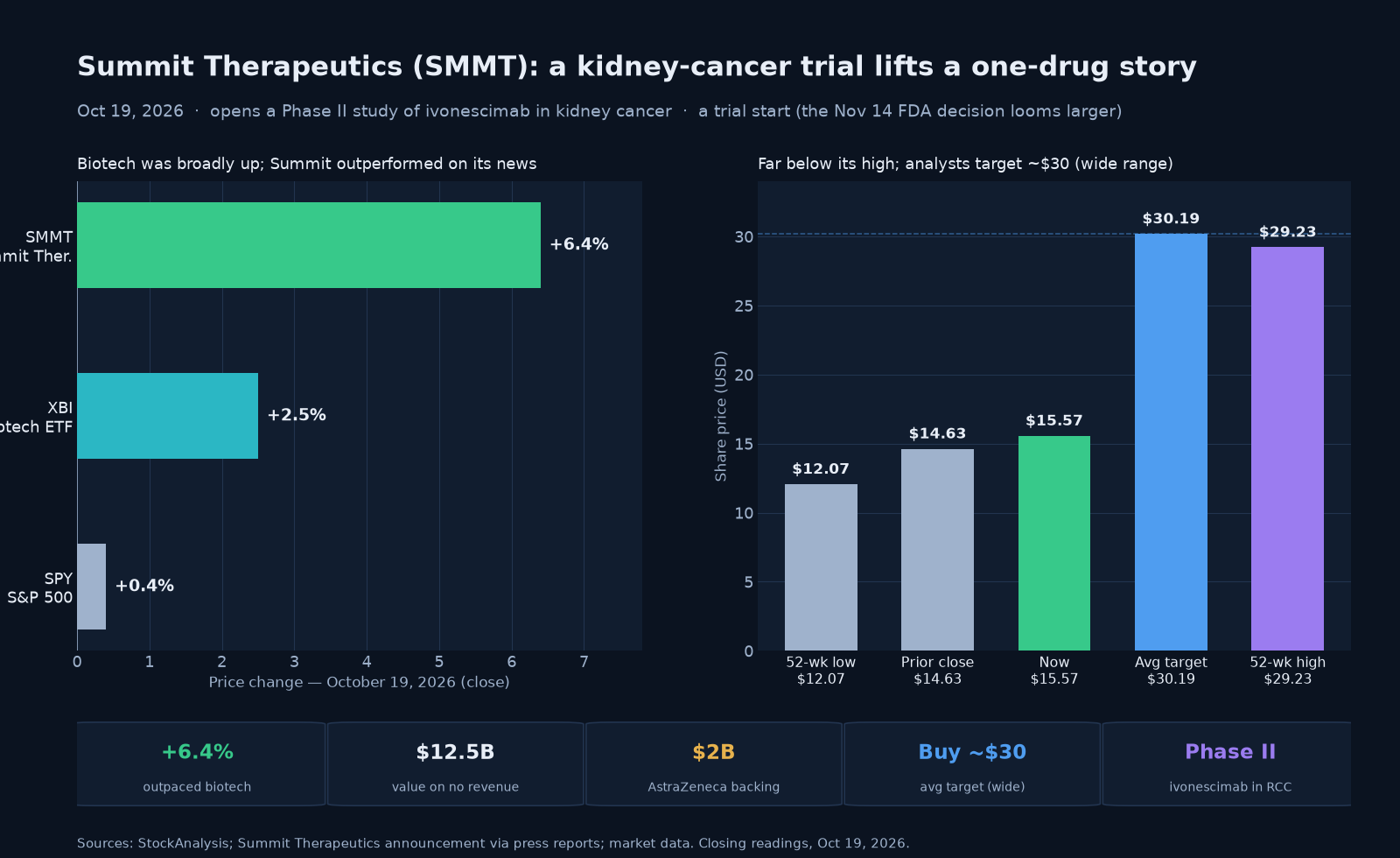
The same-session tape shows a company-specific move on a supportive biotech day [5]:
| Name (ticker) | Oct 19, 2026 | Read-through |
|---|---|---|
| SMMT — Summit Therapeutics | ≈+6.4% | The news name — up on opening a Phase II kidney-cancer trial for ivonescimab [1][2] |
| XBI — Biotechnology (ETF) | ≈+2.5% | Biotech was broadly higher; Summit outperformed the group [5] |
| SPY — S&P 500 (ETF) | ≈+0.4% | Broad market modestly higher — this was a biotech-led day [5] |
Summit up about 6% while the biotech ETF rose about 2.5% is the signature of company-specific news amplified by a supportive sector tape — not a pure single-stock event, and not purely the sector [5].
What the Street thinks
Wall Street is bullish on ivonescimab's potential, but the range of views is unusually wide — which is the whole point of a binary story stock. The consensus rating is a Buy, with an average 12-month target near $30, implying substantial upside from the current price, inside a remarkable spread that runs from about $12 to the mid-$40s [6]. The ratings are genuinely split beneath the Buy label — roughly nine or ten strong-buys against five to seven holds and a couple of sells — reflecting a real debate about whether ivonescimab's strong China data will carry through to a confirmed Western survival benefit and a successful U.S. launch, with the November 14 FDA decision the next test [6]. That dispersion is more informative than the average: it tells you the stock is priced to a distribution of outcomes, from a multi-indication blockbuster to a drug that disappoints, and that each regulatory or data event will move it sharply. A new kidney-cancer trial nudges the probability-weighting, but it does not narrow the range.
What to watch
- The November 14 FDA decision. The U.S. target date for ivonescimab in previously treated EGFR-mutated lung cancer — a first potential approval and the single biggest near-term catalyst, far more than a trial start [2].
- Ivonescimab survival data. Whether the overall-survival benefit, strong in China, is confirmed in Western patients — the question at the center of the debate [2].
- The renal-cell program. Enrollment and early signals from the new Phase II study, and from the separate Arcus Biosciences collaboration (announced in July) testing casdatifan with ivonescimab in kidney cancer, with data around mid-2027 [2].
- The AstraZeneca partnership. How the $2 billion investment and the antibody-drug-conjugate collaboration advance, now that financing is no longer the overhang it once was. Moves are tracked on the SMMT stock page [3].
Illustrative scenario sensitivity
Because the move is a pipeline-optionality event on a pre-revenue, single-asset biotech, the scenarios below are anchored to ivonescimab's regulatory and survival outcomes — above all the November 14 FDA decision — rather than earnings or a single valuation; this is an unusually binary, high-volatility name, and the dispersion is wide [6]. They are a descriptive, author-weighted exercise over roughly the coming six-to-twelve months as data and financing news arrive — not a forecast, target, recommendation, or trading advice — with subjective weights that sum to 100%.
| Scenario | Illustrative price | Weight | Key drivers |
|---|---|---|---|
| Approval and the franchise widen | ~$27 | 25% | A clean FDA approval on November 14, supportive survival data and the multi-indication story (lung plus new programs like RCC), backed by AstraZeneca, re-rate the stock toward analyst targets [6]. |
| Story stock, range-bound | ~$15.5 | 40% | Approval roughly as expected but no decisive Western survival confirmation; the stock stays volatile near current levels as the market waits for pivotal data [1]. |
| FDA or survival setback weighs | ~$10 | 35% | An FDA setback or narrow label on November 14, a Western-survival disappointment, or competitive pressure pulls the beaten-down stock toward the low end of its range [2]. |
Weighting those (0.25 × $27 + 0.40 × $15.5 + 0.35 × $10) gives an author-weighted reference value near $16 — an illustrative, probability-weighted scenario output mechanically derived from the weights above, and not a price target, fair-value estimate, or prediction — a touch above Monday's ~$15.57 close [1][6]. The near-identity reflects a balanced but extraordinarily wide-dispersion setup: a beaten-down, cash-burning biotech whose value is a leveraged bet on one drug, where a new indication adds optionality but the outcome hinges on data readouts far more than on any trial start. This is a scenario exercise and descriptive analysis of a news-driven move, not investment advice.
SMMT data snapshot — October 19, 2026
| Figure | Value | As-of / source |
|---|---|---|
| Quote | $15.57 (+~6.4%) — closed near the high of a $14.83–$15.77 day range | Mon, Oct 19, 2026 (close) — StockAnalysis [1] |
| Prior close / open | $14.63 prior close; opened $14.90 | Oct 19, 2026 [1] |
| 52-week trend | 52-week range $12.07–$29.23; down ~26% over 52 weeks and ~47% below the $29.23 high (beaten down); beta ≈−1.52 (idiosyncratic) | As of Oct 19 [1] |
| Market cap | ≈$12.45B (≈799.7M shares); enterprise value ≈$11.78B | Oct 19 — StockAnalysis [3] |
| Financials | Pre-revenue (no product revenue); net loss ≈$856M (EPS ≈−$1.12); free cash flow ≈−$460M (annual burn); no P/E | TTM — StockAnalysis [3] |
| Balance sheet | Transformed by a ~$2B AstraZeneca strategic equity investment (announced late Sept 2026, ~12% stake) — well-funded, financing no longer an overhang (the stale ~$690M cash figure predates it); the raise added ~12% to the share count | Sept–Oct 2026 [3] |
| Catalyst | Summit announced it opened trial sites for a global Phase II study (SMT112-216) of ivonescimab in previously untreated advanced clear cell kidney cancer (~100 patients, US + China, with Akeso; vs a nivolumab/ipilimumab comparator) — a pipeline expansion beyond lung cancer. A trial opening, not a data readout | Oct 19, 2026 — company announcement [2] |
| Near-term catalyst | FDA decision Nov 14, 2026 on ivonescimab in previously treated EGFR-mutated lung cancer — a first potential US approval, the big binary event | Nov 14, 2026 (target) [2] |
| Same-day cross-section | XBI (biotech ETF) +2.5%, SPY +0.4% — biotech broadly higher; SMMT outperformed the group | Oct 19 [5] |
| Analyst view | Consensus Buy, avg target ~$30.19 (low $12, high ~$43.58) — well above the price; ratings ~9–10 Strong Buy / ~5–7 Hold / ~2 Sell (a debate stock) | Oct 19, 2026 — StockAnalysis / analyst notes [6] |
Summit Therapeutics (SMMT) stock FAQ
Why did Summit Therapeutics (SMMT) stock jump on October 19, 2026?
Summit rose about 6% to roughly $15.57 after announcing it had opened a global Phase II trial of ivonescimab, its lead drug, in previously untreated advanced clear cell kidney cancer (renal cell carcinoma). The study, run with partner Akeso, is expected to enroll about 100 patients across the United States and China. The important nuance is that this is the opening of a mid-stage trial, not a data readout — so it is an incremental catalyst that expands ivonescimab's potential into a new cancer type rather than a result that proves the drug works there. The move was also helped by a broadly higher biotech sector that day, though Summit outperformed the group, which suggests the trial news did real work. For a company whose value rests almost entirely on one drug, a new indication is a fresh way for the thesis to pay off, which is why the stock reacted.
What is ivonescimab and why is Summit's stock so tied to it?
Ivonescimab is a next-generation PD-1/VEGF bispecific antibody — a single molecule that blocks two targets at once — that Summit Therapeutics licensed from China's Akeso for most major markets outside Greater China. It drew intense attention after the China-run HARMONi-2 trial showed it outperforming Merck's Keytruda in lung cancer, nearly doubling progression-free survival and, in updated data, delivering a statistically significant overall-survival benefit (median 30.8 versus 22.6 months). The more debated data come from the global HARMONi trial behind Summit's U.S. filing, where the overall-survival benefit has trended favorably but has not been formally confirmed in Western patients. Two recent developments raised the stakes: AstraZeneca agreed in late September 2026 to invest about $2 billion in Summit equity to accelerate ivonescimab, and the FDA has a November 14, 2026 decision date on ivonescimab in previously treated EGFR-mutated lung cancer — a first potential U.S. approval. Summit is effectively a one-drug company with no product revenue, so with a market value above $12 billion, essentially all of its worth is the market's estimate of ivonescimab's success — which is why the stock is so reactive to any news and so volatile.
Is the kidney-cancer trial a major catalyst for Summit?
It is a positive but incremental one, and it is important not to overstate it. Opening a Phase II trial expands ivonescimab into a new indication — advanced clear cell kidney cancer — and widens the drug's potential market, which matters for a one-drug company. But it is a trial start, not a data readout: it adds a shot on goal rather than a result, and kidney-cancer immunotherapy is a competitive field. The events that will actually settle Summit's valuation are efficacy and survival data from ivonescimab's programs, not the opening of new studies. So the roughly 6% move is best read as the market adding a new way for the thesis to win, not as validation that it will. Summit also has a separate collaboration with Arcus Biosciences testing another combination in kidney cancer, with initial data expected around mid-2027.
What are the risks for Summit Therapeutics stock?
The risks are the ones that define a clinical-stage biotech. First and most immediate, the FDA decision targeted for November 14, 2026 on ivonescimab in previously treated EGFR-mutated lung cancer is a major near-term swing factor just weeks away — a first U.S. approval would be an important milestone, while a setback or a narrow label would sting (though it would not erase the value of the broader ivonescimab franchise). Second, the Western survival question is unresolved: ivonescimab's China data are strong on both progression-free and overall survival, but the global trial's overall-survival benefit has not been formally confirmed in Western patients, which is the crux of the bear case. Third, the valuation is binary — a market value above $12 billion rests on essentially one molecule, so any key readout can reprice the stock sharply. Fourth, the stock is technically weak, down about 26% over the past year and roughly 47% below its 52-week high. Note that financing is no longer the overhang it was: AstraZeneca's roughly $2 billion investment leaves Summit well-funded, though that equity raise added about 12% to the share count. Finally, the kidney-cancer move was a trial opening rather than data, and part of the day's gain was simply a strong session for biotech generally.
What do analysts think about Summit Therapeutics stock?
Analysts are bullish on ivonescimab's potential but deeply split on the stock, which is exactly what you would expect for a binary, single-asset biotech. The consensus rating is a Buy, with an average 12-month price target near $30 — well above the recent price, implying substantial upside — but inside an unusually wide range that runs from about $12 to the mid-$40s. The ratings themselves are divided: roughly nine or ten strong-buy ratings against five to seven holds and a couple of sells. That dispersion is more telling than the average: it reflects a genuine debate about whether ivonescimab's strong China data will translate into a confirmed Western overall-survival benefit and a successful U.S. launch, with the November 14 FDA decision the next test. In other words, the stock is priced to a wide distribution of outcomes, and each major regulatory or data event is likely to move it sharply in one direction or the other.
What should investors watch next for Summit Therapeutics?
Four things. First and most important, the FDA decision due November 14, 2026 on ivonescimab in previously treated EGFR-mutated lung cancer — a first potential U.S. approval and the single biggest near-term catalyst, far more than any trial start. Second, ivonescimab's survival data — whether the overall-survival benefit, strong in China's HARMONi-2, is confirmed in Western patients, the question at the center of the debate. Third, the new renal-cell program: enrollment and early signals from the Phase II study, plus the separate Arcus Biosciences collaboration (announced in July 2026) testing casdatifan with ivonescimab in kidney cancer, with initial data around mid-2027. Fourth, the AstraZeneca partnership: how the roughly $2 billion investment and the antibody-drug-conjugate collaboration progress, now that financing is no longer the overhang it once was. Because Summit's value is a leveraged bet on one molecule, the stock is likely to stay highly sensitive to each of these — and far more to regulatory and data events than to trial openings.