Stock Analysis
DoorDash's $17 Billion Instacart Takeover Heads to a DOJ Antitrust Review
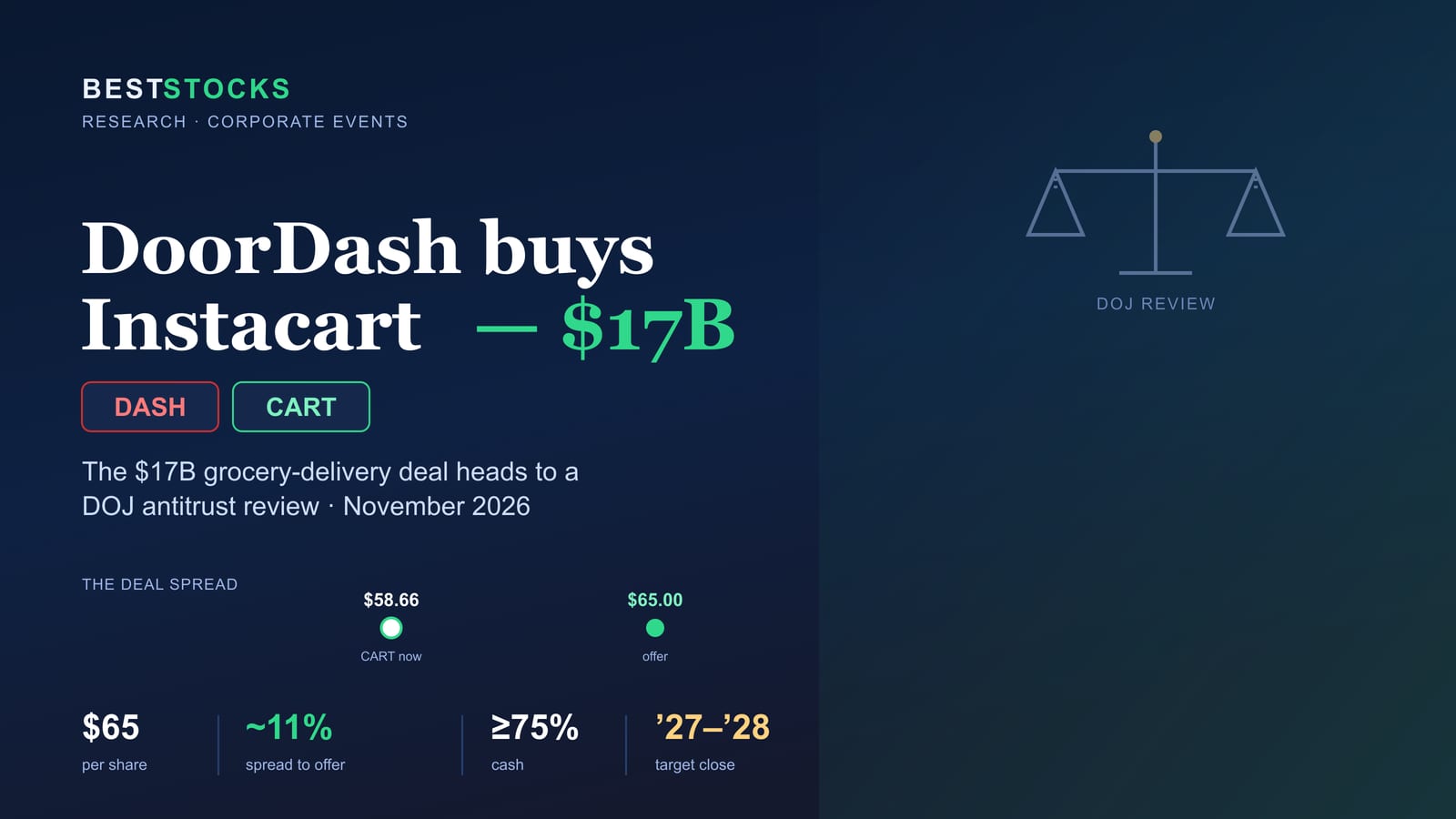
DoorDash's roughly $17 billion, $65-a-share acquisition of Instacart now heads to a U.S. Department of Justice antitrust review, Reuters and Bloomberg reported — the DOJ, not the FTC, taking the lead on a deal to combine the top restaurant-delivery and online-grocery platforms. A review is not a challenge, and both companies still target a late-2027/early-2028 close, but with CART near $59 versus the $65 offer, the ~11% spread tells the real story: time, regulatory risk, and a stock-heavy slice of the consideration that floats with a falling DoorDash.
Summary
DoorDash's roughly $17 billion acquisition of Instacart — the deal to combine the biggest U.S. restaurant-delivery platform with the leading online-grocery one — has drawn its antitrust referee: on November 16, 2026, Reuters reported, and Bloomberg confirmed, that the U.S. Department of Justice, not the Federal Trade Commission, will lead the review [2]. The single most important thing to understand is what that is not: a DOJ review is not a decision to sue or block the deal. It establishes which agency holds the pen on a merger that both companies still expect to close in late 2027 or the first half of 2028 [1][2]. The market's own verdict is written in the spread: Instacart (NASDAQ: CART) trades near $58.66, well below the $65.00-per-share headline offer, while DoorDash (NASDAQ: DASH) sits near $167, softer on the day — a gap that prices the long timeline and real, now-sharper regulatory risk rather than a done deal [3][4].
What changed
The acquisition itself is three weeks old — the merger agreement was signed October 28 and announced October 29, 2026, at $65.00 a share in a cash-and-stock deal worth about $17 billion of equity value [1]. What changed on November 16 is the regulatory venue. Food and retail mergers usually fall to the FTC, so the DOJ taking the lead is itself a signal that Washington intends to scrutinize the tie-up closely — combining the number-one restaurant-delivery app with the number-one online-grocery platform raises obvious questions about competition, consumer and merchant pricing, and concentration against rivals like Amazon and Walmart [2][5]. But those are potential theories of harm, not allegations the DOJ has made; as of this writing the department has opened a review, nothing more [2].
Why does CART trade at $58.66 when the offer is $65? Three reasons, and they are the heart of this story. First, time: a close targeted for late 2027 or early 2028 is 14 to 18 months away, so even a near-certain deal is discounted for the wait. Second, regulatory risk, which the DOJ's involvement just raised. Third — and most overlooked — the consideration is not a clean $65 of cash. Shareholders can elect $65 in cash, or 0.3372 DoorDash shares, or $48.75 in cash plus 0.0843 DoorDash shares, subject to proration and a 25% cap on the stock portion, and because the exchange ratios are fixed with no collar, that stock piece floats with DoorDash's price [1]. With DoorDash shares having fallen toward $167, 0.3372 of a share is worth about $56, so the blended value of the mostly-cash-but-partly-stock package has drifted to roughly $63 — which means part of CART's discount to $65 is simply arithmetic, not pure deal skepticism [1][4].
Why it matters
Beyond the two tickers, this is a test case for how aggressively the government will police consolidation in the on-demand economy. DoorDash and Instacart are not direct head-to-head rivals in the way two restaurant-delivery apps would be — one moves restaurant meals, the other groceries — which is the companies' core defense: they argue the combination expands competition against giants like Amazon and Walmart rather than reducing it, and that keeping both apps and adding combined membership benefits helps smaller merchants compete [5]. The DOJ's potential concern runs the other way: that merging the leaders of two adjacent delivery markets concentrates data, advertising and logistics power, and could disadvantage rival delivery providers and raise costs for merchants and consumers over time [2]. Which framing wins will shape not just this deal but the next wave of platform mergers.
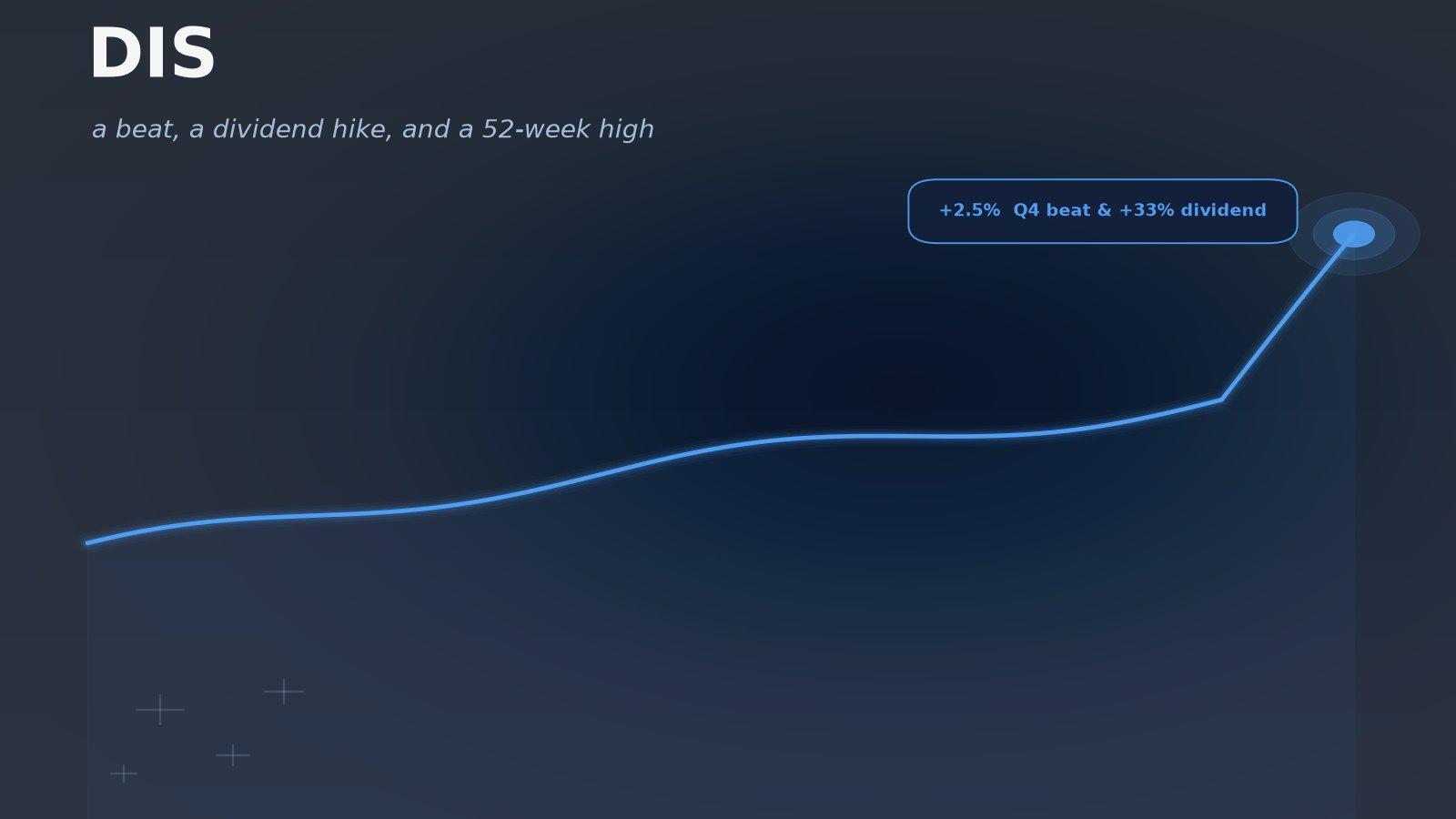
For DoorDash shareholders, the deal is one of several forces on a stock that has fallen from a 52-week high near $239 to about $167. Brokers have been trimming price targets — Rosenblatt to $210, MoffettNathanson to $239, Wells Fargo to $200 — citing both the pending Instacart acquisition and, notably, Amazon's new partnership with Uber Eats, which hands Prime members free restaurant delivery and directly threatens DoorDash's core business [4]. That matters for interpreting the tape: DoorDash slipping on the day the DOJ news broke is real, but the stock was already under pressure from competition, so attributing the whole move to the antitrust headline would overstate it. The cleaner read is that the Instacart deal adds regulatory and balance-sheet risk to a stock already navigating a tougher competitive landscape, even as the Street keeps a Strong Buy consensus and sees large upside if DoorDash executes [4].
What to watch
- The DOJ's next step. Whether the review stays a review, escalates to a "second request" for documents, or moves toward a challenge — the single biggest swing factor, with no fixed timetable [2].
- Instacart's shareholder vote. Holders of about 19% of shares have already signed support agreements; watch for the proxy and the meeting date through the companies' SEC filings [1].
- DoorDash's share price. Because up to a quarter of the consideration is DoorDash stock at a fixed ratio with no collar, a falling DASH lowers the blended value stock-electing holders receive [1].
- State and local antitrust interest. State attorneys general (such as California and New York) retain independent authority to scrutinize or challenge the tie-up [2].
- The competitive backdrop. How the Amazon–Uber Eats alliance affects DoorDash's core volumes, reported each quarter on its earnings calls [4].
Is the DoorDash–Instacart deal going to be blocked?
No decision has been made. As of November 17, 2026, the U.S. Department of Justice is taking the lead on reviewing DoorDash's roughly $17 billion acquisition of Instacart, but a review is not the same as a challenge — the DOJ has not sued to block the deal or announced that it will [2]. Both companies continue to expect the transaction to close in late 2027 or the first half of 2028, subject to shareholder and regulatory approvals [1]. The DOJ (rather than the FTC) leading the review signals closer scrutiny, but the outcome — clearance, clearance with conditions, or a challenge — remains open.
Why is Instacart (CART) stock trading below the $65 offer?
- Time value. The deal is not expected to close until late 2027 or early 2028, so the $65 is discounted for a 14-to-18-month wait [1].
- Regulatory risk. The DOJ-led antitrust review introduces a real chance of delay, conditions, or a challenge [2].
- The stock portion floats. Up to 25% of the consideration is DoorDash stock at a fixed exchange ratio with no collar; with DoorDash shares down near $167, that piece is worth less than $65, pulling the blended value to about $63 [1][4].
- Proration. Elections for cash or stock are prorated to hold the mix near 75% cash / 25% stock, so not every holder gets their first choice [1].
DoorDash–Instacart deal terms at a glance
| Term | Detail |
|---|---|
| Price / value | $65.00 per share, ~$17B equity value; signed Oct 28, announced Oct 29, 2026 [1] |
| Consideration | Cash-and-stock, ≥75% cash; elect $65 cash, or 0.3372 DASH shares, or $48.75 cash + 0.0843 DASH shares; proration + 25% stock cap; fixed ratios (no collar) [1] |
| Premium | ~26% over CART's Oct 22, 2026 close (~$51.60), the last day before deal reports [1] |
| Expected close | Late 2027 / 1H 2028, subject to shareholder & regulatory approvals [1] |
| Breakup fees | DoorDash owes a $1.25B reverse termination fee (regulatory failure); Instacart owes a $650M termination fee (e.g. a superior proposal) [1] |
| Financing | Up to $13B bridge from JPMorgan; no financing condition [1] |
| Support | Holders of ~19% of Instacart shares signed support agreements [1] |
| Regulator | DOJ leading the antitrust review (reported Nov 16, 2026) — a review, not a challenge [2] |
What could move DASH and CART next?
- DOJ escalation or clearance — a second request, a consent decree, or a challenge; the dominant catalyst, on no fixed timeline [2].
- Instacart's shareholder vote — proxy and meeting date [1].
- DoorDash's stock and quarterly results — which set the blended deal value and reflect the Amazon–Uber Eats competitive hit [4].
- A competing bid for Instacart — unlikely given the strategic fit, but the $650M termination fee frames the cost of a jilt [1].
- State attorneys general — independent reviews in states such as California and New York [2].
What is the fair value of Instacart (CART) after the DOJ news?
Because CART is now an arbitrage situation, its value is driven by the probability and timing of the deal closing rather than by a standalone multiple. The scenarios below anchor to the $65 headline offer, the ~$63 blended value (given DoorDash's current price), the ~$1.25 billion reverse termination fee as downside cushion, and Instacart's standalone fundamentals (trailing revenue of about $4.15 billion, ~14% growth), against the ~$58.66 intraday price on November 17. Probabilities are illustrative author estimates and sum to 100%; this is descriptive analysis, not a forecast, target, recommendation, or a prediction about the DOJ's decision.
| Scenario | Illustrative price | Probability | Key drivers |
|---|---|---|---|
| Deal clears (on or near terms) | ~$64 | 57% | DOJ clears, perhaps with minor conditions; CART converges toward the blended consideration as the close nears [1]. |
| Prolonged review / repricing | ~$58 | 25% | A second request, remedies, or timeline slippage keep CART range-bound with elevated volatility [2]. |
| Deal blocked or abandoned | ~$48 | 18% | DOJ challenge or collapse; CART falls toward standalone value, cushioned by the $1.25B reverse termination fee [1]. |
Weighting those (0.57 × $64 + 0.25 × $58 + 0.18 × $48) gives a probability-weighted fair value near $60 — about 2% above the ~$58.66 price [3]. The near-match is the honest signal: the market is pricing a more-likely-than-not close with a meaningful risk tail, so the risk-reward from here is roughly balanced and distinctly binary — it hinges on whether the DOJ moves from reviewing to challenging, not on Instacart's quarter-to-quarter numbers. This is a scenario exercise and descriptive analysis, not investment advice.
DoorDash–Instacart deal FAQ
Is the DoorDash acquisition of Instacart confirmed?
Yes, as a signed agreement — but not yet completed. DoorDash and Instacart (Maplebear Inc.) signed a definitive merger agreement on October 28, 2026 and announced it on October 29, under which DoorDash will acquire Instacart for $65.00 per share, about $17 billion of equity value, in a cash-and-stock deal with at least 75% cash. The transaction still requires Instacart shareholder approval and regulatory clearance, and both companies expect it to close in late 2027 or the first half of 2028. So the deal is agreed and both boards are behind it, but it is pending — which is why Instacart's stock trades below the $65 offer rather than at it.
What does the DOJ review mean for the deal?
On November 16, 2026, Reuters reported and Bloomberg confirmed that the U.S. Department of Justice, rather than the Federal Trade Commission, will lead the antitrust review of the acquisition. That is significant mainly as a signal: food and retail mergers usually go to the FTC, so the DOJ asserting jurisdiction suggests closer scrutiny. But a review is not a lawsuit — the DOJ has not decided to challenge or block the deal, and opening a review is a routine step for a transaction this size. The possible outcomes range from clearance, to clearance with conditions (such as divestitures), to a challenge. Until the DOJ signals its direction, the review simply adds uncertainty, which is part of why Instacart trades at a discount to the offer price.
Why is Instacart (CART) stock below the $65 offer price?
Three reasons. First, time: the deal is not expected to close until late 2027 or early 2028, so a future $65 is worth less today. Second, regulatory risk: the DOJ-led review introduces a real chance of delay, conditions, or a challenge, and the market discounts for that. Third, the consideration is not a clean $65 of cash — up to a quarter of it can be DoorDash stock at a fixed exchange ratio with no collar, so as DoorDash shares have fallen toward $167, that stock portion is worth less than $65, pulling the blended value of the package to roughly $63. Together those factors leave Instacart near $58.66, about 11% below the headline offer and around 7% below the blended value. The size of that spread is effectively the market's price for bearing the deal's timing and antitrust risk.
What happens to Instacart stock if the deal is blocked?
If the DOJ challenges the deal and it is ultimately blocked, or if it collapses for another reason, Instacart would likely fall back toward its standalone value — probably into the high-$40s to low-$50s, below both the current price and the pre-report level, since a failed deal removes the takeover premium and can weigh on sentiment. One cushion exists: DoorDash owes Instacart a $1.25 billion reverse termination fee in specified regulatory-failure circumstances, which on roughly 237 million shares is worth about $5 per share and would partly offset the drop. On the other side, if the deal clears, Instacart should converge toward the blended consideration (around the mid-$60s). That binary — a meaningful drop on a block versus a move toward the mid-$60s on a clear — is exactly what the current spread reflects, which is why the stock is best understood as a merger-arbitrage position rather than a bet on Instacart's fundamentals.
Why has DoorDash (DASH) stock been falling?
DoorDash has slid from a 52-week high near $239 to about $167 for more than one reason, so it would be a mistake to blame the DOJ headline alone. The Instacart acquisition is part of it — a large, mostly-cash deal adds balance-sheet and regulatory risk — but an arguably bigger factor is competition: Amazon recently launched a partnership with Uber Eats that gives Prime members free restaurant delivery, directly threatening DoorDash's core marketplace. Several brokers cut their price targets (for example, Rosenblatt to $210, MoffettNathanson to $239, Wells Fargo to $200) citing both the pending deal and that Amazon–Uber Eats alliance. DoorDash did dip on the day the DOJ news broke, but the stock was already under pressure, so the antitrust report intensified an existing trend rather than causing it outright. Notably, the analyst consensus remains bullish (Strong Buy) with substantial implied upside if DoorDash executes.
Who would run the combined company, and what is the strategic rationale?
DoorDash, led by CEO Tony Xu, would own Instacart, whose CEO is Chris Rogers, after the deal closes — but the companies have said post-closing organizational roles and reporting lines are not yet determined, so it would be premature to say who will run the Instacart business. The strategic rationale is to combine DoorDash's logistics network and large consumer base with Instacart's grocery technology, deep retailer relationships, and fast-growing advertising business. DoorDash plans to keep both the DoorDash and Instacart brands and apps, offer combined membership benefits, and help retailers expand online, and it has pointed to an estimated $100 million in annual membership-fee savings for customers. The companies frame the tie-up as expanding competition against larger players like Amazon and Walmart rather than reducing it — the opposite of the potential concern antitrust reviewers may examine.