Stock Analysis
Johnson & Johnson (JNJ) Falls ~6% Despite a Q3 Beat-and-Raise
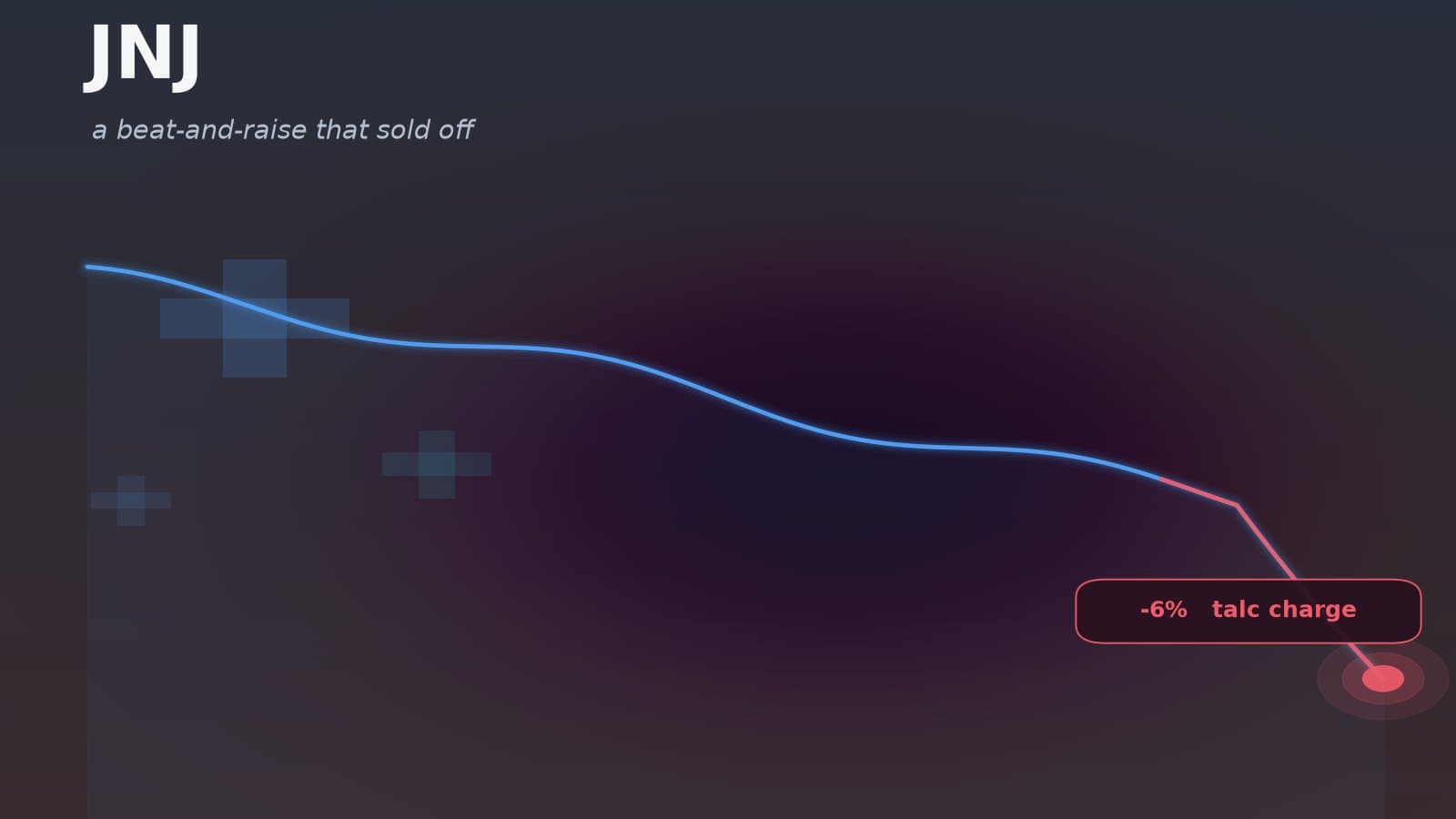
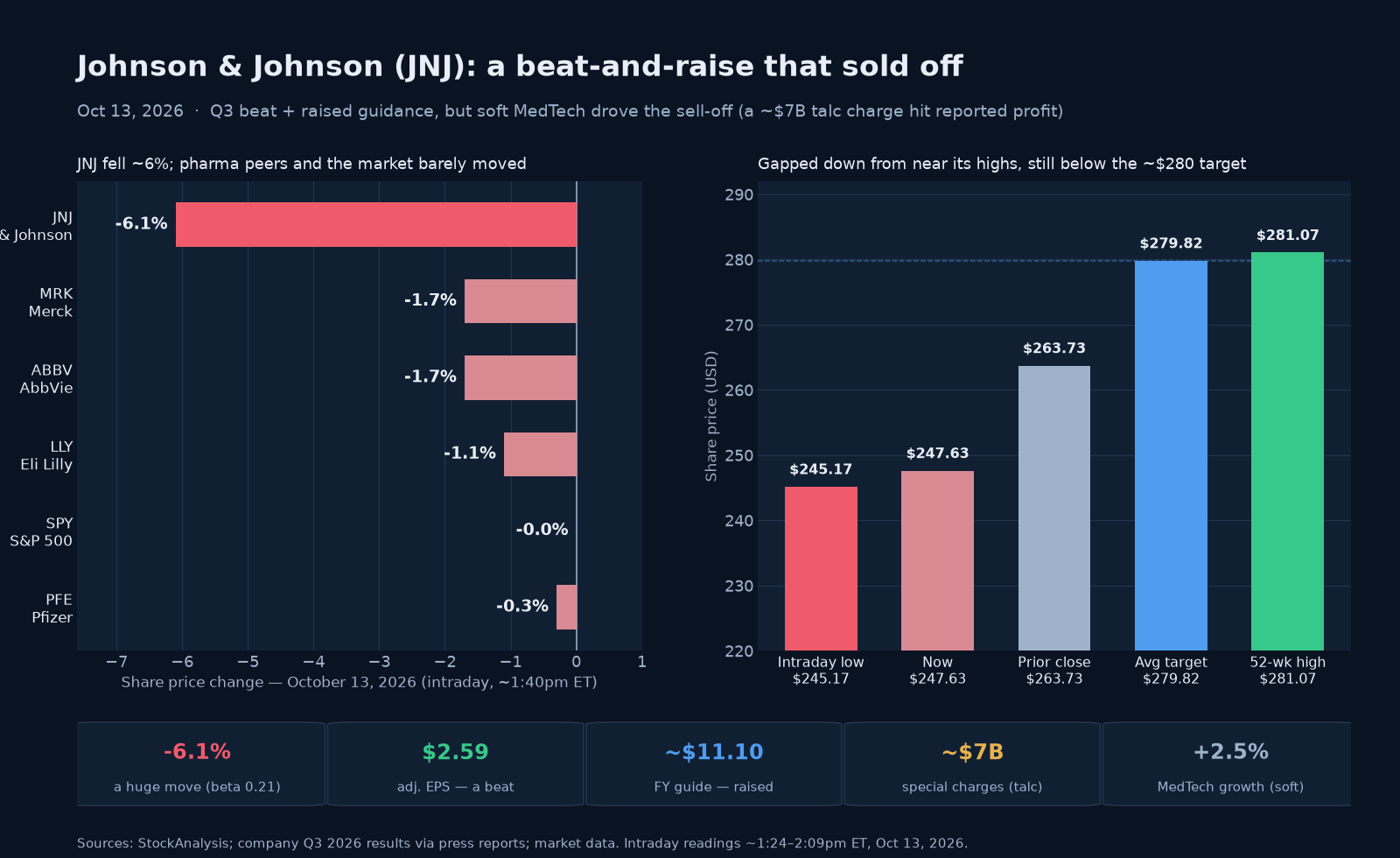
Johnson & Johnson fell about 6% to roughly $247.63 on October 13 after third-quarter results — an unusually large move for a defensive Dow stalwart with a beta near 0.21. The strange part: at the headline it was a beat-and-raise. Adjusted earnings of $2.59 topped estimates and the company raised full-year guidance, lifting adjusted EPS to about $11.10 at the midpoint and putting sales on track to cross $100 billion for the first time. The stock fell anyway, and the main reason was the device business: MedTech sales of about $8.6 billion grew just 2.5% and missed Wall Street's estimate for a second straight quarter, against a strong 7.9% for the Innovative Medicine drug division. On top of that, the guidance raise was modest, the adjusted 'beat' was still down about 7.5% from a year earlier, and the stock had run up about 30% over the past year, leaving it priced for good news. A separate, largely accounting story grabbed headlines: reported GAAP net income collapsed to about $210 million (EPS of $0.09) on roughly $7.6 billion of special charges, about $5.5 billion of it a talc-litigation provision — but that settlement had been announced back in July, so the quarter merely booked the charge rather than breaking news. Pharma peers and the market barely moved, confirming a company-specific drop. The trailing P/E near 30 looks alarming but is distorted by the charges; on adjusted earnings the stock trades closer to 22 times forward. Analysts keep a Buy consensus with an average target near $280, above the price.
Why Johnson & Johnson stock fell — a beat-and-raise that sold off
On Tuesday, October 13, 2026, Johnson & Johnson (NYSE: JNJ) fell about 6%, trading near $247.63 intraday after opening lower and sliding to a $245.17 low [1]. That is an unusually large move for J&J — a defensive Dow stalwart with a beta near 0.21, a stock that barely moves on a typical day — and it happened on a report that, at the headline level, looked good. The company beat Wall Street's adjusted-earnings estimates and nudged up its full-year guidance [2]. The market sold it anyway. Understanding why is the whole story: the beat was narrow and the quality of the quarter was the problem — a soft MedTech division, a modest guidance bump, and a stock priced for good news mattered more than the headline, while a large one-time litigation charge separately gutted the reported bottom line.
The surface numbers looked fine. Adjusted earnings came in at $2.59 a share, a few cents ahead of the roughly $2.53–$2.54 analysts expected — though exactly how big the "beat" was depends on whose consensus you use — on revenue of about $25.4 billion, up roughly 6% and broadly in line with estimates [2]. And J&J raised its 2026 outlook, lifting adjusted earnings guidance to about $11.10 at the midpoint and sales to roughly $101 billion, which would take the company past $100 billion in annual sales for the first time [2]. On those figures alone, a 6% drop looks strange.
What actually drove the sell-off — soft MedTech and a high bar
The clearest reason sits in the device business. MedTech sales of about $8.6 billion grew just 2.5% and missed Wall Street's estimate (around $8.7 billion) for the second quarter in a row, with international device sales essentially flat (up about 0.1%), weak cardiovascular and surgery performance outside the U.S., and continued physician selectivity in the Abiomed heart-recovery business [2]. That stood in stark contrast to the drug division, Innovative Medicine, which grew about 7.9% to roughly $16.8 billion. On top of the MedTech miss, the guidance raise was modest — a few cents on adjusted EPS — the adjusted "beat" was still down about 7.5% from a year earlier, and the stock had climbed roughly 30% over the past year into the print, leaving it priced for good news rather than merely adequate news [1].
The headline-grabbing number — a near-wipeout of reported profit — is a separate, largely accounting story. On a GAAP basis, net earnings fell to about $210 million (diluted EPS of roughly $0.09), down from about $5.15 billion a year earlier, on roughly $7.6 billion of pre-tax special charges [2]. The dominant piece — about $5.5 billion, or roughly 72% — was a litigation charge tied to J&J's proposed talc settlement, which the company had actually announced back in July 2026; the rest was intangible-asset amortization, a charge for the planned orthopaedics separation, in-process R&D impairments and restructuring [2]. Those items are excluded from adjusted earnings, so they do not change the underlying earnings power J&J guides to — but the collapse in reported profit is a vivid reminder that the long-feared talc liability is being quantified and paid. Crucially, the talc charge was not fresh news on the day; the quarter simply booked it. What was new — and what the market appeared to react to — was the soft MedTech print [2].
The valuation wrinkle
One number that will look alarming is J&J's trailing price-to-earnings ratio, around 30 times — high for a mature healthcare company. But that figure is distorted: the special charges have depressed trailing GAAP earnings, mechanically inflating the multiple. On the adjusted earnings the company actually guides to — about $11.10 a share this year — the stock trades closer to 22 times forward earnings [3]. That is still a premium to J&J's historical mid-teens multiple, a product of the stock's strong run and optimism about its drug pipeline. So the valuation story cuts both ways: the scary trailing number is an artifact of the charge, but even the clean forward number leaves little margin for a soft quarter — which is part of why the reaction was so sharp.
Why it matters
The episode is a textbook case of expectations beating results. J&J did essentially what it was supposed to — beat and raise — and still fell hard, because the move is set by the gap between what happened and what was already priced in, not by the headline alone. It is also a clean illustration of the difference between adjusted and reported earnings: the same quarter can show a solid $2.59 adjusted profit and a near-zero $0.09 reported one, and investors have to decide which story matters. The cross-section confirms the move was J&J's own, not the sector's: pharma peers barely budged and the market was flat, so this was company-specific, driven by the earnings print — a soft MedTech division and a modest raise — with the big talc charge a separate accounting event [5]. For a stock that is usually a port in a storm, a 6% drop is a reminder that even defensive compounders can be repriced quickly when a high bar meets a disappointing division.
The move, in one cross-section
The same-session tape shows an idiosyncratic, company-specific drop [5]:
| Name (ticker) | Oct 13, 2026 (intraday) | Read-through |
|---|---|---|
| JNJ — Johnson & Johnson | ≈−6.1% | The earnings name — down on soft MedTech, a modest raise, and a high bar (with a large talc charge separately hitting reported profit) [1][2] |
| PFE — Pfizer | ≈−0.3% | Pharma peer — roughly flat [5] |
| MRK — Merck | ≈−1.7% | Pharma peer — modestly lower, no company catalyst [5] |
| ABBV / LLY — AbbVie / Eli Lilly | ≈−1.7% / −1.1% | Pharma peers — modestly lower with the group [5] |
| SPY — S&P 500 (ETF) | ≈flat | Broad market — little changed; JNJ's drop was its own [5] |
One stock down 6% while its peers and the market are flat-to-slightly-lower is the signature of a company-specific catalyst — here, a complicated earnings print — rather than a sector move [5].
What the Street thinks
Wall Street's longer-term view did not change much on the day. The consensus rating is a Buy, with an average 12-month target near $280 — comfortably above where the stock trades after the drop, implying roughly 13% of upside [6]. The ratings are two-sided beneath that label: a cluster of strong-buys against a meaningful block of holds, reflecting a long-running debate about valuation and the litigation overhang rather than doubts about the franchise [6]. If anything, Tuesday's sell-off widened the gap to those targets — the kind of move that turns a fully priced defensive name back into a debate about whether the pullback is an opportunity or a warning. The answer hinges on the two things the quarter put in focus: how durable the talc resolution proves, and whether MedTech reaccelerates.
What to watch
- The talc resolution. Whether the proposed settlement becomes final and removes the overhang, or drags on — the single biggest swing factor beyond the quarter [2].
- MedTech growth. Whether the device business reaccelerates from its soft ~2.5% operational pace, or stays the drag on an otherwise strong top line [2].
- Margins and the deal drag. Whether the drug unit's margin — pressured this quarter by Firefly- and Sail-related R&D costs and mix, even as MedTech's own margin improved — normalizes, against a premium forward multiple [3].
- The $100 billion milestone. Whether crossing $100 billion in annual sales, led by Innovative Medicine, re-anchors the story on growth. Moves are tracked on the JNJ stock page [1].
Illustrative scenario sensitivity
Because the move is an earnings reaction — a soft MedTech division and a modest raise, with a separate litigation charge — rather than a change in long-term earnings power, the scenarios below are anchored to the raised guidance against the MedTech recovery, the talc overhang, and a premium multiple rather than a single valuation [6]. They are a descriptive, author-weighted exercise over roughly the coming six-to-twelve months as the talc resolution and MedTech trend play out — not a forecast, target, recommendation, or trading advice — with subjective weights that sum to 100%.
| Scenario | Illustrative price | Weight | Key drivers |
|---|---|---|---|
| Beat-and-raise wins out | ~$278 | 30% | The market refocuses on raised guidance, the $100B milestone and strong Innovative Medicine, and the stock re-rates toward the ~$280 average target [6]. |
| Dust settles near here | ~$250 | 40% | The talc charge and softer MedTech keep a lid on the stock near current levels while investors wait for cleaner quarters [3]. |
| Overhang and multiple weigh | ~$222 | 30% | Talc-resolution uncertainty, continued MedTech softness and compression of a premium multiple pull the stock lower, back toward the middle of its 52-week range [1]. |
Weighting those (0.30 × $278 + 0.40 × $250 + 0.30 × $222) gives an author-weighted reference value near $250 — an illustrative, probability-weighted scenario output mechanically derived from the weights above, and not a price target, fair-value estimate, or prediction — a touch above Tuesday's ~$247.63 intraday price [1][6]. The near-identity reflects a balanced setup: a high-quality franchise that beat and raised, offset by a vivid litigation charge, a soft MedTech line and a premium valuation, with the next move hinging on the talc resolution rather than this quarter's numbers. This is a scenario exercise and descriptive analysis of a news-driven move, not investment advice.
JNJ data snapshot — October 13, 2026
| Figure | Value | As-of / source |
|---|---|---|
| Intraday quote | ~$247.63 (−~6.1%) — an intraday reading (the session was open); fell to a $245.17 low | Tue, Oct 13, 2026, ~1:42pm ET — StockAnalysis [1] |
| Prior close / open / range | $263.73 prior close; gapped down to open $254.56; day range $245.17–$256.18 | Oct 13, 2026 [1] |
| 52-week trend | 52-week range $184.66–$281.07; up ~30% over 52 weeks (near highs before the print); beta ≈0.21 (very low — a 6% move is large) | As of Oct 13 [1] |
| Market cap | ≈$596.75B (≈2.41B shares) | Oct 13 — StockAnalysis [3] |
| Valuation | Trailing P/E ≈30.6× (distorted upward by the charges); forward P/E ≈22–23× on ~$11.10 adjusted EPS; price-to-sales ≈6.4×; dividend yield ≈2.2% | Oct 13 — StockAnalysis [3] |
| Q3 2026 results | Adjusted EPS $2.59 (beat ~$2.53, but −7.5% YoY from $2.80); revenue ~$25.4B (+5.9%); reported GAAP EPS $0.09 (net earnings ~$210M, from ~$5.15B) on ~$7.6B of pre-tax special charges (~$5.5B talc, ~72%); Innovative Medicine +7.9% op. ($16.8B), MedTech +2.5% op. ($8.6B, missed ~$8.7B est.) | Oct 13 — company results [2] |
| Catalyst | Q3 earnings: a beat-and-raise that sold off. Adjusted EPS beat (provider-dependent) and FY2026 guidance was nudged up (adj EPS ~$11.10 mid; sales ~$101B, >$100B first time), but MedTech missed estimates for a second straight quarter (the sell-off driver), while ~$7.6B of special charges — led by a ~$5.5B talc provision for a settlement announced back in July 2026 — gutted reported profit | Oct 13, 2026 — company results via press reports [2] |
| Same-day cross-section | PFE −0.3%, MRK −1.7%, ABBV −1.7%, LLY −1.1% (pharma peers); SPY ≈flat — JNJ's drop was company-specific | Oct 13 intraday [5] |
| Analyst view | Consensus Buy, avg target ~$279.82 (low $190, high $320) — above the price (~+13%); ratings ~10 Strong Buy / 8 Hold / 1 Sell | Oct 13, 2026 — StockAnalysis / analyst notes [6] |
Johnson & Johnson (JNJ) stock FAQ
Why did Johnson & Johnson (JNJ) stock fall on October 13, 2026?
Johnson & Johnson fell about 6% to roughly $247.63 after third-quarter results that looked fine at the headline but disappointed under the surface. It fell for three reasons, and the order matters. First, its MedTech device business was soft — sales grew just 2.5% to about $8.6 billion and missed Wall Street's estimate for a second straight quarter — which is what the market actually reacted to. Second, the guidance raise was modest and the adjusted 'beat' ($2.59 a share versus about $2.53 expected) was still down about 7.5% from a year earlier, against a stock up roughly 30% over the past year and priced for good news. Third, on a reported (GAAP) basis net income collapsed to about $210 million (EPS of $0.09) on roughly $7.6 billion of pre-tax special charges — mostly a talc-litigation provision — but that was largely an accounting event tied to a settlement J&J had announced back in July, not fresh news. A 6% move is especially large for J&J, a defensive stock with a very low beta near 0.21.
If J&J beat estimates and raised guidance, why did the stock drop?
Because stock moves are set by the gap between results and expectations, not by the headline alone — and J&J's bar was high. The most important disappointment was MedTech: device sales grew just 2.5% and missed estimates for a second consecutive quarter, with international sales essentially flat. The guidance raise was also modest, and even the adjusted 'beat' was down about 7.5% from a year earlier. With the stock up about 30% over the past year and trading at a premium forward multiple, that combination was enough to trigger a sharp pullback. The scary-looking GAAP number — net income of about $210 million on roughly $7.6 billion of special charges, mostly a talc-litigation provision — grabbed headlines, but those charges are excluded from adjusted earnings and the talc settlement had been announced back in July, so it was more an accounting event than the day's news. It is a classic case of expectations beating results.
What is the talc charge in J&J's earnings?
Johnson & Johnson recognized a large charge tied to the proposed resolution of the long-running talc litigation — lawsuits alleging its talc-based products were linked to cancer. The talc-related (litigation) item was about $5.5 billion, roughly 72% of some $7.6 billion in total pre-tax special items for the quarter (the rest was intangible-asset amortization, a charge for the planned orthopaedics separation, in-process R&D impairments and restructuring). Those items reduced reported (GAAP) net income to about $210 million, or $0.09 a share, down from about $5.15 billion a year earlier. Two things are worth keeping straight. First, the charges are excluded from adjusted earnings, so J&J's underlying earnings power — reflected in its raised guidance of about $11.10 adjusted EPS for the year — is unchanged. Second, the talc settlement itself was not new on earnings day: J&J had announced the proposed roughly $5.5 billion resolution back in July 2026 (conditional on broad claimant participation); the quarter simply booked the charge. So while it dominates the reported numbers, it was not the reason the stock fell that day — the soft MedTech print was.
Is J&J's P/E ratio really 30, and is the stock expensive?
The trailing price-to-earnings ratio near 30 is real but misleading, because it is distorted by the special charges. Those charges depressed trailing GAAP earnings, which mechanically inflates the trailing multiple. A cleaner gauge is the forward multiple on the adjusted earnings J&J actually guides to — about $11.10 a share this year — which puts the stock closer to 22 times forward earnings. That is still a premium to J&J's historical mid-teens multiple, reflecting the stock's strong run and optimism about its drug pipeline. So the stock is not as expensive as the trailing 30x suggests, but it is not cheap either — and a premium valuation is part of why the market reacted so sharply to a complicated quarter. Valuation here cuts both ways.
How did J&J's results compare with pharma peers that day?
The move was specific to J&J, not a sector event. On the same day, pharma peers barely moved: Pfizer was down about 0.3%, Merck about 1.7%, AbbVie about 1.7% and Eli Lilly about 1.1%, while the S&P 500 was roughly flat. J&J's roughly 6% drop stood out sharply against that backdrop, which is the classic signature of a company-specific catalyst — in this case its own earnings report and the talc charge — rather than a broad move in healthcare or the market. That isolation matters for interpretation: it tells you the sell-off was about J&J's quarter and the litigation charge, not about a change in sentiment toward drugmakers or defensive stocks generally.
What should investors watch next for Johnson & Johnson?
Four things. First, the talc resolution: whether the proposed settlement becomes final and lifts the litigation overhang, or drags on — the single biggest swing factor beyond the quarter. Second, MedTech: whether the device business reaccelerates from its soft roughly 2.5% operational growth or remains a drag on an otherwise strong top line. Third, margins: whether the margin pressure investors flagged is transitory or a developing trend, which matters more given a premium forward multiple. Fourth, the growth story: whether crossing $100 billion in annual sales for the first time, led by the Innovative Medicine drug business, re-anchors the narrative on growth rather than litigation. Analysts still carry a Buy consensus with an average target near $280, above the current price, so the debate is whether the pullback is an opportunity or a warning.