Stock Analysis
Alcoa (AA) Jumps ~7% as a Strong Q3 Meets a Tight Aluminum Market
Alcoa rose about 7% to roughly $43.20 on October 16, in the first full session after reporting third-quarter results after the close on October 15. Two forces drove it. First, a genuine earnings beat: adjusted earnings of about $1.82 a share topped the roughly $1.54 expected, with net income of $483 million and free cash flow of $472 million, powered by record production, the completed Alumar smelter restart, and higher alumina prices that offset lower aluminum prices and higher carbon costs — though revenue of about $3.7 billion slightly missed and adjusted EBITDA fell sequentially. Second, and just as important, a broad bid for aluminum stocks on a tightening-supply narrative: peers Century Aluminum (+4.5%) and Kaiser Aluminum (+2.4%) and the materials sector (+1.5%) all rose while the market was flat, so Alcoa led a group move rather than rallying alone — a point underscored by Barclays' Overweight initiation two days earlier citing constrained supply through 2026. Alcoa is a cheap, high-beta cyclical, trading around 7 times earnings and still about 49% below its intra-year high, with earnings that swing on volatile metal prices and a tariff overhang. Analysts carry a Buy consensus and an average target near $60, so the debate is less about execution — which was strong — than about where aluminum prices and trade policy go next.
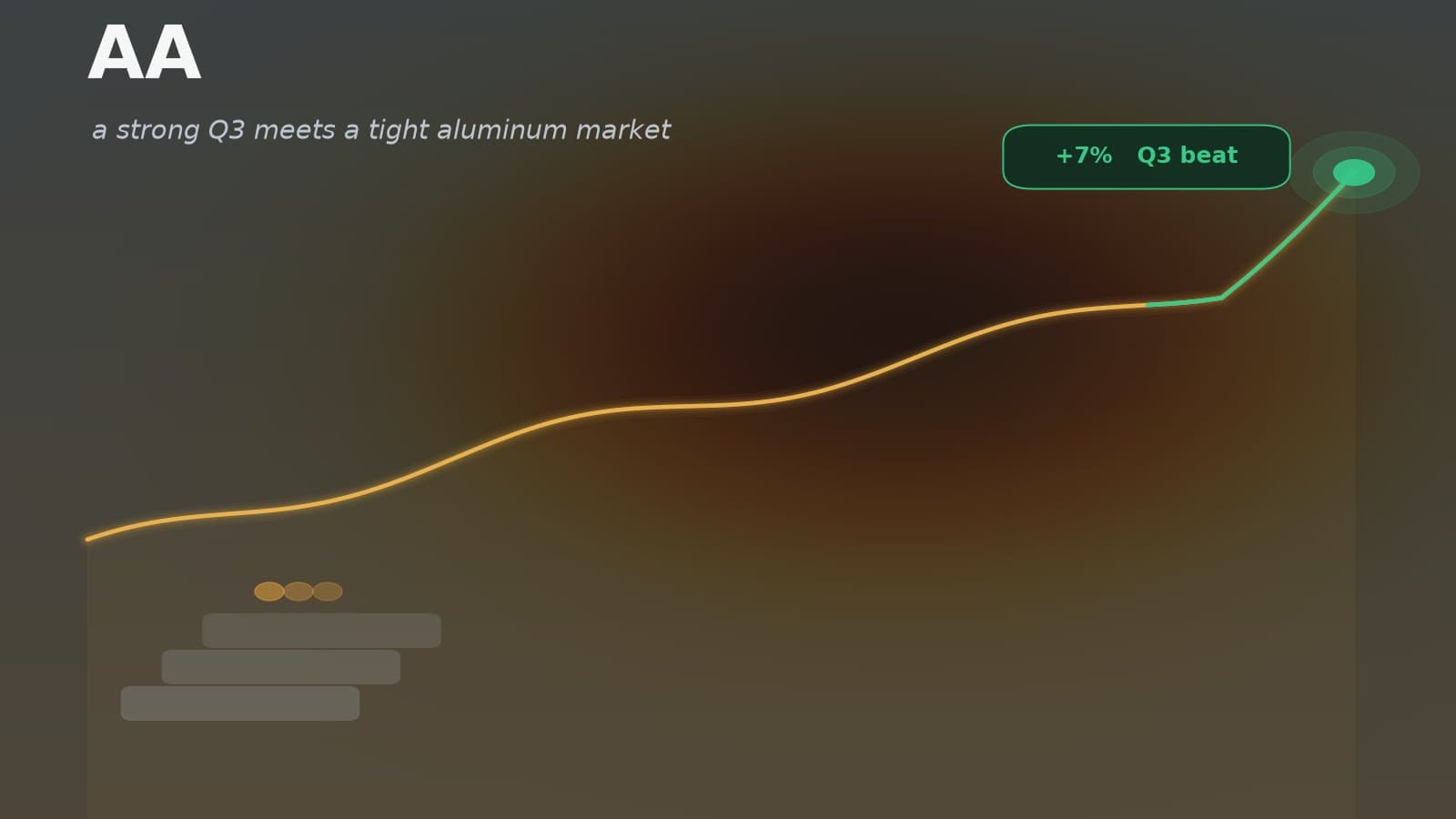
Why Alcoa stock jumped — a strong Q3 meets a tight aluminum market
On Friday, October 16, 2026, Alcoa (NYSE: AA) rose about 7%, trading near $43.20 intraday after opening higher and reaching about $43.25 [1]. The move came in the first full session after the aluminum producer reported third-quarter results after the close on Thursday, October 15 — so Friday was the market digesting the quarter in full, rather than a same-day earnings pop [2]. Two forces pushed the stock: a genuine earnings beat, and a broad bid for aluminum stocks on a tightening-supply narrative that lifted the whole group.
The quarter itself was solid where it counted. Alcoa posted adjusted earnings of about $1.82 a share, comfortably ahead of the roughly $1.54 analysts expected, with net income of $483 million and free cash flow of $472 million [2]. The operational story was the highlight: the company notched several year-to-date production records, completed the restart of its Alumar smelter, and recovered output at the Pinjarra refinery, while higher realized alumina prices helped offset lower aluminum prices and higher carbon costs [2]. There was a blemish — revenue of about $3.7 billion slightly missed estimates, and adjusted EBITDA of $789 million was down from the prior quarter — but the market focused on the earnings beat, the cash generation, and the operational momentum.
The sector tailwind — this was not Alcoa alone
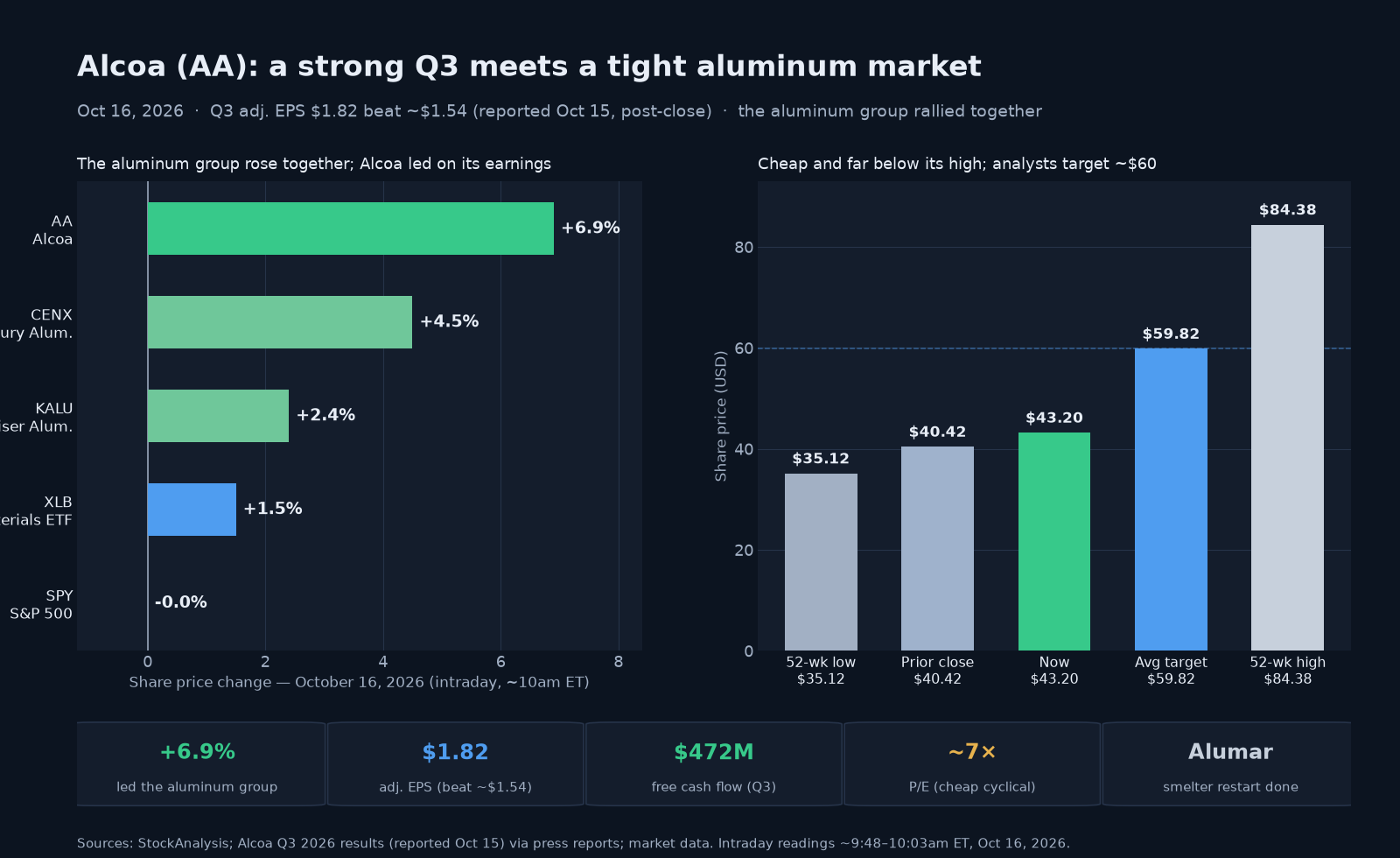
It is important to be precise about what drove the move, because Alcoa did not rally in isolation. On the same morning, aluminum peers rose too: Century Aluminum was up about 4.5% and Kaiser Aluminum about 2.4%, and the broad materials sector gained about 1.5% while the S&P 500 was flat [5]. That cross-section tells the story cleanly — Alcoa outperformed its peers by a couple of points on its own results, but the whole aluminum complex was being bid on a tight-supply narrative. Just two days earlier, Barclays had started coverage of Alcoa at Overweight with a $55 target, citing a constrained aluminum-supply environment extending through 2026 [6]. So the honest read is that a good quarter landed on fertile ground: part of Friday's gain was the earnings beat, and part was the sector's bullish backdrop.
The reasons for caution
For all the momentum, Alcoa is a cyclical commodity producer, and that cuts both ways. Its earnings swing with volatile aluminum and alumina prices, and this very quarter is a case in point: results were sharply higher year over year but softer sequentially — the beat was supported by higher alumina prices, operational improvements and lower costs, even as realized aluminum prices fell (down about $225 a tonne quarter over quarter, though still higher than a year ago) and both adjusted EBITDA and adjusted earnings declined from the prior quarter [2]. The aluminum segment remained the larger earnings contributor, so this was not an alumina-led quarter so much as one where alumina and cost control cushioned weaker aluminum prices. A stock with a beta near 1.74 moves far more than the market in both directions, and Alcoa remains roughly 49% below its intra-year high near $84 even after the pop [1]. There is also a policy overhang: as a producer with Canadian smelting exposure, Alcoa sits squarely in the path of U.S. aluminum tariffs, a source of uncertainty that can swing margins regardless of operations. The low valuation — about 7 to 7.5 times trailing earnings at the post-move price — reflects exactly this: the market pays a low multiple for cyclical, commodity-driven profits that can reverse when the aluminum cycle turns.
Why it matters
The episode is a clean lesson in separating a company's results from its sector's mood. Alcoa delivered a real beat, but the cross-section — peers up, materials up, the market flat — suggests the move appears to have been amplified by a broad rotation into aluminum on tightening-supply expectations, rather than driven by Alcoa's numbers alone [5]. It is also a reminder of how cyclicals are priced: at about 7 times earnings, Alcoa trades at a fraction of the market multiple precisely because its profits are volatile and commodity-linked, so a single strong quarter can move the stock 7% without changing the long-run picture much. For investors, the signal in Friday's tape is less "Alcoa is transformed" and more "the aluminum trade is back in favor, and Alcoa — the biggest, cheapest, most operationally improved name in the group — led it." The durability of the move now rests on aluminum prices and trade policy, the two things that will decide whether a good quarter becomes a trend.
The move, in one cross-section
The same-session tape shows an aluminum-group rally led by the earnings name [5]:
| Name (ticker) | Oct 16, 2026 (intraday) | Read-through |
|---|---|---|
| AA — Alcoa | ≈+6.9% | The earnings name — up on a Q3 beat and strong cash flow, leading the group [1][2] |
| CENX — Century Aluminum | ≈+4.5% | Aluminum peer — up on the tight-supply narrative, no earnings of its own [5] |
| KALU — Kaiser Aluminum | ≈+2.4% | Aluminum products peer — higher with the group [5] |
| XLB — Materials sector (ETF) | ≈+1.5% | The materials group rose; aluminum names led [5] |
| SPY — S&P 500 (ETF) | ≈flat | Broad market — little changed; this was an aluminum move [5] |
The aluminum group up together, with Alcoa out front, is the signature of a sector re-rating amplified by a company-specific beat — not a pure single-stock event [5].
What the Street thinks
Wall Street was already warming to Alcoa before the quarter. The consensus rating is a Buy, with an average 12-month target near $60 — well above the stock even after the jump, implying substantial upside, within a wide range from the high $40s to about $80 [6]. The ratings lean bullish — roughly nine strong-buys against a handful of holds and a lone sell — reflecting optimism about a tight aluminum market more than any single quarter [6]. Two days before earnings, Barclays captured that mood, initiating coverage at Overweight with a $55 target on expectations of constrained supply through 2026; other firms have been more cautious, with Morgan Stanley and J.P. Morgan sitting nearer $50 with neutral-leaning views [6]. The spread of opinion is itself the point: the debate on Alcoa is less about execution — which was strong — than about where aluminum prices and trade policy go next.
What to watch
- Aluminum and alumina prices. The single biggest driver of Alcoa's earnings and the durability of this move — the Q3 beat leaned on alumina even as aluminum prices fell [2].
- Tariffs and trade policy. U.S. aluminum tariffs and Alcoa's Canadian smelting exposure, a swing factor for margins independent of operations [3].
- The strategic deals. Progress on the Massena East site sale (up to $315 million) and the AliGroup acquisition, which cleared a South32 shareholder vote [2].
- Whether the group holds its bid. Whether the tight-supply rally in aluminum names persists or fades, since much of Friday's move was sector-wide. Moves are tracked on the AA stock page [5].
Illustrative scenario sensitivity
Because the move is an earnings beat amplified by an aluminum-market re-rating rather than a change in through-cycle earnings power, the scenarios below are anchored to metal prices, trade policy, and a cheap cyclical multiple rather than a single valuation [6]. They are a descriptive, author-weighted exercise over roughly the coming six-to-twelve months as the aluminum cycle and tariff picture evolve — not a forecast, target, recommendation, or trading advice — with subjective weights that sum to 100%.
| Scenario | Illustrative price | Weight | Key drivers |
|---|---|---|---|
| Tight market persists | ~$56 | 30% | Constrained aluminum supply and firm prices, plus operational momentum and deal value, re-rate the stock toward the ~$55–$60 analyst targets [6]. |
| Range-bound cyclical | ~$44 | 40% | Metal prices and tariffs stay uncertain; the stock holds the earnings pop but trades sideways as a cheap, volatile cyclical [1]. |
| Cycle and tariffs weigh | ~$36 | 30% | Softer aluminum prices, a macro slowdown or tariff disruption pull the high-beta stock back toward the lower end of its 52-week range [3]. |
Weighting those (0.30 × $56 + 0.40 × $44 + 0.30 × $36) gives an author-weighted reference value near $45 — an illustrative, probability-weighted scenario output mechanically derived from the weights above, and not a price target, fair-value estimate, or prediction — a touch above Friday's ~$43.20 intraday price [1][6]. The near-identity reflects a balanced but wide-dispersion setup: a cheap, well-run cyclical with real upside if the aluminum market stays tight, and real downside if the cycle or trade policy turns — an outcome that hinges on metal prices far more than on this one quarter. This is a scenario exercise and descriptive analysis of a news-driven move, not investment advice.
AA data snapshot — October 16, 2026
| Figure | Value | As-of / source |
|---|---|---|
| Intraday quote | ~$43.20 (+~6.9%) — an intraday reading (the session was open) | Fri, Oct 16, 2026, ~10:03am ET — StockAnalysis [1] |
| Prior close / open / range | $40.42 prior close; opened $41.65; traded up to ~$43.25 (rose ~1.8% after hours on Oct 15 first) | Oct 15–16, 2026 [1] |
| Timing | Q3 earnings were reported after the close on Oct 15; Oct 16 is the first full session reacting to them | Oct 15–16 [2] |
| 52-week trend | 52-week range $35.12–$84.38; up ~18% over 52 weeks but ~49% below the intra-year $84 high; beta ≈1.74 (high — a cyclical) | As of Oct 16 [1] |
| Market cap | ≈$11.40B (≈263.91M shares) | Oct 16 — StockAnalysis [3] |
| Valuation | Cheap cyclical: trailing P/E ≈7.0× (forward ≈7.2×); price-to-sales ≈0.75×; price-to-book ≈1.3×; dividend yield ≈0.9% | Oct 16 — StockAnalysis [3] |
| Financials (TTM) | Revenue ≈$14.3B (+11.2%); net income ≈$1.51B (+33%); EPS ≈$5.76; gross margin ≈23%, operating ≈15%, EBITDA ≈20%; free cash flow ≈$890M; cash ≈$4.4B vs debt ≈$4.8B (≈net-cash counting investments) | TTM — StockAnalysis [3] |
| Q3 2026 results | Adjusted EPS $1.82 (beat ~$1.54); net income $483M; adjusted EBITDA $789M (down seq.); FCF $472M; revenue ~$3.7B (slight miss); realized aluminum price −$225/t, alumina +$19/t; Alumar restart completed; record production | Oct 15 — company results [2] |
| Same-day cross-section | CENX +4.5%, KALU +2.4% (aluminum peers); XLB +1.5% (materials); SPY ≈flat — an aluminum-group rally led by AA | Oct 16 intraday [5] |
| Analyst view | Consensus Buy, avg target ~$59.82 (low $48, high $80) — above the price; Barclays initiated Overweight $55 (Oct 14) on tight supply; ratings ~9 Strong Buy / ~3 Hold / ~1 Sell | Oct 16, 2026 — StockAnalysis / analyst notes [6] |
Alcoa (AA) stock FAQ
Why did Alcoa (AA) stock jump on October 16, 2026?
Alcoa rose about 7% to roughly $43.20 in the first full session after reporting third-quarter results after the close on October 15, so Friday was the market digesting the quarter rather than a same-day pop. Two things drove it. First, a genuine earnings beat: adjusted earnings of about $1.82 a share topped the roughly $1.54 expected, with net income of $483 million and free cash flow of $472 million, helped by record production, the completed Alumar smelter restart, and higher alumina prices. Second, a broad rally in aluminum stocks on a tightening-supply narrative — peers Century Aluminum and Kaiser Aluminum also rose, and the materials sector gained while the market was flat. So Alcoa led a group move rather than rallying alone. Revenue of about $3.7 billion did slightly miss, and adjusted EBITDA fell sequentially, but the market focused on the earnings beat and the cash generation.
Was the jump about Alcoa's earnings or the aluminum sector?
Both, and it is worth separating them. Alcoa delivered a real earnings beat, so part of the move was company-specific — it outperformed its peers by a couple of percentage points on its own results. But the move was clearly amplified by a sector-wide bid: on the same morning, Century Aluminum rose about 4.5%, Kaiser Aluminum about 2.4%, and the broad materials sector about 1.5%, while the S&P 500 was flat. That pattern — the whole aluminum group up together, with Alcoa out front — is the signature of a sector re-rating on a tight-supply narrative, amplified by a company-specific beat, rather than a pure single-stock event. Two days earlier, Barclays had initiated coverage of Alcoa at Overweight on expectations of constrained aluminum supply through 2026, capturing the same bullish backdrop. The honest read is that a good quarter landed on an already-improving tape for aluminum.
Is Alcoa stock cheap at 7 times earnings?
It is statistically cheap — a trailing price-to-earnings ratio around 7, price-to-sales near 0.75 and price-to-book around 1.3 — but that low multiple is normal for a cyclical commodity producer, not necessarily a bargain. Alcoa's profits swing with volatile aluminum and alumina prices it does not control, so the market pays a low multiple for earnings that can reverse when the cycle turns. This very quarter shows the dynamic: the beat was carried by higher alumina prices and strong operations, while realized aluminum prices actually fell and adjusted EBITDA declined sequentially. With a beta near 1.74, the stock moves far more than the market in both directions, and it remains about 49% below its intra-year high even after the jump. The cheap valuation reflects that volatility and a tariff overhang, which is why analysts frame the stock as a bet on the aluminum cycle rather than a steady compounder.
What were the highlights of Alcoa's Q3 2026 results?
Alcoa reported adjusted earnings of about $1.82 a share, ahead of the roughly $1.54 consensus, with net income of $483 million (up from $407 million the prior quarter) and free cash flow of $472 million. The operational performance stood out: the company achieved several year-to-date production records, completed the restart of its Alumar smelter, and recovered output at the Pinjarra refinery. Higher realized alumina prices (up about $19 a tonne) and a roughly 7% rise in the Alumina segment's third-party revenue (to about $680 million, which also includes bauxite) helped cushion lower realized aluminum prices (down about $225 a tonne) and higher carbon costs; adjusted EBITDA was $789 million, down from $901 million the prior quarter, and adjusted EPS slipped from $2.12 — so results were much stronger year over year but softer sequentially. Revenue of about $3.7 billion slightly missed estimates. On strategy, Alcoa agreed to sell part of its Massena East site for potential proceeds of up to $315 million and its AliGroup acquisition cleared a South32 shareholder vote (the deal is targeted to close in the first half of 2027). In short, strong operations and cash flow cushioned softer aluminum prices.
What are the risks for Alcoa stock?
The main risk is the one that defines the company: it is a cyclical commodity producer whose earnings rise and fall with aluminum and alumina prices it does not set. The Q3 beat itself leaned on alumina strength and operations even as realized aluminum prices fell, and adjusted EBITDA declined sequentially — a reminder that a good quarter can mask softening in part of the business. A beta near 1.74 means the stock amplifies market moves, and it remains well below its intra-year high. There is also a policy overhang: as a producer with Canadian smelting exposure, Alcoa is directly affected by U.S. aluminum tariffs, which can swing margins regardless of how well the plants run. Finally, much of the October 16 move was a sector-wide re-rating of aluminum names, so the stock is exposed if that tight-supply narrative fades. The cheap multiple reflects these risks rather than ignoring them.
What should investors watch next for Alcoa?
Four things. First and most important, aluminum and alumina prices — the single biggest driver of Alcoa's earnings and the durability of this move, especially since the Q3 beat leaned on alumina even as aluminum prices fell. Second, tariffs and trade policy: U.S. aluminum tariffs and Alcoa's Canadian smelting exposure can swing margins independently of operations. Third, the strategic deals — progress on the Massena East site sale (up to $315 million) and the AliGroup acquisition that cleared a South32 shareholder vote. Fourth, whether the aluminum group holds its bid, since much of Friday's gain was sector-wide rather than Alcoa-specific. Because Alcoa is a high-beta cyclical trading at a cheap multiple, the stock is likely to stay sensitive to commodity prices and macro signals, so the next leg depends far more on the aluminum cycle than on another production record.