Stock Analysis
Modine (MOD) Surges ~31% on a Report Samsung Is in Talks to Buy It
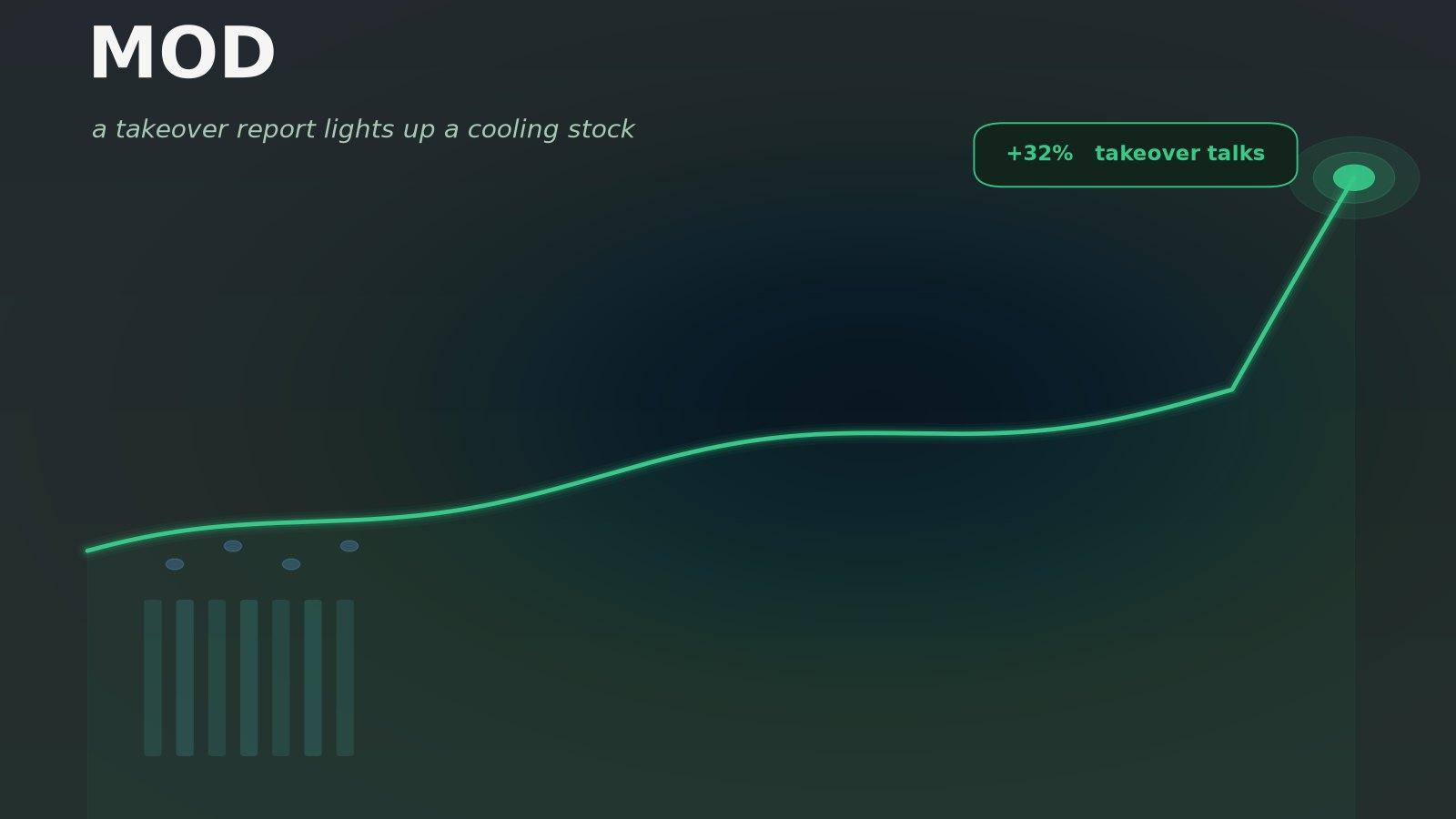
Modine Manufacturing surged about 31% to roughly $139 on November 13 after Bloomberg reported the day before that Samsung Electronics is in talks to acquire the company — a maker of the thermal and liquid cooling systems that keep AI data centers from overheating. The appeal is strategic: as AI chips run hotter, data-center cooling has become a critical bottleneck, and Modine has reinvented itself into a focused, fast-growing pure-play, separating its legacy business (combining it with Gentherm) in October while data-center sales jumped about 95% in its most recent quarter. But the crucial point is what this is not: it is not a deal. Bloomberg's report says the talks could come together in weeks but that no final decision has been made, the discussions could fall through, and another buyer could emerge — and no offer price, terms or premium have been reported, with neither company confirming. The widely cited $5.6 billion figure is essentially Modine's market value before the report, not an agreed price, and the stock has already jumped above that level, to about $7.4 billion, as traders price in a premium that has not been offered. The move was company-specific: cooling peers were flat to lower, with the sector leader Vertiv actually down, so there is no read-through to competitors. Analysts rated the stock Strong Buy even before the report, though their targets were cut sharply after a fiscal Q2 earnings miss and predate any deal. In short, the surge is real but rests on a report, not terms; from here the stock trades as a bet on the outcome of private talks.
Why Modine stock surged — a report of Samsung takeover talks
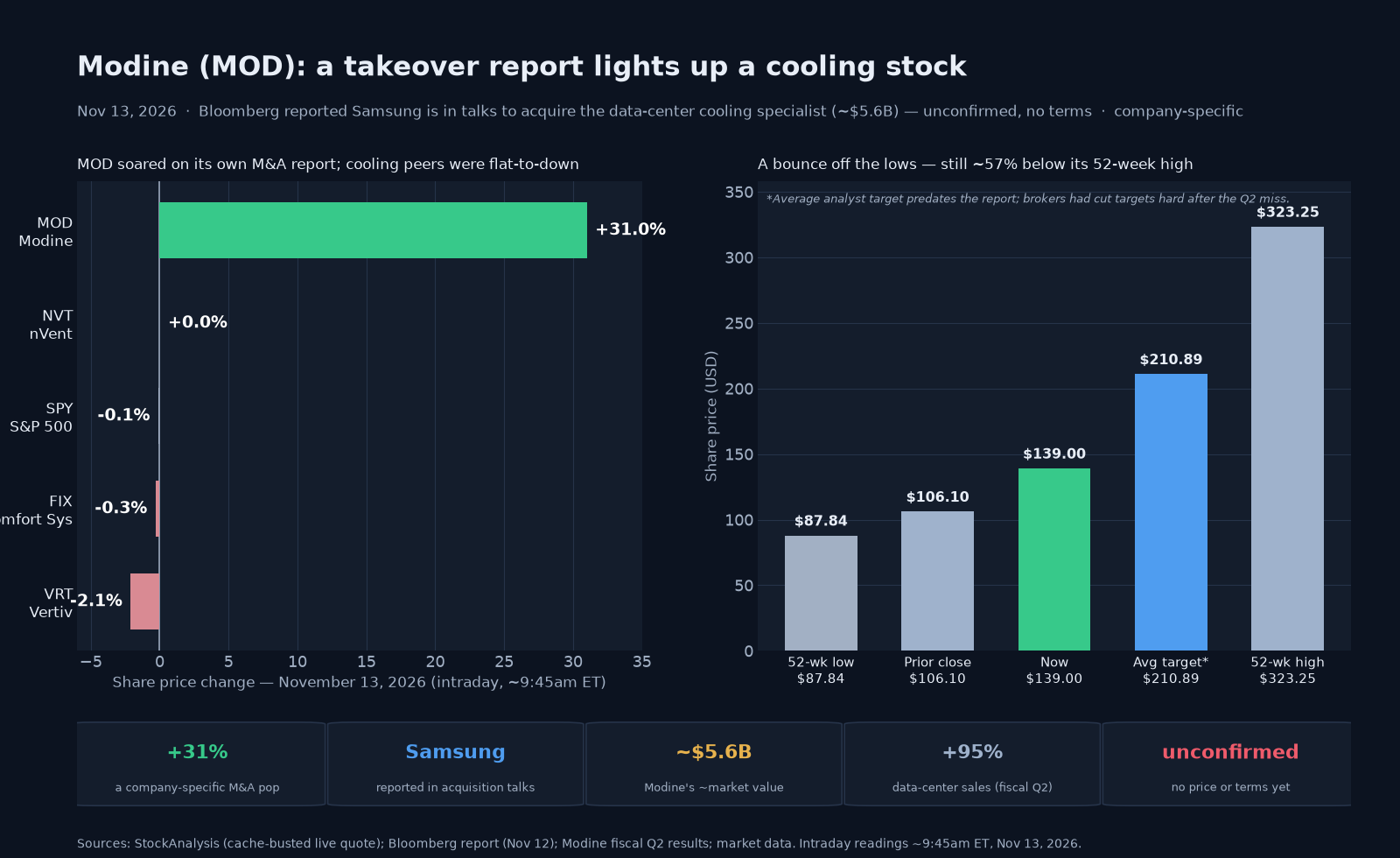
On Friday, November 13, 2026, Modine Manufacturing (NYSE: MOD) surged about 31%, trading near $139 intraday, after Bloomberg reported the day before that Samsung Electronics is in talks to acquire the company — a maker of the thermal and liquid cooling systems that keep AI data centers from overheating [1][2]. The appeal to Samsung is strategic: as AI chips run hotter and denser, data-center cooling has become a critical bottleneck in the AI-infrastructure buildout, and Modine has reinvented itself into a focused, fast-growing pure-play on exactly that problem. For a stock the market had largely left for dead, a takeover report was electric.
But the single most important thing to understand is what this is not: it is not a deal. Bloomberg's report, citing people familiar with the matter, says the two sides are in discussions that could come together in the coming weeks — but that no final decision has been made, that the talks could fall through, and that another buyer could emerge [2]. Crucially, no offer price, terms or premium have been reported, and neither company has confirmed the talks [2]. The widely cited "$5.6 billion" figure is essentially Modine's own market value before the report (about $106 a share times roughly 53 million shares), not an agreed purchase price — and the stock has already jumped well above that implied level, to a market value near $7.4 billion, as traders price in a takeover premium that has not actually been offered [3]. In other words, this is a rumor-driven, M&A-arbitrage move: the upside is a confirmed deal at a premium; the risk is that the talks go nowhere.
What actually drove the move — strategic logic meets a recent selloff
Two things made the report so combustible. First, the strategic fit is genuinely compelling. Modine has transformed itself: on October 1 it separated its legacy Performance Technologies business and combined it with Gentherm in a Reverse Morris Trust transaction (receiving about $156 million of cash, applied to debt), sharpening its focus on data-center cooling and commercial HVAC [2]. The results show why that matters: in its most recent fiscal quarter, Modine's data-center sales jumped about 95% to roughly $440 million, part of total sales up 35%, with record data-center orders that topped $1 billion for the first time, and it guided to full-year revenue growth of 50% to 55% (to about $3.1–$3.2 billion, excluding the divested unit) [2]. That makes it precisely the kind of asset a hardware giant like Samsung would want to own outright to offer complete AI-infrastructure solutions rather than buy cooling from a third party. Second, the stock was depressed: Modine's shares had tumbled after its November 3 fiscal second-quarter report — down about 21% the next day and still roughly 15% lower by the time of the takeover report — not because growth was weak (revenue soared and adjusted earnings rose) but on margin pressure (its data-center gross margin fell from about 24% to 20% on materials and tariffs) and negative free cash flow from its capacity buildout, and it was trading far below its 52-week high of $323 [1]. (That high predates the Gentherm distribution, so holders' actual economic loss is smaller than the raw price decline, since they also received Gentherm shares.) A takeover report landing on a recently sold-off, strategically coveted stock is a recipe for a violent move.
Yet the caveats are as important as the catalyst, because the stock is now trading on a report rather than a fact. Cross-border acquisitions of this kind carry real deal risk: a South Korean electronics giant buying a U.S. supplier of critical data-center infrastructure could invite regulatory and national-security scrutiny, and nothing about price, structure or timing is public [2]. The move was unmistakably company-specific — an acquisition report concerns one company by definition — and the tape confirmed it: cooling and thermal-management peers did not rally with Modine, with the sector leader Vertiv actually down on the day, because a Samsung–Modine tie-up would not help competitors and might even create a stronger rival [5]. So the surge is real, but it rests entirely on a report that may or may not become a deal; investors buying here are making a bet on the outcome of private talks, not on a disclosed transaction.
The valuation question
On ordinary measures Modine is not obviously cheap — before the report it traded at roughly 58 times trailing earnings, reflecting its growth and a recent run — but ordinary measures largely stop mattering once a stock becomes a takeover candidate [3]. From here the share price is better understood as a probability-weighted bet on a deal: at about $139 the market values Modine near $7.4 billion, above the roughly $5.6 billion it was worth before the report, which means traders are already pricing in a meaningful acquisition premium that has not been offered [3]. If a deal is announced at a premium to the pre-report price, there is further upside; if the talks collapse, the stock would likely give back much of the jump toward its depressed pre-report level. The one anchor beneath it is the business itself — a focused data-center-cooling company growing sales near 50% with a healthy balance sheet (modest net debt) — which is why analysts, even after cutting their targets following the Q2 miss, still saw the stock as worth well more than its pre-report price [6]. But in the near term, the valuation is about the deal, not the multiple.
Why it matters
The report is a signal about the AI buildout as much as about Modine. Data-center cooling — the liquid and thermal systems that keep racks of power-hungry AI chips from melting down — has quietly become one of the most supply-constrained, strategically vital niches in the entire AI-infrastructure chain. That a hardware giant like Samsung would reportedly rather own a cooling specialist than buy from one says the market increasingly views cooling as core AI infrastructure, not a commodity component, and it raises the prospect of consolidation across the cooling group — names like Vertiv, nVent and Modine [5]. For Modine specifically, the episode shows how a well-timed strategic pivot can change a company's story: by shedding its legacy business and leaning into data centers, it turned itself into an acquisition target in a hot market, even after an earnings stumble had knocked more than half off its value. But the broader lesson is about discipline with rumor-driven moves: a 31% jump on an unconfirmed report is the market pricing a probability, not a certainty, and the resolution — a real offer, a collapse of talks, or a drawn-out process — will determine whether today looks like an entry point or an overreaction. Until a deal is actually announced, this remains a story about talks, not terms.
The move, in one cross-section
The same-session tape shows an isolated, company-specific move — the hallmark of M&A news [5]:
| Name (ticker) | Nov 13, 2026 (intraday) | Read-through |
|---|---|---|
| MOD — Modine | ≈+31% | The target — surged on a report that Samsung is in talks to acquire it (unconfirmed, no terms) [1][2] |
| NVT — nVent Electric | ≈flat | Cooling/thermal peer — unchanged; no read-through from a single-company deal [5] |
| FIX — Comfort Systems | ≈−0.3% | HVAC/mechanical peer — barely moved [5] |
| VRT — Vertiv | ≈−2.1% | The data-center cooling leader — actually down; a Samsung–Modine tie-up would not help it [5] |
| SPY — S&P 500 (ETF) | ≈−0.1% | Broad market flat — Modine's move was entirely its own [5] |
Modine up about 31% while its cooling peers were flat-to-lower is the signature of company-specific M&A news, not a sector move — and the leader Vertiv falling underscores that there is no positive read-through to competitors [5].
What the Street thinks
Wall Street was bullish on the business even before the report, though its price targets are now stale. The consensus rating is a Strong Buy from about 10 analysts, with an average 12-month target near $211 — above the post-surge price — inside a range from about $160 to $285 [6]. The important context is that those targets predate the Samsung report and had just been cut sharply after Modine's fiscal Q2 earnings miss — several brokers lowered their targets in early November, in some cases from well above $300 — so the Street's stance reflects the depressed, pre-report stock, not any deal [6]. The takeaway is twofold: analysts clearly believe the underlying data-center-cooling business is worth considerably more than the pre-report price (which is why even their cut targets sit above today's level), but none of these figures incorporate a potential acquisition. Any target should be treated as provisional; a confirmed offer would reset the entire framework, and a collapse of talks would send attention back to the fundamentals and the recent earnings disappointment [6].
What to watch
- Confirmation — or denial. Any official statement from Modine or Samsung, an announced price and terms, or a report that talks have ended — the single biggest swing factor [2].
- A competing bid. Whether another suitor emerges, which could raise the price, or whether Samsung walks away [2].
- Regulatory signals. Any indication of national-security or antitrust review for a cross-border deal involving critical data-center infrastructure [2].
- The underlying business. If no deal happens, whether data-center cooling demand and margins recover from the Q2 stumble. Moves are tracked on the Modine stock page [1].
Illustrative scenario sensitivity
Because this is a reaction to an unconfirmed acquisition report rather than fundamentals, the scenarios below are anchored to the deal outcome rather than to a valuation multiple [2]. They are a descriptive, author-weighted exercise over roughly the coming weeks-to-months as the talks resolve — not a forecast, target, recommendation, trading advice, or any prediction that a transaction will occur — with subjective weights that sum to 100%.
| Scenario | Illustrative price | Weight | Key drivers |
|---|---|---|---|
| A deal is announced at a premium | ~$165 | 35% | Samsung (or another bidder) agrees terms at a premium to the pre-report price, and the stock moves toward the offer, less deal-closing risk [2]. |
| Talks continue, no deal yet | ~$135 | 40% | Discussions drag on without confirmation; the stock holds near current levels on takeover hope plus the improving data-center-cooling fundamentals, with elevated volatility [1]. |
| Talks collapse | ~$100 | 25% | The report does not become a deal (or is denied); the stock gives back most of the pop toward its depressed pre-report level and the focus returns to the Q2 miss [6]. |
Weighting those (0.35 × $165 + 0.40 × $135 + 0.25 × $100) gives an author-weighted reference value near $137 — an illustrative, probability-weighted scenario output mechanically derived from the weights above, and not a price target, fair-value estimate, or prediction that any deal will occur — a touch below Friday's ~$139 intraday price [1]. The near-identity is the honest signal: the stock has already priced in substantial deal probability, so the risk-reward from here is roughly balanced, with the outcome hinging on whether private talks become public terms rather than on any valuation multiple. This is a scenario exercise and descriptive analysis of a news-driven move, not investment advice.
Modine data snapshot — November 13, 2026
| Figure | Value | As-of / source |
|---|---|---|
| Intraday quote | ~$139 (+~31%) — an intraday reading (the session was open); opened $142, day range $138–$144.75 | Fri, Nov 13, 2026, ~9:49am ET — StockAnalysis [1] |
| Prior close | $106.10 prior close (depressed after a ~15% early-November decline on the fiscal Q2 earnings miss) | Nov 13, 2026 [1] |
| 52-week trend | 52-week range $87.84–$323.25; ~57% below the high (a round-trip: ran to $323, crashed, now bouncing); below its 50-day (~$160) and 200-day (~$214) averages; beta ≈1.84 | As of Nov 13 [1] |
| Market cap | ≈$7.4B at ~$139 (≈53.2M shares); enterprise value ≈$8.1B; ~$151M cash vs ~$867M debt (modest net debt ~$716M); no dividend | Nov 13 — StockAnalysis [3] |
| Valuation | Trailing P/E ≈58 (on EPS ttm ≈$2.41); price-to-sales ≈2.0× at the current price (~1.6× on the pre-report value) on ~$3.63B trailing revenue; gross margin ≈22% — but trailing figures predate the Gentherm separation, so they understate the now more focused, faster-growing company (guided to ~$3.1–3.2B revenue) | Nov 13 — StockAnalysis [3] |
| Catalyst | Unconfirmed acquisition report: Bloomberg (Nov 12) said Samsung is in talks to acquire Modine for a deal valued around $5.6 billion (≈Modine's pre-report market value) — no price/terms/premium reported, no confirmation, could fall through. Samsung wants Modine as an AI-infrastructure cooling asset; Modine separated its legacy segment (combining it with Gentherm) in October (data-center sales +95% in fiscal Q2) | Nov 12–13, 2026 — Bloomberg / press reports [2] |
| Same-day cross-section | NVT ≈flat, FIX −0.3%, VRT −2.1% (cooling/thermal peers), SPY −0.1% (market) — MOD's ~31% was isolated, company-specific M&A news | Nov 13 intraday [5] |
| Analyst view | Consensus Strong Buy from ~10 analysts, avg target ~$211 (low ~$160, median ~$215, high ~$285) — but these predate the report and had just been cut hard after the Q2 miss; none reflect a deal | Nov 13, 2026 — StockAnalysis / analyst notes [6] |
Modine (MOD) stock FAQ
Why did Modine (MOD) stock surge on November 13, 2026?
Modine surged about 31% to roughly $139 after Bloomberg reported the previous day that Samsung Electronics is in talks to acquire the company. Modine makes thermal and liquid cooling systems for data centers — a critical, fast-growing niche as AI chips generate ever more heat — and it recently reinvented itself as a focused pure-play on that market, so the strategic logic of a takeover is compelling. The key qualification, though, is that this is a report, not a deal: Bloomberg's sources say the talks could come together in the coming weeks but that no final decision has been made, the discussions could fall through, and another buyer could emerge. No offer price, terms or premium have been reported, and neither Samsung nor Modine has confirmed the talks. So the surge reflects the market pricing in the probability and likely premium of a potential acquisition, not an announced transaction.
Is the Samsung–Modine deal confirmed, and what is the $5.6 billion figure?
No, it is not confirmed. As of the report, Samsung and Modine were described as being in talks, with no final decision, no disclosed price or terms, and no public confirmation from either company — and the report explicitly notes the talks could fall through or draw a rival bidder. The widely cited '$5.6 billion' is not an agreed purchase price; it is essentially Modine's market value before the report (roughly $106 a share times about 53 million shares). That distinction matters because the stock has already jumped well above that level — to a market value near $7.4 billion at about $139 a share — as traders price in a takeover premium that has not actually been offered. In practical terms, anyone buying the stock now is paying more than Modine was worth before the report, betting that a deal gets done at an even higher price. Until there is an official announcement with real terms, the $5.6 billion number should be read as a description of Modine's size, not the value of a transaction.
Why would Samsung want to buy Modine?
Because data-center cooling has become one of the most strategically important and supply-constrained parts of the AI-infrastructure buildout. As AI accelerators like Nvidia's GPUs consume more power and pack more densely, removing the heat they generate — increasingly with liquid cooling — is a critical bottleneck, and the companies that supply those systems sit at a valuable choke point. Modine is a focused, fast-growing player in exactly that space: it separated its legacy vehicular and industrial thermal business in October (combining it with Gentherm in a Reverse Morris Trust) to concentrate on data-center and climate cooling, and its data-center sales jumped about 95% in its most recent fiscal quarter with record orders that topped $1 billion. For a hardware giant like Samsung, owning a cooling specialist outright — rather than buying cooling from a third party — would let it offer more complete AI-infrastructure solutions and capture more of the value in the AI buildout. That strategic fit is why the report was credible enough to move the stock so sharply, even though no deal has been confirmed.
What are the risks to the Modine takeover report?
Several, which is why the move should be treated as speculative. First and most basic, there may be no deal: the talks are unconfirmed, no terms exist, and the report itself says a final decision has not been made and the discussions could fall through. Second, the stock already trades above its pre-report value, so a meaningful premium is partly priced in; if talks collapse, the shares would likely give back much of the jump toward their depressed pre-report level, where attention would return to the fiscal Q2 earnings miss that had knocked the stock down. Third, a cross-border acquisition — a South Korean company buying a U.S. supplier of critical data-center infrastructure — could attract regulatory or national-security review, adding time and uncertainty. Fourth, a rival bidder could emerge (which might raise the price) or Samsung could simply walk away. In short, the upside case depends on a confirmed deal at a premium, while the downside case is a return to fundamentals; the current price embeds a bet on an uncertain outcome of private negotiations.
How did Modine's move compare with other cooling and data-center stocks?
It was isolated — the signature of company-specific M&A news. On the same day, Modine's cooling and thermal-management peers did not rally with it: nVent Electric was roughly flat, Comfort Systems was down slightly, and Vertiv, the data-center cooling leader, was actually down about 2%, while the S&P 500 was roughly flat. That pattern is exactly what you would expect from an acquisition report about a single company: a takeover of Modine specifically would not benefit its competitors — if anything, a Samsung-owned Modine could become a stronger rival — so there is no positive read-through to the sector. The lack of a peer rally also helps confirm that the move was driven by the deal report rather than by any broad re-rating of cooling stocks. It is a useful reminder that M&A moves are inherently company-specific, in contrast to, say, an earnings or macro catalyst that can lift a whole group.
What should investors watch next for Modine?
Above all, confirmation or denial — any official statement from Modine or Samsung, an announced price and terms, or news that the talks have ended, since that single event would reset the stock. Second, whether a competing bidder emerges (which could raise the price) or Samsung walks away. Third, regulatory signals: a cross-border deal for critical U.S. data-center infrastructure could face national-security or antitrust review, which would add time and risk. Fourth, the underlying business — if no deal happens, the focus returns to whether Modine's data-center-cooling demand and margins recover from the fiscal Q2 stumble, and to its guided 50%-plus revenue growth. Because the stock is now an event-driven, M&A-arbitrage situation, it is likely to stay highly volatile and to react sharply to any headline about the talks. Investors should size the position and expectations to the reality that this is a report, not a transaction. This is descriptive analysis, not investment advice.