

Why Akamai Technologies, Inc. (AKAM) Stock Fell 6.8% on Aug 7, 2026
The clearest new catalyst: Profitability pressure despite a revenue beat.
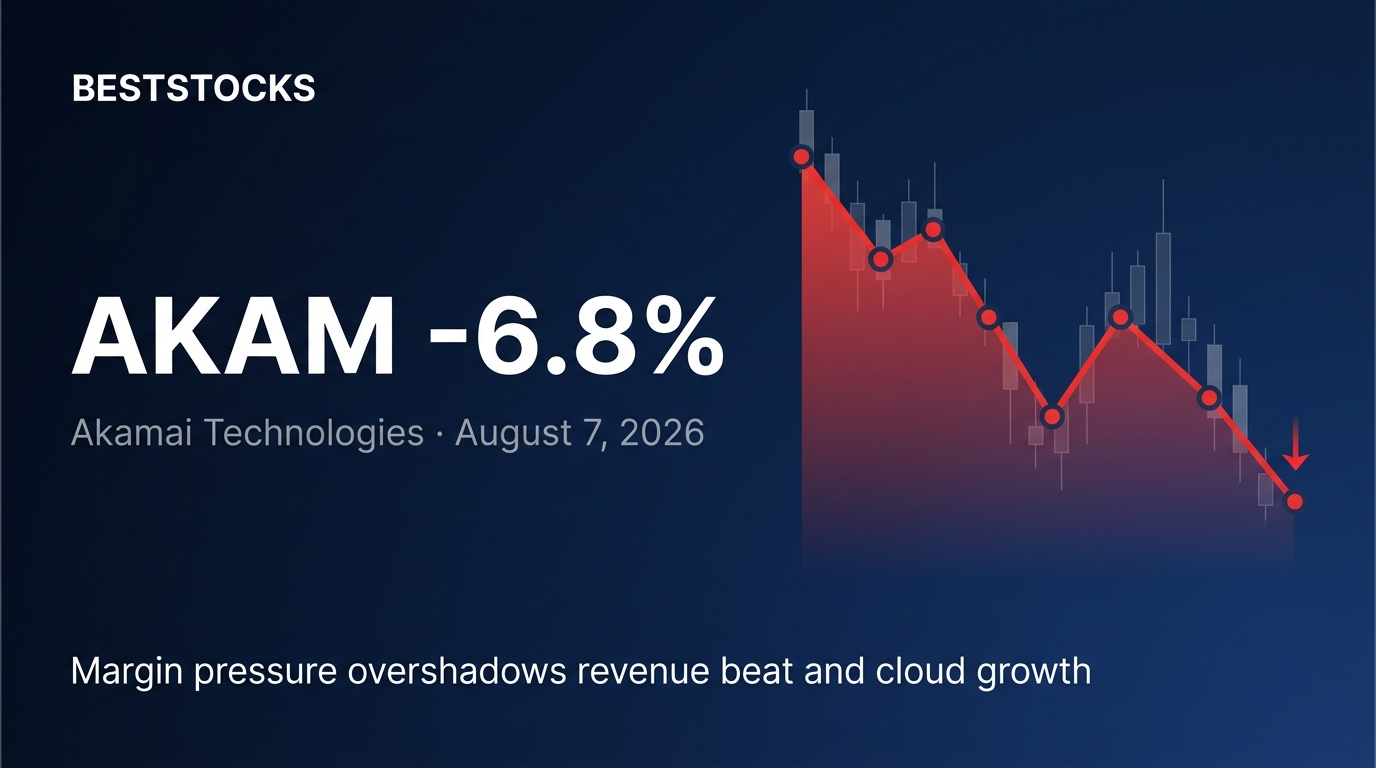
Why did AKAM stock fall?
Akamai Technologies fell 6.76% to $110.54 on Friday, August 7, 2026, as investors looked past broadly solid second-quarter results and another major cloud-infrastructure contract to focus on profitability pressure and a modest narrowing of full-year guidance. The headline move is corrected here from an earlier open-to-close mint artifact of -10.85% (the Aug 7 open of $124.00 to the $110.54 close) to the authoritative close-to-close figure of -6.76% (Aug 6 close $118.55 to Aug 7 close $110.54).
- Profitability pressure despite a revenue beat: Q2 2026 revenue rose 5% year over year to $1.10 billion, including 39% growth in Cloud Infrastructure Services to $99 million and 10% growth in Security to $604 million, but GAAP operating income fell 47% to $80 million and operating margin dropped eight points to 7%. Non-GAAP diluted EPS was $1.59, down 8% year over year.
- Modest guidance narrowing, not a guidance cut: Akamai narrowed its full-year 2026 non-GAAP EPS range to $6.40-$7.05 from $6.40-$7.15 (a $0.05 midpoint reduction, lower bound unchanged); the new midpoint of $6.725 remained slightly above the roughly $6.69 FactSet consensus. Framing this as "Akamai cut guidance" overstates the revision.
- Strong contract bookings did not offset margin concerns: Management said year-to-date multi-year Cloud Infrastructure Services contracts now exceed $2.8 billion, including a newly announced $600 million-plus, four-year robotics contract -- but this is bookings/contract value, not recognized revenue, and investors focused on near-term profitability instead.
- Capital-return context: Akamai spent $410 million in Q2 repurchasing about 3 million shares at a weighted-average $134.54 per share -- well above the $110.54 Aug 7 close.
How the story developed
- August 6, 2026Akamai reported Q2 2026 results after market close: revenue $1.10B (+5%), GAAP operating income -47% to $80M, adjusted EPS $1.59, and a modest narrowing of FY2026 EPS guidance to $6.40-$7.05 from $6.40-$7.15.
- August 7, 2026AKAM fell 6.76% to $110.54 as investors focused on margin pressure and limited guidance upside despite $2.8B+ in year-to-date contract bookings.
What it could mean for AKAM investors
The constructive case
- 39% growth in Cloud Infrastructure Services and $2.8B+ in year-to-date contract bookings point to a large, still-developing growth engine alongside the legacy delivery business.
- The new EPS guidance midpoint remains slightly above Wall Street consensus, suggesting the sell-off may have outpaced the actual change in outlook.
The cautious case & what could invalidate it
- GAAP operating margin fell to just 7%, and the market is demanding clearer evidence that cloud/AI infrastructure growth translates into stronger near-term earnings.
- The Delivery and other cloud applications segment -- still Akamai's largest by revenue -- fell 6% year over year, a continuing drag.
- Q2 buybacks were executed at a weighted-average price ($134.54) well above the post-selloff trading price, an unfavorable capital-allocation outcome in hindsight.
Initial detection
BestStocks first flagged AKAM intraday on Aug 7, 2026; this analysis was finalized after the close using the confirmed −6.8% session move and additional catalyst research.
Show the initial intraday note
Akamai Technologies, Inc. (AKAM) moved -10.85% from $124.00 to $110.54 on 2026-08-07. We checked news, earnings, analyst updates, SEC filings, and corporate actions — no company-specific catalyst was found.
What to watch next: Watch for any earnings announcement, guidance update, or news release from Akamai that may explain the move.
Frequently asked questions
Why did Akamai Technologies, Inc. (AKAM) stock fall on Aug 7, 2026?
Akamai Technologies fell 6.76% to $110.54 on Friday, August 7, 2026, as investors looked past broadly solid second-quarter results and another major cloud-infrastructure contract to focus on profitability pressure and a modest narrowing of full-year guidance. The headline move is corrected here from an earlier open-to-close mint artifact of -10.85% (the Aug 7 open of $124.00 to the $110.54 close) to the authoritative close-to-close figure of -6.76% (Aug 6 close $118.55 to Aug 7 close $110.54).
How much did AKAM stock fall on Aug 7, 2026?
AKAM fell 6.8% during the Aug 7, 2026 trading session.
What were the main drivers behind AKAM's move?
Profitability pressure despite a revenue beat; Modest guidance narrowing, not a guidance cut; Strong contract bookings did not offset margin concerns; Capital-return context.