

Why Edison International (EIX) Stock Fell 23.1% on Aug 31, 2026
The clearest new catalyst: Weekend wildfire-liability compromise omitted key protections.
Why did EIX stock fall?
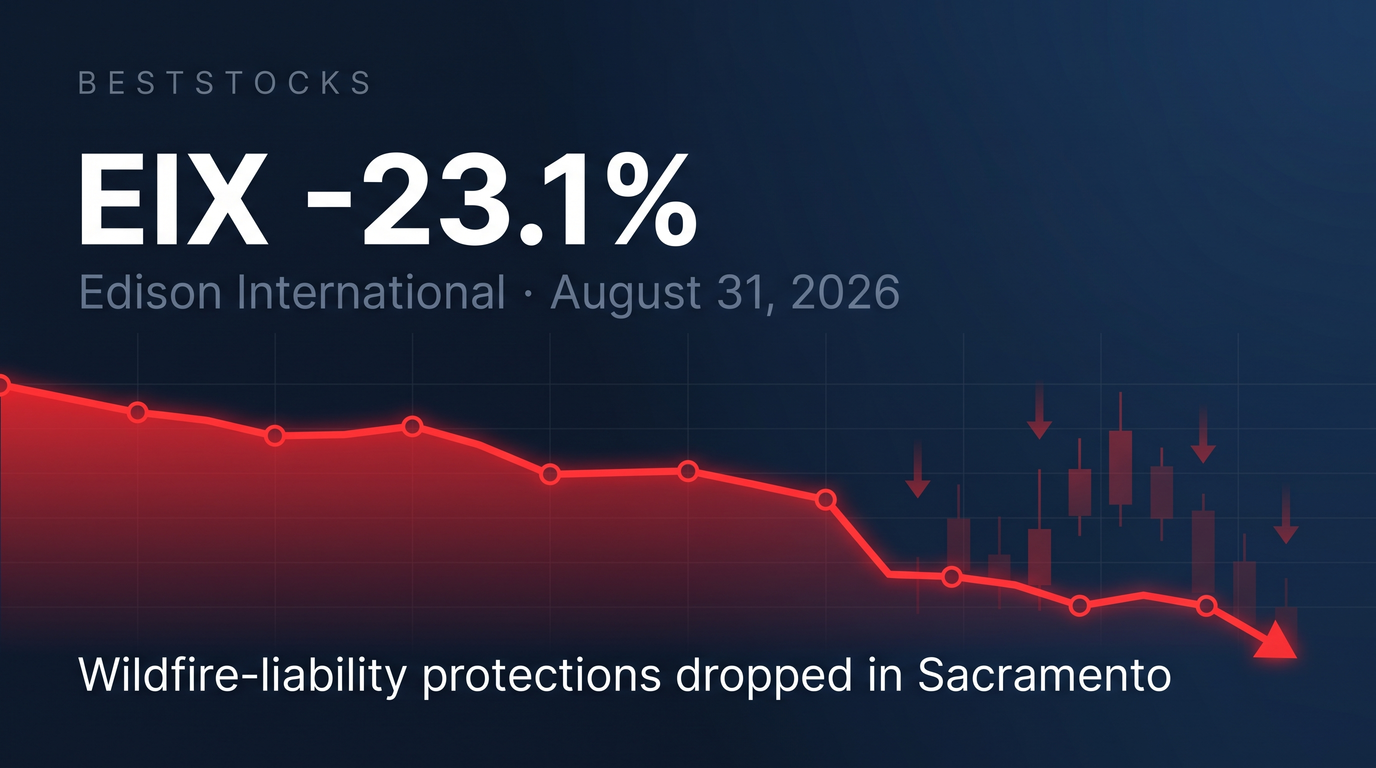
Edison International crashed 23.07% to $53.98 on Monday, August 31, 2026 — its worst single-day drop since April 6, 2001 — after a weekend wildfire-liability compromise in Sacramento omitted the protections utilities wanted. Lawmakers rejected Newsom's plan to eliminate insurer subrogation and dropped a proposed $6 billion per-incident Wildfire Fund reimbursement cap, leaving Edison exposed to uncapped wildfire claims (e.g. the January 2025 Eaton Fire). PG&E fell 20.06% the same session, and Mizuho downgraded EIX.
- Weekend wildfire-liability compromise omitted key protections: Over the August 29-30 weekend, Governor Newsom and legislative leaders reached an amended wildfire-liability compromise (an amended SB 492) that left out the provisions utilities had wanted. Lawmakers rejected Newsom's proposal to eliminate insurers' subrogation rights — the right of insurers to sue utilities to recover wildfire payouts, described as the 'biggest sticking point' — and dropped his proposed $6 billion per-incident cap on Wildfire Fund reimbursement to a utility. This was an amended-text compromise, not fully passed law.
- Uncapped liability exposure: Without a subrogation shield or the proposed reimbursement cap, Edison and its Southern California Edison subsidiary remain exposed to large, uncapped insurance claims and lawsuits over equipment-tied incidents such as the January 2025 Eaton Fire. (California already has a separate shareholder-disallowance cap — generally about 20% of a utility's transmission-and-distribution equity rate base — but that is distinct from the shields that were dropped.)
- Analyst downgrades and a sector-wide hit: Mizuho downgraded EIX to Neutral and cut its target to $70 from $86 as the fresh same-day action; further downgrades (Bank of America to a $51 target, Wells Fargo to Underweight, and a UBS cut) followed. The setback hit California investor-owned utilities broadly — PG&E closed down 20.06% at $13.27.
How the story developed
- August 29-30, 2026 (weekend)Newsom and legislative leaders reach an amended SB 492 compromise that omits the subrogation-elimination and the proposed $6B per-incident Wildfire Fund reimbursement cap.
- August 31, 2026EIX crashes 23.07% to $53.98 (PG&E -20.06%); Mizuho downgrades to Neutral ($86->$70).
- Early September 2026Further downgrades follow (BofA $51, Wells Fargo Underweight, UBS cut) as the Street reprices the uncapped-liability risk.
What it could mean for EIX investors
The constructive case
- The crash is a legislative/legal-risk repricing, not an operational failure — the underlying utility business continues to serve its customers.
- Wildfire-liability relief could still be revisited by lawmakers, and any future subrogation or cost-shift shield would be a meaningful positive.
The cautious case & what could invalidate it
- Without a subrogation shield or reimbursement cap, Edison faces large, hard-to-quantify wildfire claims (e.g. the Eaton Fire), a genuine solvency/credit concern.
- A cascade of analyst downgrades and heightened credit/cash-flow risk can pressure the shares and the dividend further.
- Legislative outcomes remain uncertain, so volatility is likely to stay elevated.
Initial detection
BestStocks first flagged EIX intraday on Aug 31, 2026; this analysis was finalized after the close using the confirmed −23.1% session move and additional catalyst research.
Show the initial intraday note
Edison International (EIX) crashed 23.07% from a prior close of $70.17 to $53.98 on Monday, August 31, 2026 — its worst single-day percentage decline since April 6, 2001 — after a weekend wildfire-liability compromise in Sacramento left out the protections utilities had been hoping for. Lawmakers rejected Governor Newsom's proposal to eliminate insurers' subrogation rights (the 'biggest sticking point') and dropped his proposed $6 billion per-incident Wildfire Fund reimbursement cap, leaving Edison and Southern California Edison exposed to large, uncapped wildfire claims such as those tied to the January 2025 Eaton Fire. Fellow California utility PG&E fell 20.06% the same day.
What to watch next: The overhang is now legislative and legal: watch whether any subrogation or liability relief resurfaces before the session fully wraps, the final form of SB 492, and Eaton Fire claim developments. After Mizuho's same-day downgrade, further cuts followed — analyst sentiment and the dividend's safety are the things to track through the uncertainty.
Frequently asked questions
Why did Edison International (EIX) stock fall on Aug 31, 2026?
Edison International crashed 23.07% to $53.98 on Monday, August 31, 2026 — its worst single-day drop since April 6, 2001 — after a weekend wildfire-liability compromise in Sacramento omitted the protections utilities wanted. Lawmakers rejected Newsom's plan to eliminate insurer subrogation and dropped a proposed $6 billion per-incident Wildfire Fund reimbursement cap, leaving Edison exposed to uncapped wildfire claims (e.g. the January 2025 Eaton Fire). PG&E fell 20.06% the same session, and Mizuho downgraded EIX.
How much did EIX stock fall on Aug 31, 2026?
EIX fell 23.1% during the Aug 31, 2026 trading session.
What were the main drivers behind EIX's move?
Weekend wildfire-liability compromise omitted key protections; Uncapped liability exposure; Analyst downgrades and a sector-wide hit.