

Why Marriott International, Inc. (MAR) Stock Fell 7.0% on Aug 3, 2026
The clearest new catalyst: Q2 revenue below Street estimates.
Why did MAR stock fall?
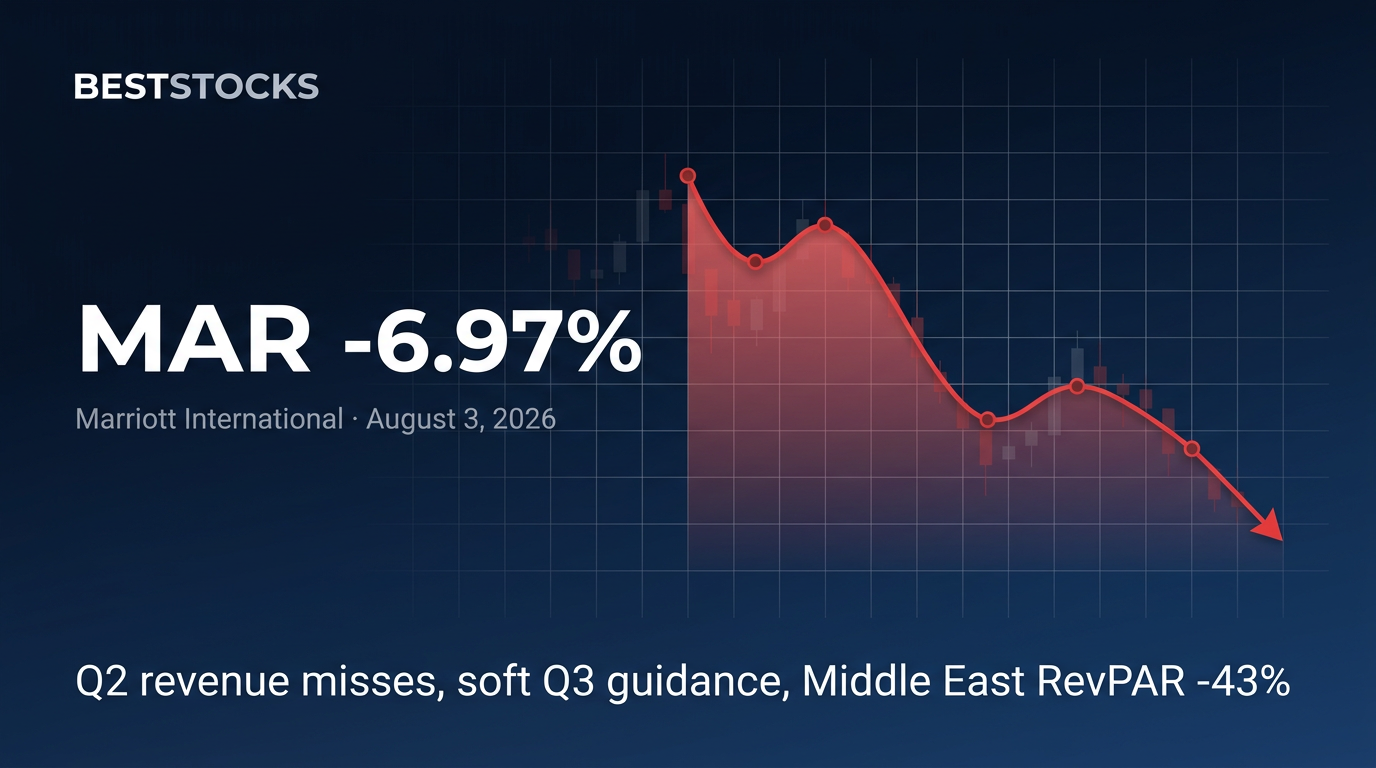
Marriott fell 6.97% on August 3 after reporting second-quarter 2026 results before the open. Adjusted diluted EPS of $3.19 beat the roughly $3.08 consensus, but total revenue of $7.07 billion came in below published estimates that ran from about $7.14 billion to $7.26 billion, and third-quarter adjusted EPS guidance of $2.74 to $2.82 landed under the $2.87 LSEG consensus. A 43 percent RevPAR decline in the Middle East dragged international RevPAR to -0.5 percent even as U.S. and Canada RevPAR rose 5 percent, and the stock's decline came against a rising tape, with the S&P 500 up 1.48 percent and the Dow at a record.
- Q2 revenue below Street estimates: Total revenues were $7,071 million, up 5 percent year over year but below published consensus estimates ranging from roughly $7.14 billion to $7.26 billion. Note that the reported figure includes $5,058 million of cost reimbursement revenue, so it is not Marriott's cleanest operating measure — gross fee revenues rose 13 percent to $1,578 million.
- Middle East RevPAR down 43 percent: Marriott reported a 43 percent RevPAR decline in the Middle East on the conflict in the region. That pulled EMEA RevPAR down more than 5 percent and international RevPAR to -0.5 percent, offsetting 5 percent growth in the U.S. and Canada, over 5 percent in APEC and over 3 percent in Greater China. Worldwide RevPAR still rose 3.4 percent.
- Third-quarter guidance below consensus: Marriott guided third-quarter adjusted diluted EPS to $2.74 to $2.82, below the $2.87 LSEG consensus — the clearest disappointment in the release and the likely focus of the selling.
- Full-year outlook raised, but not purely operational: Full-year adjusted diluted EPS guidance was set at $11.64 to $11.81 and worldwide RevPAR growth was raised to 3.0-3.5 percent from 2-3 percent. The raise is not entirely like-for-like: the new outlook includes the expected partial-year benefit of renegotiated JPMorgan Chase and American Express co-branded credit card agreements, which the previous outlook excluded.
- Adjusted EPS beat; net rooms growth to the low end: Adjusted diluted EPS was $3.19 against roughly $3.08 consensus; GAAP diluted EPS was $2.90. Marriott did not lower its net rooms growth range — it now expects growth at the low end of the unchanged 4.5-5 percent range.
How the story developed
- Second quarter 2026Middle East RevPAR fell 43 percent on regional conflict, pulling EMEA down more than 5 percent while U.S. and Canada RevPAR grew 5 percent.
- August 3, 2026 (before the open)Marriott reported Q2 2026: adjusted diluted EPS $3.19 (GAAP $2.90), revenue $7,071 million, adjusted EBITDA $1,592 million, gross fee revenues up 13 percent.
- August 3, 2026Marriott guided Q3 adjusted EPS to $2.74-$2.82 versus $2.87 consensus, raised full-year RevPAR growth to 3.0-3.5 percent, and set full-year adjusted EPS at $11.64-$11.81. Shares closed down 6.97 percent.
What it could mean for MAR investors
The constructive case
- The core fee engine is intact: gross fee revenues rose 13 percent to $1,578 million and adjusted EPS beat consensus.
- U.S. and Canada RevPAR growth of 5 percent was broad-based across chain scales and customer segments, and Greater China and APEC both grew.
- The development pipeline reached a record of roughly 629,000 rooms across nearly 4,200 properties, up about 7 percent year over year, with 44 percent under construction.
- Renegotiated JPMorgan Chase and American Express co-branded card agreements add a new, contracted earnings stream that begins contributing this year.
- Marriott repurchased 3.0 million shares for $1.1 billion in the quarter and has returned roughly $2.6 billion year to date, with over $4.5 billion of capital return guided for the year.
The cautious case & what could invalidate it
- Middle East weakness is tied to an ongoing regional conflict with no visible resolution date, so the 43 percent RevPAR decline could persist or deepen.
- Third-quarter guidance below consensus suggests the near-term earnings path is softer than the raised full-year headline implies.
- Part of the full-year raise comes from the renegotiated co-brand card agreements rather than from hotel demand — the operational raise is smaller than the headline.
- Net rooms growth landing at the low end of the 4.5-5 percent range is a modest negative for the fee base that compounds over time.
- At roughly 38x trailing earnings, the stock leaves limited room for guidance disappointments.
Initial detection
BestStocks first flagged MAR intraday on Aug 3, 2026; this analysis was finalized after the close using the confirmed −7.0% session move and additional catalyst research.
Show the initial intraday note
Marriott reported a Q2 earnings beat on net income but missed revenue expectations, prompting a 7.20% intraday decline to $345.99. Management cited Middle East geopolitical tensions as a headwind to regional sales growth, and forward guidance was tempered relative to prior expectations. Volume surged to 3.63x the time-adjusted average, underscoring heavy selling pressure.
What to watch next: Q3 booking pace and RevPAR trends, particularly for Middle East and affected regions; any management commentary on forward occupancy or rate guidance in the coming weeks.
Frequently asked questions
Why did Marriott International, Inc. (MAR) stock fall on Aug 3, 2026?
Marriott fell 6.97% on August 3 after reporting second-quarter 2026 results before the open. Adjusted diluted EPS of $3.19 beat the roughly $3.08 consensus, but total revenue of $7.07 billion came in below published estimates that ran from about $7.14 billion to $7.26 billion, and third-quarter adjusted EPS guidance of $2.74 to $2.82 landed under the $2.87 LSEG consensus. A 43 percent RevPAR decline in the Middle East dragged international RevPAR to -0.5 percent even as U.S. and Canada RevPAR rose 5 percent, and the stock's decline came against a rising tape, with the S&P 500 up 1.48 percent and the Dow at a record.
How much did MAR stock fall on Aug 3, 2026?
MAR fell 7.0% during the Aug 3, 2026 trading session.
What were the main drivers behind MAR's move?
Q2 revenue below Street estimates; Middle East RevPAR down 43 percent; Third-quarter guidance below consensus; Full-year outlook raised, but not purely operational; Adjusted EPS beat; net rooms growth to the low end.