

Why ResMed Inc. (RMD) Stock Fell 5.1% on Aug 7, 2026
The clearest new catalyst: FY2027 revenue guidance below consensus — the actual catalyst.
Why did RMD stock fall?
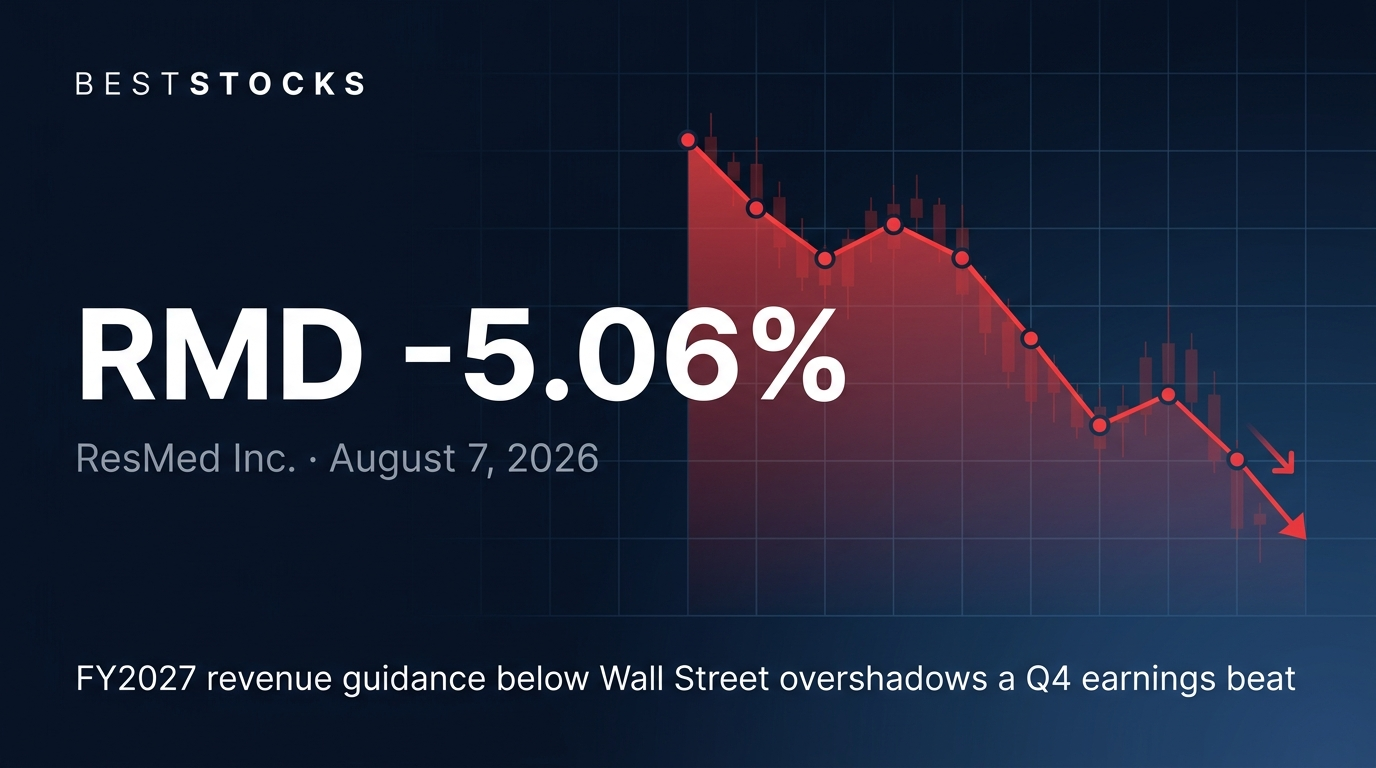
ResMed fell 5.06% on August 7, 2026, closing at $211.94 against a prior close of $223.24, after issuing fiscal 2027 guidance that came in below Wall Street expectations. The company guided to FY2027 revenue of $5.75–$5.85 billion against a consensus of roughly $5.92 billion, with the outlook absorbing a suspension of new Astral ventilator sales, the pending MatrixCare divestiture and cost inflation. That overshadowed a fiscal fourth quarter in which adjusted EPS of $2.95 beat the roughly $2.89 consensus. The decline is notably idiosyncratic: it came on a day the S&P 500 closed at a record high.
- FY2027 revenue guidance below consensus — the actual catalyst: ResMed guided to fiscal 2027 revenue of $5.75–$5.85 billion, below the roughly $5.92 billion LSEG consensus, alongside non-GAAP diluted EPS guidance of $12.00–$12.25. The revenue shortfall against the Street is the clearly documented disappointment and is what drove the selling.
- The guidance came from the call, not the press release: ResMed's 4:05 p.m. EDT press release on August 6 presented fourth-quarter and full-year fiscal 2026 results and capital returns, but did not contain the $5.75–$5.85 billion revenue or $12.00–$12.25 EPS ranges. The detailed FY2027 outlook appeared in the earnings presentation and on the call that began at 4:30 p.m. ET. The disappointing outlook therefore emerged during the after-hours call rather than at the initial release — a distinction that explains the timing of the reaction.
- The quarter itself was solid, and the beat was on earnings rather than revenue: Fourth-quarter revenue was $1,463.6 million, up 9% reported and 8% in constant currency — a record, but essentially in line with consensus rather than a meaningful beat. The clearer beat was on profitability: non-GAAP diluted EPS of $2.95, up 16%, against roughly $2.89 expected. ResMed also raised its quarterly dividend 10% to $0.66 per share and targeted more than $1.85 billion of capital returns in FY2027.
- Astral: an old problem with newly quantified financial consequences: The Astral ventilator field safety issue was not new on August 6 — customers were notified in June and the FDA published its public alert on July 31. What was new was the size: a $41.9 million field safety notification expense inside the fourth quarter, and an FY2027 outlook that assumes no new Astral sales at all, a headwind of roughly $75 million in revenue. The $41.9 million charge is a discrete accounting item; the lost Astral revenue is a continuing drag and should not be treated as one-time.
- GAAP and adjusted results diverge sharply this quarter: Because the Astral charge sits in cost of sales and is excluded from adjusted figures, the two views point in opposite directions. GAAP gross margin fell 200 basis points to 58.8% while non-GAAP gross margin rose 90 basis points to 62.3%. GAAP income from operations actually declined 1% to $448.7 million, with GAAP operating margin down 300 basis points to 30.7%, and GAAP diluted EPS rose only 2% to $2.64 against the 16% rise in the adjusted figure. Fourth-quarter operating cash flow fell 16% to $454.6 million and free cash flow fell 21% to $404.2 million.
- Cost inflation is now outrunning productivity: Management indicated that its productivity programme can no longer fully offset rising freight and electronic component costs, and pointed to planned price increases. That is a change in tone for a company whose margin story has rested on productivity execution.
How the story developed
- June 2026ResMed notified customers of a field safety issue affecting its Astral life-support ventilator line.
- July 7, 2026ResMed announced an agreement to sell its MatrixCare business to Frazier Healthcare Partners for $490 million in cash, with closing expected in the first quarter of fiscal 2027. MatrixCare represented roughly $220 million of FY2026 revenue and about $55 million of non-GAAP operating profit; the transaction explicitly excludes Brightree and MEDIFOX DAN.
- July 31, 2026The FDA published its public alert regarding the Astral ventilator field safety notification.
- August 6, 2026 (4:05 p.m. EDT)ResMed released fiscal fourth-quarter and full-year 2026 results: Q4 revenue $1,463.6 million (+9%), non-GAAP diluted EPS $2.95 (+16%), GAAP diluted EPS $2.64 (+2%), and a 10% dividend increase to $0.66 per quarter. The release quantified the Astral field safety notification expense at $41.9 million.
- August 6, 2026 (4:30 p.m. ET)On the earnings call and in the accompanying presentation, management issued FY2027 guidance of $5.75–$5.85 billion in revenue and $12.00–$12.25 in non-GAAP diluted EPS, below the roughly $5.92 billion revenue consensus, and flagged zero new Astral sales plus cost inflation.
- August 7, 2026RMD fell through the session and closed at $211.94, down 5.06%, on about 2.5x average volume — against an S&P 500 that closed at a record high.
What it could mean for RMD investors
The constructive case
- The headline growth comparison understates the continuing business. ResMed's own normalised outlook calls for roughly 5%–7% core constant-currency growth once MatrixCare is held constant and acquired Noctrix revenue is excluded — materially better than the 1.7%–3.5% implied by comparing guidance to unadjusted FY2026 revenue.
- The fourth quarter's margin weakness is concentrated in one identifiable charge. Excluding the $41.9 million Astral expense, gross margin expanded 90 basis points, and full-year non-GAAP gross margin rose 240 basis points to 62.4%.
- Capital returns are rising sharply: a 10% dividend increase to $0.66 per quarter and a target of more than $1.85 billion returned in FY2027, against roughly $1.0 billion returned in FY2026.
- Core demand held up. Fourth-quarter masks and other revenue grew 11% and Rest of World sleep and breathing revenue grew 13%, so the guidance issue is largely about Astral, divestiture mechanics and costs rather than the sleep franchise.
- The $490 million MatrixCare sale converts a slower-growth software asset into cash and sharpens focus on the core, with proceeds available for buybacks or reinvestment.
The cautious case & what could invalidate it
- The lost Astral revenue is recurring, not one-time. Guidance assumes no new Astral sales at all through fiscal 2027, roughly $75 million, and there is no published date for resuming them.
- Management's acknowledgement that productivity can no longer fully offset freight and component inflation is a genuine change, and planned price increases carry their own volume risk in a reimbursement-sensitive market.
- Even on the normalised 5%–7% core constant-currency basis, growth is slower than the 8% constant-currency rate ResMed delivered in fiscal 2026.
- Fourth-quarter cash generation weakened, with operating cash flow down 16% and free cash flow down 21% year over year.
- The stock fell on a record day for the S&P 500 and had already declined substantially from its highs, which suggests the market read the guidance as a change in the growth algorithm rather than a timing issue.
- The gap between GAAP and adjusted results is unusually wide this quarter; investors relying only on adjusted figures would miss that GAAP operating income actually declined.
Initial detection
BestStocks first flagged RMD intraday on Aug 7, 2026; this analysis was finalized after the close using the confirmed −5.1% session move and additional catalyst research.
Show the initial intraday note
ResMed reported fiscal Q4 2026 earnings late yesterday with non-GAAP EPS of $2.95 beating expectations, but the market reacted negatively to lower-than-expected gross margins, $42 million in field safety notification expenses for Astral respirators, and conservative fiscal 2027 core revenue growth guidance of 5–7% (per investor.resmed.com and Seeking Alpha). Stock fell 6.03% to $209.78 on elevated volume of 2.6M shares (2.28x typical for this time of day).
What to watch next: Management commentary on timeline for resolving Astral respirator field notifications and any updates on competitive pressures in PAP devices during earnings call or investor interactions; watch for gross margin trends in Q1 FY2027 results.
Frequently asked questions
Why did ResMed Inc. (RMD) stock fall on Aug 7, 2026?
ResMed fell 5.06% on August 7, 2026, closing at $211.94 against a prior close of $223.24, after issuing fiscal 2027 guidance that came in below Wall Street expectations. The company guided to FY2027 revenue of $5.75–$5.85 billion against a consensus of roughly $5.92 billion, with the outlook absorbing a suspension of new Astral ventilator sales, the pending MatrixCare divestiture and cost inflation. That overshadowed a fiscal fourth quarter in which adjusted EPS of $2.95 beat the roughly $2.89 consensus. The decline is notably idiosyncratic: it came on a day the S&P 500 closed at a record high.
How much did RMD stock fall on Aug 7, 2026?
RMD fell 5.1% during the Aug 7, 2026 trading session.
What were the main drivers behind RMD's move?
FY2027 revenue guidance below consensus — the actual catalyst; The guidance came from the call, not the press release; The quarter itself was solid, and the beat was on earnings rather than revenue; Astral: an old problem with newly quantified financial consequences; GAAP and adjusted results diverge sharply this quarter; Cost inflation is now outrunning productivity.