Stock Analysis
WIX Stock: Wix's Base44 AI Pivot, Layoffs, Buyback and Guidance Cut Explained
Wix repurchased 30% of its shares at $92 in April. By June 8, WIX closed at $48.21 after a Q1 loss, 20% layoffs and a guidance cut driven by Base44's AI costs.

Summary: Why WIX Stock Sold Off
Wix (NASDAQ: WIX) has packed a lot of bad news into eight weeks. The company missed first-quarter estimates on May 13 and swung to a GAAP net loss of $57.5 million [1]. On May 28 it announced the largest layoff in its history, about 1,000 jobs or 20% of the workforce [2]. On June 8 it cut its full-year outlook [3], and the stock closed at $48.21. All of this came after Wix spent $1.6 billion in April to repurchase roughly 30% of its own shares at $92 apiece [1]. The common thread is the cost of the company's answer to AI competition: the Base44 acquisition is growing fast, but compute and marketing expenses have pushed Wix into the red while its core Partners business slows.
| WIX: key numbers | Figure |
|---|---|
| Q1 2026 revenue | $541.2M (+14% y/y) |
| Q1 2026 bookings | $585.0M (+15% y/y) |
| GAAP net loss (Q1 2026) | $57.5M |
| Non-GAAP diluted EPS | $0.68 (vs. $1.22 consensus) |
| Free cash flow (Q1 2026) | $75.0M |
| Tender offer price | $92.00 |
| Shares repurchased | 17.5M (~30% of shares out) |
| Workforce reduction | ~1,000 jobs / 20% |
| Annualized savings target | ~$150M |
| Base44 ARR | ~$150M as of mid-May 2026 |
| June 8, 2026 close | $48.21 |
Q1 figures per Wix's earnings release and call [1][4]; consensus per cited reporting [5]; June 8 closing price via FMP.
| Date | Key events behind Wix's 2026 reset |
|---|---|
| Jun 18, 2025 | Wix acquires vibe-coding startup Base44 for ~$80M initial consideration plus earnouts through 2029 [6] |
| Apr 2026 | $1.6B tender offer completed: 17.5M shares repurchased at $92, ~30% of shares outstanding [1] |
| May 13, 2026 | Q1 miss: GAAP loss of $57.5M, non-GAAP operating margin 5% (from 21%). Stock falls 27% [1][7] |
| May 28, 2026 | Largest layoff in company history: ~1,000 roles, 20% of the workforce [2] |
| Jun 8, 2026 | 2026 guidance cut: bookings to low-teens growth, revenue to low- to mid-teens. WIX closes at $48.21 [3] |
What Changed: Q1 Results, Base44 Costs, the Buyback and Layoffs
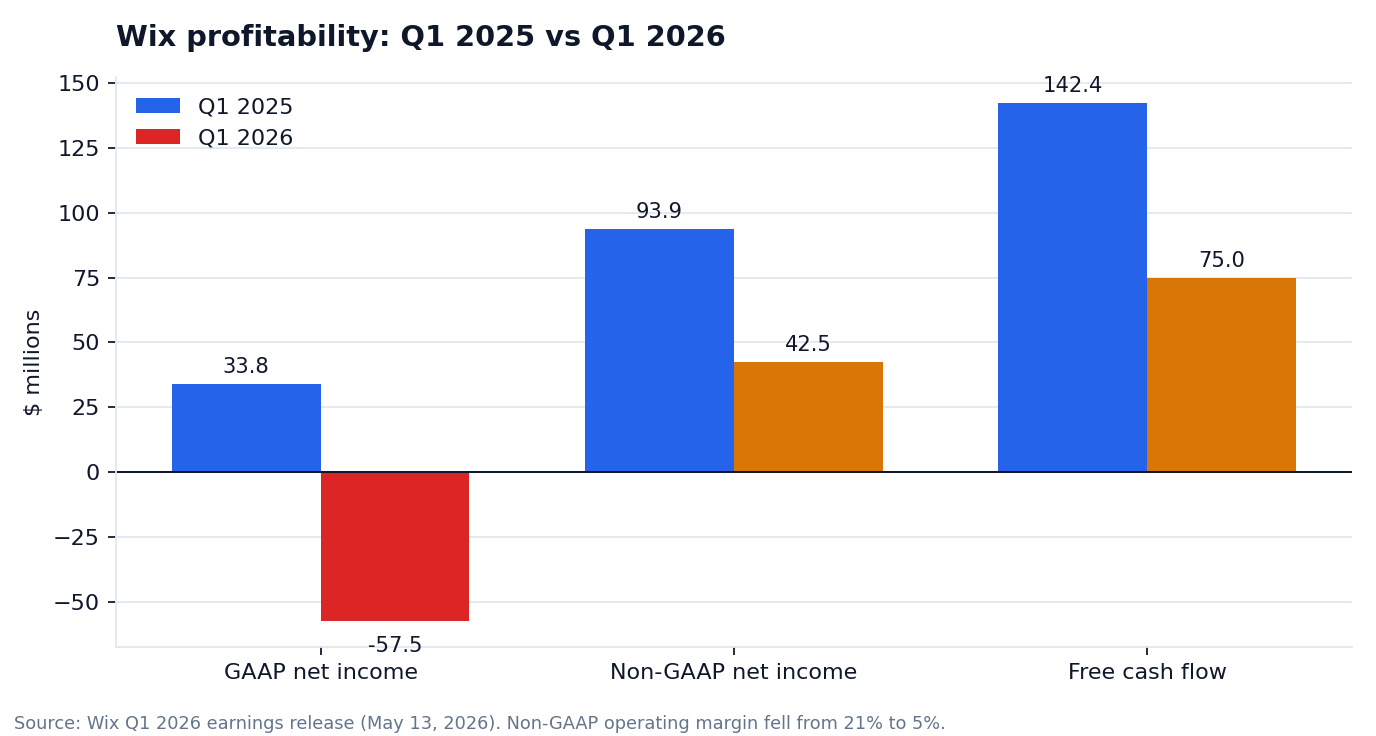
Start with the quarter. Revenue rose 14% to $541.2 million and bookings grew 15% to $585 million, in line with what Wix has delivered for years [1][8]. Profitability is another story. Non-GAAP net income fell from $93.9 million a year earlier to $42.5 million, non-GAAP operating margin dropped from 21% to 5%, and free cash flow fell from $142.4 million to $75 million [1]. Adjusted EPS of $0.68 missed the $1.22 consensus by 44% [5]. The stock fell 27% on the report [7].
Base44: the AI bet raising revenue and costs
Two costs did most of the damage. The first is Base44, the vibe-coding startup Wix bought in June 2025 for roughly $80 million in initial consideration plus earnouts through 2029 [6]. The product works: ARR went from $100 million in early March to $150 million by mid-May [4]. But every new Base44 user arrives with an AI inference bill, and management attributed part of the drop in gross margin to 66% to that compute [4]. The second is marketing, including Super Bowl campaigns to push Base44 and widen the funnel [4][5].
The $1.6B buyback looks worse after the selloff
Then the capital structure. In April, Wix completed a $1.6 billion modified Dutch auction tender, retiring 17.5 million shares at $92 each and leaving about 41.8 million shares outstanding [1]. WIX closed at $48.21 on June 8, 2026, about 47.6% below the $92 tender offer price.
Layoffs and a guidance cut inside two weeks
Management responded on May 28 with a plan to cut about 1,000 roles, around 20% of a 5,277-person workforce, and to flatten the org chart [2]. CEO Avishai Abrahami also pointed at the shekel, which has strengthened against the dollar and adds roughly $64 million of expense headwind this year [1][2]. On June 8, a 6-K filing trimmed guidance: bookings growth is now expected in the low teens (from mid-teens) and revenue growth in the low- to mid-teens, about $50 million less in bookings and $25 million less in revenue than planned a month earlier [3]. The layoffs should save about $70 million in 2026 and roughly $150 million annualized, against a one-time charge of $30–35 million [3][9].
Why It Matters for WIX Stock
Wix is turning into the test case for what happens when an incumbent buys its own disruptor. Base44 settles the strategic question: Wix now owns a credible AI-native builder instead of watching rivals such as Lovable take its future customers [7]. It does not settle the economics. Creative Subscriptions, the traditional core, runs at an 80% non-GAAP gross margin [4]; AI app generation carries inference costs that model never had to absorb. Growth at Base44 raises revenue and costs at the same time, which is how a company can grow 14% and still lose money.
The buyback compounds the stakes. Wix moved to a net debt position, took on a $500 million credit facility, and gave up interest income on the cash it spent [1]. With about 41.8 million shares outstanding, every swing in the business now hits per-share numbers harder, in both directions. And the more conventional problem may be the bigger one: the Partners business, about 38% of revenue, slowed sharply in late May and early June, and the company acknowledged the weakness goes beyond its own restructuring [9].
What Investors Should Watch Next
Wix is expected to report second-quarter earnings in early August [10]. Base44's gross margin trajectory matters most; management projected quarter-over-quarter improvement and a significant change by year-end as AI costs get optimized and user cohorts shift into a cheaper maintenance phase [4]. Watch whether Partners growth stabilizes after the May–June slump, whether the $70 million of 2026 savings shows up net of the $30–35 million severance charge, and whether free cash flow tracks toward the roughly $420 million full-year target [3][9].
Two variables sit outside management's control: the shekel-dollar exchange rate, which moves the cost base directly, and the pace at which competitors keep cutting the price of AI site-building. Wix Harmony, the company's proprietary model, is its main lever on compute costs; on the Q1 call, management said it already lowered model costs while output quality improved [4]. Whether that holds at Base44's scale will decide if low-teens growth can coexist with recovering margins.
Is WIX stock below its buyback price?
Yes. Wix repurchased 17.5 million shares at $92.00 in its April 2026 tender offer [1], and WIX closed at $48.21 on June 8, 2026 — 47.6% below the tender price. The gap is measured from the $92 tender price to the June 8 closing price, not to an intraday level.
Why did WIX stock fall in 2026?
- A Q1 earnings miss (May 13). Non-GAAP EPS of $0.68 vs. a $1.22 consensus, a swing to a $57.5 million GAAP net loss, and operating margin down from 21% to 5%. The stock fell 27% on the report [1][5][7].
- Base44 compute and marketing costs. Gross margin fell to 66% as AI inference and Super Bowl-scale campaigns scaled with Base44's growth [4].
- The largest layoff in company history (May 28). About 1,000 roles, 20% of the workforce, citing AI disruption and shekel strength [2].
- A guidance cut (June 8). Bookings growth lowered to the low teens and revenue to the low- to mid-teens, with a sharper-than-expected Partners slowdown [3][9].
Wix guidance: May 13 vs. June 8, 2026
The June revision is the cleanest measure of how fast the picture changed: both lines below are the company's own targets, four weeks apart.
| Metric (FY 2026) | May 13 guidance | June 8 guidance | Change |
|---|---|---|---|
| Bookings growth | Mid-teens % | Low-teens % | ~$50M lower bookings |
| Revenue growth | Mid-teens % | Low- to mid-teens % | ~$25M lower revenue |
| Free cash flow (ex. acquisition/restructuring costs) | ~$400M implied | ~$420M | +~$20M |
| Cost savings from realignment | — | ~$70M in 2026; ~$150M annualized | New |
| One-time restructuring charge | — | $30–35M pre-tax | New |
Baselines are Wix's May 13, 2026 earnings release and its June 8, 2026 6-K [1][3]. The ~$400M prior FCF figure is implied by the reported ~$20M raise to ~$420M [9] and is approximate.
What could move WIX next?
- Q2 2026 earnings (expected early August). First quarter with layoff savings partially in the run rate; Base44 gross margin is the number to check [10][4].
- Partners business data. The segment (~38% of revenue) drove the June guidance cut; stabilization or further erosion moves the growth story either way [9].
- Restructuring execution. Roughly $70M of 2026 savings against a $30–35M charge; free cash flow tracking toward ~$420M ex-costs [3].
- Shekel-dollar exchange rate. A ~$64M expense headwind this year; further shekel strength deepens it [1].
- Ongoing filings and estimate revisions. New 6-K filings, guidance updates and analyst-estimate changes will show whether June's cut was a floor or a step down — the kind of signal BestStocks surfaces with the change-detection process behind the site.
WIX stock FAQ
What is Wix's ticker symbol?
Wix.com Ltd. trades on the Nasdaq under the ticker WIX.
Why did WIX stock fall in 2026?
Three hits in eight weeks: a May 13 Q1 report that missed EPS estimates ($0.68 vs. $1.22) and showed a $57.5 million GAAP net loss, a 20% workforce cut announced May 28, and a June 8 guidance reduction. WIX closed at $48.21 on June 8, 2026, about 48% below the April buyback price.
What is Base44 and why does it matter for Wix?
Base44 is a vibe-coding platform that builds apps from natural-language prompts. Wix acquired it in June 2025 for about $80 million in initial consideration plus earnouts through 2029. Its ARR reached roughly $150 million by mid-May 2026, but the AI compute behind that growth weighs on Wix's gross margin.
What is Wix's 2026 guidance now?
As of the June 8, 2026 update: bookings growth in the low teens, revenue growth in the low- to mid-teens, and free cash flow of roughly $420 million excluding acquisition and restructuring costs.
How big was the Wix buyback?
A $1.6 billion modified Dutch auction tender completed in April 2026. Wix repurchased 17.5 million shares at $92 each, about 30% of shares outstanding, leaving roughly 41.8 million shares.
When are Wix's next earnings?
Wix is expected to report Q2 2026 results in early August 2026.