AI Infrastructure
Aramark (ARMK) Stock: Why the Q3 Beat and Nexus Data-Center Ramp Sent It to a High
Aramark beat fiscal Q3 estimates and raised its full-year organic revenue outlook to 9–10% from 7–9%, crediting the launch of operations with a top global hyperscaler under its Aramark Nexus data-center platform. ARMK jumped about 10% to a fresh 52-week high while the market and its food-services peers were flat. Why a defensive caterer got repriced as an AI-services play.
Summary
Before Tuesday's open on August 11, 2026, Aramark (NYSE: ARMK) reported fiscal third-quarter results (quarter ended July 3, 2026) that beat on both lines and — the part the market rewarded — raised its full-year organic revenue outlook to 9–10% from 7–9%, explicitly crediting the ramp of its new hyperscale-data-center hospitality platform, Aramark Nexus [1][2]. Revenue was $5.06 billion, up about 9%, with adjusted EPS of $0.52, up 29% versus $0.40 a year earlier [1]. The stock, which closed at $55.71 on Monday, opened at $59.95 and traded near $61.15, up about 9.8%, at 11:09 a.m. ET — brushing a fresh 52-week high of $61.33 [3][4]. With the S&P 500 and Aramark's food-services peers roughly flat on the day, this was a company-specific re-rating: a low-beta contract caterer being repriced partly as an AI-infrastructure services play.
What changed
Two things moved at once. The base business simply executed — $5.06 billion of revenue (about +9% organic), GAAP EPS of $0.36 (+34%), adjusted operating income of $261 million (+13% in constant currency), record client retention near 98% and net-new business of $1.6 billion fiscal year to date, up 51% [1]. CEO John Zillmer summed it up plainly: "The Company delivered another impressive quarter of strong top and bottom-line results" [1]. On its own that is a solid but unremarkable quarter for a mature contract caterer.
What re-rated the stock is the second thing: Aramark raised its full-year FY2026 organic revenue outlook to 9–10%, up from 7–9%, and management tied the increase directly to "commencing operations with a top global hyperscaler." Late in the third quarter, Aramark began operations at its first Texas-based site supporting a top global hyperscaler, with a second location mobilizing and more anticipated; separately it announced "a multi-year engagement with a leading AI data center colocation provider to serve workforce communities" [1][2]. The company reaffirmed its outlook for adjusted operating income growth (12–17%), adjusted EPS growth (20–25%) and a sub-3x leverage target [1].
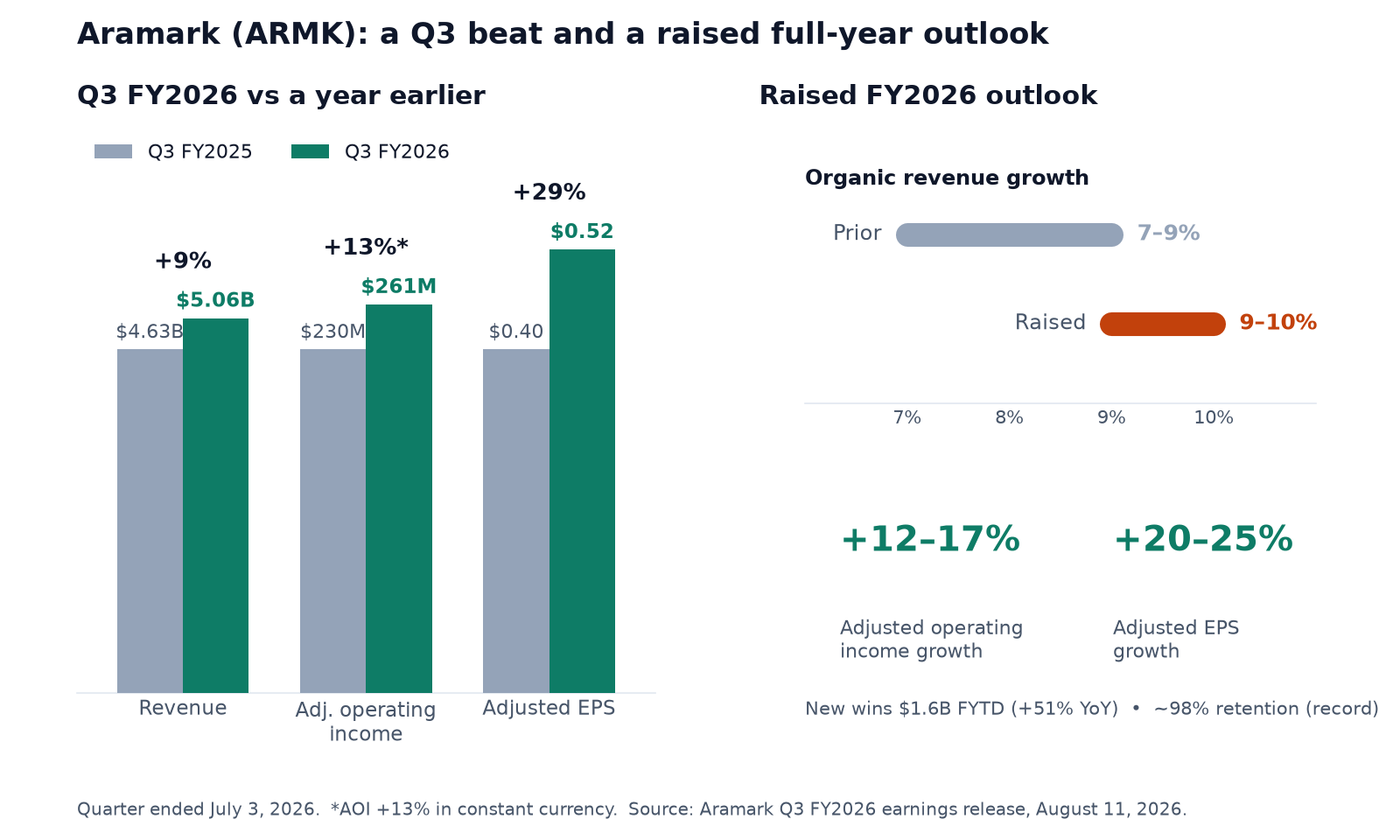
The segment split shows the breadth. FSS United States revenue was $3.496 billion (+8% organic) and FSS International was $1.562 billion (+11% organic) [2]. The one blemish is the balance sheet: leverage sat at about 3.5x against a stated goal of under 3x by fiscal year-end. Quarterly free cash flow was a slim +$8.7 million, while nine-month operating cash flow was still negative (about −$265 million) on the normal first-half seasonality — Aramark's cash generation is back-half weighted, so the Q4 print is what proves the deleveraging [1].
Why "Nexus" is the whole story
Aramark Nexus is the company's platform for delivering integrated hospitality, dining and facilities services inside hyperscale AI data centers — feeding and supporting the construction and operations workforces at campuses that increasingly sit in remote locations with thousands of workers and no nearby amenities [5]. It launched formally in April 2026 with a multi-year engagement with a top global hyperscaler; this quarter is the first time it showed up as live revenue and, more importantly, as a reason to lift guidance [1][5]. The read-through is that the same AI build-out repricing bitcoin miners and power producers has now reached the services layer — and Aramark is the scaled incumbent that can staff it.
Why it matters
Aramark is the mirror image of the trades that have dominated this year's AI-infrastructure coverage. Where Riot Platforms, Hut 8 and TeraWulf re-rated as the landlords of AI compute, Aramark is being repriced as one of its service providers — the caterer and facilities operator for the people who build and run the campuses. It is a lower-beta, cash-generative way to touch the same secular build-out, and this quarter is the first hard evidence that the theme extends past power and real estate into the workforce economy around the data center.
How the peers and sector traded the same day
The tell that this was Aramark's own news, not a sector move, is that nothing else moved. The broad market was flat — the S&P 500 slipped about 0.06% to 7,753 — and Aramark's two large-cap contract-services peers were unchanged on the session [9]:
| Name (ticker) | Aug 11 move | Note |
|---|---|---|
| ARMK — Aramark | +9.8% | Q3 beat + raised FY organic outlook on hyperscaler ramp [1][3] |
| CMPGY — Compass Group (ADR) | ≈ flat | ~$32.4; global No.1 caterer, also citing AI-data-center catering demand [10][11] |
| SDXAY — Sodexo (ADR) | 0.0% | $13.01 at 9:50 a.m. ET; guiding faster growth from 2027 [12] |
| S&P 500 (index) | −0.06% | Broad market flat at ~7,753 [9] |
Compass Group has made the same strategic point — its Business & Industry unit booked more than $2 billion of new business helped by "robust demand for food and support services from AI hyperscalers" [11] — which is exactly why Aramark's confirmation that the revenue is now live was worth a re-rating. The theme is industry-wide; the catalyst on August 11 was Aramark-specific.
What to watch
The guidance raise is the promise; the disclosure is the proof. The milestones that turn Nexus from a footnote into a modeled revenue line:
- The Q4 FY2026 print — Aramark's cash generation is back-half weighted, so Q4 is where the sub-3x leverage target and the full-year adjusted-EPS growth of 20–25% either land or slip [1].
- Nexus site count and disclosed revenue — one Texas hyperscaler site is live and a second is mobilizing; watch for a named, quantified Nexus contribution rather than a qualitative mention, and whether management starts breaking it out [1][5].
- The path to Oppenheimer's $3–4B 2028 run-rate — that is the number underwriting the bull case; each new hyperscaler or colocation engagement is a data point for or against it [7].
- Organic growth in the core FSS segments — International (+11%) is outrunning the US (+8%); the raised 9–10% company outlook assumes both hold while Nexus adds at the margin [2].
- Fresh post-print analyst targets — the pre-earnings bull cluster ($63–$70) predates this quarter; watch whether the Aug 11 numbers pull the laggards up or simply confirm a stock already at consensus. Day-to-day is tracked on the ARMK stock page, and the next print will appear on our earnings calendar.
Illustrative valuation scenarios
The scenarios below are a descriptive, probability-weighted price-anchor exercise — not a forecast or a recommendation. The high end is anchored to a named, dated analyst target (Truist $70, Jul 27); the low end to the pre-run-up level and the more cautious Morgan Stanley $55. The probabilities are the author's own illustrative estimates and sum to 100%.
| Scenario | Price anchor | Prob. | Key drivers |
|---|---|---|---|
| Bull | ~$70 | 30% | Nexus scales to multiple hyperscaler and colocation sites and gets disclosed as a real revenue line; core organic growth holds at 9–10%; leverage falls below 3x. The market keeps paying a growth multiple for an AI-services optionality. Anchored to Truist's $70 [13]. |
| Base | ~$62 | 45% | The beat-and-raise holds, Nexus ramps roughly on the guided path but stays a modest contributor into FY2027, and the stock consolidates near consensus at ~23–24x forward. Matches the ~$61.6 average target [8]. |
| Bear | ~$52 | 25% | Nexus timelines slip ("2–3 quarters away" becomes later), leverage stays above 3x, or a softer macro pressures the core FSS business; the AI-optionality premium compresses back toward a defensive-caterer multiple. Near Morgan Stanley's $55 and the pre-run-up zone [8]. |
Blending those (0.30 × $70 + 0.45 × $62 + 0.25 × $52) gives a probability-weighted anchor near $62, essentially on top of the ~$61 price [3]. Unlike the miner trades — where the Street's central case sat well above the stock — Aramark now trades in line with its blended fair value: the re-rating has largely happened, and further upside leans on Nexus turning into disclosed dollars rather than on the gap between price and target closing.
Why is Aramark (ARMK) stock up today?
On August 11, 2026, before the open, Aramark reported fiscal Q3 results that beat expectations — revenue $5.06 billion (+9%), adjusted EPS $0.52 (+29%) — and raised its full-year organic revenue outlook to 9–10% from 7–9%, crediting the launch of operations with a top global hyperscaler under its Aramark Nexus data-center platform [1][2]. The stock rose about 9.8% to roughly $61.15 by late morning, a fresh 52-week high, while the broad market and its food-services peers were flat [3][9].
ARMK data snapshot — August 11, 2026 (timestamped)
| Figure | Value | As-of / source |
|---|---|---|
| Prior close | $55.71 | Mon, Aug 10, 2026 [3] |
| Open (Aug 11) | $59.95 | 9:30 a.m. ET [3] |
| Primary intraday quote | $61.15 (+9.76%) | ≈ 11:09 a.m. ET — StockAnalysis [3] |
| Corroborating quote | $61.12 (+9.71%) | This site's ARMK what-changed feed [4] |
| Volume vs average | ≈ 1.38M by 11:09 a.m. vs ~2.58M full-day avg | Above-average pace two hours in [3][6] |
| 52-week range | $35.07 – $61.33 | At/near the high, Aug 11 [3] |
| Market cap | ≈ $16.1B | At the intraday quote, Aug 11 [3] |
| Valuation | P/E ≈ 42.8 trailing; ≈ 23.8 forward | Aug 11 — StockAnalysis [3] |
| Dividend | $0.48 (0.78%); ex-div Aug 19 | Aug 11 — StockAnalysis [3] |
Each figure is valid only at its stated time; the intraday quote comes from a fast-moving session and two independent feeds (StockAnalysis and this site's own) agree to within a few cents on both price and the ~9.7% move.
The quarter at a glance
| Question | Answer |
|---|---|
| What was reported? | Fiscal Q3 2026 (quarter ended July 3, 2026): revenue $5.06B (+9%), GAAP EPS $0.36 (+34%), adjusted EPS $0.52 (+29%), AOI $261M (+13% cc) [1]. |
| Why did guidance go up? | Full-year organic revenue outlook raised to 9–10% (from 7–9%), reflecting the start of operations with a top global hyperscaler under Aramark Nexus [1][2]. |
| What is Aramark Nexus? | Aramark's platform providing integrated hospitality, dining and facilities services inside hyperscale AI data centers; first Texas site live late in Q3, a second mobilizing [1][5]. |
| How big is Nexus today? | Small — it nudged guidance at the margin. Analysts see "material" results 2–3 quarters out; Oppenheimer's $3–4B run-rate is a 2028 estimate, not a current figure [7]. |
| What's the catch? | Leverage was ~3.5x versus a sub-3x fiscal-year-end target, and the stock is now at a 52-week high, on the ~$61.6 consensus target and ~24x forward earnings [1][8]. |
Aramark (ARMK) stock FAQ
Why did Aramark (ARMK) stock jump on August 11, 2026?
Before the open, Aramark reported fiscal Q3 2026 results that beat expectations — revenue of $5.06 billion (up about 9%) and adjusted EPS of $0.52 (up 29%) — and raised its full-year organic revenue outlook to 9–10% from 7–9%, crediting the start of operations with a top global hyperscaler under its Aramark Nexus data-center platform. The stock rose about 9.8% to roughly $61.15, a fresh 52-week high.
What is Aramark Nexus?
Aramark Nexus is the company's platform for delivering integrated hospitality, dining and facilities services inside hyperscale AI data centers — supporting the large construction and operations workforces at remote campuses. It launched in April 2026 with a multi-year engagement with a top global hyperscaler; Aramark began operations at its first Texas-based hyperscaler site late in fiscal Q3 2026, with a second location mobilizing.
How much did Aramark raise guidance, and why?
Aramark lifted its full-year FY2026 organic revenue growth outlook to 9–10%, up from 7–9%, and management attributed the increase to commencing operations with a top global hyperscaler. It reaffirmed its outlook for adjusted operating income growth of 12–17%, adjusted EPS growth of 20–25%, and a leverage ratio target below 3x.
Is Aramark Nexus a big part of revenue yet?
No. Nexus moved the full-year guidance only at the margin this quarter. Even bullish analysts say 'material' results are two to three quarters away; Oppenheimer's estimate that Nexus could contribute a $3–4 billion revenue run-rate is a 2028 figure, not a current one. Today it is an early-stage growth option layered on a large, established contract-catering business.
What did the quarter's core numbers look like?
Revenue was $5.06 billion (about +9% organic), GAAP EPS $0.36 (+34%), adjusted EPS $0.52 (+29%), and adjusted operating income $261 million (+13% in constant currency). FSS United States grew 8% organically and FSS International 11%. Client retention hit a record near 98% and net-new business reached $1.6 billion fiscal year to date, up 51%. Leverage was about 3.5x against a sub-3x fiscal year-end target.
Is ARMK expensive after the move?
After the jump the stock sits at a 52-week high, essentially on the roughly $61.6 average analyst price target and around 23–24x forward earnings. That is a full multiple that already prices in much of the near-term Nexus optionality, so further upside leans on Nexus converting into a disclosed, quantified revenue line rather than on the stock closing a gap to target. This is descriptive analysis, not investment advice.