Stock Analysis
Why did Hut 8 (HUT) stock jump ~11% on July 20, 2026 — a second $9.8 billion Beacon Point lease that fully commercializes a 1 GW campus
Hut 8 jumped about 11% on July 20, 2026 after a second 352 MW, 15-year, $9.8 billion lease fully commercialized its 1 GW Beacon Point campus in Texas — signed by the same unnamed tenant that took Phase 1 in May. The deeper significance is financing: Phase 1 was funded with $4.25 billion of non-recourse, Baa2-rated notes, and an anchor lease is the precondition for repeating that. But the move only round-trips a two-session drop, leaving the stock below where it closed on Wednesday.
Summary
Hut 8 (Nasdaq: HUT) traded at $101.75 at 11:29 a.m. ET on Monday, July 20, 2026 — the snapshot every figure below is quoted as of, with the session still running — up $10.30, or 11.26%, from Friday's close of $91.45 [2][11]. The clearest company-specific catalyst came from Hut 8 itself: before the open, Hut 8 announced a second 352-megawatt lease at its Beacon Point campus in Nueces County, Texas — 15 years, $9.8 billion of base-term contract value, triple-net — that fully commercializes the 1-gigawatt site [4].
Two details in the BestStocks feed's summary are worth correcting, because both change the interpretation. First, this is the second lease of exactly this size, not the first: Hut 8 signed an identical 352 MW, 15-year, $9.8 billion lease on May 6, with the same unnamed high-investment-grade tenant, which has now doubled its campus footprint to 704 MW [4][5]. Second, the feed's volume reading of "0.9× average" was snapshotted at 9:32 a.m. ET, two minutes into the session [1]; across the morning as a whole, participation was heavy — running at roughly 2.9× a straight-line pace (see below) [3][11].
| Evidence level | What can be said |
|---|---|
| Documented | HUT quoted $101.75, +11.26%, at 11:29 a.m. ET on Jul 20; a second 352 MW / 15-year / $9.8bn triple-net lease was announced at 06:30 ET, taking Beacon Point to $19.6bn of base-term value and the whole portfolio to 949 MW and $26.6bn; Phase 1's 352 MW was funded in June with $4.25bn of non-recourse, Baa2-rated notes [2][4][6]. |
| Reported interpretation | The move came inside a broad AI-compute rally, though the two largest gainers — Hut 8 and IREN — each had their own company-specific news that morning [7][13]. |
| Author inference / not measurable | That the lease chiefly de-risks the next project financing is the author's reading, not a company statement. So is the view that the rest of the sector's move was an oversold bounce rather than a common macro driver. How much of the move is fundamental repricing versus covering by the 14.6%-of-float short base cannot be separated from one session's tape. The scenario values below are illustrative estimates, not forecasts. |
What changed
| Metric | Value | As of / source |
|---|---|---|
| Price | $101.75 | Jul 20 2026, 11:29 a.m. ET — StockAnalysis [2]; Yahoo Finance had $101.41 at 11:28:41 a.m. [11] |
| Prior close (Jul 17) | $91.45 | Identical on both feeds [2][11] |
| Change | +$10.30 / +11.26% | Vs prior close; Yahoo had +10.89% at 11:28 a.m., and Benzinga $102.02 / +11.56% in pre-market trade at 7:35 a.m. [2][10][11] |
| Day's range | $99.31 – $107.00 | The $107.00 high is +17.0% vs $91.45 — which reconciles CoinDesk's "as much as 17%" [2][7] |
| 52-week range | $18.68 – $140.80 | Still ~28% below the 52-week high even after the pop [2] |
| Volume | ~4.03M sh by 11:29 a.m. | Vs a 4.53M 3-month average full day — about 2.9× a straight-line pace [3][11] |
| Short interest | 12.69M sh | 14.61% of float (11.27% of shares out) — StockAnalysis [3] |
| Market cap | ~$11.5bn | 112.59M shares out; 5-year beta 6.07 [2][3][11] |
| Analyst targets | $70 – $226 | Consensus $134.88, median $132.50, across 16 analysts, all Buy — per StockAnalysis; other aggregators differ (MarketBeat carries 18 analysts, a $120.37 average and one Sell) [2][9][17] |
On volume, the early read is worth updating. The BestStocks entry logged turnover at "0.9× average," which reads as light participation — but that snapshot was taken at 9:32 a.m. ET, barely two minutes into trading, so it cannot describe the session [1]. By 11:29 a.m., 119 minutes into a 390-minute session (about 30% elapsed), Hut 8 had already traded 4.03 million shares against a 4.53-million three-month average day — roughly 89% of a normal full day's volume in under a third of the session, or about 2.9× a straight-line pace [3][11]. One honest caveat: volume clusters at the open, so simply extrapolating that pace overstates where the full day lands. Even allowing for that, this was a heavy tape, not a thin drift — which matters for how much conviction to read into the move.
Two further details complicate the "big move" framing, and both cut the same way. First, almost all of the repricing happened immediately: the BestStocks feed caught HUT at $101.76, +11.27%, at 9:32 a.m. — two minutes after the open — and nearly two hours later it was at $101.75 [1][2]. The market absorbed a $9.8 billion lease essentially at the bell and then went sideways. Second, and more important for anyone reading an 11% gain as a re-rating, is where it started from. HUT closed at $103.03 on Wednesday July 15, then fell two sessions running — to $91.91 on Thursday and $91.45 on Friday, with a brutal Friday range that opened at $87.02 and touched $83.30 intraday [20]. Monday's jump therefore does not take the stock anywhere new: at $101.75 it is still about 1% below its Wednesday close. The move round-trips a two-day drawdown rather than breaking new ground, and any read of what the lease is "worth" to the equity has to start there.
The catalyst: the same tenant, doubling down
At 06:30 a.m. ET Hut 8 said it had signed a second 352 MW IT lease at Beacon Point on a 15-year base term worth $9.8 billion, with a 3.0% annual escalator and three five-year renewal options that would lift campus-level value to as much as $50.2 billion if all were exercised [4]. The structure is triple-net, and the counterparty is the same high-investment-grade tenant that signed Phase 1 in May — a fact that cuts in two directions. The author reads a customer re-upping at identical scale ten weeks later as a strong operational endorsement of the site; the fair counter is that a new tenant would have validated broader market demand and diversified the credit, whereas this deal concentrates it further [4][5].
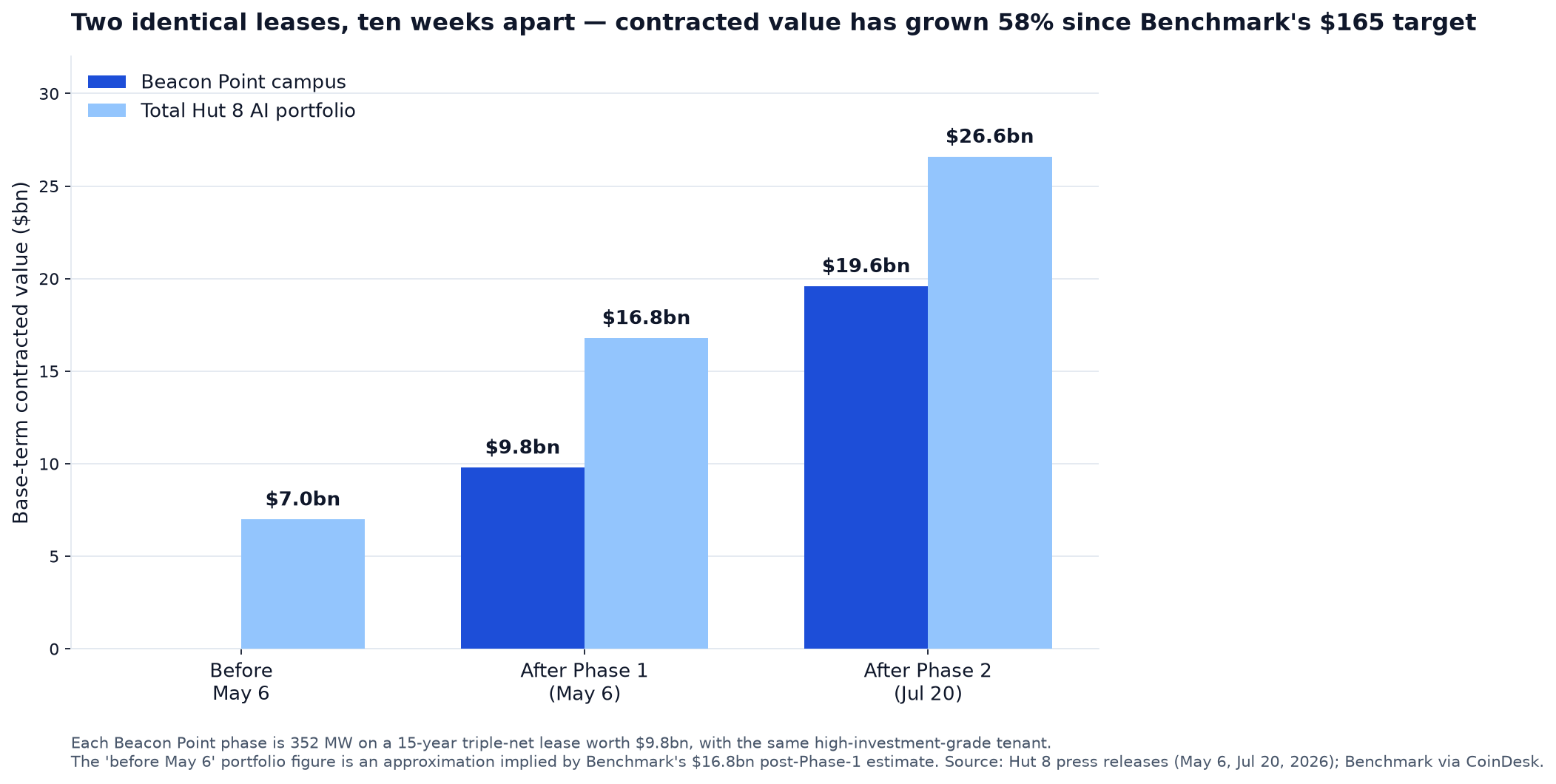
The cumulative arithmetic is what the bull case rests on. Beacon Point's base-term value goes from $9.8 billion to $19.6 billion; across the portfolio, Hut 8 now reports 949 MW of contracted IT capacity against 1,330 MW of utility capacity, $26.6 billion of aggregate base-term value, and expected average annual net operating income above $1.75 billion [4]. The 949 MW splits 704 MW at Beacon Point and 245 MW at River Bend in Louisiana [4]. On credit, the company's exact wording is worth keeping intact: 100% of the contracted portfolio is "leased to or backstopped by investment-grade counterparties" [4]. That is a slightly softer claim than a portfolio of direct investment-grade leases, and since the tenant is unnamed, readers cannot tell which of the two applies at Beacon Point.
Timing is the offsetting consideration, and it is not small. The site is on schedule to energize in Q1 2027, but the first Phase 2 data hall is not expected to deliver until Q2 2028 [4]. The $655 million of annual NOI that Phase 2 is expected to throw off at stabilization is therefore a 2028–2030 cash flow being priced into a 2026 share price — which is precisely why the discount rate you apply dominates any valuation of this company.
A sector rally — but check who had their own news
Hut 8 did not move alone. Bitcoin-miners-turned-AI-hosts rallied broadly: Cipher Mining (CIFR) rose about 11%, MARA Holdings about 9%, Applied Digital (APLD) about 9% to $28.06, TeraWulf (WULF) 6.4% and Riot Platforms (RIOT) 5%, with the CoinShares bitcoin-miners ETF (WGMI) up 8.5% [7][12].
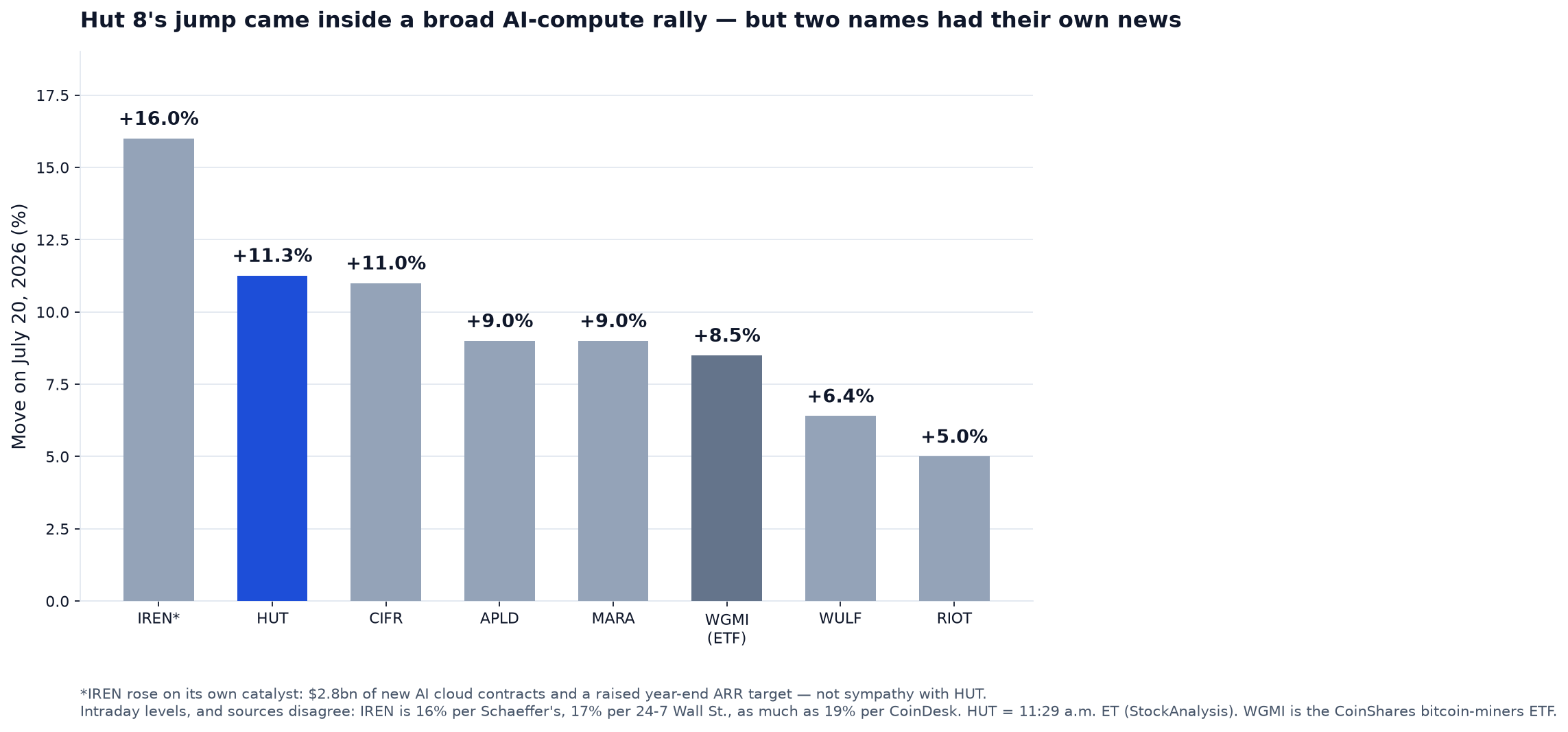
The nuance most coverage skipped: the day's largest gainer, IREN, was not trading in sympathy with Hut 8 at all. It rose about 16% on its own catalyst — $2.8 billion of new multi-year AI cloud contracts with leading AI developers, and a 2026 year-end AI cloud annualized-run-rate target raised from $3.7 billion to more than $4 billion [13][19]. So two separate, genuinely company-specific announcements landed the same morning in the same sub-sector.
What that leaves for the rest of the group is best read as a bounce rather than a re-rating, and the cited sector coverage makes the case more directly than this article would: 24/7 Wall St. framed July 20 as a technical recovery rather than a fresh catalyst, noting one-month declines of roughly 42% at IREN, 43% at Applied Digital, 35% at TeraWulf and 26% at Core Scientific going into the session, with IREN itself snapping a seven-day losing streak [12][13]. On that reading the smaller gains in RIOT and WULF are an oversold complex catching a bid on two pieces of good news — an interpretation the author finds more persuasive than a common macro driver, though the tape cannot settle it. It is the same broader AI-hardware unwind that has left HUT roughly 28% below its 52-week high of $140.80 even as its portfolio contracted value rose 58% since May, and Beacon Point's own doubled [2][4]. The closest precedent in this sector is TeraWulf, which re-rated on a comparably large AI lease — and the counter-example is Bloom Energy, which sold off on an AI-infrastructure deal, a reminder that a big contract headline does not reliably produce a green day.
The analyst scorecard, one firm at a time
Coverage is unusually one-directional: StockAnalysis counts 16 analysts and 16 Buy ratings, with no Holds or Sells, so the dispersion in targets carries more information than the ratings do [2]. Aggregators do not agree on the roster — MarketBeat tracks 18 analysts, including one Sell, and a lower $120.37 average — which is itself a reason to read any single consensus figure loosely [17]. The individually dated actions below are the more reliable record:
| Firm (analyst) | Action | Rating | Date |
|---|---|---|---|
| Benchmark (Mark Palmer) | $85 → $165 | Buy (kept) | Jul 14 [8] |
| BTIG (Gregory Lewis) | $115 → $150 | Buy (kept) | Jun 24 [9] |
| Lucid Capital Markets (Darren Aftahi) | initiated at $226 | Buy | Jun 22 — see note [21] |
| Rosenblatt (Chris Brendler) | $124 | Buy (reiterated) | Jun 11 [9] |
| Jefferies (Jonathan Petersen) | initiated at $156 | Buy | May 14 [9] |
| B. Riley (Nick Giles) | $76 → $130 | Buy (kept) | May 13 [9] |
| Compass Point | set $130 | — | May 13 [9] |
| Citizens JMP (Greg P. Miller) | $100 → $140 | Market Outperform | May 7 [9] |
| Canaccord Genuity (Joseph Vafi) | $70 → $130 | Buy (kept) | May 7 [9] |
| Needham (John Todaro) | $88 → $128 | Buy (kept) | May 7 [9] |
| Northland Securities | set $120 | — | May 7 [9] |
| Piper Sandler (Patrick Moley) | $93 → $127 | Overweight (kept) | May 6 [9] |
| Cantor Fitzgerald (Brett Knoblauch) | $68 → $80 | Overweight (kept) | Apr 9 — before either lease [18] |
| KBW / Keefe Bruyette | $89 → $138 | Outperform (kept) | June; exact date not confirmed [14] |
Note the clustering: the May 6–14 wave of raises was the market repricing Phase 1, and the July 14 Benchmark move to $165 — nearly a double from $85 — was published into visible weakness, not strength: HUT closed at $98.33 that day, near a one-month low, having sold off hard from its early-summer highs [20]. Palmer was incorporating Beacon Point and describing Hut 8's evolution into "something akin to a power-first data center REIT with an embedded development machine" [8]. The point that matters for Monday: Palmer's $165 was built on the $16.8 billion of contracted value across 597 MW that Hut 8 itself disclosed in its May 6 release [5][8]. Phase 2 lifted that base to $26.6 billion — a 58% increase — just six days after Palmer published [4]. So Benchmark's target — and, on the evidence of their dates, most of the individually documented targets behind the $134.88 consensus — rest on a contracted-value figure the company has since materially outgrown. Since aggregators do not publish a timestamped constituent list, that is a statement about the dated notes in the table rather than a claim about every input to the average; it is an argument for targets drifting up from here.
The low end deserves the same scrutiny in reverse. Cantor Fitzgerald's $80 is the lowest individually documented target in the table above, but Brett Knoblauch set it on April 9 — before the May 6 Phase 1 lease, before the June financing and before Phase 2 [18]. It is not a bearish view of the Beacon Point story so much as a target that predates it entirely. Note too that the published low is lower still and unattributed: StockAnalysis's range bottoms at $70 and MarketBeat's at $30, neither traceable to a dated note in the record above [9][17]. Treat the headline range as a loose envelope rather than a live spread of opinion.
What this means for value
Hut 8 is best valued as a development-stage infrastructure owner rather than a miner: contracted, escalating, triple-net cash flows against project-level debt, with a large uncontracted pipeline as an option on top. The scenarios below are the author's own illustrative estimates. They anchor to the company's stated >$1.75 billion of expected average annual portfolio NOI, to stabilized hyperscale data-centre cap rates of roughly 4.5–6.0%, and to the published target distribution — not to a formal model [4][16]. They sum to 100%.
It is worth showing the bridge once, so the scenario prices are reproducible rather than asserted. Hut 8 expects the full 1,000 MW Beacon Point campus to generate about $1.31 billion of average annual NOI at stabilization [4]. Capitalized at the bullish end of the hyperscale range (5.5%) that is roughly $24 billion of gross asset value for the campus alone; at a stressed 7.5% it is about $17 billion [16]. Against that sit project debt (already $4.25 billion for Phase 1, plausibly a similar sum for Phase 2 at ~$12.1 million per MW) and, critically, time — none of this NOI exists before 2027, and the Phase 2 half not before 2028. Discounting a stabilized 2029–2030 equity value back at a low-double-digit cost of equity is what pulls a $24 billion asset story down to a share price near the current one, and it is the step the published targets compress hardest.
One more anchor, because it is easy to lose sight of what is being valued: on today's numbers Hut 8 trades at roughly 36× trailing sales with a trailing loss of about $2.90 a share [3]. Nothing in the scenarios below is supported by current earnings — they rest entirely on contracted capacity that has not yet been built. That is the honest case for valuing HUT as an infrastructure owner rather than an operating company, and equally the reason a 30% bear weight is not pessimism.
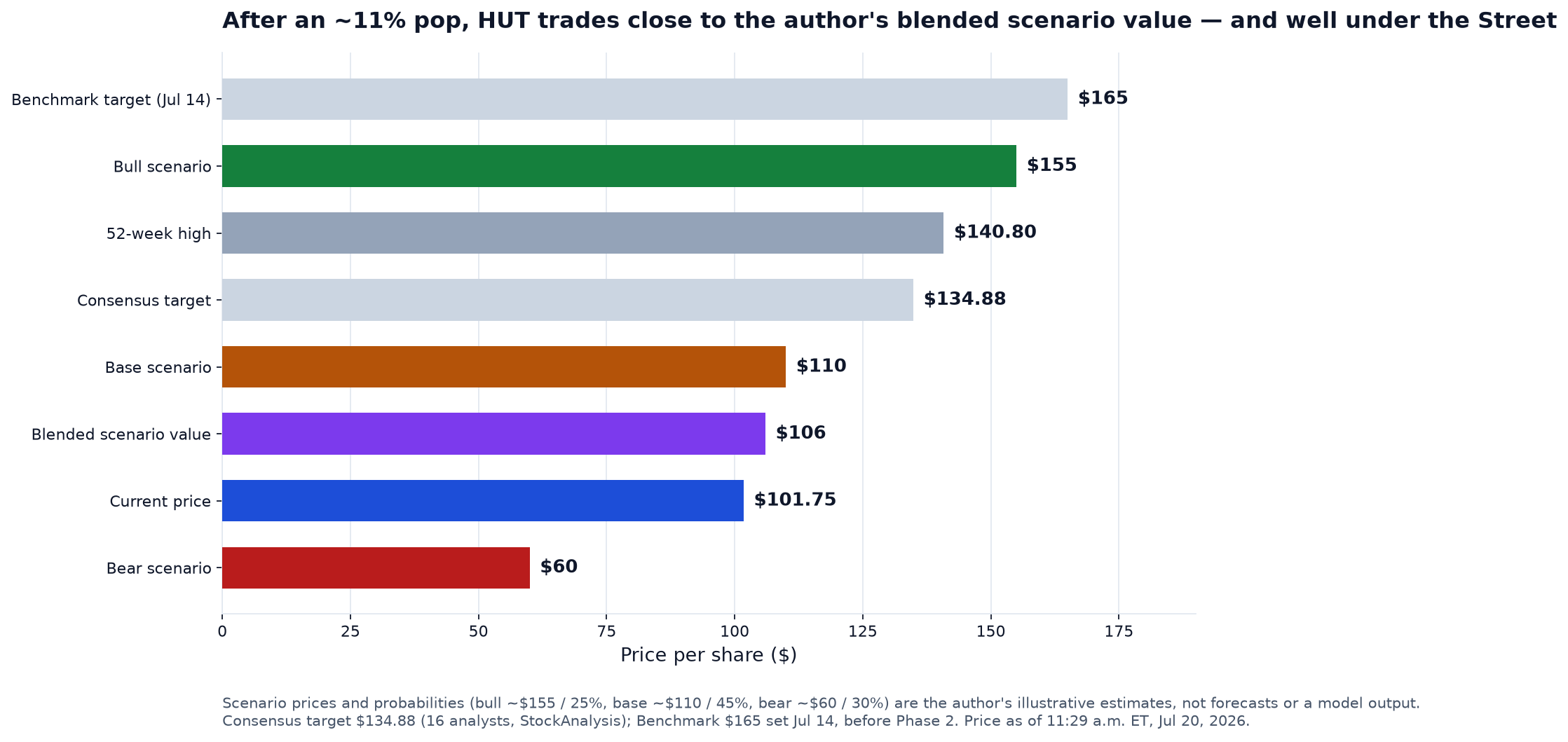
| Scenario | Price | Probability | Key driver |
|---|---|---|---|
| Bull | ~$155 | 25% | Phase 2 is financed on Phase 1-like terms (non-recourse, ~6%, non-dilutive) by early 2027; the campus energizes on schedule in Q1 2027; a ~5.0–5.5% cap rate on stabilized NOI is applied with execution risk largely retired, and the market starts paying for the 9+ GW pipeline as further campuses commercialize on the Beacon Point template — approaching, without quite reaching, the Jefferies $156 / Benchmark $165 end of the range [6][8][16] |
| Base | ~$110 | 45% | Financing gets done but at somewhat wider spreads; NOI arrives on the stated 2028–2030 schedule and is discounted at a low-double-digit cost of equity; a ~6.0–6.5% cap rate applies and only modest credit is given for uncontracted pipeline — landing between the current price and the target cluster in the $124–$140 band [4][9] |
| Bear | ~$60 | 30% | Credit markets tighten or the tenant's capex plans slip, so Phase 2's raise needs equity after all; the Q2 2028 delivery date slips; cap rates back up toward 7.5% and the single-tenant concentration draws an explicit discount — the 2026 AI-infrastructure de-rating resumes and the stock breaks decisively below the $83.30 intraday low it printed on July 17 [3][20] |
| Probability-weighted scenario value ≈ $106 (0.25 × $155 + 0.45 × $110 + 0.30 × $60 = $106.25, rounded; an illustrative estimate, not an objective fair value) — the $101.75 quote sits about 4% below it, and about 25% below the $134.88 consensus target. | |||
The blend deliberately lands well under the Street, and the reason is worth stating plainly rather than splitting the difference. Sell-side targets in the $124–$165 range are broadly consistent with capitalizing the stated stabilized NOI at hyperscale cap rates — the arithmetic works. What they compress is time and financing risk: most of that NOI does not exist until 2028–2030, roughly $4 billion of project debt for Phase 2 has not yet been raised, and a 30% bear weight on a company with a 5-year beta of 6.07 and 14.6% of its float short is not a pessimistic assumption so much as an acknowledgement of the distribution [3]. On these assumptions Monday's 11% move took HUT from modestly cheap to roughly fair — the news was genuinely good, and the market repriced most of it inside two hours.
One number not used above deserves a caveat, because it is easy to misread. Widely quoted balance-sheet figures for Hut 8 — cash of about $160 million against total debt of roughly $423 million — are drawn from the quarter ended March 31, 2026 and therefore predate the $4.25 billion of June notes entirely [3][6][15]. That $423 million is also not in tension with the claim of zero recourse debt at the parent: it is pre-notes legacy borrowing on a stale balance sheet, while the $4.25 billion sits at Beacon Point DC LLC and is non-recourse by construction [6]. Any leverage or enterprise-value screen on this name computed from stale quarterly data will be badly wrong; the company has also said it expects to fund construction from cash and bitcoin on hand alongside project-level financing [15]. The Q2 report on August 4 is the first clean look at the post-notes balance sheet [2].
What to watch
- Phase 2 project financing — the single biggest swing factor between the scenarios. Watch for another non-recourse, investment-grade-rated raise of roughly $4 billion at the project level. Terms at or near Phase 1's 6.129% / Baa2 would validate the bull case; a deal requiring parent-level equity would not [6].
- Q2 results on August 4 — the first disclosure reflecting the June notes. The specific things to look for are a post-notes balance sheet showing where the $4.25 billion sits and what remains at the parent, updated Beacon Point capex phasing, and — most valuable — whether management gives timing or structure for the Phase 2 raise on the call. Consensus revenue and EPS matter far less here than financing commentary [2].
- Q1 2027 energization — management says the site is on schedule; slippage here pushes the whole NOI ramp right and hits the base case hardest [4].
- Whether the tenant is ever named, or diversified away from — 704 MW with one counterparty is the concentration the market is currently taking on trust [4].
- Target revisions from here — Benchmark's $165 and the $134.88 consensus were both set against $16.8bn of contracted value, now $26.6bn. Whether the Street marks up, and by how much, is a direct read on how it discounts undelivered capacity [4][8].
- The 9+ GW pipeline — the option value in the bull case, and the least substantiated part of it. The figure comes from Benchmark's note rather than a Hut 8 disclosure in any of the releases cited here, and no site list, development stage or power-interconnect status is public, so treat it as an unquantified option rather than a modelled asset. Watch for the next campus commercialized on the Beacon Point template [8].
Frequently asked questions
Why did Hut 8 (HUT) stock jump on July 20, 2026?
Hut 8 announced before the open that it had signed a second 352-megawatt IT lease at its Beacon Point campus in Nueces County, Texas — a 15-year, triple-net lease carrying $9.8 billion of base-term contract value that fully commercializes the 1-gigawatt site. It was signed with the same high-investment-grade tenant that took Phase 1 in May, doubling that customer's footprint to 704 MW and lifting Beacon Point's base-term value to $19.6 billion. The stock traded at $101.75 at 11:29 a.m. ET, up 11.26% from Friday's $91.45 close. Worth noting: that gain mostly reverses a two-session drop, and leaves HUT about 1% below where it closed on Wednesday July 15.
What is Hut 8's Beacon Point campus?
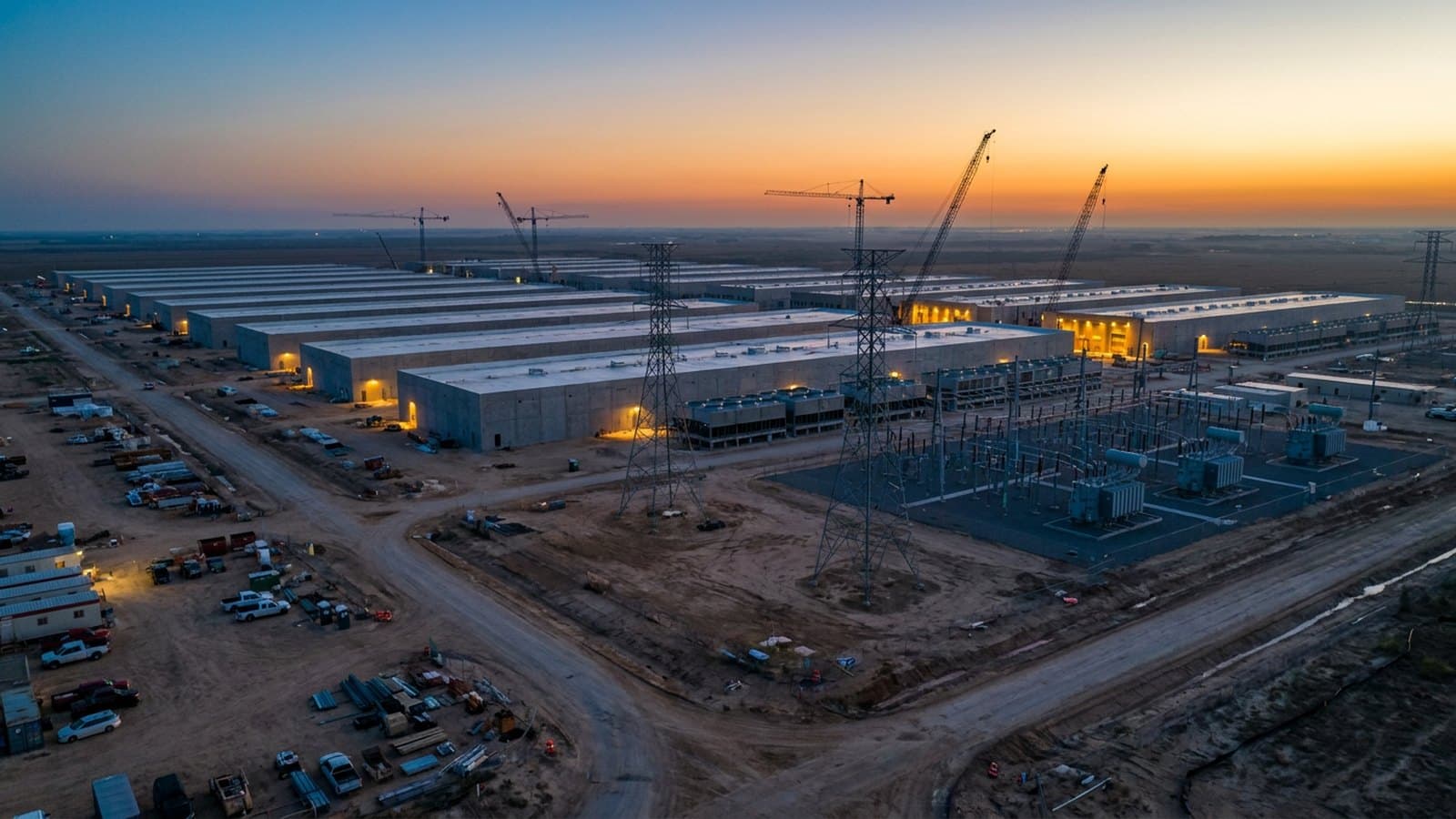
Beacon Point is Hut 8's 1-gigawatt AI data center campus in Nueces County, Texas, built for hyperscale AI training and inference workloads and designed to NVIDIA's DSX reference architecture, with American Electric Power, Vertiv and Jacobs as partners. It is now fully contracted: two 352 MW phases, each on a 15-year triple-net lease worth $9.8 billion, giving the campus 704 MW of contracted IT capacity and $19.6 billion of base-term value — up to $50.2 billion if all three five-year renewal options are exercised. The site is due to energize in Q1 2027, with the first Phase 2 data hall expected in Q2 2028. Beacon Point is the larger of Hut 8's two commercialized campuses; the other, River Bend in Louisiana, accounts for the remaining 245 MW of its 949 MW contracted portfolio.
Who is the tenant at Hut 8's Beacon Point campus?
Hut 8 has not named it. The company describes the counterparty only as a high-investment-grade company, and says that across its whole contracted portfolio 100% of capacity is leased to or backstopped by investment-grade counterparties — wording that leaves open whether the credit is a direct investment-grade lease or a parent guarantee or similar backstop. The same tenant signed both Beacon Point phases, so all 704 MW of the campus now sits with a single unnamed counterparty. That concentration is the clearest risk in the story: investors are asked to take the credit quality on trust, and there is no public way to assess the tenant's own capital commitments or the terms of any backstop. Tenant non-disclosure is common in hyperscale leasing, usually at the customer's insistence, but it does not make the concentration less real.
Is this the same $9.8 billion lease Hut 8 announced earlier in 2026?
No — it is a second, separate lease on identical terms. Hut 8 signed Phase 1 on May 6, 2026: 352 MW, 15 years, $9.8 billion. Phase 2, announced July 20, is another 352 MW, 15 years and $9.8 billion with the same unnamed tenant. Together they take the campus to 704 MW and $19.6 billion of base-term value, and the wider Hut 8 portfolio to 949 MW of contracted IT capacity and $26.6 billion. Summaries that describe a single $9.8 billion deal producing a $19.6 billion total are conflating the two announcements.
How was Phase 1 financed, and how might Phase 2 be financed?
Phase 1 was financed with non-recourse project-level debt rather than equity. On June 9, 2026 Hut 8's subsidiary Beacon Point DC LLC closed $4.25 billion of 6.129% senior secured notes due 2042, rated Baa2 by Moody's and fully amortizing from May 2030. The notes are non-recourse to Hut 8, leaving no recourse debt at the parent, and the company described the financing as non-dilutive with no expected equity issuance. That funded Phase 1's 352 MW. Phase 2 is a different matter: no comparable raise has been announced, and neither its size nor its terms are knowable today. Roughly $4 billion would be implied by Phase 1's ~$12.1 million per megawatt, but that is an inference, not a plan. Because an investment-grade anchor lease is what makes this kind of project debt possible, the Phase 2 lease should make a similar structure easier to arrange — which is why it matters beyond the headline contract value, and why the financing is the single clearest thing to watch from here.
Was Hut 8's volume on July 20 unusually high?
Yes. By 11:29 a.m. ET — 119 minutes into a 390-minute session, about 30% elapsed — roughly 4.03 million shares had traded against a three-month average of 4.53 million for a full day. That is about 89% of a normal day's volume in under a third of the session, or roughly 2.9 times a straight-line pace. Some early summaries logged turnover at 0.9 times average, but that snapshot was taken at 9:32 a.m., two minutes into trading, so it could not yet describe the session. One caveat: volume clusters near the open, so extrapolating that pace would overstate the full-day total. Separately, 14.61% of the float was sold short, so some of the turnover on a gap-up of this size is likely short covering rather than accumulation.
Did other AI data center and bitcoin mining stocks rise too?
Yes, but the group move is weaker evidence of sympathy than it looks. Cipher Mining rose about 11%, Applied Digital about 9% to $28.06, MARA about 9%, TeraWulf 6.4% and Riot Platforms 5%, with the CoinShares bitcoin-miners ETF up 8.5%. However the day's biggest gainer, IREN, rose about 16% on its own catalyst — $2.8 billion of new multi-year AI cloud contracts and a year-end recurring-revenue target raised above $4 billion. So two genuinely company-specific announcements landed in the same sub-sector the same morning. Sector coverage framed the session as a technical recovery rather than a fresh catalyst, noting one-month declines of roughly 42% at IREN, 43% at Applied Digital, 35% at TeraWulf and 26% at Core Scientific beforehand. Note that sources differ on IREN's move: 16% per Schaeffer's, 17% per 24/7 Wall St. and as much as 19% per CoinDesk.
What do analysts think Hut 8 stock is worth?
Per StockAnalysis, coverage is uniformly positive: 16 analysts, all rating it Buy, with a consensus target of $134.88, a median of $132.50 and a range from $70 to $226. Aggregators disagree on the roster — MarketBeat tracks 18 analysts, a $120.37 average and one Sell — so treat any single consensus figure loosely. The highest target from a dated, individually documented note is Lucid Capital Markets' $226 initiation on June 22; the most-discussed recent move is Benchmark's, where Mark Palmer nearly doubled his target to $165 from $85 on July 14. The important caveat is timing — Palmer's target was built on the $16.8 billion of contracted value across 597 MW that Hut 8 disclosed on May 6, and Phase 2 lifted that base to $26.6 billion six days later, a 58% increase. Both that $165 and most of the dated targets behind the $134.88 consensus therefore predate a figure the company has since outgrown. At the other end, Cantor Fitzgerald's $80 was set on April 9, before either Beacon Point lease existed.
Is Hut 8 stock still cheap after the July 2026 jump?
On the author's illustrative probability-weighted scenarios — bull ~$155 at 25%, base ~$110 at 45%, bear ~$60 at 30%, blending to about $106 — HUT at $101.75 trades roughly 4% below that figure, so close to fairly valued rather than obviously cheap, with most of the re-rating happening inside the first two hours. That blend sits about 21% under the $134.88 consensus target (the price itself is about 25% under it), and the difference is mainly about discounting rather than the assets: most of the expected NOI does not arrive until 2028 to 2030, roughly $4 billion of Phase 2 project debt has not yet been raised, and the stock carries a 5-year beta of 6.07 with 14.6% of its float short. These figures are illustrative descriptive analysis, not investment advice.