AI Infrastructure
Riot Platforms (RIOT) Stock: What the $9.1 Billion AI Data-Center Lease Changes
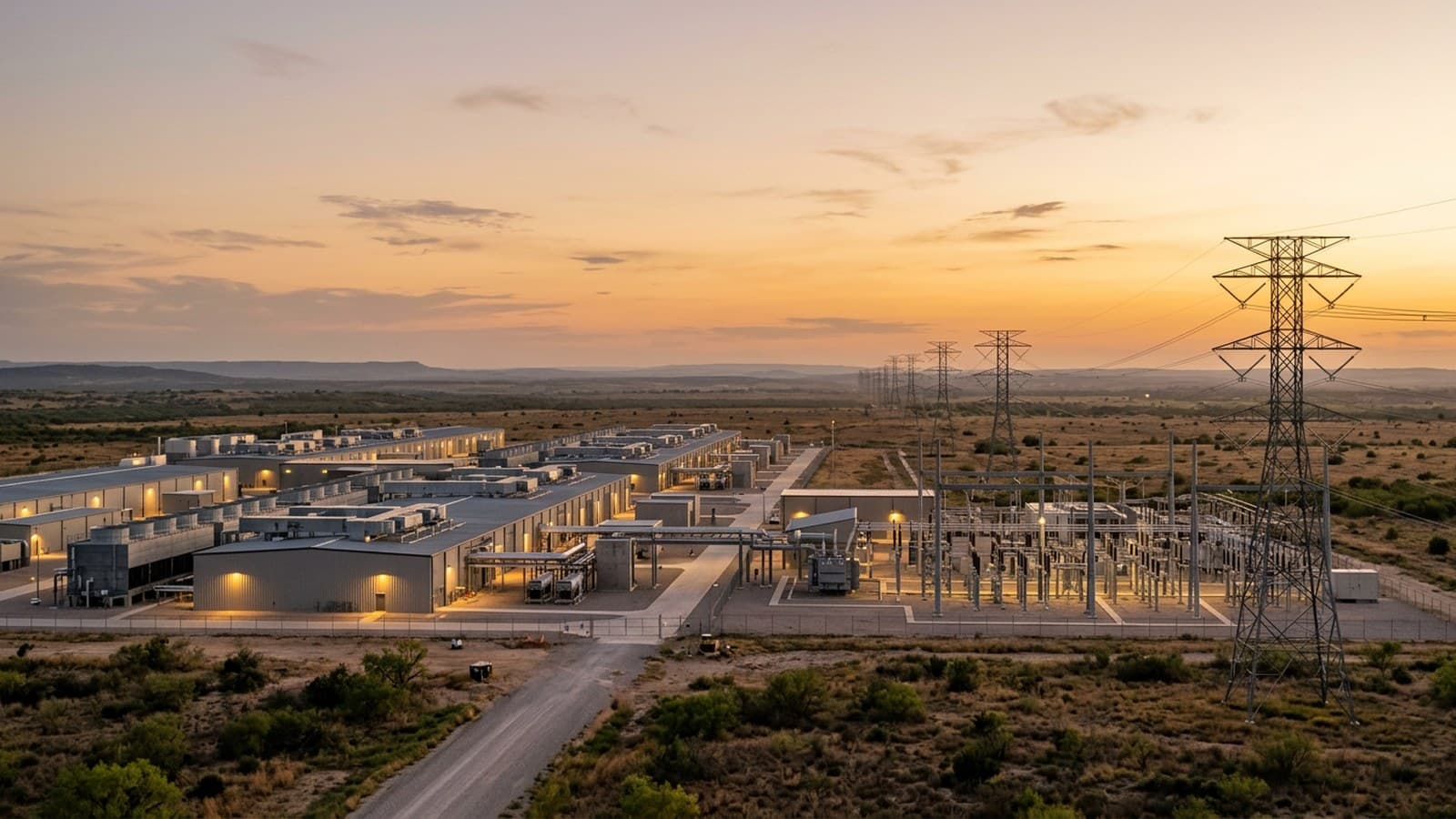
Riot Platforms disclosed a 20-year, 191 MW lease with "a leading frontier AI lab" — reported to be Anthropic — worth about $9.1 billion at its Rockdale, Texas campus, alongside a Q2 revenue beat. RIOT gapped up more than 21% at the open before fading to about +8% by mid-morning. What changed for the miner-turned-AI-landlord.
Summary
After Monday's close on August 10, 2026, Riot Platforms (Nasdaq: RIOT) reported second-quarter results and disclosed the deal the market cared about: a 20-year lease with "one of the world's leading frontier AI labs" for 191 MW of critical IT capacity at its Rockdale, Texas campus, expected to generate approximately $9.1 billion of contract revenue over the initial term [1][2]. Riot did not name the tenant; Bloomberg reported it is Anthropic, citing people familiar with the matter [5]. The stock, which closed at $19.40 on August 10, gapped up to $23.57 at Tuesday's open (about +21.5%) and touched $23.66, then gave back more than half of that: it traded near $20.98, up about 8.1%, at 10:06 a.m. ET on August 11 on very heavy volume, with the quote still moving [3][4]. This is a repricing of what Riot is — a bitcoin miner turning into a contracted data-center landlord — layered on a Q2 revenue beat, and the intraday fade is the market weighing that story against a still loss-making business.
What changed
Coming into the print, Riot was a bitcoin miner with a half-built second act. In February it had begun converting its Rockdale power into AI-data-center capacity, and in the second quarter it completed delivery of the initial 25 critical IT MW to AMD on time and on budget, with a second 25 MW under construction [1][2]. What it lacked was a marquee, long-duration tenant. The August 10 announcement supplies exactly that — and at scale: 191 MW on a two-decade term running through June 2048, with two five-year extension options that could lift total contract value to about $16.1 billion if both are exercised [1][6]. CEO Jason Les called it "a defining moment in our evolution into a leading developer of large-scale data centers" [1].
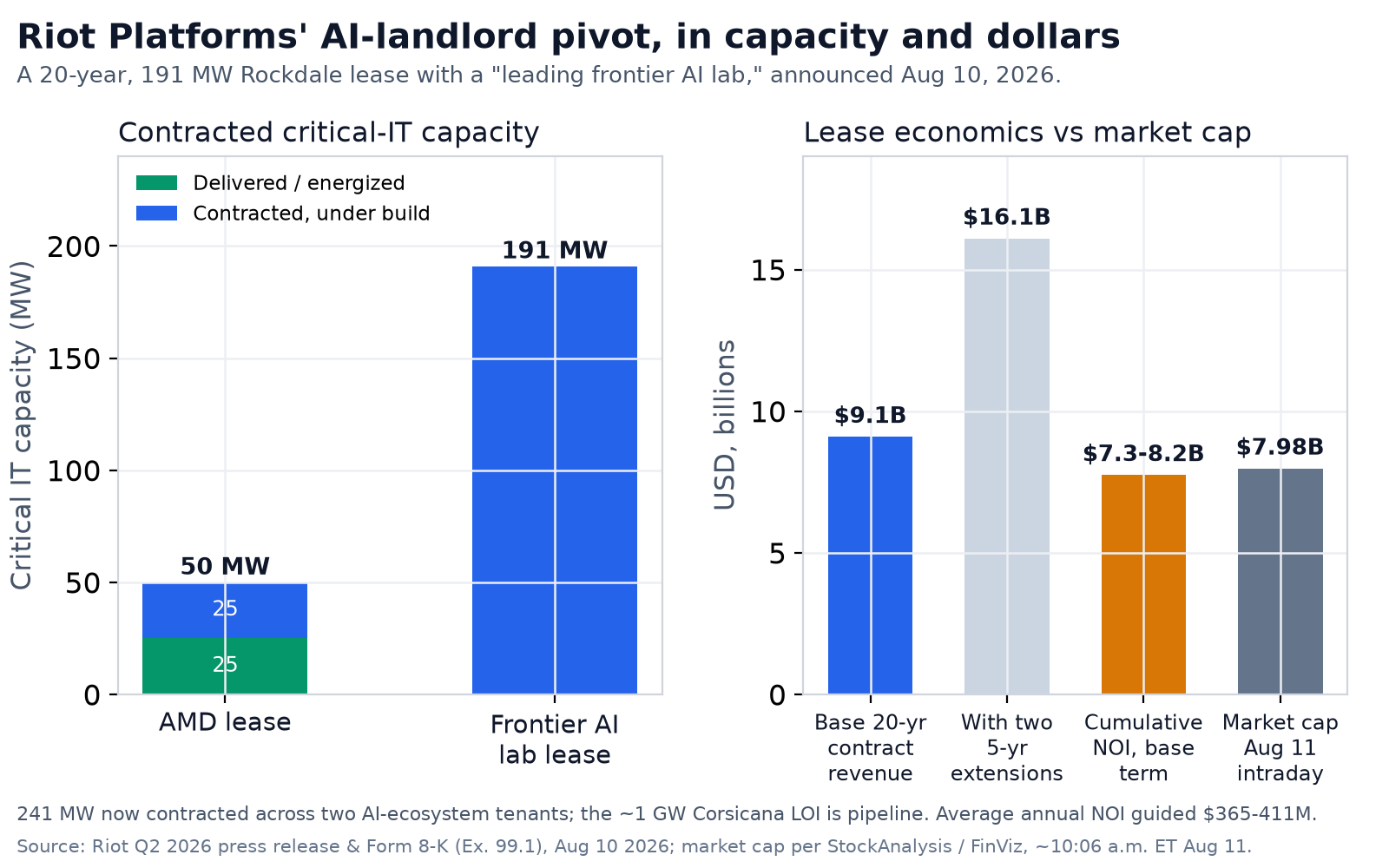
The economics Riot disclosed are specific. Over the base term the company expects cumulative net operating income of $7.3 billion to $8.2 billion, or average annual NOI of $365 million to $411 million once fully ramped [1]. Capacity phases in — an initial 96 IT MW by December 2027 and the full 191 MW by June 2028 — leveraging interconnection Riot says is already fully approved and energized at Rockdale [1][6]. The financing bridge is explicit too: a $573 million interim facility from Morgan Stanley funds initial development "while the investment-grade credit backstop is finalized" [1]. That last clause matters — the backstop is being finalized, not yet closed.
Add the new lease to the AMD deal and Riot now reports 241 MW of contracted critical-IT capacity "with two of the most significant companies in the AI ecosystem" [1]. On top of that sits a non-binding letter of intent for a proposed lease at Riot's Corsicana facility — a site reported to carry roughly a gigawatt of potential capacity — which the 8-K flags as an LOI, i.e. pipeline, not a signed contract [2][12].
The quarter underneath the headline
The lease landed on a genuinely better quarter. Q2 revenue was $174.2 million, up from $153.0 million a year earlier (about +13.9%) and ahead of consensus near $152–154 million [1][11]. But the business is still deeply unprofitable at the bottom line: Riot reported a net loss of about $237.2 million and adjusted EBITDA of about −$69.7 million for the quarter, mined 1,587 bitcoin, and held 11,380 BTC (5,821 of them pledged as collateral) [1]. The revenue beat is real; so is the loss. That tension is the whole reason the stock could open up 21% and be up 8% two hours later.
Why it matters
Duration is what turns power into a financeable asset. After this lease a lender looking at Rockdale sees twenty years of contracted payments, expected investment-grade support, and a tenant committed through 2048 [1] — the same logic that has repriced the miners-turned-landlords ahead of Riot. It is the model TeraWulf used with its $19 billion Anthropic lease in Kentucky and that Hut 8 used to commercialize its Beacon Point campus. Riot's move is the same play on a larger power base, and the market read it that way: this was a stock-and-group move, not a market move.
How the peers traded the same morning
With the broad market roughly flat — the S&P 500 up about 0.1% and the Nasdaq Composite up about 0.2% near 10:08 a.m. ET [13] — the AI-infrastructure miners moved together, RIOT among the leaders:
| Ticker | Aug 11 intraday move | Price | As-of (ET) |
|---|---|---|---|
| RIOT — Riot Platforms | +8.1% | $20.98 | ~10:06 a.m. [3] |
| CIFR — Cipher Mining | +10.8% | $18.09 | ~10:10 a.m. [3] |
| HUT — Hut 8 | +8.9% | $93.30 | ~10:08 a.m. [3] |
| WULF — TeraWulf | +7.6% | $17.43 | ~10:09 a.m. [3] |
| IREN — IREN Ltd | +5.2% | $40.74 | ~10:10 a.m. [3] |
| CORZ — Core Scientific | +4.7% | $20.36 | ~10:09 a.m. [3] |
| APLD — Applied Digital | +3.4% | $30.06 | ~10:10 a.m. [3] |
| MARA — MARA Holdings | +3.2% | $9.87 | ~10:10 a.m. [3] |
Riot led on its own catalyst; the rest is a group that re-rates whenever another miner proves the AI-landlord thesis. The gap between Riot's move and a peer like Cipher — up more, with no company-specific news that day — is a reminder that a lot of this is sentiment repricing across the complex, not just Riot's contract.
What to watch
The deal is signed; the value is not yet delivered. The milestones that convert the headline into cash:
- The investment-grade credit backstop closing — the press release says it is being "finalized." Terms and timing set the spread between Riot's cost of capital and the lease yield, which is the entire economics of being a landlord [1].
- Construction milestones: the initial 96 MW by December 2027 and the full 191 MW by June 2028 — rent phases in as capacity is delivered, so the schedule is the revenue [1][6].
- Whether the Corsicana LOI becomes a signed lease, and any further capacity commitments — that is how the ~1 GW of pipeline gets credited [2][12].
- Confirmation (or not) of the counterparty. Riot has not named the tenant; Bloomberg reports Anthropic [5]. A named investment-grade lease reads differently to a lender than an unnamed one.
- The mining core and the bitcoin balance: a $237 million quarterly loss and 11,380 BTC on the balance sheet (5,821 pledged) mean bitcoin's price still swings the P&L while the data-center revenue is years away [1]. Next results land on our earnings calendar, and the day-to-day is tracked on the RIOT stock page.
Illustrative valuation scenarios
The scenarios below are a descriptive, probability-weighted price-anchor exercise, not a forecast or a recommendation. The high and low ends are anchored to named, dated analyst targets (H.C. Wainwright $40 and, near the low, the pre-deal level around $19–20); the probabilities are the author's own illustrative estimates and sum to 100%. They are inputs for thinking about the risk/reward, not precise odds.
| Scenario | Price anchor | Prob. | Key drivers |
|---|---|---|---|
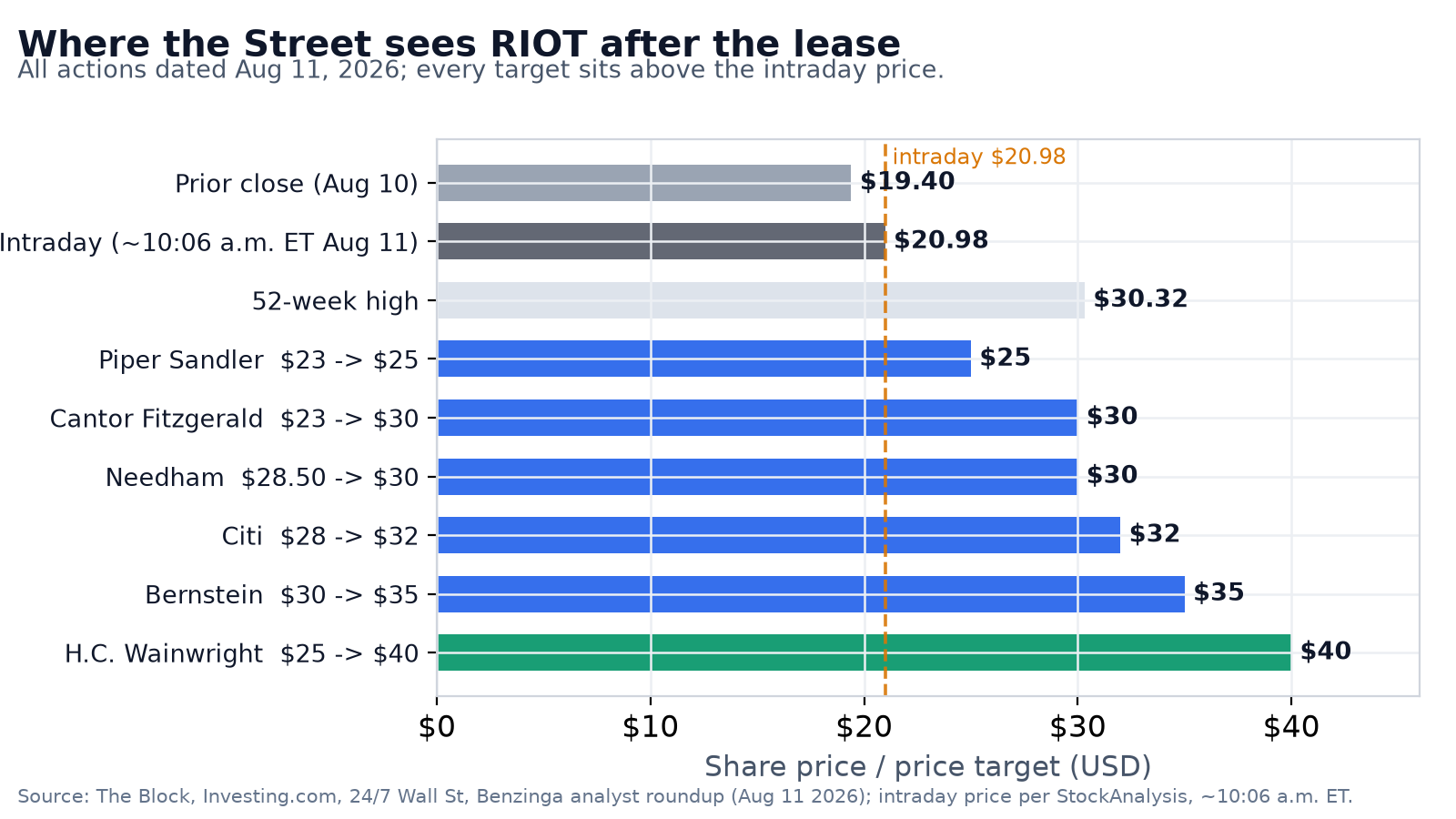
| Bull | ~$40 | 25% | Both leases delivered on schedule; investment-grade backstop closes on good terms; Corsicana LOI converts and further capacity is contracted. RIOT re-rates as a contracted AI-infrastructure landlord on its $365–411M/yr NOI. Anchored to H.C. Wainwright's $40 [8]. |
| Base | ~$31 | 45% | The 241 MW executes, but financing/dilution and a still loss-making mining core cap the multiple; the stock holds the post-deal re-rating without the full ~1 GW pipeline credited. Matches the Citi / Cantor / Needham cluster ($30–32) [9][10][11]. |
| Bear | ~$20 | 30% | Construction or the backstop slips, backstop terms disappoint, bitcoin weakness pressures the mining segment, and single-tenant / unnamed-counterparty concentration weighs. The pop round-trips toward the pre-announcement level near the $19.40 prior close [3]. |
Blending those (0.25 × $40 + 0.45 × $31 + 0.30 × $20) gives a probability-weighted anchor near $30, against an intraday price of about $21 [3]. In other words, the Street's central case sits meaningfully above the current price — but that gap is the market's discount for execution and financing risk on a business still losing money at the core, and the fade from +21% to +8% is that discount being applied in real time, not free upside.
Why is Riot Platforms (RIOT) stock up today?
After the August 10, 2026 close, Riot reported Q2 results and disclosed a 20-year, 191 MW data-center lease with "a leading frontier AI lab" (Bloomberg reports Anthropic) at its Rockdale, Texas campus, expected to generate about $9.1 billion of contract revenue over the initial term [1][5]. The stock closed at $19.40, opened the next morning at $23.57 (about +21.5%), and had eased to about $20.98 (+8.1%) by 10:06 a.m. ET on August 11, on volume already above a full average day [3][4].
RIOT price snapshots on August 11, 2026 — timestamped
| Figure | Value | Timestamp / basis |
|---|---|---|
| Prior official close | $19.40 | Monday, August 10, 2026 [3][4] |
| Open (Aug 11) | $23.57 (≈ +21.5%) | 9:30 a.m. ET open [3] |
| Intraday high | $23.66 | Early session, Aug 11 [3] |
| Change-Feed headline snapshot | $23.07 (+18.94%) | Near-open snapshot on this site's own feed; a mid-morning reading was materially lower |
| Primary intraday quote | $20.98 (+8.1%); day low $21.15 | ≈ 10:06 a.m. ET, Aug 11 — StockAnalysis [3] |
| Corroborating quote | $21.09 (+8.7%) | ≈ 10:10 a.m. ET, Aug 11 — FinViz [4] |
| Volume vs average | ≈ 25.5M by 10:06 a.m. vs 16.81M full-day average | Already above a full average day in under a fifth of the session [3][4] |
| 52-week range | $11.04 – $30.32 | As of Aug 11 [4] |
| Market cap / shares | ≈ $7.98B / ≈ 378M shares | At the intraday quote, Aug 11 [4] |
The stock moved quickly through the open and the first hours of trade; each figure above is valid only at its stated time, and the site's 18.94% Change-Feed headline reflects a near-open snapshot rather than the settled day.
The lease at a glance
| Question | Answer |
|---|---|
| What was announced? | A 20-year lease for 191 MW of critical IT capacity at Riot's Rockdale, Texas campus with "one of the world's leading frontier AI labs" — reported by Bloomberg to be Anthropic — plus Q2 results and a non-binding LOI for the Corsicana site [1][2][5]. |
| How big is it? | ~$9.1B of contract revenue over the initial term through June 2048; up to ~$16.1B with two five-year extensions; cumulative NOI of $7.3–8.2B, or $365–411M a year at full ramp [1]. |
| When does revenue start? | Capacity phases in: initial 96 MW by December 2027, full 191 MW by June 2028; rent follows delivery [1][6]. |
| How is it financed? | A $573M interim facility from Morgan Stanley funds initial development while an investment-grade credit backstop is finalized [1]. |
| What about the core business? | Q2 revenue $174.2M (up ~14% YoY) beat consensus, but Riot still posted a ~$237M net loss and negative adjusted EBITDA; it holds 11,380 BTC [1][11]. |
Riot Platforms (RIOT) stock FAQ
Why did Riot Platforms (RIOT) stock jump on August 11, 2026?
After the August 10 close, Riot reported Q2 results and disclosed a 20-year lease for 191 MW of critical IT capacity at its Rockdale, Texas campus with "one of the world's leading frontier AI labs" — reported by Bloomberg to be Anthropic — expected to generate about $9.1 billion of contract revenue over the initial term. The stock gapped up about 21.5% at the open before easing to roughly +8% by mid-morning.
Who is the tenant in Riot's $9.1 billion lease?
Riot's disclosure names only "one of the world's leading frontier AI labs" and does not identify the counterparty. Bloomberg reported that it is Anthropic, citing people familiar with the matter. As of publication Riot had not confirmed the tenant, so the identification is a media attribution rather than a company disclosure.
How much is the Riot–frontier AI lab lease worth?
Approximately $9.1 billion of contract revenue over the initial 20-year term through June 2048, and up to about $16.1 billion if both five-year extension options are exercised. Riot expects cumulative net operating income of $7.3–8.2 billion over the base term, or roughly $365–411 million a year once fully ramped.
When does the Rockdale capacity come online?
The lease phases in: an initial 96 IT megawatts are expected by December 2027 and the full 191 megawatts by June 2028, using interconnection Riot says is already approved and energized at Rockdale. Rent follows delivery, so no meaningful lease revenue arrives before late 2027.
Was Riot's Q2 2026 quarter actually good?
Revenue was strong — $174.2 million, up about 14% year over year and ahead of consensus near $152–154 million. But the company still posted a net loss of about $237 million and negative adjusted EBITDA, and it holds 11,380 bitcoin, so the core business remains unprofitable and exposed to bitcoin's price while the data-center revenue is still years away.
What are analysts saying after the deal?
Several firms raised targets the next morning, all above the intraday price: H.C. Wainwright to $40 (from $25), Bernstein to $35 (from $30), Citi to $32 (from $28), Needham and Cantor Fitzgerald to $30, and Piper Sandler to $25 (from $23). The cluster runs $25–40, implying the Street sees the shares trading below its post-deal central case — a gap that reflects execution and financing risk.