Earnings
AECOM (ACM) Stock Drop: Why the $337M Charge Is the Whole 'Cut'
AECOM took a $337 million charge on one 2019 Construction Management project, swinging to a GAAP loss and dropping ~9% to a 52-week low. But the headline 'guidance cut' is mostly the one-time charge: excluding it, AECOM's FY2026 adjusted-EPS guide of $5.90–6.10 still brackets the ~$5.97 consensus, backlog is at a record $27.8B, and the stock now trades near 10.5x forward earnings. One-off, or a warning about the legacy contract book?
Summary
After Monday's close on August 10, 2026, AECOM (NYSE: ACM) reported fiscal third-quarter 2026 results built around a single ugly number: a $337 million pre-tax charge on one Construction Management project, which pushed the engineering giant to a GAAP net loss of about $84 million (−$0.65 a share) and an adjusted loss of −$0.50, against a Street that had modeled a roughly +$1.46 profit [1][2]. The stock, which closed at $73.30, fell to about $66.45, down ~9.3%, by 11:48 a.m. ET on Tuesday and printed a fresh 52-week low of $63.67 intraday [3][4]. But the headline "guidance cut" is mostly optics: AECOM's full-year adjusted-EPS guide excluding the charge is $5.90–$6.10 — which brackets the ~$5.97 consensus it supposedly slashed. With peers flat on the day, the real debate is whether a record-backlog infrastructure compounder just went on sale, or whether one legacy contract is a warning about others.
What changed
The charge is the whole story, and its origin matters. AECOM booked $337 million pre-tax against a Construction Management (CM) project awarded back in 2019, where — in the company's words — "lower subcontractor productivity is driving a delayed completion and a higher estimated cost to complete." Management was blunt that the contract was signed under terms that "would not meet the company's current risk policies," and it now expects substantial completion in the second quarter of fiscal 2027 [1][2]. Chairman and CEO Troy Rudd led with it: "We are disappointed by the loss we took this quarter on the Construction Management project" [1].
The mechanical damage to the quarter was severe. Revenue fell 14% year over year to $3.586 billion and net service revenue (NSR) dropped 16% to $1.609 billion; the charge dragged the company to a GAAP operating loss of about $76 million and adjusted EBITDA of −$8 million, both swinging from prior-year profits [1][5]. Cash generation weakened too: operating cash flow fell 66% to about $95 million and free cash flow 79% to about $55 million [1].
The guidance "cut" that mostly isn't
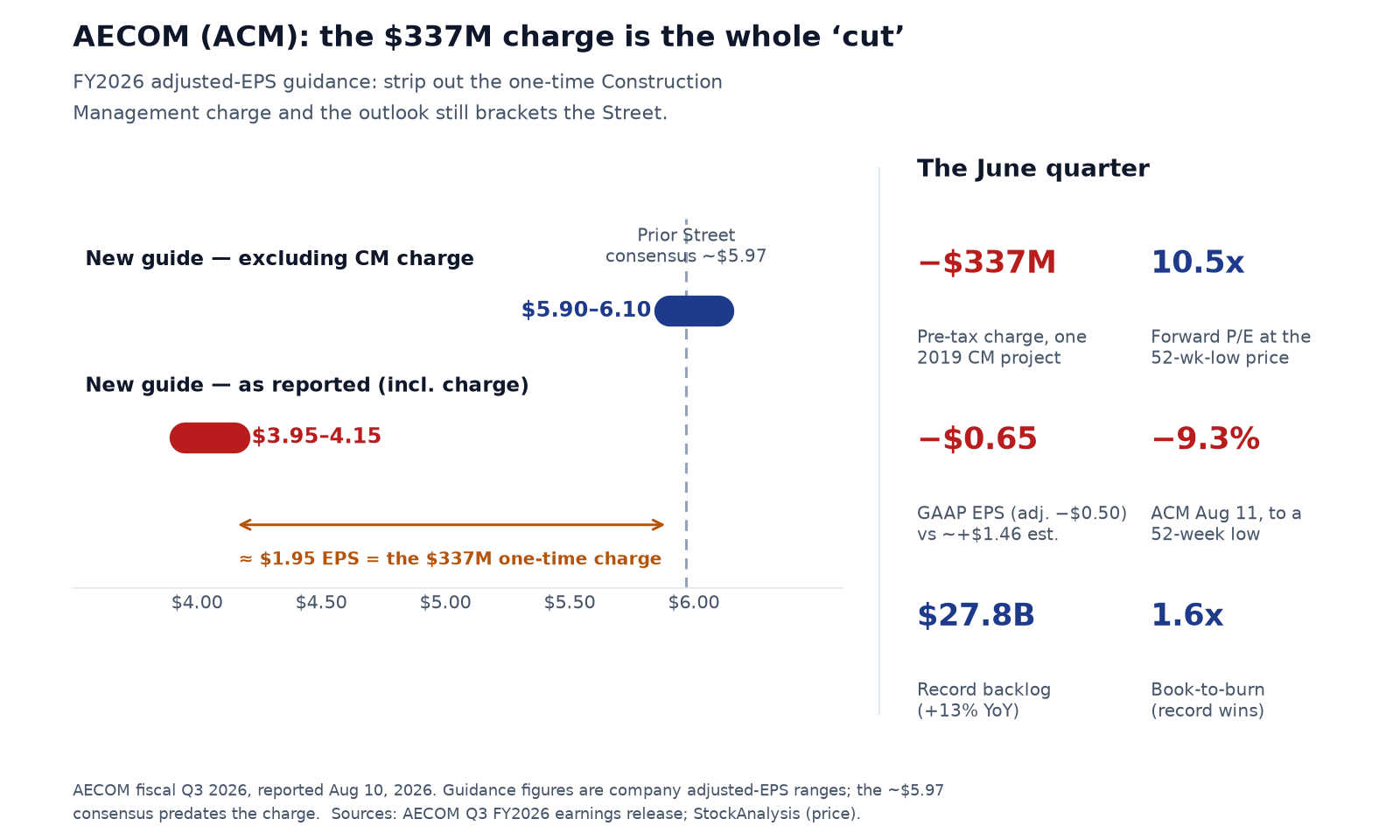
This is where the tape and the fundamentals diverge. AECOM's new full-year fiscal 2026 outlook, as reported, calls for adjusted EPS of $3.95–$4.15, adjusted EBITDA of $935–$965 million, and NSR of $7.30–$7.35 billion — figures that include the CM charge and look far below the ~$5.97 consensus [1][6]. But the release also gives the outlook excluding the charge: adjusted EPS $5.90–$6.10, adjusted EBITDA $1,275–$1,305 million, and NSR $7.65–$7.70 billion [1]. The ex-charge EPS range straddles the very consensus number the headlines say was slashed. In other words, the underlying earnings power AECOM is guiding to is essentially unchanged; the reported "cut" is the one-time $337 million landing in the FY number. (The charge sits inside the quarter's adjusted EPS too — the −$0.50 is not charge-adjusted — which is why the ex-charge lens is the cleaner read of run-rate earnings, and why a reader shouldn't take the reported adjusted loss as the going concern.)
And the forward business is not shrinking. AECOM reported record wins of $4.2 billion, a 1.6x book-to-burn, and a record total backlog of $27.8 billion, up 13% year over year [1][5]. That is the opposite of a demand problem.
Why it matters
AECOM is the blue-chip of design-led infrastructure — it deliberately shed most fixed-price construction risk years ago to become a higher-margin professional-services firm, which is why a single legacy CM charge is jarring rather than routine. The market's instinct was to extrapolate: if one 2019 contract can cost $337 million, how ring-fenced is the rest? The company's answer is that this is precisely the kind of contract it no longer signs, and that the core professional-services business — the record backlog, the 1.6x book-to-burn, the ex-charge EBITDA guide of ~$1.29 billion — is intact. Which reading is right decides whether Tuesday was an overreaction or a first shoe.
How the peers and sector traded the same day
The clearest evidence that this was AECOM-specific, not a sector event, is that nothing else in engineering & construction moved. With the S&P 500 roughly flat (−0.06%), AECOM's closest peers were flat to higher on the session [9]:
| Name (ticker) | Aug 11 move | Note |
|---|---|---|
| ACM — AECOM | −9.3% | $337M CM charge → GAAP loss; 52-week low [1][3] |
| J — Jacobs Solutions | −0.3% | ~$146.95; no read-through despite the shared E&C exposure [10] |
| FLR — Fluor | +0.7% | ~$52.61; higher after its own recent Q2 beat [11] |
| TTEK — Tetra Tech | +0.7% | ~$35.30; unbothered [12] |
| S&P 500 (index) | −0.06% | Broad market flat [9] |
Peers shrugging off the print says the market read the charge as an AECOM contract issue, not an industry cost-inflation signal — consistent with the company's framing that the problem contract is a pre-2019-vintage outlier.
What to watch
The question is containment, and these are the tells:
- Whether the $337M is final — the project isn't substantially complete until Q2 FY2027, so watch the next two prints for any further true-ups on cost-to-complete; a second charge would validate the bear read [1].
- Any disclosure on the rest of the legacy CM book — management said this contract predates current risk policies; investors will want reassurance (or quantification) that similar-vintage fixed-risk contracts aren't lurking [2].
- Ex-charge execution — does the underlying business actually land the $5.90–6.10 adjusted EPS and ~$1.29B EBITDA it's guiding to, with NSR back toward $7.65–7.70B? That is the number that matters once the charge is in the base [1].
- Backlog conversion — a record $27.8B backlog and 1.6x book-to-burn only help if they convert to NSR and cash; free cash flow fell 79% this quarter, so the FCF recovery toward the ~$300M full-year guide is the proof [1].
- Analyst follow-through — targets were cut to $90–105 but ratings stayed constructive; watch whether anyone moves to a genuine downgrade on the risk-policy question. The next print lands on our earnings calendar, and moves are tracked on the ACM stock page [7][8].
Illustrative valuation scenarios
The scenarios below are a descriptive, probability-weighted price-anchor exercise — not a forecast or a recommendation. The high end is anchored to named, dated analyst targets (RBC $105, consensus ~$96); the low end to the fresh 52-week low. Probabilities are the author's own illustrative estimates and sum to 100%.
| Scenario | Price anchor | Prob. | Key drivers |
|---|---|---|---|
| Bull | ~$95 | 30% | The charge is one-and-done; the ex-charge earnings power (~$6 adjusted EPS) proves real, the record backlog converts, and the stock re-rates back toward the analyst target cluster and its historical mid-teens multiple. Anchored to RBC's $105 / ~$96 consensus [7][8]. |
| Base | ~$78 | 45% | No further big charges, but the market keeps a discount for CM-execution uncertainty and soft near-term NSR; the stock recovers off the panic low to ~13x the ex-charge ~$6 EPS without fully closing the gap to targets. |
| Bear | ~$60 | 25% | A further cost-to-complete true-up or evidence of risk in other legacy CM contracts; NSR growth stays soft and the multiple sits near the trough. Near the fresh 52-week low ($63.67) [3]. |
Blending those (0.30 × $95 + 0.45 × $78 + 0.25 × $60) gives a probability-weighted anchor near $79, versus the ~$66 intraday price [3]. That gap says the market is likely over-discounting a charge the company frames as one-time — but the entire bull-to-base case is contingent on "one-time" holding, which the next two quarters will settle. This is descriptive analysis of a corporate event, not investment advice.
Why is AECOM (ACM) stock down today?
AECOM fell about 9% on August 11, 2026 after reporting fiscal Q3 results that included a $337 million pre-tax charge on a 2019 Construction Management project, which drove a GAAP net loss (−$0.65 a share, adjusted −$0.50) versus an expected ~$1.46 profit and dropped the shares to a fresh 52-week low [1][3]. The reported full-year guidance also looks slashed — but that is because it now includes the charge; excluding it, AECOM's adjusted-EPS guide of $5.90–$6.10 still brackets the ~$5.97 consensus [1].
ACM data snapshot — August 11, 2026 (timestamped)
| Figure | Value | As-of / source |
|---|---|---|
| Prior close | $73.30 | Mon, Aug 10, 2026 [3] |
| Open (Aug 11) | $68.25 | 9:30 a.m. ET [3] |
| Primary intraday quote | $66.45 (−9.35%) | ≈ 11:48 a.m. ET — StockAnalysis [3] |
| Corroborating quote | $66.42 (−9.39%) | This site's ACM what-changed feed [4] |
| Intraday low (fresh 52-wk low) | $63.67 | Aug 11 session [3] |
| Volume vs average | ≈ 2.9M by 11:48 a.m. vs ~2.08M full-day avg (~3.5x rel. vol.) | Aug 11 — StockAnalysis / FinViz [3][4] |
| 52-week range | $63.67 – $135.52 | At the low, Aug 11 [3] |
| Market cap | ≈ $8.5B (~128.5M shares) | At the intraday quote, Aug 11 [3] |
| Valuation | P/E ≈ 30 trailing; ≈ 10.5 forward | Aug 11 — StockAnalysis [3] |
| Dividend | $1.24 (~1.9%) | Aug 11 — StockAnalysis [3] |
Each figure is valid only at its stated time; the intraday quote comes from a fast-moving session and two independent feeds (StockAnalysis and this site's own) agree to within a few cents on both price and the ~9.3% move.
The quarter at a glance
| Question | Answer |
|---|---|
| What happened? | A $337M pre-tax charge on a 2019 Construction Management project drove a GAAP net loss of ~$84M (−$0.65/sh; adjusted −$0.50) on revenue of $3.586B (−14%) [1]. |
| Why the charge? | Lower subcontractor productivity delayed completion and raised the estimated cost to complete; AECOM says the contract was signed under terms it would not accept today. Substantial completion is expected in Q2 FY2027 [1][2]. |
| Was guidance really cut? | Only on paper. The as-reported FY26 adjusted-EPS guide ($3.95–4.15) includes the charge; excluding it, the guide is $5.90–6.10, which brackets the ~$5.97 consensus [1]. |
| Any good news? | Record quarterly wins of $4.2B, a 1.6x book-to-burn, and a record $27.8B backlog (+13% YoY) [1][5]. |
| What did analysts do? | Cut targets but mostly kept constructive ratings above the price: RBC $105 (Outperform), Barclays $90 (Equal Weight), Baird $91 (Neutral); consensus ~$96 [7][8]. |
AECOM (ACM) stock FAQ
Why did AECOM (ACM) stock drop on August 11, 2026?
AECOM fell about 9% to a fresh 52-week low after reporting fiscal Q3 2026 results that included a $337 million pre-tax charge on a 2019 Construction Management project. The charge drove a GAAP net loss of roughly $84 million (−$0.65 per share; adjusted −$0.50) versus an expected ~$1.46 profit, and revenue fell 14% to $3.586 billion.
What caused AECOM's $337 million charge?
The charge relates to a Construction Management project awarded in 2019. AECOM said lower subcontractor productivity is driving a delayed completion and a higher estimated cost to complete, and noted the contract was signed under terms that would not meet the company's current risk policies. Substantial completion is expected in the second quarter of fiscal 2027.
Did AECOM really cut its guidance?
Mostly on paper. AECOM's new full-year fiscal 2026 adjusted-EPS guidance of $3.95–$4.15 includes the one-time charge, which is why it looks far below the ~$5.97 consensus. Excluding the charge, the company's adjusted-EPS guide is $5.90–$6.10 — which brackets that consensus — with ex-charge adjusted EBITDA of $1,275–$1,305 million. The underlying earnings power AECOM is guiding to is essentially unchanged.
Was there any good news in the quarter?
Yes. AECOM reported record quarterly wins of $4.2 billion, a 1.6x book-to-burn ratio, and a record total backlog of $27.8 billion, up 13% year over year. Demand is not the problem; the quarter was about a single legacy project charge.
What did analysts do after the report?
Several firms cut price targets but largely kept constructive ratings above the stock price: RBC Capital to $105 from $111 (Outperform), Barclays to $90 from $110 (Equal Weight), and Baird to $91 from $98 (Neutral). The consensus target sits near $96, well above the ~$66 post-drop price, reflecting a view that the charge is one-time.
Is AECOM stock cheap after the drop?
After the fall the stock trades near 10.5x forward earnings — a trough multiple for a design-led infrastructure firm with a record backlog and book-to-burn above 1. On the ex-charge earnings power (~$6 adjusted EPS) and the reduced analyst targets ($90–105), the shares screen inexpensive, but the case depends on the $337 million charge being contained rather than the first of several. This is descriptive analysis, not investment advice.