Healthcare
Amgen (AMGN) Falls as a Rival's Lp(a) Trial Failure Clouds Its Pipeline
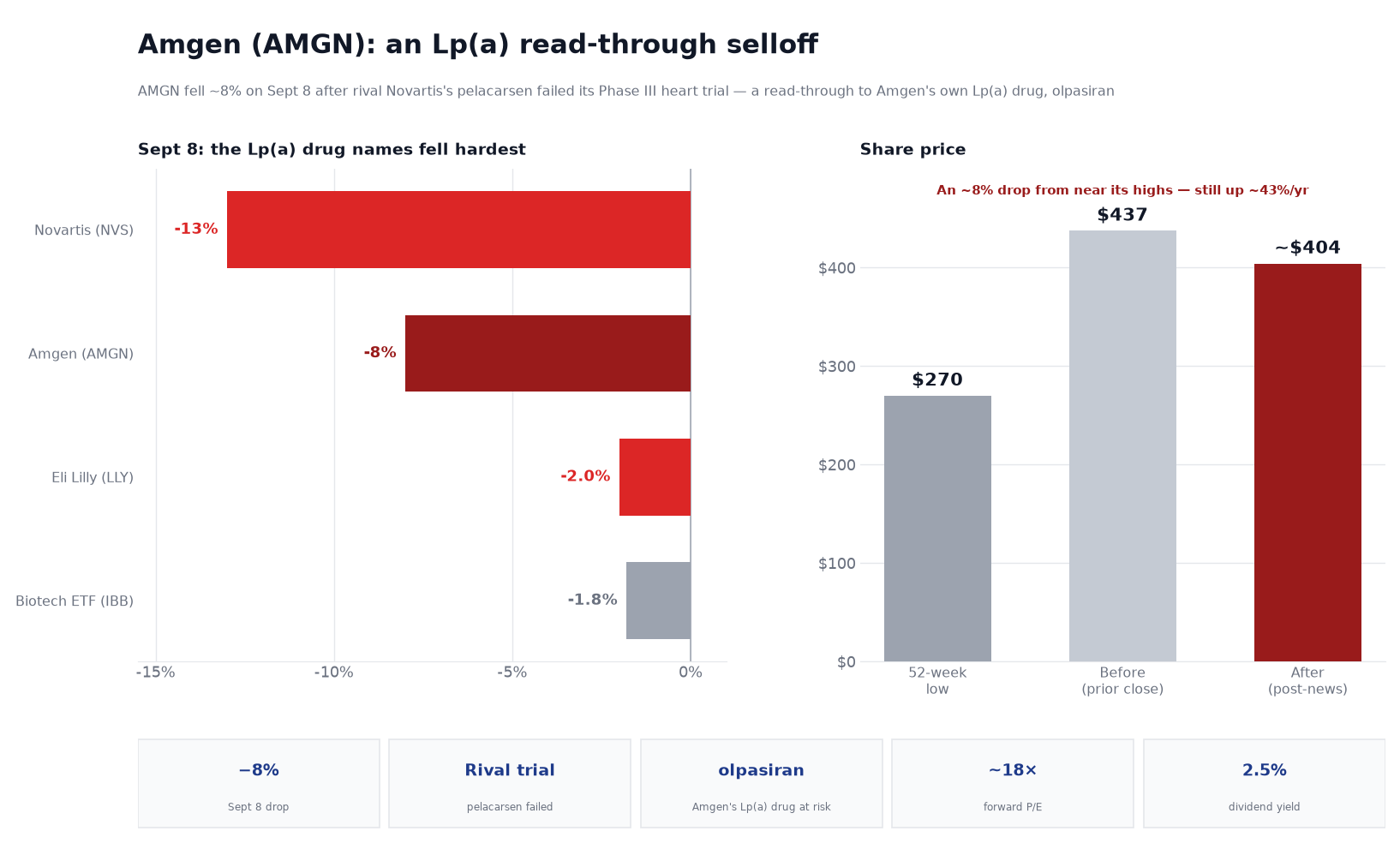
Amgen fell about 8% to roughly $404 on September 8 even as it posted its own good news that morning — its cancer drug IMDELLTRA, with AstraZeneca's Imfinzi, hit its primary survival goal in a Phase III lung-cancer study. The shares dropped anyway, on a rival's failure: Novartis disclosed late last week that pelacarsen — its drug for lowering lipoprotein(a), or Lp(a), a genetic cardiovascular risk factor — failed the primary goal of its large Phase III outcomes trial, not reducing heart attacks, strokes and cardiovascular deaths despite lowering Lp(a). Because Amgen is racing in the same class with its own experimental drug, olpasiran, the read-through was direct: the first dedicated Phase III cardiovascular-outcomes readout of an Lp(a) therapy came up empty, casting doubt on the science behind the category. A separate same-day BMO Capital downgrade — on valuation and pipeline grounds — formed part of the negative backdrop. What cushioned the fall is that Amgen is a cheap, cash-rich defensive franchise — about 18 times forward earnings, a 2.5% dividend, ~$10 billion of free cash flow — so the Lp(a) opportunity was upside, not the foundation. Even so, the stock had run up ~43% over the year, and the Street was already cautious, with a large share of analysts at Hold and an average target below the pre-drop price.

Why Amgen stock fell — a rival's failure that hit close to home
On Tuesday, September 8, 2026, Amgen (NASDAQ: AMGN) fell about 8% to roughly $404, gapping down from a $437.23 prior close on heavy volume [1]. What makes the drop striking is that Amgen had good news of its own that morning — its cancer immunotherapy IMDELLTRA, paired with AstraZeneca's Imfinzi, hit its primary overall-survival goal in a Phase III lung-cancer study [2]. The shares fell anyway, overwhelmed by a competitor's clinical failure. Late last week, Novartis disclosed that pelacarsen, its closely watched drug for lowering lipoprotein(a) — a genetically driven cardiovascular risk factor known as Lp(a) — failed the primary goal of its large Phase III outcomes trial, not reducing heart attacks, strokes and cardiovascular deaths versus placebo even though it lowered Lp(a) levels [2]. Amgen began sliding in Friday's after-hours session; after markets closed Monday for Labor Day, the decline deepened when regular trading resumed Tuesday — a read-through hitting every company chasing the same target, Amgen chief among them, against a separate same-day analyst downgrade that added to the negative backdrop [2][6].
The Lp(a) bet, and why pelacarsen's failure matters
For years, drugmakers have wagered that lowering Lp(a) — a stubborn, largely untreatable risk factor that statins do not touch — would translate into fewer cardiovascular events, opening a potential multibillion-dollar market. Amgen is one of the leaders of that race with olpasiran, an experimental medicine now in its own large Phase III cardiovascular-outcomes trial [2]. Pelacarsen's failure is the first dedicated Phase III cardiovascular-outcomes readout of an Lp(a)-targeting therapy, and it delivered the worst possible message: dramatically lowering Lp(a) did not, in that study, reduce cardiovascular events. That casts a shadow over the core scientific premise behind olpasiran and Lilly's rival lepodisiran. Bulls will argue the drugs differ — olpasiran uses a different mechanism (small interfering RNA) and lowers Lp(a) more deeply, so its outcomes trial could still succeed — but the market's instinct on Tuesday was to mark down the probability that any Lp(a) drug proves it can save lives. For Amgen, that means a meaningful pipeline opportunity suddenly looks less certain.
A cheap, cash-rich base business
What cushions the fall is that Amgen is not a speculative pipeline story — it is a large, highly profitable, dividend-paying franchise. Even after a strong year, the shares trade at about 18 times forward earnings [3], undemanding for a company with an operating margin above 33%, a return on equity near 90%, and roughly $10 billion of annual free cash flow [3]. It pays a dividend yielding about 2.5%, and its beta near 0.43 marks it as a classic defensive holding. The Lp(a) opportunity was upside to that base, not the foundation of it — which is why the stock fell 8% rather than 20%. The question the market is now weighing is how much of Amgen's future growth was resting on Lp(a), and how much on its approved medicines and the rest of a broad pipeline.
Why it matters
Tuesday's move is a reminder that in large-cap biopharma, the biggest swings often come not from a company's own trials but from the scientific hypotheses its pipeline is built on. Lp(a) has been one of cardiology's most tantalizing targets — a risk factor affecting roughly one in five people, with no approved therapy — and several of the industry's biggest names have poured resources into drugging it. Pelacarsen's failure does not end that pursuit, but it raises the bar: the remaining candidates must now prove that their approach works where the first one did not. For investors, the episode underscores both the risk and the optionality embedded in a stock like Amgen — a stable, cash-generative business with a series of high-stakes pipeline bets layered on top, each capable of moving the shares on a single data release, whether its own or a rival's.
The Lp(a) selloff, in one cross-section
The same-day tape shows the Lp(a) names led the decline, underperforming an already-soft biotech tape [5]:
| Name (ticker) | Sept 8, 2026 | Read-through |
|---|---|---|
| NVS — Novartis | ≈−13% | Its pelacarsen failed — and a second Phase III (deldesiran) also missed that day [2][5] |
| AMGN — Amgen | ≈−8% | Its olpasiran targets the same Lp(a) pathway — pipeline risk repriced [1][2] |
| LLY — Eli Lilly | ≈−2% | Its lepodisiran is also in the class, but a small part of a huge story [5] |
| IBB — Biotech ETF | ≈−1.8% | An already-soft biotech tape — the Lp(a) names fell far more [5] |
The drug's owner down ~13% (with a second trial miss of its own), its two class rivals down ~8% and ~2%, and the biotech ETF off less than 2% is the signature of a target-specific setback layered on an already-weak biotech day, not a broad market rout [5].
What the Street thinks
The reaction split the sell side. On the day of the drop, BMO Capital's Evan Seigerman downgraded Amgen to a Hold (Market Perform) with a $450 target — but on its own grounds rather than the trial news, citing the stock's roughly 34% year-to-date run (so commercial execution is now priced in), loss-of-exclusivity headwinds, and questions about Amgen's obesity candidate MariTide after mixed Phase 2 data [6]. That separate bearish note landed the same day as the Lp(a) read-through, forming part of the negative backdrop rather than a proven cause of the decline. Others defended the stock: Piper Sandler's David Amsellem reiterated a Buy at $457, and Goldman Sachs's Salveen Richter reiterated a Buy at $450, while Truist's Gregory Renza stayed at Hold [6]. The nominal consensus remains a Buy, but a cautious one — a large share of the roughly three dozen analysts sit at Hold, with a couple of Sells — and the average 12-month target of about $388 actually sits below the post-drop price, in a wide range from a low near $230 to a high of $457 [6]. Notably, several of the targets set around the news still sit above the current price, so the freshest calls imply the selloff may have gone somewhat far, even as the class's science is in question.
What to watch
- The olpasiran readout. Data from Amgen's own Phase III Lp(a) outcomes trial, the definitive test of whether its drug can succeed where pelacarsen failed [2].
- Management's framing. How Amgen characterizes the pelacarsen result and its confidence in olpasiran's differentiated mechanism [2].
- The base business. Growth from Amgen's approved medicines and other pipeline programs, the real anchor of the valuation [3].
- Valuation versus targets. Whether the drop to below the average analyst target draws buyers. Moves are tracked on the AMGN stock page [1].
Illustrative valuation sensitivity
The scenarios below are anchored to Amgen's base-business earnings (about 18 times forward earnings) and to the analyst target distribution (low near $230, average ~$388, high $457) [6], turning on how much of the Lp(a) opportunity survives. They are a descriptive, author-weighted exercise — not a forecast, target, recommendation, or intrinsic fair-value calculation — with subjective weights that sum to 100%.
| Scenario | Illustrative price | Weight | Key drivers |
|---|---|---|---|
| Upside | ~$450 | 30% | The read-through overshoots, olpasiran's differentiated mechanism keeps its outcomes trial in play, and the cheap, cash-rich base business re-rates toward the bullish targets [6]. |
| Middle | ~$400 | 40% | The Lp(a) overhang persists but Amgen's profitable, diversified base and 2.5% dividend stabilize the stock near current levels [3]. |
| Downside | ~$320 | 30% | Olpasiran is increasingly seen as likely to fail too, that pipeline value erodes, and the multiple compresses toward the low end of the analyst range [6]. |
Weighting those (0.30 × $450 + 0.40 × $400 + 0.30 × $320) gives an author-weighted reference value near $391, close to Tuesday's ~$404 level and roughly in line with the ~$388 consensus target [1][6] — reflecting a cheap, defensive franchise whose base business anchors the valuation while a pipeline bet has just lost value. This is a Street-target-and-earnings-based scenario exercise and descriptive analysis of a news move, not investment advice.
AMGN data snapshot — September 8, 2026
| Figure | Value | As-of / source |
|---|---|---|
| Intraday quote | ~$404 (−~8%), a gap-down from near its highs — an intraday reading (the session was still open) | Tue, Sep 8, 2026 — StockAnalysis [1] |
| Prior close / open / range | $437.23 prior close (Fri Sep 4; markets closed Mon Sep 7 for Labor Day); opened $408.90; day range $399.68–$410.03 | Sep 8, 2026 [1] |
| 52-week range / trend | $269.77–$447.03; up ~43% over 52 weeks (falling from near the $447 high); near its ~$398 50-day and above its ~$359 200-day averages; RSI ≈41 | As of Sep 8 [3] |
| Market cap / EV | ≈$217B (540.6M shares); enterprise value ≈$260B; beta ≈0.43 (very defensive) | Sep 8 — StockAnalysis [3] |
| Valuation | Trailing P/E ≈25×; forward P/E ≈18× (undemanding for pharma); ≈6.2× sales; dividend yield ≈2.5% ($10.08) | Sep 8 — StockAnalysis [3] |
| Financials (TTM) | Revenue ≈$38.1B (+9%); net income ≈$8.7B; EPS $16.09; gross margin ≈72%; operating margin ≈33%; ROE ≈91%; free cash flow ≈$10.2B | TTM — StockAnalysis [3] |
| Catalyst | Novartis's pelacarsen failed its Phase III Lp(a) cardiovascular-outcomes trial (disclosed ~Sep 4); the read-through hit Amgen's own Lp(a) drug, olpasiran. A separate same-day BMO downgrade (valuation / loss-of-exclusivity / MariTide) added to the negative backdrop — even as Amgen's own IMDELLTRA lung-cancer data hit that morning | Sep 4–8, 2026 — trial reporting / analyst note [2][6] |
| Same-day peers | NVS −13% (its pelacarsen failed — plus a second same-day Phase III miss), LLY −2% (its lepodisiran); IBB biotech ETF −1.8% (an already-soft tape) — the Lp(a) names led the decline | Sep 8 [5] |
| Analyst view | Nominal consensus Buy but skews cautious — a large share of the ~34 analysts at Hold, a couple of Sells; avg target ≈$388 — below the post-drop price, range ~$230–$457; Sep-8 BMO downgrade to Hold ($450), Piper Sandler Buy $457, Goldman Buy $450 | Sep 2026 — StockAnalysis / analyst notes [6] |
Amgen (AMGN) stock FAQ
Why did Amgen (AMGN) stock fall on September 8, 2026?
Amgen fell about 8% to roughly $404, and the striking part is that it dropped even though it had its own good news that day — its cancer drug IMDELLTRA, with AstraZeneca's Imfinzi, hit its primary survival goal in a Phase III lung-cancer study. The decline was driven instead by a competitor's failure: Novartis disclosed late the previous week that pelacarsen — its drug for lowering lipoprotein(a), or Lp(a) — failed the primary goal of its large Phase III cardiovascular-outcomes trial. Because Amgen is developing its own Lp(a) drug (olpasiran), investors marked down the odds for the whole class. Shares began falling in Friday's after-hours session and, after the Monday Labor Day holiday, extended the decline Tuesday, against a separate BMO Capital downgrade the same day.
What is Lp(a), and why does the pelacarsen failure matter for Amgen?
Lipoprotein(a), or Lp(a), is a genetically determined cardiovascular risk factor that current therapies like statins do not meaningfully lower. Drugmakers have bet that reducing Lp(a) will cut heart attacks and strokes, opening a large market. Pelacarsen's Phase III trial was the first dedicated cardiovascular-outcomes readout for an Lp(a)-lowering therapy — and it failed, lowering Lp(a) without reducing cardiovascular events. That casts doubt on the core scientific premise behind Amgen's own experimental Lp(a) drug, olpasiran, which is in its own late-stage outcomes trial, so the failure directly reduces the perceived odds of a key Amgen pipeline opportunity.
Does this mean Amgen's olpasiran will also fail?
Not necessarily. Bulls argue the drugs are meaningfully different: olpasiran uses small interfering RNA (siRNA) rather than pelacarsen's antisense approach and lowers Lp(a) more deeply, so its outcomes trial could still succeed. But the market's immediate reaction was to lower the probability, because pelacarsen's failure was the first real-world test of the idea that lowering Lp(a) reduces cardiovascular events — and it did not. The definitive answer will come from olpasiran's own Phase III cardiovascular-outcomes data.
Is Amgen still a good defensive stock after the drop?
Amgen's appeal as a defensive holding rests on its base business, which is unaffected by the pelacarsen result. It is a large, diversified drugmaker with an operating margin above 33%, a return on equity near 90%, roughly $10 billion of annual free cash flow, and a dividend yielding about 2.5%, at a low beta near 0.43. It trades at about 18 times forward earnings, undemanding for pharma. The Lp(a) opportunity was upside to that foundation rather than the foundation itself, which is why the stock fell about 8% rather than collapsing — though it does remove a piece of the long-term growth story.
What do analysts think of Amgen stock now?
Coverage is nominally a Buy but genuinely cautious and split: a large share of the roughly three dozen analysts sit at Hold, with a couple of Sells, and the average 12-month target of about $388 sits below the post-drop price, in a wide range from a low near $230 to a high of $457. On the day of the drop, BMO Capital's Evan Seigerman downgraded Amgen to a Hold (Market Perform) at $450 — but on valuation and pipeline grounds (the stock's ~34% run, loss-of-exclusivity headwinds, and questions about the obesity drug MariTide), not the trial news — while Piper Sandler's David Amsellem (Buy, $457) and Goldman Sachs's Salveen Richter (Buy, $450) reiterated bullish views, so several of the freshest targets still sit above the current price.
What is the biggest risk for Amgen now?
The near-term risk is sentiment around the Lp(a) class: if investors and analysts increasingly conclude that olpasiran is likely to fail like pelacarsen, that pipeline value keeps eroding and the stock could drift toward the low end of the analyst range. More broadly, Amgen faces the usual large-pharma risks — patent expirations, pricing pressure and competition across its portfolio. The offsetting strength is a cheap, highly cash-generative, diversified base business that does not depend on any single pipeline bet, which is what limited the damage on the news.