Stock Analysis
Why Did Arista Networks (ANET) Stock Rise 5.5%? The AI-Switching Re-Rating Behind the Bounce
ANET added about 5.5% intraday on July 8 on below-average volume — a bounce and a fresh $216 note on top of the real driver: the 1.6T 7060XE7 launch and a wave of price-target hikes toward $200.

Summary
Arista Networks (NYSE: ANET) rose about 5.5% intraday on Wednesday, July 8, 2026, trading near $175.59 against Tuesday's $166.46 close — one of the larger gainers on BestStocks' change feed for the session [1]. A second market feed put the move at +5.65% to $175.86 by midday, a roughly $9.40 gain that left the stock within a few dollars of its 52-week high of $179.80, at a market value of about $221 billion [2]. The proximate trigger the feed surfaced was thin for a swing that size: a Seeking Alpha contributor reiterated a “Strong Buy” with a $216 price target [5], and AI-infrastructure names broadly rebounded after a Tuesday selloff [1]. The more durable story sits underneath. Since Arista launched its 1.6-terabit 7060XE7 switching line on June 9, at least three banks have pushed targets toward $200 and the stock has re-rated in a matter of weeks [4][7]. Notably, Wednesday's gain came on below-average volume — roughly 0.6x the normal pace — which reads more like momentum and a bounce than fresh institutional accumulation [1].
What changed
Nothing changed at the company on Wednesday. Tuesday, July 7 had been a down session for AI-infrastructure stocks, and July 8 was largely a bounce off that low; BestStocks' feed described the group as “bouncing back after Tuesday's decline” [1]. The one fresh, ANET-specific item on the tape was an opinion piece: a Seeking Alpha contributor reiterating a “Strong Buy” and a $216 target, built by applying a 43x forward multiple to 2028 estimated non-GAAP EPS of about $5.03 [5]. That note frames Arista's growth as stacked drivers — AI Fabrics, 800G switching, campus expansion, software/services, plus deferred-revenue conversion and operating leverage — that it estimates add roughly $1.53 to EPS by 2028, with AI Fabrics the single largest contributor [5]. It is a contributor target, not a sell-side rating, and at $216 it sits well above the bank consensus.
The re-rating that actually moved the stock happened earlier. On June 9, Arista announced the 7060XE7 Series — 1.6-terabit-per-port platforms, double the 800G standard most AI clusters run today, built on Broadcom's Tomahawk 6 silicon and reaching about 100 terabits per second of switching capacity [3][4]. The launch featured customer endorsements from Meta, Microsoft, and Oracle, and paired the switches with linear pluggable optics that cut interconnect power by roughly 60% [3][4]. Around that launch window, banks raised targets: KeyBanc to $200 from $178 (Overweight, June 18), Bank of America to $200 from $185, and Morgan Stanley to $190 from $180 [4][6][7]. Those hikes helped frame the re-rating, and — not Wednesday's op-ed — set the backdrop for ANET's 8.31% jump to $173.28 on Monday, July 6 [7].
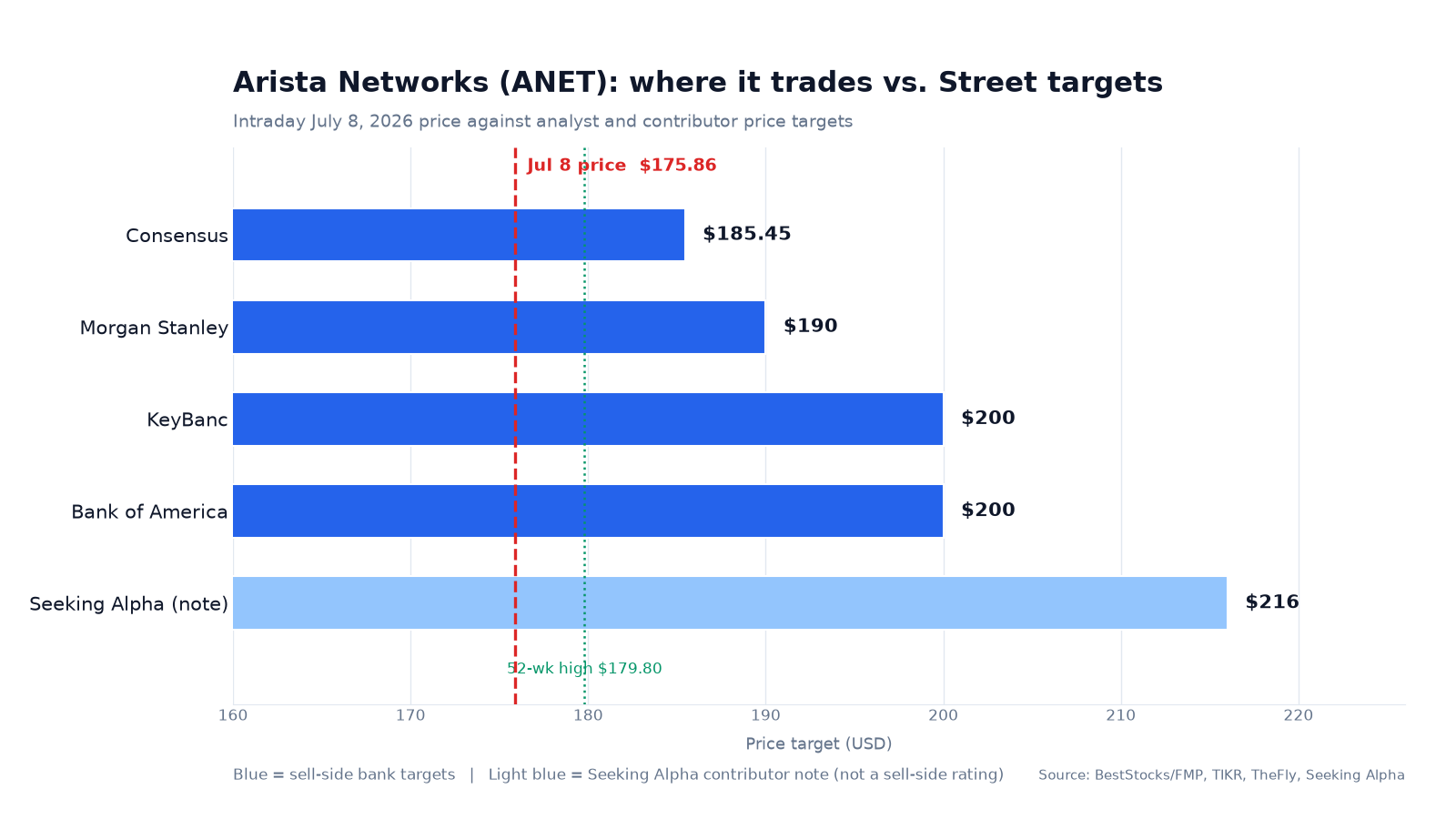
The result is a stock that, at roughly $175.86, has moved into a crowded target zone: below the roughly $185–$190 sell-side consensus (BestStocks' feed shows $185.45) and near the upper end of its own 52-week range, with recent bank targets clustered around $190–$200 and some high estimates — including the Seeking Alpha note's $216 — reaching above $200 [1][2]. On BestStocks' data, the $185.45 consensus implied only about 5.6% of remaining upside from Wednesday's ~$175.6 price; other vendors' higher averages imply a bit more [1].
Why it matters
Arista's rally is a clean read on how the market is pricing the “picks and shovels” of AI build-outs. The 7060XE7 matters because networking has become a more important bottleneck alongside compute in large AI clusters — the fabric that stitches accelerators together — and 1.6T-per-port switching is the next rung, twice today's 800G, for rack-scale training and inference fabrics [3][4]. Named customer support from three hyperscalers strengthens the bull case that Ethernet, and Arista's merchant-silicon approach, can stay competitive in AI back-end networks against NVIDIA's InfiniBand and white-box alternatives.
It also matters because the same customer roster that drives the growth is the concentration risk. A large share of Arista's revenue flows from a handful of cloud titans, so a pause in any one hyperscaler's capex — or an in-house networking effort — hits harder than it would for a diversified vendor. That is why the stock trades on hyperscaler capex commentary as much as on its own results, and why a broad AI-infrastructure wobble like Tuesday's dragged ANET down before Wednesday's bounce [1]. For holders, the practical takeaway is that after a multi-week, product-plus-upgrade re-rating, the easy part of the move is likely behind the stock; from here it has to grow into a valuation that already assumes years of AI-fabric share gains.
What to watch
First, second-quarter earnings, estimated for on or around August 4, 2026 [1]. The numbers that matter are AI-back-end revenue, 800G and early 1.6T momentum, and — above all — management's tone on hyperscaler capex and 2026–2027 guidance; a re-rated stock leaves little room for a soft outlook. Second, follow-through on the 7060XE7: additional named deployments, availability timing, and any competitive response from NVIDIA or white-box vendors [3]. Third, analyst actions — whether banks chase the stock above $200 or start flagging valuation now that price has met most targets [4][6]. Finally, watch the tape itself: Wednesday's gain came on below-average volume, so whether ANET can hold above its prior range on rising volume, or fades back toward the $166 pre-bounce level, will say more about conviction than any single op-ed [1][2].
Why did ANET stock rise on July 8, 2026?
ANET rose about 5.5% intraday, from a $166.46 prior close to roughly $175.6–$175.9, mainly as a bounce after Tuesday's AI-infrastructure selloff, helped by a Seeking Alpha contributor reiterating a “Strong Buy” and a $216 target [1][5]. The move came on below-average volume (about 0.6x), and the durable driver behind the stock's recent strength is the June 9 launch of its 1.6T 7060XE7 AI switches and a wave of bank price-target hikes toward $200 [3][4].
Why has Arista Networks stock been rising?
- A new 1.6T AI-switching line. The 7060XE7 Series, announced June 9, doubles the 800G standard and launched with named customer endorsements from Meta, Microsoft, and Oracle [3][4].
- A cluster of price-target hikes. KeyBanc and Bank of America moved to $200 and Morgan Stanley to $190 around mid-June, driving an 8.3% jump to $173.28 on July 6 [4][6][7].
- A relief bounce. July 8 was a rebound for AI-infrastructure names after a Tuesday decline [1].
- A fresh bull note. A Seeking Alpha contributor reiterated a $216 target the same day [5].
The July 8 move in numbers
| Measure | Value | Note |
|---|---|---|
| ANET close, Tue Jul 7 | $166.46 | Prior-day close / bounce baseline [1][2] |
| ANET intraday, Wed Jul 8 (site feed) | $175.59 | +5.5%, about +$9.13 [1] |
| ANET intraday, Wed Jul 8 (second feed) | $175.86 | +5.65%, about +$9.40 at ~12:40 p.m. ET [2] |
| Day's volume | ~0.6x average | Below-average participation [1] |
| 52-week range | $100.95 – $179.80 | Trading near the high [2] |
| Market capitalization | ~$221 billion | Jul 8, 2026 [2] |
| ANET close, Mon Jul 6 | $173.28 | +8.31% on the bank-target cluster [7] |
| Consensus price target | $185.45 | Range $164–$200 [1] |
| Notable targets | MS $190; KeyBanc, BofA $200; SA $216 | SA is a contributor target [4][5][6] |
What is the Arista 7060XE7 and why does it matter?
The 7060XE7 Series, announced June 9, 2026, is a line of 1.6-terabit-per-port Ethernet switches — double the 800G most AI clusters use today — built on Broadcom's Tomahawk 6 silicon and reaching roughly 100 terabits per second of switching capacity, with linear pluggable optics that cut interconnect power by about 60% [3][4]. It extends Arista's Etherlink AI fabric for rack-scale AI and launched with named customer endorsements from Meta, Microsoft, and Oracle, positioning Ethernet against InfiniBand for AI back-end networks [3][4].
What could move ANET next?
The next scheduled catalyst is second-quarter earnings, estimated on or around August 4, 2026, where AI revenue, 1.6T momentum, and hyperscaler-capex commentary will matter most [1]. Between now and then, watch for follow-on 7060XE7 deployment news, further analyst actions as the price meets most targets, competitive responses from NVIDIA and white-box vendors, and whether the July 8 gain holds on rising volume or fades back toward the $166 pre-bounce level [2][4].
Arista Networks stock FAQ
Why did Arista Networks (ANET) stock rise on July 8, 2026?
ANET rose about 5.5% intraday, from a $166.46 prior close to roughly $175.6–$175.9, mostly as a bounce after Tuesday's AI-infrastructure selloff, helped by a Seeking Alpha contributor reiterating a Strong Buy with a $216 target. The move came on below-average volume.
What is driving Arista Networks' recent rally?
The June 9, 2026 launch of the 1.6-terabit 7060XE7 AI-switching line — with named customer endorsements from Meta, Microsoft, and Oracle — plus a cluster of bank price-target hikes toward $200 (KeyBanc and BofA to $200, Morgan Stanley to $190) around that window. ANET later jumped 8.31% to $173.28 on July 6.
Was the ANET rally caused by the $216 Seeking Alpha price target?
Only in part. The $216 target came from a Seeking Alpha contributor, not a bank, and it landed the same day ANET was already bouncing with other AI-infrastructure names. The durable driver was the June 9 launch of the 1.6T 7060XE7 switches and a wave of bank target hikes toward $200 in mid-June.
Is ANET stock near its 52-week high?
Yes. At about $175.86 on July 8, 2026, Arista traded within a few dollars of its 52-week high of $179.80, near the top of a roughly $101–$180 range. It still sat below the $190–$200 bank price targets.
What is the analyst price target for ANET?
The consensus target is about $185.45, with a range of roughly $164 to $200. Morgan Stanley is at $190, and KeyBanc and Bank of America are at $200. A Seeking Alpha contributor carries a higher $216 target, but that is an independent note rather than a sell-side rating.
Is Arista Networks stock overvalued after the run?
It trades at a rich multiple — roughly 35 times 2028 estimated earnings, and the $216 bull case applies a 43x forward multiple. At about $175.86 the stock sits near its 52-week high and below the $185 consensus, so most of the sell-side sees limited remaining upside. Customer concentration is the most-cited risk.
Why does the 7060XE7 switch matter for Arista?
It delivers 1.6 terabits per port — double the 800G standard — on Broadcom's Tomahawk 6 silicon, extending Arista's Etherlink AI fabric for rack-scale AI. Named customer support from three hyperscalers helps defend Ethernet against NVIDIA's InfiniBand in AI back-end networks.
When is Arista Networks' next earnings report?
It is estimated for on or around August 4, 2026. AI-back-end revenue, 1.6T momentum, and management's commentary on hyperscaler capital spending and guidance will be the key items after the recent re-rating.